Artificial Generation
Source
Jābir ibn Ḥayyān: Contribution à l’histoire des idées scientifiques dans l’Islam, vol. II: Jābir et la science grecque, 1942
Contents
Chapter III: “La génération artificielle”
Translated and edited by Ben Gaskin
School of History and Philosophy of Science
The University of Sydney
Version 1.0 · 7 October 2026 · DOI: 10.5281/zenodo.23174647
Source and edition
Original chapter
Paul Kraus, “III. La génération artificielle”, in Jābir ibn Ḥayyān:
Contribution à l’histoire des idées scientifiques dans l’Islam,
vol. II, Jābir et la science grecque, pp. 97–134. Mémoires
de l’Institut d’Égypte, vol. XLV. Cairo: Imprimerie de l’Institut
français d’archéologie orientale, 1942.
Citation for this English edition
Kraus, Paul. 2026. Artificial Generation: Chapter III of Jābir ibn
Ḥayyān, Volume II (English Translation). Translated and edited by
Ben Gaskin. Version 1.0. Zenodo. https://doi.org/10.5281/zenodo.23174647.
Rights and source provenance
Paul Kraus died in 1944.
The English translation and original editorial matter © 2026 Ben Gaskin
are licensed under Creative Commons
Attribution 4.0 International. Reproduced source material is outside
the scope of this licence; its rights status has not been established
for every jurisdiction. The facsimile extracts derive from the Internet
Archive scan of the original volume, item
kraus-paul-jabir-ibn-hayyan-2.
Acknowledgement
This research was supported by the Commonwealth through an Australian
Government Research Training Program Scholarship [DOI: https://doi.org/10.82133/C42F-K220].
Text and apparatus
This edition comprises the English translation, Kraus’s notes, additions and errata, and translator’s notes.
Quotations from Jābir and other authors that Kraus gives in French are translated from his French. Greek and Latin quotations are retained; the English translations in symbol-marked editorial footnotes were prepared for this edition from the Greek and Latin as reproduced by Kraus. Arabic quotations retain their original language. Arabic and selected complex passages appear as facsimile extracts, with adjacent French wording translated in the surrounding note.
Editorial conventions
Page markers such as [111] indicate the original pagination. A superscript reference such as 111.1 leads to Kraus’s first note on that page. Notes are grouped by original page after the chapter, with continuations under the same note number. Return arrows beside note numbers lead back to the text; repeated calls have numbered return arrows. Cross-references to pages, chapters, “above” and “below” follow the 1942 volume. Textes, Bibl. and other editions retain their original numbering.
“We”, “our edition” and “our translation” refer to Kraus. His qualifications, conjectures, lacunae, source ellipses and editorial signs are retained, including angle-bracket supplements and parenthetical explanations.
Editorial annotations are prefixed “Ed.”; translator’s notes are labelled T1–T3. Symbol-marked footnotes give English translations of the Greek and Latin quotations and restart on each page of the printed edition. A1–A4 present Kraus’s relevant additions and errata. Facsimile extracts preserve the original printing, with his corrections supplied alongside.
Transliteration and diacritics are regularised in the running text; technical capitals such as “Natures”, “Substance”, “Balance” and “Art” follow Kraus.
Abbreviations used by Kraus
The following key translates the volume’s “Abréviations”, on the unnumbered page following p. XV. Its first-person possessives have been expanded to identify Kraus.
Bibl. Kraus’s Bibliographie Jābirienne, in Mémoires de l’Institut d’Égypte, vol. XLIV.
Berthelot, III. M. Berthelot, La Chimie au moyen âge, vol. III, L’alchimie arabe, with the collaboration of M. O. Houdas, Paris 1893. The numbers refer to pages of the Arabic section.
Coll. Collection des anciens alchimistes grecs, published by M. Berthelot with the collaboration of Ch.-É. Ruelle, Paris 1888.
Holmyard. The Arabic Works of Jabir ibn Hayyan, edited by E. J. Holmyard, vol. I, 1 (the only part published), Paris 1928.
Textes. Kraus’s edition of Textes choisis de Jābir (Muḫtār rasāʾil Jābir b. Ḥayyān, Cairo–Paris, 1354/1935).
In the text and notes, k. abbreviates kitāb, and r. abbreviates risāla. Folio references preserve the source’s recto/verso notation as superscript a and b.
Chapter III. Artificial Generation
1. Divine Creation and Human Creation
97 In the list of seven “Arts” contained in the k. iḫrāj mā fī’l-quwwa ilā’l-fiʿl,97.1 Jābir mentions last the “science of forms” (ʿilm al-ṣuwar) or the “science of generation” (ʿilm al-takwīn), which, according to the brief chapter devoted to it in the same work,97.2 represents the conclusion (natīja) of all the disciplines preceding it: namely, the science of the Balance (ʿilm al-mīzān), theurgy (ʿilm al-ṭilasmāt), the science of the subjugation of spiritual beings (istiḫdām al-rūḥāniyyāt, or al-ʿulwiyyāt), the science of properties (ʿilm al-ḫawāṣṣ),97.3 medicine, and alchemy. As we can see from the place Jābir assigns it in his system, it is the supreme goal towards which all his efforts are directed. The chapter in question is, however, too concise and obscure to yield useful information about the content of this science. Alongside remarks concerning the theory of the Balance, it contains summary indications about the apparatus to be employed, the different kinds of water used in the operation, and so forth; but the true scope of ʿilm al-takwīn is scarcely touched upon. To understand it, we must refer to other writings in the Corpus, especially the kitāb al-tajmīʿ, which is, indeed, expressly cited in the course of the exposition in the kitāb iḫrāj.97.4
Takwīn, the causative of kawn (= γένεσις), means generation, and more specifically artificial generation. According to Jābir, the science of generation has as its object the artificial production of beings belonging to the three kingdoms and, above all, the production of living beings. Alchemy, as we have seen, serves not only to transform certain bodies into others; it also supplies the means of forming new bodies from their constituent elements. Now, the artificial generation of stones necessarily has its counterpart in the generation of plants and animals, and, in particular, in the artificial generation of man. Thus, ʿilm al-takwīn is divided into three parts: the production of minerals (= alchemy); 98 the production of plants; and the production of animals. When speaking of the production of animals, Jābir often uses tawlīd, a literal translation of γέννησις, in place of takwīn.98.1
Is artificial generation possible? Basing himself on the principles of his physics, Jābir answers in the affirmative. The living being, even man himself, is the result of the combined action of natural forces. Now, nature, in its production, obeys a law of quantity and number whose secret is disclosed to us by the theory of the Balance. To reproduce nature’s procedure, even to improve upon it where necessary, is at least theoretically possible.
Here is what we read in the Seventy Books:98.2
Certain people, by denying (the possibility of the Art), accuse the partisans of the Natures98.3 of falsehood. Or else, they say: first teach us what the principles of things are! When this has been explained to them, they object: but where is the proof? The partisans of the Natures then reply: the proof is that we ourselves have the capacity to produce the minerals that are formed in mines and to reproduce the action of the Natures in minerals, plants, and animals. The proof is that we actually do it, and that you yourselves have seen us do it many times. The opponents say: how could you produce anything resembling man? The partisans of the Natures reply: first admit that we are capable of producing minerals, plants, and all animals except man. Otherwise, we wish first to demonstrate that! The opponents: we admit it. The partisans of the Natures: since, in its principle, the genus as a whole is one and differs only in its species, and since it is the principle that produces the entire genus, it follows that, by admitting something of a certain (species) of this genus, you are obliged to admit it equally of all the (other species). Otherwise, you contradict yourselves.
The idea addressed in these lines is fairly widespread. The Middle Ages and the Renaissance dreamed of the automaton-man, of the homunculus. But rarely has the problem received so “scientific” and so detailed an expression as in Jābir. Convinced that he has established natural science 99 on foundations of rigorous exactitude, Jābir is bold enough to think that he has wrested nature’s last secret from her. It is characteristic of his science to recognise no limit to human thought.
The starting point of the whole development that follows is the thoroughly ancient idea that art (τέχνη) imitates nature (φύσις).99.1 But Jābir is fond of giving it a bolder formulation, at least for the Muslim reader. According to the ancient definition,99.2 inspired by a formula of Plato’s,99.3 philosophy consists in assimilating oneself to God, in imitating God insofar as such imitation is possible for man.99.4 Jābir applies this definition to natural science: the human artisan (ṣāniʿ = δημιουργός) imitates the Demiurge (bāriʾ), creator of the universe, by exercising a creative power himself.99.5 According to the k. al-taṣrīf,99.6 the objects of this world have 100 been produced by the combined action of the Soul of the World and Substance. Now, in the k. maydān al-ʿaql,100.1 Jābir, speaking of the elixir, writes: “(If you succeed in combining these isolated things), you will take the very place of the Soul and Substance, (the isolated things) occupying, in relation to you, the place of the Natures; thus you will be able to transform them into whatever you desire.” It is perhaps not too bold to relate Jābir’s conception to the remarkable passage in Plato’s Republic100.2 according to which the plastic art imitates the work of the divine Artisan.100.3 We might also compare the cosmology of the Timaeus,100.4 in which the gods of the second rank fashion the world by imitating the supreme God.100.5
Other texts are still more explicit. According to the first kitāb al-aḥjār, Balīnās (Apollonius of Tyana) is said to have distinguished two kinds of generation: the first (al-kawn al-awwal), created by God, and the second, possible for man (lanā).100.6 The k. al-mīzān al-ṣaġīr goes so far as to designate these two modes of generation by the term creation (ḫalq):100.7 “There are two kinds of creation, a first and a second; and the second, represented by art, resembles the first.”100.8
In the same treatise, Jābir gives a detailed exposition of the categories involved in every generation. These categories are five in number: Substance, Quantity, Quality, Time, and Place.100.9 Through the combined action, convergence, or divergence of these 101 categories, he explains the many possible forms of generation.101.1 The difference between divine creation and human action (fiʿlunā naḥnu) is that, in the first case, the Natures are applied to Substance all at once (dafʿatan wāḥidatan), whereas in the second they are united with Substance only successively.101.2
The Most High Demiurge (al-bāriʾ) orders the Natures101.3 to confine101.4 Substance101.5 within the Time and Place in which He has willed to realise them. The Natures then take possession101.6 of Substance, and each of them takes possession of the diameter proper to it … When one of the active (Natures)101.7 takes possession of the top of Substance, the other occupies the bottom. And when one of the passive (Natures)101.8 takes possession of the length of Substance, the other occupies its breadth. The very thing resulting from this will therefore be due solely to the action (fiʿl) of our Most High Lord. How magnificent and admirable an action it is! God, while denying human beings the ability to produce such things, has taught them the manner in which He 102 has produced them. By using the Natures, Substance, Time and Place, Quality and Quantity, they succeed in producing whatever they wish; but, apart from this power, they are incapable of doing as He does …102.1
As for the second production, which is that of Art, the person who has acquired the necessary knowledge and practice … will first choose the Time in which he wishes to compose such a thing, and then the Place; or else he will first choose the Place and then the Time … After this he will choose, for the application of the Natures to Substance, a suitable Quantity and Quality … Then he will combine (with Substance) one of the strongest Natures (that is, the active ones), which must occupy the interior of the body. Beware of beginning by combining (the Nature that is) outside, for that would be a grave error. To the former he will join its corresponding passive (Nature). The outside will then be composed … in accordance with the composition of the inside; and thus the thing will truly be brought from non-being into being.102.2
Despite this difference, the two productions are so close to one another that Jābir can say:102.3 “Both fall under the same genus and the same species, and at the same time do not fall under the same genus and the same species. They are at once concordant and discordant.”
Among the writings dealing with artificial generation,102.4 it is the kitāb al-tajmīʿ, belonging to the collection of the Kutub al-Mawāzīn,102.5 that offers the most detailed exposition. Unfortunately, the text of this book is in a very poor state, so that many passages remain inexplicable. Apart from this, its internal difficulties are very great, and we do not claim to have resolved them all. It is nevertheless certain that Ṭuġrāʾī102.6 is wrong to seek in it a mere allegory of alchemical procedures.
2. The Artificial Generation of Man
103 The exposition in the k. al-tajmīʿ is divided into three parts: (1) the artificial production of animals (takwīn al-ḥayawān);103.1 (2) the artificial production of plants (takwīn al-nabāt);103.2 and (3) the artificial production of minerals (takwīn al-ḥajar).103.3 The first chapter is the most extensive, and it alone supplies the information that follows; we shall confine ourselves to giving a few references to the others.
Just as Jābir always distinguished three modes of operation in alchemy (al-tadbīr or al-bāb al-awwal, al-ṯānī, al-ṯāliṯ),103.4 so he distinguishes three different forms in the artificial production of animals: a first, which is not further specified; a second, which is the production of a “stupid” animal (ablah or balīd); and a third, which is the production of an “intelligent” animal (ḏakī).103.5 This distinction, to which the division of the chapter into three sections corresponds,103.6 is very curious. It also occurs, with a few modifications, in the chapter on the production of plants.103.7
As for the first mode of production, Jābir specifies further that it requires the longest time103.8 and that, according to certain ancient authors,103.9 it would be superior to the second and third. The aim of this first production is the artificial generation of man and of every other organised animal, as they exist in nature and are imitated by Art.103.10
The second category has as its object103.11 the generation of animals that are “stupid and understand nothing, but which, through habit,103.12 approach the normal state”. In the section in question, Jābir deals exclusively with the artificial production of certain lower animals, such as wasps, bees, snakes, and the insects with a low degree of organisation that nature often produces by spontaneous generation.
104 The second category is opposed to the third, that of “intelligent” animals. The “stupid” animal is slow (baṭīʾ) and earthy (cold–dry), whereas the intelligent animal is swift (sarīʿ) and aerial (hot–moist).104.1 The upper elements, fire and air, are the cause of intelligence, whereas the lower elements, earth and water, are the cause of stupidity.104.2 The stupid animal acquires knowledge only through long and repeated instruction,104.3 whereas the intelligent animal possesses knowledge from the beginning of its production104.4 and through immediate intuition.104.5 More curious still, however, Jābir characterises the third category as the production “of an intelligent animal, endowed with life, penetration, imagination, and a lawgiving nature (nāmūsī al-ṭibāʿ)”.104.6 At the head of the section devoted to the description of this third category we read: “Discourse on the production of intelligent persons (or individuals) belonging to all species: a production that we wish to call that of legislators (aṣḥāb al-nawāmīs).”104.7
In the terminology of the Arab philosophers, ṣāḥib al-nāmūs designates the legislator-prophet, the possessor of divine Law, the νόμος of the Greek philosophical tradition being identified with the Muslim šarīʿa.104.8 But can Jābir be speaking of the artificial production of prophets? Does he not expressly say that the third category embraces the production not only of the human being but also of every other animal?104.9 No doubt the meaning “ruse, stratagem, magical operation”, which also belongs to the Arabic word nāmūs,104.10 plays a part in the designation chosen by Jābir;104.11 and the pseudo-Laws (k. al-nawāmīs), a magical work attributed to Plato by medieval tradition, certainly influenced the Jābirian conception of artificial generation.104.12 If this apocryphon were better 105 known to us, and if we understood its relations to Plato’s authentic Laws, we might be better placed to judge how the two meanings of the term nāmūs are related by derivation. Let us at least note that, in his exposition, Jābir makes several unmistakable allusions to the prophetology of the Arab philosophers. According to this theory,105.1 the prophet possesses not only a perfect intelligence and an immediate vision of things, but also a perfect imagination, proper to him in his capacity as a statesman. Now, according to Jābir, the “intelligent” being resulting from the third production is endowed with imagination (ḫayāl),105.2 and the laws (nawāmīs) of which the text speaks are connected with genuine political government (siyāsa).105.3
If, then, the term aṣḥāb al-nawāmīs must be taken in its proper sense, it remains to establish what meaning Jābir assigns to these “legislators” within his doctrine as a whole. We shall be able to answer this question only at the end of our analysis of the k. al-tajmīʿ.105.4
From the standpoint of Greek sources, the second of the groups mentioned above presents the fewest difficulties of interpretation. Indeed, the best authors of antiquity 106 believed in the spontaneous generation (generatio aequivoca) of certain animals with a low degree of organisation.106.1 Plutarch106.2 tells us that the scholars of Alexandria claimed to have established how wasps, beetles, and bees were born from the corpses of oxen, horses, and asses; and it is especially in Egypt that such doctrines seem to have taken shape.106.3 Like a great many other Arab authors,106.4 Jābir reproduces at length what he found in his sources. He speaks of snakes which, being earthy in constitution, derive from hair, which is likewise earthy in constitution:106.5
For snakes, and particularly black snakes, are born from hair106.6 placed in glass, the glass being regarded as the mother and the hair as the father … As for scorpions, they are born, he says,106.7 in purslane (ḥawk), that is, ocimum,106.8 which is buried in glass. Black beetles are born from mint that is likewise buried. As for scorpions again, we observe that they are born particularly in dust and honey lees placed in a basin … as well as in moist reeds106.9 used to make date baskets, when they are affected by the heat of fire. Wasps are born from thoroughly decomposed flesh, I mean dead flesh. Worms are born from the flesh of slaughtered animals … Mosquitoes (baqq) are often born from the thick lees of vinegar, and flies from all sweet things. Let us add that baqq is a plant … whose stalk106.10 rises a cubit above the ground and whose (fruits) are the size of a nut or larger still; when (these fruits) open, mosquitoes (baqq) emerge from them106.11 … All this is therefore of earthy origin.106.12
107 The theme of “bugonia”, particularly dear to ancient authors,107.1 is also mentioned:107.2
One takes a bull—if it is red in colour, so much the better—makes it enter a chamber (bayt), and throws it leaves of ḥašāšiyā.107.3 Then one blocks the entrance through which the bull was brought in, opens four skylights above …107.4 and leaves the bull until it dies and putrefies. Wasps will then be born from it, and after a short time they will begin building hives in this chamber.107.5
To prove the existence of spontaneous generation, Jābir also invokes ancient legends107.6 about animals said to have been found half-formed:107.7
Several truthful people have told me, concerning certain places in the islands of the sea,107.8 that hares, foxes, mice, and snakes are found there, of which half, a third, or only a part has formed in clay, while the remainder is still unfinished … I myself have seen, in many regions (or islands), marvellous specimens of unfinished animals, such as crayfish, tortoises, and snakes. In the mountains of Mukrān …;107.9 and in Jabal,107.10 I have seen many scorpions, snakes, hares, and 108 foxes of this kind.
And he adds:
Praise be to God who, by His power,108.1 has created us from this same clay108.2 and has given us intelligence so that we may know these things … Is He who does this not able to raise the dead? Indeed, by the glory of my Lord and Creator, nothing is easier for Him!108.3
From these purported observations it is but a step to wishing to reproduce the generation of these animals by a rational method.108.4 Having studied the different modes of putrefaction,108.5 Jābir prepares to explain the artificial generation of snakes and other animals.108.6 We shall not dwell on the details of this excessively obscure exposition. Let us note only that, in these speculations, the number, colour,108.7 and arrangement of the hairs capable of producing snakes play an important part. The different possible combinations number twenty-two and correspond to the letters of the Abjad alphabet.108.8 Certain geometrical figures also come into play.108.9
109 The exposition becomes bolder still when Jābir extends artificial generation to the entire animal kingdom, including man, and gives a detailed description of the devices used for it. These devices are constructed in the image of the celestial spheres, thus strikingly illustrating the guiding idea of the science of generation, which consists in imitating nature’s procedures. The author does not even hesitate to aim at producing kinds of animals that do not exist in nature. Here is the translation of a highly characteristic passage from this exposition:109.1
The celebrated philosophers pronounce as follows: if we take the white of any egg and apply to it the procedure described above, placing inside the “spheres” chiefly moist materials, or aerial and moist materials, a bird (of the species) to which this egg belongs will be produced.109.2 If alterations are made in its organs, the result will conform (to these alterations). And if certain of its (organs) are dyed different colours, the bird will emerge with the colour that has been applied to it. For the principle of dyes is, according to these people, sal ammoniac (nūšādir) combined with the colour desired. [Ed.: see translator’s note T2.] Yellow, for example, is produced with (yellow) arsenic and sal ammoniac; green is produced from the water of green leaves and sal ammoniac dissolved in it. White dye is produced by white-coloured water and whitened sal ammoniac. The same holds if it is dyed with other dyes capable of producing the colour in question. Thus arsenic is introduced (into the mixture) to produce yellow, or saffron and other similar drugs are employed. Likewise for all the other colours.
On the subject of this chapter, the great Porphyry109.3 says: if one colour predominates over the others, the skin of this animal will be dyed that colour.—He means by this that one sometimes prefers to employ several dyes in the operation, such as red, blue, green, and yellow. In that case, if red predominates over the other three, the colour of the skin will be red. So it is with the other colours. And he says further: if the colours are mixed, (the animal) will have the colour of the chameleon.109.4—This statement is clear and needs no explanation. Understand, then, my brother, these principles, and take account of them, so that you may find your way.
110 Likewise, if (the said materials) are putrefied in earth, dung, moisture, or vinegar,110.1 (artificial generation) will take place. The following procedure is also correct: first construct the form (ṣūra), which has detachable parts,110.2 and place in it the “Element” (ʿunṣur)—that is, what the philosophers call either “Element”, “Matter” (mādda), “Essence” (ḏāt), “Body”, or “Semen”, for whatever produces something is called Semen by the philosophers.110.3—Then take a perforated vessel such as we have described,110.4 and place the form (ṣūra), that is, the mould (miṯāl), on its axis inside the perforated vessel, which must be round. Note that the great Porphyry says that this apparatus may be conical. Then place the vessel in a large pot filled with water, so that the water covers it, and boil it over a gentle fire; this dispenses with all the other modes of putrefaction.
In one place Porphyry affirms: this generation is earthy; and in another he says: it is aerial.110.5 When he says that this generation is earthy, it is because of the water and its kinship with the coldness of the earth. When he says it is aerial, it is because (the contents of the apparatus) are boiled and, in this process, air is produced from water …
The greater part of the exposition of the first mode of artificial generation is devoted to the detailed description110.6 of an apparatus constructed especially to produce human beings. The Greek inspiration of this description and its relations to ancient 111 technology are apparent in almost every detail; and the curious reference—unfortunately excessively corrupt—to an Egyptian perpetuum mobile enables us to place the passage in the history of Oriental Hermeticism. This does not mean that the whole exposition must be traced back to an ancient source. We shall subsequently study the paths by which ideas about artificial generation were transmitted until they reached the form presented to us in the kitāb al-tajmīʿ. Since the passage in question contains the earliest mention of the automaton-man, we reproduce it below in full:111.1
It is known that (in artificial generation) the mould (miṯāl)111.2 is indispensable; and this is also our opinion. (This mould may be) either that of a man or that of any animal.111.3 Let us first establish the transmutation of its states, (knowledge of) which results from (the study of) a book in which is set forth …111.4 degree by degree.111.5 Then construct an apparatus of glass, crystal, stone, or any kind—glass is best suited to it—with the thickness of a finger. If one prefers to give it greater or lesser length and breadth, this can be done. Likewise, if one wishes to combine (?)111.6 the body of a young girl with a man’s face, or a man’s intelligence with the body of an adolescent, or if one prefers variations (in the form), this is possible: the apparatus can be given whatever form is desired. Next, construct a sphere (kura) whose dimensions are one and a half times those of the mould and which surrounds the mould on every side, so that the latter is in the middle, like a circle within another circle.111.7 Then add 112 an additional piece of glass at the head and feet of the mould. Note that the sphere must be solid. Then apply smooth clay to it, namely clay prepared without hair or straw and consequently smooth. This is the clay called ṭīn ḥurrī (?);112.1 we have described it in the Book of Clays;112.2 try to obtain it.—Cover the sphere with a thick layer of this clay and let it dry and harden. When it is dry, polish its surface until it resembles a mirror. Then cut the sphere in two with a fine, delicate, sharp saw that is not toothed; take one half, polish it inside as you polished it outside, and do the same with the other half. If the two halves are then joined ⟨……⟩.112.3 As for the mould, it must be entirely hollow, and each of its joints separate from the next: one piece for the head and everything attached to it; another for the shoulders, chest, belly, and back; likewise the extremities, arms, and hands (?) must be separable, so that they can easily be detached and reassembled.112.4 Then take semen that has not been exposed to cold, or earth from the mountains of the regions of Mukrān and Kirmān112.5 which we have made known to you,112.6 or a piece of flesh from the animal of which one wishes to produce a specimen; the same holds for semen … Take, then, parts of the animal’s body, of its flesh, then medicines, drugs, and other similar things, employing (the method of) the Balance.112.7 Put each thing in its place, beginning with the bones; then proceed to the flesh, nerves, veins, arteries, cartilages, and everything possessing callosity.112.8 Then join the parts of the mould in whatever manner you prefer. Finally, set it aside with everything it holds together.
Inside the sphere112.9 cut in two, install an axis (miḥwar) fitted with a pivot (mirwad) around which the effigy (ṣanam) turns …112.10 on the pivot and the axis. Bring the two 113 halves of the sphere together and caulk the crack. The sphere also has an axis113.1 and a crank (?)113.2 that turns above a ditch like a canal113.3 …113.4 Then place the sphere on its axis. It must also have a ⟨mechanism⟩ to make it turn continuously.113.5 Below the sphere, light a fire of the first degree of intensity …113.6 (In this way) the motion (of the effigy) will be perpetual and spontaneous, ⟨like the motion of a waterwheel or the motion⟩113.7 of a millstone, or other similar things to which motion is proper.113.8
An example is supplied by the two statues of Egypt that move perpetually. These statues are placed on an iron column beneath which there is a polished mirror. It is not in the nature of either the column or the mirror ever to stop.113.9 The column is rounded at its base,113.10 and the mirror is concave. The upper part of the column is fixed, whereas the rounded and smooth form is not fixed because of …113.9 In this way its motion has been made perpetual throughout the passage of time. The builder (of these statues) established this motion in accordance with the motion of the sphere—I have treated this in the Book of Natural Figures113.11—with no intention other than (to imitate) the Sphere and its motion. (This apparatus) will function until the end of days.113.12
114 Beware! If your knowledge of the number of days114.1 (necessary for the accomplishment of the Work) is imperfect, and you fall short of it or exceed it, the thing whose generation you desire will be destroyed. For, by my Master,114.2 there might have come from it a being more beautiful and perfect than anything in the world. Strive for it to attain perfection and thereby confirm the correctness of our assertion. As soon as one of its organs has attained perfection, the whole will be produced in the same way, since in simple things there is a correspondence between the parts and the wholes. Understand this.
This is what must be retained concerning this kind of generation (tawlīdāt) according to Porphyry’s exposition. For in this book we do no more than comment on the book of Porphyry of Tyre114.3 and Zosimus’s book on the Balance.114.4 Whoever examines and studies these works will recognise how great are the benefits we confer upon him. For these two authors have greatly obscured the exposition of these things.
115 As for the school that declares itself in favour of putrefaction,115.1 it affirms: this generation cannot be completed, because it is carried out without putrefaction; and generation takes place only through putrefaction. Nevertheless, they say, the procedure is good and correct provided that moisture is employed. This is how one proceeds: place the mould inside a copper sphere arranged in the same way as the one of which we spoke first. Let this (sphere) be filled with water, and the mould placed within the water. Let the copper sphere be inside the clay sphere, and let the fire be several times stronger than in the first case. Know that, so long as there is a single sphere containing the mould, the fire will have the power of the first degree—this is why we said that (the power of fire) can be expressed in numbers.—If, on the other hand, the sphere is inside another sphere, the fire will have the power of the second degree, that is, it will be three times as strong as in the first case115.2 …
As for those who say that the (vital) spirit is generated only with the aid of air, (they employ an apparatus) of a different structure. They place the mould in an empty sphere of yellow copper, pierced with numerous fine holes. They place this sphere inside a copper sphere filled with water, in accordance with what we said at the beginning. This last sphere is placed inside the large clay sphere. The fire will be five times as strong as in the first case, and this is the power of the third degree.115.3 This is the strongest fire admitted in all the operations of artificial generation, for it represents the extreme degree,115.4 as we told you previously …
You must know that, in relation to the first sphere, the mould must have exactly half its dimension, without excess or deficiency. We discussed this in (the exposition) on the reduction (?) of circles to half or two-thirds, (an exposition belonging) to the Geometrical Instructions.115.5 Thus ⟨the circumference of a circle⟩115.6 equals its diameter multiplied by , and half ⟨the circumference⟩115.6 equals half the diameter multiplied by . The circumference of the first circle would thus stand to its diameter as 22 to 7.115.7 The circumference of the second circle would stand to its diameter as 44 to 116 14. As for the largest circle, its circumference would stand to its diameter, the latter beginning at the point of perforation, as 66 to 21. It is therefore demonstrated that the mould must be half the first circle (that is, the first sphere).116.1 If the mould is included in the calculation, there will be (for example) 88 for the first circle, 66 for the second, and 44 for the third, while the mould will equal 22. One could also adopt multiples (of these numbers), or (numbers) greater ⟨or smaller⟩.116.2 Thus, for example, the first circle will equal 40, the second 20, the third 10, and the mould 5. Understand this and take account of it. By my Master, I have explained here many mathematical matters insofar as they relate to Porphyry’s exposition.
Another school says: there must be semen inside the effigy, for semen is the principle without which there is no generation.—This assertion, however, holds only for beings endowed with Speech (al-nāṭiq), whereas the other forms do not need semen. Understand this.
A school says: if changes are made to the (original) form, and one wishes (for example) to produce a man with wings, the semen of the bird or animal in question must be employed …
Another school says: no; instead, take the drugs mentioned, reduce them completely to powder, and, after kneading them with semen, place them in the vessel that constitutes the mould.
A third school says: generation needs neither drugs nor medicines, nor even (the use of the method of) the Balance (mīzān). Rather, it must be prepared with blood belonging to the genus (of animal) in question. In this way the desired genus will be produced. When, on the other hand, the blood is mixed with blood of another genus, the genus produced will necessarily bear a certain resemblance to the genus whose blood has been added to the mixture. Understand this! …
The exposition of the third kind of artificial generation,116.3 that of “intelligent individuals” and “legislators” (aṣḥāb al-nawāmīs),116.4 is much more abstruse still. After 117 a general survey of the apparatus to be employed,117.1 of the time to choose for the completion of the Work,117.2 and of the duration of the operation,117.3 Jābir raises the question117.4 of how the intelligence peculiar to these beings, manifesting itself in knowledge (ʿilm) and speech (nuṭq), is produced in them. Certain authors—who claim the highest rank among the adherents of this (artificial) generation117.5—hold that intelligence is due to the use of the brain of the animal one wishes to produce. They seriously discuss117.6 which part of the brain is most suitable: the seat of imagination (ḫayāl), the seat of memory (ḏikr), or the seat of thought (fikr). On this occasion Jābir again refers to Porphyry,117.7 who is said to have stated in these very words:
Let us suppose that the upper motions are in equilibrium and that the time (chosen for generation) accords with them: if (artificial) generation is then carried out using all the parts of the Thrice-Wise,117.8 the being produced will be destined to play a great part from the moment of its emergence. One must also know that such an occasion arises very rarely and that, consequently, (these beings) appear only very rarely in the world.
In his commentary, Jābir tells us that the Thrice-Wise of whom Porphyry speaks is none other than the brain, which consists of three parts.117.9 He also invokes the authority of Homer117.10 118 and Galen,118.1 who instead employ the term “quintuple” (mutaḫammis) as a symbolic name for the brain, meaning by this the five senses.
119 Three opinions compete to explain the origin of knowledge in this “intelligent being”.119.1 According to the first, it learns all the sciences from the moment it emerges from the apparatus, through the instruction supplied by the operator. According to the second, knowledge is rather innate in it, or comes to it spontaneously (badīha), as in Socrates and other great philosophers who possess knowledge by nature.119.2 According to the third opinion, finally, neither instruction nor spontaneity makes it knowledgeable—unless “spontaneity” is understood in the sense of an innate desire (šahwa) directed towards the sciences. For, by definition, the soul is powerful, active, and ignorant.119.3 The adherents of this last opinion further maintain that it is through a kind of metempsychosis119.4 that the soul enters the body prepared for it, and that its fundamental ignorance manifests itself in the fact that it no longer remembers its previous state.
3. The Homunculus and the Statues of the Gods
Although the idea of the artificial generation of man is unknown to Greek authors, ancient literature nevertheless contains some beginnings that might have contributed to its formation. The thesis of the automaton-man, of the animal-machine, so fashionable at the dawn of modern thought,119.5 ultimately goes back to ancient sources. The Attic comedy that attributes to Daedalus the idea of imparting motion to a wooden Venus by placing mercury in it119.6 merely anticipates the ingenious experiments of a Hero of Alexandria and a 120 Philon of Byzantium.120.1 Greco-Oriental magic, always ready to mingle the results of natural science with the most chimerical imaginings in a disconcerting fashion, claims to possess the secret formula for creating a man outright. The pseudo-prophets grouped together by Lucian,120.2 and notably Simon Magus,120.3 are supposed to be capable of performing this miracle. The idea of the homunculus, so close to Jābir’s conception, is therefore not modern.120.4 If Zosimus employs the term homunculus (ἀνθρωπάριον) in his alchemical 121 allegories,121.1 this presupposes that such an idea was widespread in Hermetic circles.121.2 Finally, the theory of the spontaneous generation of man through the mere combined action of natural forces—a theory which, in opposition to the dogma of divine creation, occupies a predominant place in Arab philosophy121.3—certainly contributed to the formation of the idea of the artificial generation of man. A conception analogous to Jābir’s is attested several times in the magical literature of the Muslim period.121.4
122 All these materials, parallels, and beginnings of ideas are nevertheless insufficient to explain the particular features of Jābirian doctrine. On the one hand, they cannot even make plausible the hypothesis that Jābir’s exposition derives directly from an ancient source. On the other, the Greek reminiscences in our text are far too evident for us to be content to regard it as independent. We must also take into account that Jābir himself refers to ancient or supposedly ancient sources, of which his exposition claims to be merely a commentary.
Following the description of the apparatus for the generation of living beings, he indeed says:
This is what must be retained concerning this kind of generation according to Porphyry’s exposition. For in this treatise we do no more than comment on the book of Porphyry of Tyre and Zosimus’s book on the Balance. Whoever examines and studies these works will recognise how great are the benefits we confer upon him. For these two authors have greatly obscured the exposition of these things.122.1
Likewise, speaking of the dimensions of the spheres composing the apparatus, the author says: “I have explained here many mathematical matters insofar as they relate to Porphyry’s exposition.”122.2 Porphyry’s name is often invoked in the k. al-tajmīʿ;122.3 and on one occasion the very book of Porphyry from which all these quotations are said to have been drawn is named. Speaking of the artificial generation of snakes, Jābir writes: “Porphyry said the following in the book from which we have 123 borrowed these things and which is entitled Book of (Artificial) Generation (kitāb al-tawlīd) …”123.1
Let us first note that such a title (in Greek, περὶ γεννήσεως) does not occur in the list of Porphyry’s works known from ancient sources.123.2 Nor do Arab authors123.3 ever mention it. The authenticity of the treatise is therefore highly doubtful. Moreover, such a subject does not fit Porphyry’s literary activity as we know it. It is true that, in his youth, before meeting Plotinus, Porphyry took a keen interest in astrology123.4 and magic;123.5 but the surviving works and fragments provide no indication that he wrote a purely technical treatise on artificial generation. We shall therefore be tempted to regard the kitāb al-tawlīd as an apocryphal writing, perhaps even a forgery of the Arab period.
Nevertheless, the Neoplatonic, and even Porphyrian, affinities of our text are very striking. We have already mentioned Jābir’s allegorical interpretation of a verse of Homer, apparently drawn from the work attributed to Porphyry.123.6 This kind of allegory is particularly characteristic of Porphyry, whose Homeric Questions (Ὁμηρικὰ ζητήματα) are still partly preserved.123.7 Likewise, the passage concerning metempsychosis and the soul’s forgetting of its previous state123.8 is Neoplatonic in inspiration. This is, moreover, readily understandable: if the work cited by Jābir is apocryphal, there must be a reason for its attribution to Porphyry. We are therefore entitled to seek in Porphyry’s work the beginnings of ideas that, though considerably modified, may underlie the treatise.
A passage in the k. al-tajmīʿ whose Neoplatonic provenance is beyond doubt allows us to make the question more precise. Having surveyed the different schools dealing with artificial generation,123.9 Jābir continues:123.10
Now, the people (of this craft) are those who have given themselves the name “image-makers” (muṣawwirūn). By this name they wish to 124 indicate that they imitate the Cause that produced these things. For, according to them, this (Cause) ⟨…⟩, and they occupy (in relation to it) the rank of ⟨…⟩.124.1 For these people maintain that the power which did this was an individual like themselves. This individual first produced something imperfect and never ceased improving it until he died. They call death destruction, and also separation, for destruction is a necessary consequence of the separation of the body from the soul.124.2 Some time afterwards another (individual) came, who began studying this product of art and said to himself: it is bad! Then he reflected assiduously (??),124.3 and, when he understood the cause of this defect, corrected and improved it. In this way one comes after another until the destruction of the Sphere. Perpetual progress in (this art) takes place because the (successive) discoveries of men manifest themselves in it, and men construct images in accordance (with these discoveries). For every soul tends towards a more beautiful form. Through this operation they challenge the first (individual who practised this art), seeking precedence over him although they come later. For when someone is first (in a science), and his successor, though less learned than he, catches up with him and even surpasses him in a second attempt, the first is recognised as having lost precedence to the second.
Although Porphyry is not named at the beginning of this paragraph, everything suggests that Jābir intended to attribute it to him. When the “image-makers” claim to imitate “the Cause that produced these things”, this does not mean that they imitate God the Creator. That idea, which is itself quite ancient,124.4 is excluded by what follows, where the human character and death of the first artist are in question. This “individual”, the inaugurator of the plastic art, is the hero, the man-god who, like Prometheus or Asclepius, sojourned on earth to teach civilisation to men. The Platonic origin of the phrase “every soul tends towards a more beautiful form”124.5 is apparent. But the strongest confirmation of our hypothesis is the notice concerning death: to die, according to our text, means that the body is separated from the soul. One would rather expect death to be defined as the separation of the soul from the body.124.6
125 Yet Porphyry, in his Aids to the Intelligibles (Ἀφορμαὶ πρὸς τὰ νοητά),125.1 teaches that there is a twofold death: one, known to all men (natural death), releases the body from the soul; the other, sought by philosophers, releases the soul from the body.125.2 Finally, the idea of progress that forms the central theme of our text125.3 is by no means foreign to ancient literature. A celebrated passage in Seneca’s Natural Questions,125.4 which, through Roger Bacon,125.5 played a considerable part in the renewal of Western thought,125.6 bears undeniable resemblances to the Jābirian text. The idea of the progress of the alchemical art125.7 already occurs in Zosimus,125.8 where, however, its continuation in the future is not discussed. Following Epicurus and Lucretius,125.9 the Neoplatonist Macrobius speaks of the progress of human civilisation,125.10 while admitting, like Jābir, that this progress is limited, if not by the “destruction of the Sphere”, at least by the great cataclysms that mark the history of our earth. The philosophical tradition of Islam,125.11 in contrast to orthodoxy, which sees the ideal state in the past,125.12 has always cherished the idea of progress.125.13 So much so that Rāzī, who in 126 philosophy claims to have surpassed his masters Plato and Aristotle, can say that others will come after him who will partly destroy the results of his researches and replace them with new researches: for we never possess the truth, yet we must advance towards it.126.1
What is the relation between the passage on the “image-makers” and the theories expounded in the k. al-tajmīʿ? The practitioner of artificial generation (ṣāḥib al-tawlīd, al-takwīn) first constructs a mould (miṯāl = εἴδωλον),126.2 a form (ṣūra = εἶδος),126.3 or an effigy (ṣanam = ἄγαλμα)126.4 of the being he wishes to produce, and subsequently attempts to breathe life into this effigy. So too the sculptor (muṣawwir = εἰδωλοποιός, ἀγαλματοποιός, ἀνδριαντοποιός): to the matter he works, he gives, at least externally, the form of a living being; and perhaps he even succeeds, through some higher, magical power, in making his statues living, moving, acting. Thus the sculptor and the practitioner of artificial generation meet in their effort to imitate nature.126.5 Daedalus, the prodigious artist, creator of animated statues,126.6 who retouches the shapeless images of his predecessors,126.7 is assimilated to Prometheus, who is said to have modelled men in clay.126.8 The attribution of life to images and statues is an ancient 127 belief, shared by the Greeks and other peoples.127.1 In the Neoplatonic period it was elaborated into a philosophical theory whose most prominent representative is none other than Porphyry.
In its concern to defend paganism, the Neoplatonic school was particularly attracted to the question of the relation between statues and the gods they represent. How could the gods be made present in the images erected to them in sanctuaries? How did the life of the gods manifest itself in statues? Plotinus127.2 devoted a fine passage to this theme, which was taken up by almost all the later Neoplatonists.127.3 Although some authors see in statues only symbols that speak to the imagination of believers,127.4 most appeal to the prodigies and healings accomplished by statues in order to attribute life to them. Thus the sculptor’s art becomes linked to the theurgical art.
Porphyry dealt with images of the gods on several occasions. In the Philosophy of Oracles (περὶ τῶν ἐκ λογίων φιλοσοφίας), a work of his youth, before he had embraced Plotinus’s philosophy, he sets forth, with the conviction of a faithful believer, “the most backward superstitions and the most extraordinary rites of the cults of the Orient”.127.5 Undertaking a magical explanation of all the practices of paganism, he gives, among other things, prescriptions for the manufacture and ornamentation of idols regarded as the dwelling places of gods and demons.127.6
The idea expressed in Porphyry’s On Images (περὶ ἀγαλμάτων)—a work which, according to Bidez,127.7 dates from the 128 years immediately preceding Porphyry’s entry into Plotinus’s school—is quite different. Against the attacks of the opponents of paganism (Jews and Christians), Porphyry affirms that “the faithful do not take for gods the statues and other symbols venerated in the temples”. Statues are merely symbols, and the rites performed before them must be understood allegorically. Here Porphyry, probably under the influence of his teacher Longinus, has almost entirely freed himself from the magical practices of the cults of his time, without his philosophical doubts, however, leading him to reject popular beliefs wholesale.
He takes this final step in a curious epistle preserved for us through quotations in St Augustine,128.1 Eusebius,128.2 and Theodoret,128.3 as well as through a refutation devoted to it by the author of De mysteriis.128.4 The Letter to Anebo128.5 is already wholly inspired by Plotinus’s doctrine. Porphyry asks an Egyptian priest to free him from certain philosophical doubts that have arisen concerning pagan cults and mysteries. In reality, his questions are very embarrassing for the representative of those cults. It is well known that the contradictions pointed out by Porphyry furnished the arsenal of the Christians in their struggle against paganism.
129 In the course of his questioning, Porphyry comes to speak of images.129.1 It is quite natural that the ideas he sets forth here should be closer to the magical interpretation given in the Philosophy of Oracles than to the allegorical explanation given in On Images. At the same time, we encounter here at least some of the ideas that Jābir, in the k. al-tajmīʿ, puts into Porphyry’s mouth. With the irony that marks the whole treatise,129.2 Porphyry maintains that one must not disregard the existence of people capable of manufacturing images endowed with activity.129.3 This sentence corresponds closely to the material in the k. al-tajmīʿ; and the term ἀναγεννητικούς, by which the image-makers are designated, recalls the title of the treatise (k. al-tawlīd = περὶ γεννήσεως) attributed to Porphyry. The author of the reply (De mysteriis) emphasises the same conception:
οὐδὲν γὰρ τῶν κατὰ μέρος αἰσθητῶν σωμάτων γεννᾷ δαίμονας. πολὺ δὲ μᾶλλον ταῦτα γεννᾶταί τε καὶ φρουρεῖται ὑπὸ τῶν δαιμόνων.*129.4
To Porphyry’s alleged theory, he replies that man is incapable of constructing the forms of demons as though by an artifice (?). By mixing a multitude of material elements, one will never create demons, which are immaterial beings.129.5 He nevertheless admits that image-making (εἰδωλοποιία), like all the other arts (ἰατρική τε καὶ γυμναστική†), participates to some degree in creative power through an emanation from the divine world.129.6
As in Jābir,129.7 Porphyry maintains in the Letter to Anebo that the maker of images of gods—or rather demons—must observe celestial motions so that the images may become the gods’ dwelling places.129.8 And when the author of De mysteriis compares 130 the demiurge’s creation to the art of the “image-maker”,130.1 one seems to hear Jābir defining the distance separating divine creation from human creation.130.2
The author of De mysteriis seems to have denied the theurgical character130.3 of statues produced by the sculptor only in order to elaborate another philosophy of images, no less superstitious and no less miraculous. At least Iamblichus, in his On Images (περὶ ἀγαλμάτων), defended the thesis that images which are truly the dwelling places of gods have fallen from heaven and have not been touched by the impure hands of men.130.4
When Porphyry, addressing an Egyptian priest, speaks of the construction of images of the gods, he certainly has in mind a theory of images current in Egypt in his time. Such a theory is indeed attested in the Hermetic Corpus,130.5 where we encounter several times the strange doctrine that terrestrial gods—that is, demons—unlike celestial gods, owe their existence to human production. In the third dialogue of Hermes Trismegistus with Asclepius,130.6 preserved only in a Latin translation and excerpted by Augustine,130.7 we indeed read:
Et quoniam de cognatione et consortio hominum deorumque nobis indicitur (Scott: inducitur) sermo, potestatem hominis, o Asclepi, vimque cognosce. Dominus et pater, vel, quod est summum, deus ut effector est deorum caelestium, 131 ita homo fictor est deorum qui in templis sunt humana proximitate contenti …131.1 nec solum ad deum proficit, verum etiam conformat deos … Species vero deorum quas conformat humanitas ex utraque natura conformatae sunt, ex divina quae est purior multoque divinior, et ex ea quae intra (Scott: infra) homines est, id est ex materia qua fuerint fabricatae; et non solum capitibus solis, sed membris omnibus totoque corpore figurantur.131.2 Ita humanitas semper memor naturae et originis suae, in illa divinitatis imitatione perseverat, ut, sicuti pater ac dominus, ut sui similes essent, deos fecit aeternos, ita humanitas deos suos ex sui vultus similitudine figuraret.*
And to Asclepius’s question, “Statuas dicis o Trismegiste?†”, Hermes replies:
Statuas, o Asclepi. Videsne quatenus tu ipse diffidas. Statuas animatas, sensu et spiritu plenas,131.3 tantaque facientes et talia, statuas futurorum praescias, eaque sorte, vate, somniis, multisque aliis rebus praedicentes, imbecillitates hominum facientes easque curantes, tristitiam laetitiamque pro meritis ⟨dispensantes add. Scott⟩.‡
The same theme is evoked again in a later passage:131.4
omnium enim mirabilium vincit admirationem, quod homo divinam potuit invenire naturam eamque efficere. Quoniam ergo proavi nostri multum errabant circa deorum naturam … invenerunt artem qua efficerent deos … quoniam animas facere non poterant, evocantes animas daemonum vel angelorum, eas indiderunt imaginibus sanctis … Ascl.: Et horum, o Trismegiste, deorum qui terreni habentur, cuius modi est qualitas?—Trism.: Constat, o Asclepi, de herbis, de lapidibus, et de aromatibus divinitatis naturam in se habentibus … Sic deorum fictor est homo.§
The passages quoted from the dialogue Asclepius contain the rare reminiscences of genuinely Egyptian doctrines found in the Hermetic writings.131.5 For the primitive belief that the god or demon, through the magical ritual of consecration, comes to inhabit its statue 132 has been elevated in the religion of ancient Egypt into a genuine theological principle.132.1 Even the Egyptian language expressed it, designating the sculptor by the root śʿnḫ, which means “to give life”.132.2 In the Roman period there was still, among the personnel of Egyptian temples, a particular caste of sculptors,132.3 called by Firmicus Maternus, as in the Hermetic texts, fabricatores deorum vel cultores divinorum simulacrorum¶.132.4
The herbs, stones, and aromatics with which the Hermetic author has the divine statue constructed132.5 closely recall the drugs and medicines which, according to Jābir, are placed in the mould of the artificial man.132.6 This conception should therefore be compared with the Egyptian ritual of the festivals of Osiris,132.7 whose significance has been brought to light by Mr I. Lévy.132.8 This ritual contains the detailed recipe for the manufacture of divine images and specifies the precise mixture of the effigy that makes the god of the year appear in the rites of the month of Khoiak. “Into the mould representing a human-headed figure with the divine lock and the uraeus, holding in its hands the pedum and the flagellum”, a certain quantity of earth and sacred water is introduced … “aromatic plants ground and passed through a sieve … metals and precious stones, twenty-four in number”, and so forth. Later the effigy is taken out of the mould, and its eyes, hair, beard, and cheeks are painted in different colours.—Jābir describes, with a profusion of detail in which fancy certainly plays a part, the construction of the mould and its manner of operation, but scarcely discusses the composition of the mixture itself.132.9 The Egyptian text, no less “esoteric”,132.10 gives only the list of the effigy’s components, while remaining silent about the procedure of its manufacture.
Mr I. Lévy has shown132.11 how, in the Greek period, Alexandrian authors assimilated this material from the Egyptian ritual to the legend of the colossal statue of Sarapis which King Sesostris or Sesonchosis132.12 is said to have had constructed in the sanctuary founded on the site of the future Alexandria, and which Ptolemy (Soter?) is said to have renewed, with the aim of “presenting to the Alexandrians 133 a direct manifestation of the divinity”.133.1 According to Athenodorus,133.2 the sculptor Bryaxis, who made this statue, “employed a material compounded of copper, lead, tin, and fragments of all the precious stones known to the Egyptians”, adding the funerary drugs left over from the embalming of Osiris and Apis. Origen,133.3 following Numenius, reports that the mixture of the effigy contained all the products of the animal and vegetable kingdoms. Jābir,133.4 for his part, invokes in his exposition of the “science of artificial generation” the “two statues of Egypt that move perpetually”. Everything suggests that the Jābirian conception ultimately goes back to the Greek version of an Egyptian rite.133.5
It is readily understandable that Jābir regards intelligence and speech as the most characteristic features of the artificial man.133.6 But when he declares that the “intelligent” being is formed of fire and air, whereas the “stupid” being has its cause in the lower elements,133.7 he is apparently drawing upon Neoplatonic demonology: the distinction between fiery and aerial demons and demons formed of earth is directly attested for Porphyry.133.8 Likewise, the designation aṣḥāb al-nawāmīs (legislators, prophets), by which Jābir names the most highly developed product of artificial generation,133.9 now receives an explanation that is at least persuasive. For the author of the dialogue Asclepius, speaking of the animated statues of the gods, describes them as futurorum praescias eaque sorte, vate, somniis … praedicentes*;133.10 and similarly Proclus, in his commentary on the Timaeus, emphasises the “prophetic” faculty of images of the gods.133.11 If account is taken of the fact that even in the Muslim period the idea of the demonic character of prophecy is not entirely unknown,133.12 one will readily believe 134 that such a transposition of Hermetic and Neoplatonic material is not impossible.
Thus an ancient ritual and magical idea appears to have passed, through the intermediary of the Hermetic writings, into Neoplatonic teaching, finally becoming assimilated to the “alchemical” conception of the artificial man. We do not claim that the k. al-tawlīd commented upon by Jābir is authentic. It nevertheless contains elements that recall certain doctrines of Porphyry and adequately explain the attribution of the pseudepigraph. The k. al-tawlīd stands to Porphyry’s teaching as the alchemical Timaeus commented upon by Jābir134.1 stands to Plato’s Timaeus.
If our hypothesis is correct—and there is a strong likelihood that it is—we catch here, in the very act, one of the most characteristic features of natural magic. No doubt under the influence of the dogma of a single God, Neoplatonic and Hermetic demonology, so closely bound to ancient polytheism, transforms itself into natural science. The idea of the god’s statue, brought to life by magical procedures, is replaced by this other idea, still more audacious, if not less at odds with religious beliefs:134.2 the artificial generation of man.
Kraus’s notes
The labels below preserve the original page and note number. These are Kraus’s notes, translated from the French; source-language quotations are retained. Notes extending onto the next original page are printed together under the page on which they begin.
Original p. 97
Original p. 98
98.1 Cf., for example, k. al-tajmīʿ (= Textes, pp. 347, 3; 348, 10; 369, 1; 371, 7); likewise k. al-aḥjār (= Textes, p. 138, 8). Cf. also the expression al-kawn wa’l-tawlīd in Ps.-Majrīṭī, k. ġāyat al-ḥakīm, 337, 18 Ritter. In the k. al-ḥajar (Holmyard, p. 39, 1 ff.), Jābir distinguishes from tawlīd, or rather tawallud = spontaneous generation, the term tawālud = natural generation. The same terminology occurs in Faḫr al-Dīn al-Rāzī, k. al-mabāḥiṯ al-mašriqiyya, II, 219; cf. also Ibn Abī’l-Ḥadīd, šarḥ nahj al-balāġa, I, 34, concerning the spontaneous generation of man:

(The printed text has tawālud everywhere in place of tawallud.)
Original p. 99

99.2 Elias, Prolegomena Philosophiae (Comm. in Arist. Gr., XVIII, 1), c. 4, p. 8, 10, 17 Busse: ὁρισμὸς φιλοσοφίας … ὁμοίωσις Θεῷ κατὰ τὸ δυνατὸν ἀνθρώπῳ*. Likewise David, Prolegomena (Comm. in Ar. Gr., XVIII, 2), p. 20, 29 Busse; Crameri Anecd., IV, 418. In Arabic, cf., for example, Fārābī, r. fīmā yanbaġī an yuqaddam qabl taʿallum al-falsafa (F. Dieterici, Alfārābī’s philosophische Abhandlungen, Leiden 1890, p. 53, 16); Rasāʾil Iḫwān al-Ṣafāʾ (Bombay), I b, 34; 110; II, 371 infra, 406 supra; III, 133; 140; Maimonides, Guide, III, chap. 54 in fine; in Hebrew translation: Isḥāq al-Isrāʾīlī, Livre des définitions, ed. H. Hirschfeld, in Festschrift Steinschneider, 1896, p. 132; cf. J. Guttmann, Die philosophischen Lehren des Israeli (= Beitr. z. Gesch. d. Philos. des Mittelalters, X, 4), p. 21; in Syriac, Severus bar Šakkū in J. Ruska, Zeitschr. f. Assyr., XII (1897–98), pp. 146–7. Faḫr al-Dīn al-Rāzī, k. lawāmiʿ al-bayyināt (Cairo 1323), p. 127 infra, compares the philosophers’ formula al-tašabbuh bi’llāh with the mystic’s formula al-taḫalluq bi aḫlāq Allāh; for the latter, cf. Nallino in R S O, VIII, p. 85.
99.3 Theaetetus, 176 b. Cf. the analysis in Albinus (Alcinous), Didasc., c. 28, in Plat. Dialogi, VI, 181 Hermann; see ibid., p. 150, 10; 151, 4. Elias, loc. cit., already pointed out the Platonic source of the formula. So too Moses b. Ezra; cf. Guttmann, loc. cit.
99.4 In its moral sense this definition occurs frequently in ancient authors; cf., for example, Sallustius, On the Gods and the World, 14 (if we are good, we draw near to the Gods through resemblance); Porphyry, Sententiae ad intell., XXXII, 3 (p. 19, 7 Mommert: the contemplative virtues aim to make man like God); Porphyry, De anima, in Eusebius, Praep. Ev., XI, 28, 11 (= vol. II, p. 62.22 ff. Dindorf: the soul is immortal because it resembles God); Galen, De moribus, c. 2 (k. al-aḫlāq; cf. our edition of the Arabic abridgement of this treatise, lost in Greek, in Bull. of the Fac. of Arts, Egypt. Univ., V, 1937, p. 41). See also Muḥammad b. Zakariyyā al-Rāzī, k. al-sīra al-falsafiyya (ed. in Orientalia, IV, 1935, pp. 318, 332).
99.5 Cf. k. al-baḥṯ, f. 64ᵃ supra:

Cf. also k. al-baḥṯ, f. 4ᵃ. When Stephanus, De magna et sacra arte, book VI (in Ideler, Physici et medici, II, p. 224, 27), cites the definition of philosophy mentioned above, it is not entirely excluded that he intends to give it an “alchemical” meaning analogous to that encountered in Jābir. [Ed.: Authorial correction to the Arabic: see Appendix A, entry A2.]
Original p. 100
100.3 We shall see below that there is a close relationship between Jābir’s science of generation and the sculptor’s art.
100.4 42 e: μιμούμενοι τὸν σφέτερον δημιουργόν*.
100.5 This comparison seems valid from two points of view: (1) Jābir’s human artisan, like the Creator, manipulates the elements that he has succeeded in reducing to their pure state; now, the gods of the Timaeus undertake their creation πυρὸς καὶ γῆς ὕδατός τε καὶ ἀέρος ἀπὸ τοῦ κόσμου δανειζόμενοι μόρια†; (2) the monotheistic tradition transformed the gods of the Timaeus into angels (malāʾika; cf. the Arabic translation of Galen’s paraphrase of the Timaeus, Plato-Arabus, I, ad chap. VI, 1) or into spiritual beings (rūḥāniyyūn; thus, for example, Balīnās’s k. sirr al-ḫalīqa). Now, for Jābir, those who possess the power to operate with the elements and to intervene in the changes of nature are endowed with an angelic nature and are even to be regarded as angels.
100.8 Perhaps one should read “imitates the first” in place of “resembles the first”. [Ed.: The two Arabic readings are reproduced here in their original order]

100.9 Textes, p. 434, 1 ff. In the Corpus Hermeticum, XI, ii, in fine (Scott, I, 220, 31), these five categories occur in a mystical context: καὶ ταῦτα πάντα ὁμοῦ νοήσας, χρόνους, τόπους, πράγματα (= οὐσίας), ποιότητες, ποσότητες, δύνασαι νοῆσαι τὸν Θεόν‡ (cf. also Scott, II, 334).
Original p. 101
101.1 Textes, p. 437, 5 ff. Jābir distinguishes five different combinations (tarkīb), determined by the following formulae (cf. the diagrams, Textes, p. 443):
I. Quality agrees with Quantity;
Time agrees with Space;
The Natures are implanted in Substance all at once.
II. Quality disagrees with Quantity;
Time disagrees with Space;
The Natures are implanted in Substance successively.
III. Quality agrees with Quantity;
Time disagrees with Space;
The Natures are implanted in Substance all at once.
IV. Quality disagrees with Quantity;
Time agrees with Space;
The Natures are implanted in Substance all at once.
V. Quality disagrees with Quality; [Ed.: see translator’s note T1]
Time agrees with Space;
The Natures are implanted in Substance successively.
The first, third, and fourth combinations are of divine origin (ilāhī), whereas the second and fifth are produced by art (maṣnūʿ). The details of this scheme remain obscure.

Original p. 102
102.1 According to Textes, p. 444, 6 ff., man is capable of measuring the quantity of the Natures in God’s work, but does not know how to produce them. In “our production”, by contrast, we not only determine the measure (the weight) of the Natures involved, but can also execute it with all the exactitude it entails.
102.2 According to ibid., p. 454, 9 ff., Pythagoras, Homer, Archigenes, and Socrates hold that Moisture must first be applied (literally: projected onto) Substance, because Moisture is capable of sticking things together (talzīq) and refining them (taldīn), as well as making them persist in this state. According to another school, one may begin with any of the four Natures.
102.4 According to k. al-aḥjār, I (= Textes, p. 138, 10), the following treatises are devoted to ʿilm al-takwīn or al-tawlīd: k. al-tajmīʿ (the only one preserved), k. al-afāḍil (Bibl., no. 313), k. al-šams (Bibl., no. 386), k. al-qamar (Bibl., no. 382), k. al-muntahā (Bibl., no. 373), šarḥ al-muntahā (Bibl., no. 374), šarḥ al-šams wa’l-qamar (Bibl., no. 388). To these must be added the last chapter of the k. iḫrāj mā fī’l-quwwa ilā’l-fiʿl (Textes, p. 93 ff.), a part of the k. al-taṣrīf (cf. Textes, p. 397 ff.), and finally the k. al-mīzān al-ṣaġīr (= Textes, p. 425 ff.).
Original p. 103
103.5 Cf. Textes, p. 343, 9 ff. See also k. al-mīzān al-ṣaġīr (= Textes, p. 449, 9); k. al-baḥṯ, f. 12ᵇ infra.
103.6 Al-takwīn al-awwal: pp. 343, 14–353, 13; al-tawlīd al-ṯānī: pp. 353, 14–368, 16; al-tawlīd al-ṯāliṯ: pp. 369, 1–380, 3.
103.10 Cf. 344, 1: immā insān wa immā wāḥid min al-ḥayawān; likewise 351, 11: naḥnu wa amṯālunā min jamīʿ al-ḥayawān.
103.12 Likewise p. 368, 12 ff., habit (ʿāda) is regarded as characteristic of the second category; cf. also k. al-mīzān al-ṣaġīr (Textes, p. 449, 10).
Original p. 104
104.11 In the k. al-iḫrāj (Textes, p. 46, 4), when discussing the influence of the planets on the formation of the three kingdoms, Jābir attributes a mercurial nature to those among men and animals who devise stratagems and ruses (aṣḥāb al-ḥiyal wa’l-nawāmīs).
104.12 In the k. ġāyat al-ḥakīm, p. 147, Ps.-Majrīṭī records the existence of two Books of Laws (nawāmīs), one larger (akbar), the other smaller (aṣġar), attributed to Plato. Magical in content, these two apocrypha do indeed appear to have dealt with artificial generation (cf. ibid., l. 19). On this occasion Majrīṭī recalls Jābir’s theory of the artificial generation of rational and irrational animals (nāṭiq and ġayr nāṭiq), referring expressly to the k. al-tajmīʿ (cf. p. 148, 1). There Jābir is said to have taught takwīn from the natural standpoint, attempting to imitate the works of nature, whereas Plato is said to have based his exposition on astral influences (aʿmāl falakiyya) and pneumatic forms (ṣuwar rūḥāniyya), whose substrates are natural materials. In discussing the artificial generation of snakes, Jābir indeed mentions (Textes, p. 367, 1) a work “in which we have refuted Plato’s book of Laws” (cf. Bibliographie, no. 1981). According to a passage in the k. al-sumūm (Bibliographie, no. 2145), Plato’s k. al-nawāmīs contained, among other things, prescriptions concerning the artificial generation of plants. This is confirmed by a fragment of the Arabic text (my own copy of a manuscript consulted in private hands in Cairo), in which we read a chapter on plants that grow immediately after sowing and yield edible fruit within the same hour:

For the different versions of the k. al-nawāmīs, cf. M. Steinschneider, Zur pseudepigr. Lit., p. 53; the same, Die arab. Übersetzungen aus dem Griechischen, § 10 (= Centralblatt f. Bibliothekswesen, Beiheft 12, Leipzig 1893, p. 19), and Die hebräischen Übersetzungen des Mittelalters, Berlin 1893, p. 849. See also the ḏayl of Dāwūd al-Anṭākī’s taḏkira (Cairo 1354/1935), pp. 59 and 62 infra. The k. al-ḫamsīn, chap. 9 (f. 131ᵇ), attributes to Plato prescriptions intended to make the (artificial?) man intelligent, infallible, and capable of foretelling things to come. Such a man will remain in this state for twelve months. Plato is said to have undertaken this experiment twice, succeeding the second time!
Original p. 105
Original p. 106
106.1 Cf. Rodemer, Die Lehre von der Urzeugung bei den Griechen und Römern, diss. Giessen 1928; E. O. von Lippmann, Urzeugung und Lebenskraft, Berlin 1933.
106.2 Vita Cleomedis, 39 in fine (vol. IV, 164, 20 Sintenis). [Ed.: See translator’s note T3.]
106.3 Cf. Diodorus Siculus, Bibl. hist., I, 10, 7; see also É. Bréhier, Les idées philosophiques et religieuses de Philon d’Alexandrie, Paris 1925, p. 284; M. Wellmann, Die Georgika des Demokritos, p. 24.
106.4 Cf. already Jāḥiẓ, k. al-ḥayawān, III, pp. 110, 17; 112, 10 ff. See also Lippmann, op. cit., p. 26.
106.6 Cf., for example, Berthelot, La chimie au M. Â., II, p. 155; see also Stapleton in Mem. As. Soc. Bengal, I (1905), p. 35, where the relationship of this conception to the production of sal ammoniac is discussed.
106.8 Bāḏarūj: this is the true basil genus, the ocimum of ancient and modern authors (cf. Renaud–Colin, Tuḥfat al-Aḥbāb, Paris 1934, no. 72). According to the Greek Geoponica, XI, 28, 3, Pliny, Nat. hist., XX, 12 (119), and Dioscorides, 2, 171, scorpions are born in ocimum, which is, however, denied by Galen, De alim. facult., II, 55 (vol. VI, p. 640 Kühn). Ps.-Majrīṭī, k. ġāyat al-ḥakīm, p. 411, gives a prescription for the artificial production of scorpions using leaves of wild ocimum (waraq al-bāḏarūj al-barrī).
106.9 We propose to move the word meaning “moist” after the word for “reeds”. [Ed.: Kraus’s precise Arabic reading is reproduced below]


106.11 Cf. M. Meyerhof, “Sur le nom dardār (orme et frêne) chez les Arabes”, in Bull. de l’Inst. d’Ég., XVIII (1936), pp. 137–149.


Original p. 107
107.1 Cf., for example, Archelaus, in Varro, De re rust., III, 16, 4 Keil; Pliny, Nat. hist., XI, 20 (70); Virgil, Georgica, IV, 295 ff.; Porphyry, De antro nymph., 18 (p. 69, 14 Nauck); Augustine, De moribus Manich., II, 17 (Patr. Lat., XXXII, col. 1372), and often elsewhere; cf. Lippmann, op. cit., p. 4, and Wellmann, Die Georgika, p. 57.
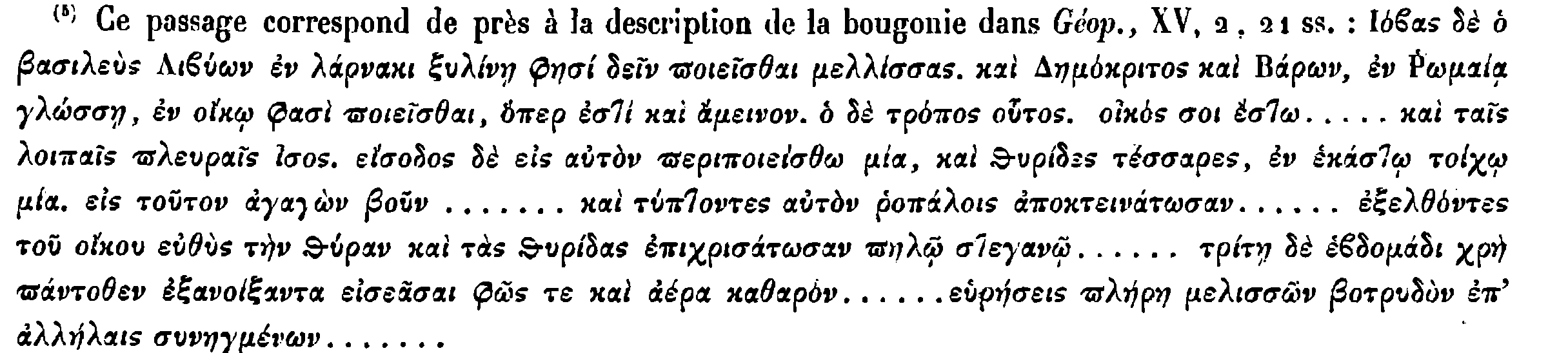
107.5 This passage closely corresponds to the description of bugonia in the Geoponica, XV, 2, 21 ff.:
107.6 Cf. Pliny, Nat. hist., IX, 58 (179); Aelian, De nat. anim., II, 56; Horapollo, Hieroglyphica, I, 24 (ed. C. Leemans, Amsterdam 1835, p. 30); Diodorus Siculus, Bibl. hist., I, 10, 7; cf. Wellmann, Physiologus, p. 80; Lippmann, op. cit., p. 22.
Original p. 108

108.3 A similar exclamation occurs in the k. al-ḫawāṣṣ al-kabīr, chap. 54, in connection with the artificial generation of snakes:

Cf. also William of Auvergne, De legibus, chap. 24 (Opera Omnia, Paris 1674, vol. I, p. 69), speaking of the artificial generation of worms and frogs: Qui autem in his docti sunt, talia non mirantur, sed solum creatorem in eis glorificant scientes quod sola omnipotentissima voluntate ipsius natura operatur.†

108.5 Pp. 353, 14–355, 6. Besides natural putrefaction (taʿfīn = σῆψις), the author knows three others, artificial: with vinegar, with moisture, and with horse dung (sarjīn al-ḫayl), the last being the strongest.
108.7 Cf. p. 363, 12: “Likewise, if hair is boiled or putrefied for a long time, snakes are produced from it. What is true of white hair is equally true of black hair. The colour remaining unchanged in both cases, white snakes are produced from white hair and black snakes from black hair …” Another recipe for the production of snakes occurs in the k. al-ḫawāṣṣ al-kabīr, chap. 54: here it is the corpses of spiders (ʿankabūt) that are transformed into snakes. If they are corpses of tarantulas (rutaylāʾ), basilisks (ṯuʿbān) are produced from them. On this occasion Jābir remarks, referring to the observations of the Egyptians (ahl Miṣr), that a natural enmity exists between the rutaylāʾ and the ṯuʿbān; he even says that he visited Egypt to verify this. Cf. above, pp. 67 and 89.
108.9 P. 364, 6–10. Prescriptions for the production of snakes also occur in Ps.-Majrīṭī, k. ġāyat al-ḥakīm, p. 412; Dāwūd al-Anṭākī, taḏkira, III (ḏayl), p. 63.
Original p. 109
109.1 P. 361, 7 ff. Referring to Hermetic books, William of Auvergne, loc. cit. (cf. Thorndike, A History of Magic, II, 348), declares that natural magic is capable of working non solum novis modis, sed etiam res novas. Non erit igitur dubitandum in novis seminum commixtione et ipsorum adiutoriis nova animalia et necdum visa posse gigni, sicut aperte docet Emuth de quo superius fecimus mentionem.*
109.2 In view of the part played by the symbols of the bird and the egg in Greco-Arabic alchemy (cf. E. von Lippmann, Entstehung, I, index, s.v. Ei and Vogel), one is tempted to see an alchemical allegory in this exposition. The whole of ʿilm al-takwīn, however, cannot be reduced to such an explanation.
109.4 Abū Qalamūn designates in Arabic (cf. Dozy, Suppl., I, 6), first, a fabric of Egyptian provenance (Damietta), whose “colours were very brilliant and changed according to how they were exposed” [cf. also Qazwīnī, Cosmographie, II, p. 129, infra, where the Arabic reading should be as reproduced below; Jāḥiẓ, k. al-tabaṣṣur bi’l-tijāra (ed. H. H. ʿAbdalwahhāb, Cairo 1354/1935 = al-rasāʾil al-nādira, no. 7), p. 22; Bērūnī, k. al-jawāhir, pp. 52, 74 supra, 75; see also Muḥ. Zakī Ḥasan, Kunūz al-Fāṭimiyyīn, Cairo 1937, p. 52, note; E. Wiedemann, Beiträge XXIV, p. 106, n. 4]. Next, a precious stone (jasper or opal?) which offers “to the eye iridescent shades varying between red, green, and yellow”; and finally a multicoloured bird and a marine animal. Dozy, following Fleischer, sought the origin of this word in ὑποκάλεμον, a term of the late Byzantine period whose meaning does not correspond at all to that of the Arabic word. But already S. de Sacy, Chrestomathie arabe, III, translation, p. 268, had connected abū Qalamūn with the Greek χαμαιλέων. In ancient alchemy, the term χαμαιλέων is often employed to designate the philosopher’s stone, whose changing colours are thus characterised (cf. E. von Lippmann, Entstehung, I, index, s.v.). Jābir attests this same terminology by giving one of his alchemical writings (CXII 35), which treats the different colours of the seven metals, the title k. abī Qalamūn. Cf. also the verse that Badīʿ al-Zamān al-Hamaḏānī, in the maqāma al-makfūfiyya (Maqāmāt, Beirut ed., 1889, p. 78), puts into the mouth of his hero Abū’l-Fatḥ al-Iskandarānī, the prototype of the perpetually disguised wanderer: “I am a chameleon; I am always changing colour.”


Original p. 110
Original p. 111
111.1 Since the technical language of this passage is particularly difficult, our translation claims to be no more than an approximate attempt. Account must also be taken of the deplorable state of the sole manuscript on which we based our edition.
111.2 Probably εἴδωλον*.
111.5 Mr Muṣṭafā Jawād suggests the following reading to me, “rectifying (the weight in the balance) degree by degree”:

In any event, as the use of the verb ṣarrafa indicates (for taṣrīf, “transmutation, morphology”, cf. below, chap. V, 3), the text alludes to the theory of the Balance, and the book mentioned is probably one of the Kutub al-Mawāzīn, the collection to which the kitāb al-tajmīʿ also belongs. With the aid of the theory of the Balance, one first establishes the natural constitution of the body one wishes to reproduce. Then one constructs the apparatus for its generation. Cf. also pp. 345, 10, and 384, 3, on the artificial generation of plants.
111.7 Cf. the description of the apparatus for the artificial generation of plants, Textes, p. 383, 10 ff.: the apparatus must be of glass and placed inside another apparatus which is likewise of glass. The inner apparatus, representing the Form, must be perforated from end to end … The inner apparatus must measure two-thirds of the other (the outer one); if one is twenty (units), the other will be thirty …
Original p. 112
112.1 Uncertain reading; cf. the expression ṭīn ḥurr in Ḫwārazmī, k. mafātīḥ al-ʿulūm, p. 265, 8; likewise Qazwīnī, Cosm., II, pp. 121, 5; 124, 2; see also Textes, p. 383, 15: turāb al-ḥurr. Cf. also the mention of ṭīn muḥkam in the analogous passage LXX 34 (= Textes, p. 471, 8).
112.2 CXII 81. The description given here closely resembles that of the apparatus for melting iron (maḏāba) in LXX 18 and 34, a translation of which was given above (p. 57 ff.). In LXX 34 (= Textes, p. 471, 9), the reference to the kitāb al-aṭyān also occurs.
112.4 Similar directions occur at p. 382 concerning the mould intended for the artificial generation of plants.
Original p. 113
113.3 Cf. LXX 18 (= Textes, p. 463, 12) and LXX 34 (= Textes, p. 472, 2), where one manuscript has the first of the following readings in place of the second:

113.5 LXX 34 (= Textes, p. 371, 12) also speaks of the constant motion of the apparatus. [Ed.: See translator’s note T3.]
113.6 The author refers here to other treatises in which he also discussed the different degrees of intensity of fire. As the sequel to his exposition also shows, there are four degrees: the second has three times the intensity of the first, the third five times, and the fourth, the strongest, eight times. We shall see below that the series 1, 3, 5, 8 is closely connected with Jābir’s theory of the Balance.
113.7 A lacuna in the text; for the reconstruction, cf. the analogous passage LXX 34 (= Textes, p. 472, 2). The image of the waterwheel (dūlāb) and of the millstone (raḥā) is also invoked in connection with the motion of the celestial spheres; cf. k. iḫrāj mā fī’l-quwwa ilā’l-fiʿl (= Textes, pp. 33, 1 and 35, 4).
113.8 The description of the apparatus is very obscure and probably incomplete. Is the perpetual and spontaneous motion due to the action of a fire lit in the ditch? Does the apparatus in question bear some resemblance to the steam sphere described by Hero of Alexandria? (Cf. Heronis Alex. op., ed. Schmidt, I, p. XLV; Diels, Antike Technik, Berlin 1914, p. 51.)
113.12 The fanciful description of this supposed perpetuum mobile appears to draw on several conceptions of different provenance:
The two statues of Egypt suggest the two Colossi of Memnon. The audible cracking sounds that one of them was supposed to produce in Roman times before daybreak or at the first rays of the sun gave rise to numerous legends (cf. Pauly–Wissowa, Real-Enc., XXIX, 648–649), magnified in proportion to the distance separating their reporters from Egyptian realities; cf. also Lepidius, Schol. ad Juvenal, 15, 5: Memnonis ex aere (sic) statua. hanc Cambyses rex iussit aperiri, existimans mechanicum aliquod esse quod intra statuam lateret; nihilominus tamen aperta statua, quae erat magice consecrata, horis statutis sonum reddidit*;
Rāzī, in his k. al-ḫawāṣṣ (cf. above, p. 63), speaks of a marble column erected in Egypt which moves perpetually, inclining towards one side:

A similar account is quoted in Qazwīnī, Cosmologie, II, p. 97 infra, according to which the column is situated in Alexandria. Qazwīnī claims to have drawn his account from Bērūnī’s Chronology, where, however, I have looked for it in vain. On moving statues erected by the kings of Egypt, cf. also the legends reported in L’Abrégé des merveilles, trans. Carra de Vaux (Paris 1898), pp. 161, 272, 278. See also Berthelot, Archéologie, p. 249;
The mirror of which the text speaks may be a reminiscence of the fabulous mirror of the lighthouse of Alexandria;
Finally, as Mr Ch. Kuentz points out to me, the author may have misunderstood an ancient description of a concave gnomon. In that case it would not be the column itself that is in perpetual motion “in accordance with the motion of the sphere”, but only its shadow.
Original p. 114
114.1 The detailed exposition of the number of days necessary for the accomplishment of the Work occurs in the k. al-taṣrīf (= Textes, p. 399, 8 ff.). The duration of the Work varies according to the degrees of intensity of each Nature that one proposes to produce, these degrees being proportional to the series 1 : 3 : 5 : 8. In the production of an animal, for example, the duration is 150 days (first degree), 450 (second), 750 (third), and 1,200 (fourth). Similar indications are given for the generation of plants (p. 401, 6 ff.) and minerals (p. 403, 11 ff.).
Original p. 115
115.4 The third degree is the limit because the fourth degree of fire, and of everything in the world, is destructive; cf. below, chap. V, 1.
115.7 This is the computation, generally accepted since the Hellenistic period (cf., for example, Hero of Alexandria, Opera, IV, 442–444 Heiberg), of the ratio of the circumference of a circle to its diameter. According to Archimedes, the number would more exactly lie between and (cf. P. Tannery, Mém. Scient., I, 226–253; III, 149, 198; see also Bērūnī, k. al-tafhīm li-awāʾil ṣināʿat al-tanjīm, ed. Ramsay Wright, The Book of Instructions in the Elements of the Art of Astrology, London 1934, §§ 37 and 145). The value was adopted by most Arab geometers; cf., for Ibn al-Hayṯam, Wiedemann, Beiträge XVII, p. 18.
Original p. 116
116.1 Here, as at the beginning of the paragraph, the expression “the first circle” refers to the sphere immediately surrounding the mould. In the following sentence, by contrast, it designates the outer sphere, the one farthest from the mould.

Original p. 117
117.1 P. 369, 3: “As for the apparatus, it is the same as the apparatus of glass, copper, and clay of which we spoke previously. In this there is no difference (between the first and the third generation). As for the perfection of the Form (of the mould), it depends upon its builder (muhandis).”
117.2 P. 369, 8 ff.: “One must know that the philosophers have many (divergent) opinions on this subject. By philosophers I mean (here), in particular, those who practise (artificial) generation. Some say: one must know the instant (favourable to generation).—On this point let our book entitled Book of the Balance be consulted. We have discussed these degrees and their causes in particular in a work belonging to the Theurgical Books (kutub al-ṭilasmāt), in which we treat (?) the number of degrees of the Sphere and of the images (appearing in it). Another school says: this mode of generation can be practised at any instant. Nevertheless, the first opinion is more correct from every point of view …”
117.9 Cf. also Coll. anc. alch. gr., II, 132, 23, where Τρισμέγιστος* appears to be employed as a designation of the elixir, composed of three substances.
117.10 Textes, p. 374, 9–11, Jābir says: “As for the expression ‘the Thrice-Wise’, Homer in his poetry (šiʿr) always (replaces) it with the designation ‘the quintuple … the superior’.” [Ed.: The Arabic phrase and the word discussed are reproduced below.] The middle word, which might at a stretch be translated “by the second”, is apparently corrupt. But the other two have too unusual a sense for us not to be tempted to look for this phrase in the Homeric poems. I believe, indeed, that the passage intended is none other than Iliad, M 87, where, concerning the Trojans who follow Hector into battle, it is said: πένταχα κοσμηθέντες ἅμ’ ἡγεμόνεσσιν ἕποντο† (“grouping themselves into five divisions [or forming groups of five?], they followed their leaders”). Mutaḫammis corresponds exactly to πένταχα (κοσμ.), and al-ʿulwī (the superior) might well be the translation of ἡγεμόνεσσι. One should then seek in the intervening Arabic word the translation of ἕποντο, which might be obtained by a slight correction. With every reservation, we therefore propose to read the Homeric quotation al-mutaḫammis(a) al-tāliya al-ʿulwī (or, better, li’l-ʿulwī), to be translated: “those who are grouped in five and follow the superior.” According to Textes, p. 375, 2 ff., the expression mutaḫammis refers to the five senses. Jābir, or rather his source, thus appears to have had in view an allegorical interpretation of the verse of the Iliad: an interpretation that sees the military formation in groups of five as an allusion to the five senses and identifies the ἡγεμόνες with the ἡγεμονικόν, the intelligence of man. Although this allegory does not appear to be directly attested in antiquity, analogous interpretations of Homeric passages are nevertheless frequent among Greek authors. Pythagorean exegesis (cf. Ps.-Plutarch, De vita et poesi Homeri, § 145 ff.; see also A. Delatte, Études sur la littérature pythagoricienne, p. 109 ff.) early drew attention to the characteristic numbers found in the Homeric poems, and the Stoics had a particular fondness for physical and psychological allegories (cf. von Arnim, Stoic. Vet. Fragm., II, 251 ff.; but see already Plato, Rep., IV, 441 b; likewise Ps.-Plutarch, op. cit., § 122 ff.).


Another, likewise arithmological, reference to Homer occurs in the k. al-ḫawāṣṣ, chap. 21 (cf. Textes, p. 315, 8). Speaking of the number of the 144 books in the collection of the Kutub al-Mawāzīn, Jābir adds the following remark: “Already the poet Homer said that things numbering four and having three aspects represent the elements (literally, the mothers) of science. He thereby showed that wonders come to light in four times three, which gives twelve, and this last number multiplied by itself gives 144. (The number 144) thus contains within itself the root, division, and multiplication, as well as (the rules of) algebra (al-jabr wa’l-muqābala). If, in these sciences, you wish to attain your desire, you must set yourself to studying geometry.” It is not entirely excluded that this speculation ultimately derives from the passage in the Odyssey, ε 306: τρὶς μάκαρες (Δαναοὶ) καὶ τετράκις*, a passage taken up by Virgil, Aen., I, 94: terque quaterque beati†, and which gave rise in antiquity to arithmological commentaries (cf. Theologoumena arithmeticae, p. 26, 15 de Falco; Macrobius, In Som. Scip., I, 6, 44); one might also think of Il. Α 128: τριπλῇ τετραπλῇ‡. That people sought in Homer not only the elements of arithmetic and music, but also the method of calculation (λογιστικὴν μέθοδον), is attested by Ps.-Plutarch, De vita, § 146.—The k. muṣaḥḥaḥāt Iflāṭūn, chap. 4, attributes to Homer knowledge of the Tetractys 1 + 2 + 3 + 4 = 10 and a fondness for the number ten (cf. also Delatte, op. cit., p. 122).
In his work on India (ed. Sachau, p. 21, 6; cf. trans., I, p. 42), Bērūnī, speaking of the music of the spheres, attributes to Homer (ʾUmīrūs šāʿir al-Yūnāniyyīn) a passage relating to the number seven (the melodies of the seven planets). Another verse is quoted ibid., p. 48 (trans., I, p. 98).—For the supposed Syriac translation of Homer attributed to Theophilus of Edessa (died 785), cf. A. Baumstark, Geschichte der syrischen Literatur, Bonn 1922, p. 341.
Original p. 118
118.1 The latter refers to the physician Philon of Tarsus (al-ṭabīb al-Ṭarsūsī, p. 374, 14; ibid., l. 12, read the first Arabic form reproduced below in place of the second). Cf. the parallel passage in the k. al-ḫamsīn, chap. 17 (f. 122ᵇ):

The title of the Galenic work cited in the k. al-tajmīʿ (Textes, p. 374, 11) is corrupt. In place of the reading reproduced below, one should read bi’l-mayāmir, the usual title among Arab physicians for Galen’s De compositione medicamentorum secundum locos (περὶ συνθέσεως φαρμάκων κατὰ τόπους); cf. M. Steinschneider, “Die griechischen Ärzte in arabischen Übersetzungen”, in Virchow’s Archiv f. Pathologie, CXXIV, 1891, p. 291. It is indeed in this work (IX, 4; vol. XIII, pp. 267–276 Kühn) that Galen quotes and comments upon the allegorical verses in which Philon of Tarsus described his celebrated theriac. The passage intended by Jābir is the verse: κρόκου δὲ σταθμὸν φρένας ἀνέρος, οὐ γὰρ ἄδηλον§ (p. 268), which Galen explains (p. 269, infra) as follows: σταθμὸν δὲ ἀξιοῖ τοῦ κρόκου πέντε δραχμὰς εἶναι, φρένας ἀνέρος εἰπὼν τὰς αἰσθήσεις, οὔσας πέντε¶. Bērūnī, Hind, p. 46 (trans., I, p. 95), refers to the same passage but seems to have used a different translation of the work.

[Ed.: Authorial correction to the Arabic quotation: see Appendix A, entry A3.]
Original p. 119
119.2 A similar idea occurs in the k. al-baḥṯ, f. 132ᵃ, concerning Thales, Pythagoras, Socrates, and Plato:

119.3 P. 377, 13 ff. This is also the definition of the Soul of the World given in the k. al-taṣrīf (= Textes, p. 407, 4); cf. below, chap. IV, 2.
119.6 Cf. Aristotle, De anima, I, 3 (406 b 12 Bekker). See also Robert, in Pauly–Wissowa, Real-Enc., IV, 2002.
Original p. 120
120.1 For the whole question of automata, cf. H. Diels, Antike Technik, Berlin 1914. See also J. Bidez, in Cat. Mss. alch. gr., VI, p. 23.
120.2 Philopseudes, chap. 35 ff.—Cf. also A. Dieterich, Abraxas, Leipzig 1891, p. 161; R. Reitzenstein, Hellenistische Wundererzählungen, Leipzig 1906, p. 5.
120.3 Cf. Clem. Rom., Oper. dub. Hom., II, 26 (= Migne, Patr. Lat., I, 904–905): Ait quod primo hominis spiritus, versus in naturam calidi, circumstantem aerem, sicut cucurbitula facit, attractum imbibit quem deinde intra spiritus formam positum ipse Simon in aquam vertit cumque aer in spiritu consistens ob spiritus continuitatem effundi nequeat eundem convertit in sanguinem: et ex sanguine concreto carnem fecit; sicque postea carne solidata hominem non e terra sed ex aere protulit, atque hunc in modum sibi persuadens potuisse a se creari novum hominem, ait se eum resolutis conversionibus rursum aeri reddidisse.*—For the Jewish legend of the Golem, cf. K. Mueller, “Die Golemsage und die sprechenden Statuen”, in Mitt. d. Schles. Gesell. f. Volkskunde, XX (1918), pp. 1–40 (not consulted); G. Scholem, in Encyclopaedia Judaica, VII, 501 ff.; the same, in the Hebrew journal Lešōnēnū, VI, pp. 40–41. [Ed.: The final reference incorporates Kraus’s erratum; see Appendix A, entry A4.]
120.4 The ideas expounded in the k. al-tajmīʿ should be compared with the chapter on the homunculus in Paracelsus, De natura rerum, I, Theophrasti Bombasti ab Hohenheim dicti Paracelsi operum medico-chimicorum sive paradoxorum, vol. VI (Francofurto MDCV), pp. 203–204:
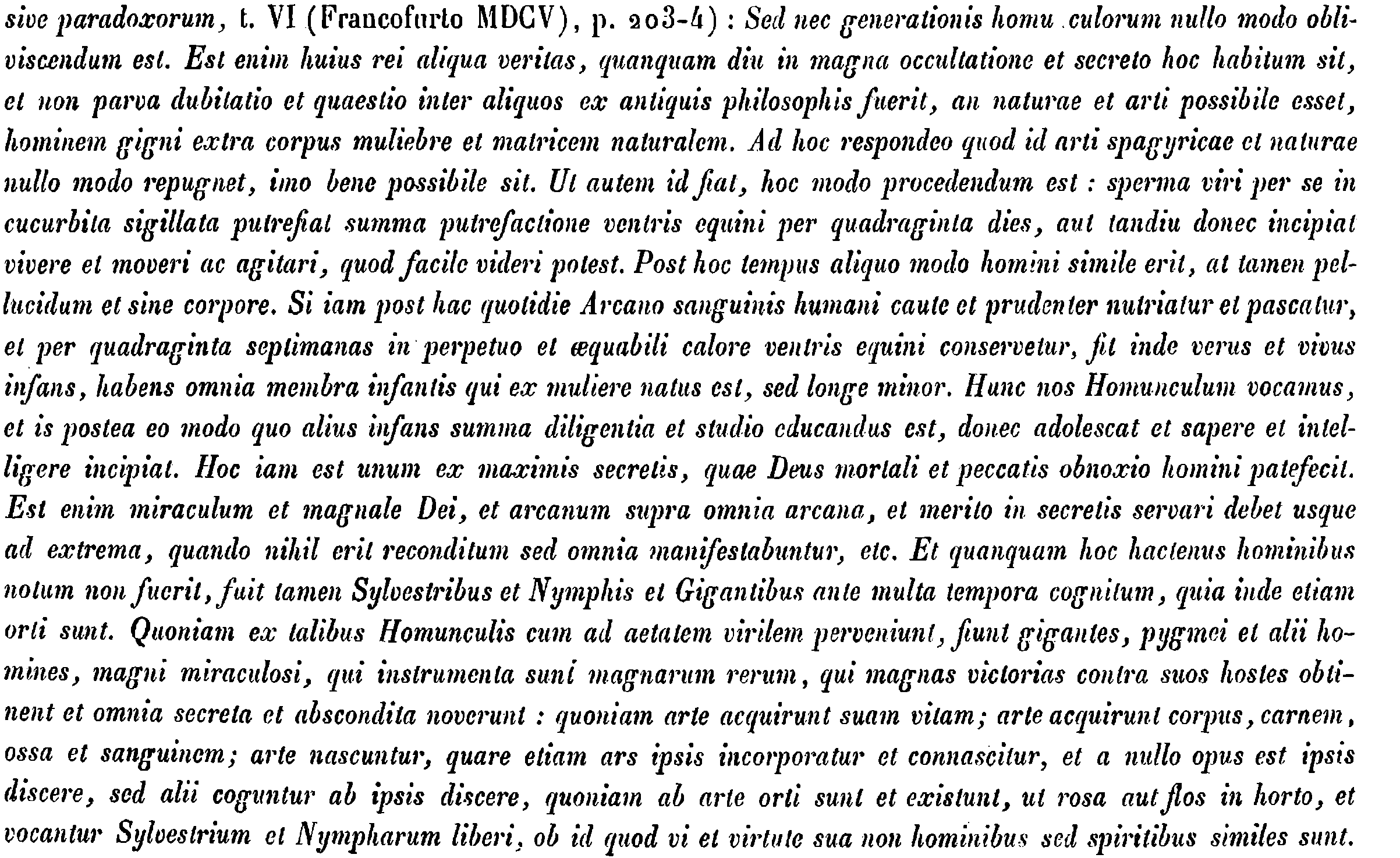
The German recension of De natura rerum was re-edited by K. Sudhoff in volume 11 of Theophrast von Hohenheim, gen. Paracelsus, Sämtliche Werke, Munich–Berlin 1928. The passage in question occurs there at p. 316 ff. For De natura rerum, cf. also E. Darmstaedter’s critical study in Janus, XXXVII, 1933.
Original p. 121
121.1 Cf. above, p. 36. See also Berthelot, Origines, p. 60, and E. von Lippmann, Urzeugung und Lebenskraft, p. 35; Jacoby, in Handwörterbuch des Deutschen Aberglaubens, IV, 286 ff.
121.3 It is already attested in the Hermetic work k. sirr al-ḫalīqa, attributed to Balīnās (Apollonius of Tyana)—on the date of this work and its relations to the Jābirian Corpus, cf. below, chap. V, 5—according to which the first human beings were born through spontaneous generation, in the same way as various insects are still formed by the mere combined action of the elements; cf. especially p. 150 (of my own copy):

[The parallel passage in Job of Edessa’s Book of Treasures, II, chap. 17 (ed. A. Mingana, Cambridge 1935, p. 104 ff.), although deriving from the same source, is less explicit.]
An analogous theory occurs in the Rasāʾil Iḫwān al-Ṣafāʾ (Bombay ed.), II, 376, and, attributed to Indian thinkers, in Ibn Abī’l-Ḥadīd, šarḥ nahj al-balāġa, I, 34 (cf. already above, p. 98, n. 1); likewise in Faḫr al-Dīn al-Rāzī, k. al-mabāḥiṯ al-mašriqiyya, Hyderabad 1343, II, 219, and in the k. al-anwār al-laṭīfa of the Ismāʿīlī dāʿī Muḥammad b. Ṭāhir al-Ḥāriṯī (for this author, cf. W. Ivanow, A Guide to Ismaili Literature, London 1933, p. 53), according to which the first man (Adam) is said to have been born through spontaneous generation on the island of Sarandīb (Ceylon). It is likewise on a deserted island of India, situated on the equator, that the hero of Ibn Ṭufayl’s philosophical romance, Ḥayy b. Yaqẓān, is said to have been born in fermenting clay (al-ṭīna al-mutaḫammira), without father or mother (cf. L. Gauthier, Ibn Thofaïl, sa vie et ses œuvres, Paris 1909, p. 62); likewise Fāḍil b. Nāṭiq, the hero of an analogous tale by Ibn al-Nafīs [cf. Brockelmann, Suppl., I, 900, no. 14; the r. al-kāmiliyya fī’l-sīra al-nabawiyya, mentioned there under no. 10, is identical with the r. Fāḍil b. Nāṭiq; accordingly, this work is not a refutation of Ibn Sīnā’s r. Ḥayy b. Yaqẓān, but an imitation, from an orthodox standpoint, of Ibn Ṭufayl’s romance]. The description of Fāḍil’s spontaneous generation at the beginning of the treatise is particularly extensive. The incompatibility of this doctrine with the thesis of divine creation was brought out as early as 355 AH by Muṭahhar b. Ṭāhir al-Maqdisī (Ps.-Balḫī), k. al-badʾ wa’l-taʾrīḫ, II, 80 Huart.
121.4 Ibn Waḥšiyya, in his k. al-taʿfīn (Book of Putrefaction) or k. asrār al-šams wa’l-qamar (Book of the Secrets of the Sun and Moon), discussed the artificial generation (takwīnāt, tawlīdāt) of plants and animals, attributing this doctrine to Babylonian scholars (Ašqūlabīṯā, Ankabūṯā, and others); cf. D. Chwolson, Ueber die Ueberreste der altbabylonischen Lit. in arabischen Uebersetzungen, Académie des Sciences, Pétersbourg, savants étrangers, sixth series, 8, 1859, pp. 59; 164 ff. Several extracts from this work were collected by Nuwayrī in volume 11 of his encyclopaedia Nihāyat al-arab fī funūn al-adab (Cairo 1935, p. 43 ff.).—According to De essentiis, attributed to St Thomas Aquinas, Rāzī is said to have treated the same subject in his Book of Properties (cf. L. Thorndike, A History of Magic and Experimental Science, III, 139). No such passage can be found in the Arabic original of this work (k. al-ḫawāṣṣ; cf. above, p. 63, n. 5). Cf., however, the ḏayl of Dāwūd al-Anṭākī’s taḏkira, III, p. 63, where the idea of the artificial generation of certain animals is attributed to Abū Bakr al-ḥakīm (= Rāzī).—See also William of Auvergne, De universo, II, iii, 25 (Paris 1674, vol. I, p. 1072): Nec mirum cum iam attentatum sit ab hominibus et creditum ab eis homines per aliam viam efficere quam per viam consuetae generationis sicut in libris experimentorum poteris invenire* (cf. Thorndike, op. cit., II, 353).
Original p. 122
122.3 Textes, pp. 347, 4; 349, 9; 361, 17; 362, 12; 363, 3; 368, 11, and often elsewhere. Other references to Porphyry occur especially in the k. al-baḥṯ. According to f. 27ᵃ (cf. Textes, p. 506, 9), he agrees with Pythagoras in regarding the stars as angels (malāʾika); and f. 76ᵃ of the same work refers to his journey to Sicily and his visit to Etna (nār Ṣiqilliyya). F. 57ᵇ mentions his definition of Accident, citing the Isagoge, and the k. al-ḥajar (Holmyard, p. 21, 4) refers to the quinque voces. Alchemical doctrines are attributed to Porphyry in the k. al-sirr al-maknūn II, ff. 51ᵃ, 52ᵃ–ᵇ, and in the k. muṣaḥḥaḥāt Iflāṭūn. The k. al-tajmīʿ (Textes, pp. 361, 17; 362, 12) calls Porphyry al-ʿaẓīm (the great), which corresponds to the epithet ὁ μέγας, often bestowed upon the later Neoplatonists. See P. Tannery, Mém. Scient., II, 529. Cf. especially Ὀλυμπιόδωρος ὁ μέγας*, Coll. anc. alch. gr., II, 426, 7. Cf. also Iflāṭūn al-ʿaẓīm, LXX 18 (= Textes, p. 464, 4).
Original p. 123
123.2 Cf. J. Bidez, Vie de Porphyre, in Recueil des travaux publiés par la Faculté de philosophie et lettres, Univ. de Gand, fasc. 43, Ghent–Leipzig 1913, appendix, pp. 65–73.
123.4 Cf. Πορφυρίου φιλοσόφου εἰσαγωγὴ εἰς τὴν ἀποτελεσματικὴν τοῦ Πτολεμαίου†, Basel ed., 1559, p. 181 ff.
123.7 Porphyrii quaestionum homericarum ad Iliadem pertinentium reliquias, collected by H. Schrader, 1880–1882; Porph. quaest. hom. ad Odysseam pert. rel., collected by H. Schrader, 1890. Cf. Bidez, p. 31 ff. In his other works, too, Porphyry delights in displaying his knowledge in this field; cf., in particular, the title of one of his treatises: περὶ τῆς Ὁμήρου φιλοσοφίας‡.
Original p. 124
124.1 The text is defective; probably to be restored: “For, according to them, this cause ⟨is the inaugurator of this art?⟩, and they occupy (in relation to it) the rank of ⟨successors, or imitators⟩.”
124.5 Cf. also Timaeus, 46 c, 8, speaking of the divine demiurge: τὴν τοῦ ἀρίστου κατὰ τὸ δυνατὸν ἰδέαν ἀποτελῶν§. Cf. also M. b. Zak. al-Rāzī, k. al-ṭibb al-rūḥānī (Opera Philosophica, I, p. 86, 10).
124.6 This definition ultimately derives from the Phaedrus, 67: λύσις καὶ χωρισμὸς ψυχῆς σώματος¶. Closer to Jābir is the formula employed by the author of the Hermetica, XII, ii, 16 (vol. I, p. 232, 26 Scott): οὐ γὰρ ἀποθνήσκει … ἀλλ’ ὡς σύνθετα σώματα διαλύεται. ἡ δὲ διάλυσις οὐ θάνατός ἐστιν, ἀλλὰ κράματος διάλυσις. διαλύεται δὲ οὐχ ἵν’ ἀπόληται, ἀλλ’ ἵνα νέα γένηται‖; cf. ibid., VIII (p. 174, 10 Scott): ὁ γὰρ θάνατος ἀπώλειά[ς] ἐστιν**. [Ed.: See translator’s note T3.]
Original p. 125

125.2 This distinction of Porphyry’s is apparently related to that of Plotinus, Enn., I, 9, where, however, it is not formulated with the same clarity. It also occurs in Macrobius, In Somn. Scip., I, 13, 11, in the summary of Plotinus’s theory of suicide: addit etiam illam solam esse naturalem mortem, ubi corpus animam, non anima corpus relinquit†.—For the two deaths (natural death and violent death) in the Hermetic writings (Asclepius, 27 e; Scott, Hermetica, I, 264 ff.), cf. A.-J. Festugière, RÉGr., 49 (1936), p. 590 ff., who has made it probable that Porphyry used this passage in De abstinentia (II, 47; p. 175, 6 ff. Nauck).
125.3 It also occurs in the k. iḫrāj (= Textes, p. 71, 11 ff.), where it is attributed to a group of philosophers designated by the apparently corrupt word (ṭāʾifat) al-tawqīdiyya. In view of the passage in the k. al-tajmīʿ, one is tempted to correct it to the word for “the school of artificial generation”. [Ed.: The printed and proposed Arabic forms are reproduced below]

125.6 Cf. especially Pascal, Fragment d’un traité du vide (Pensées et Opuscules, ed. L. Brunschvicg, p. 80, with other references); cf. also J. Delvaille, Essai sur l’histoire de l’idée du progrès jusqu’à la fin du XVIIIe siècle, Paris 1910; J.-B. Bury, The Idea of Progress, London 1928; R. Klibansky, in Isis, XXVI, 1936, pp. 147–149.
125.10 In Somn. Scip., II, 10; cf. Th. Whittaker, Macrobius or Philosophy, Science and Letters in the year 400, Cambridge 1933, p. 76.
125.12 Cf. the almost proverbial formula: the first has left nothing for the last to do (mā taraka’l-awwalu li’l-āḫiri šayʾan).
Original p. 126
126.1 Cf. the conversation between Abū Ḥātim al-Rāzī and Muḥ. b. Zak. al-Rāzī, reproduced from the k. aʿlām al-nubuwwa in our edition of Abi Bakr Mohammadi filii Zachariae Raghensis Opera Philosophica, Cairo 1940, I, pp. 301–302. More explicitly still, Rāzī expounds the idea of progress in the introduction to his k. al-šukūk ʿalā Jālīnūs (Dubitationes in Galenum), an edition of which will be included in the second volume of the Opera Philosophica.
126.7 Cf. already above, p. 119.—Commenting upon this idea, Deonna, loc. cit., p. 234, reports after Lang an American myth that presents a particularly striking parallel to the conception of progress in the plastic art encountered in the Jābirian text: “In Oregon … the coyote seems a somewhat inexperienced demiurge, and the men he created … stood greatly in need of revision, correction, and considerable enlargement … Since he was the first to work for Nature, he made men rather badly; their eyes were closed and their feet incapable of movement. A benevolent priest named Ikanam retouched these crude attempts of the coyote with a stone … he opened their eyes and gave their hands the power to move. This Ikanam is also a culture hero who first taught the arts to men.”
126.8 Cf. especially Lactantius, Divinae institutiones (ed. Brandt–Laubmann in Corpus Script. Eccl. Lat., vol. XIX, 1890), II, 10, 12 ff.: the pagan idea that Prometheus modelled men (cf., for example, Plotinus, Enn., IV, 3, 14) is false, or rests, at most, on an allegory; in reality he was the first to fashion statues: sed primum omnium Promethea simulacrum hominis formasse de molli ac pingui luto ab eoque primo natam esse artem statuas ac simulacra fingendi … sic veritas fucata mendacio est et illud quod a deo factum ferebatur, homini qui opus divinum imitatus est, coepit adscribi.* Cf. also St Augustine, De civ. Dei, XVIII, 8, taken up by R. Bacon, Opus maius, II, 9 (vol. I, p. 48 Bridges).
Original p. 127
127.1 Cf. Mme Weynants-Ronday, Les statues vivantes. Introduction à l’étude des statues égyptiennes, Brussels 1926; P. Schuhl, Platon et l’art de son temps, Paris 1933, appendix VII.
127.3 Cf. E. von Dobschuetz, Christusbilder, in Texte und Untersuchungen zur Geschichte der alt-christlichen Literatur, XVIII (new series, III), Leipzig 1899, p. 22; Joseph Kroll, Die Lehren des Hermes Trismegistos (Beitr. z. Geschichte der Philosophie des Mittelalters, XII, 2–4), Münster 1914, pp. 90–94 and 409; Ch. Clerc, Les théories relatives au culte des images chez les auteurs grecs, Paris 1916; the same, “Plutarque et le culte des images”, RHR, 70 (1914), pp. 107–124.—For medieval Christian legends, cf. G. Huet, “La légende de la statue de Vénus”, RHR, vol. 68 (1913), pp. 193–217. See also the prescriptions for the manufacture of images of the gods in the Mappae Clavicula; cf. Berthelot, La chimie au moyen âge, I, 57.
127.4 Cf., for example, Maximus of Tyre, Philosophumena, II (p. 18 ff. Hobein): εἰ θεοῖς ἀγάλματα ἱδρυτέον†.
127.6 Eusebius, Praep. ev., V, 11 (vol. I, 232, 11 ff. Dindorf) [= G. Wolff, Porphyrii de philosophia ex oraculis haurienda librorum reliquiae, Berlin 1856, p. 129]:

For Porphyry’s theurgical works, cf. also J. Bidez, in Cat. Cod. Astr. Gr., VI, 84.
127.7 Cf. Bidez, op. cit., pp. 21–28, 143–157, and the fragments collected ibid., appendix, pp. 1–23.
Original p. 128
128.4 Jamblichi de mysteriis liber, edited by G. Parthey, Berlin 1857. In his introduction (pp. XIX–XLV), Parthey reproduced Thomas Gale’s attempted reconstruction of the Letter to Anebo from his editio princeps (Oxford 1678). A new reconstruction of the text would meet an urgent need. Cf. also Bidez’s analysis, pp. 80–87. For the attribution of De mysteriis to Iamblichus, cf. now J. Bidez, in Mélanges Desrousseaux, Paris 1937, p. 11 ff.
128.5 Porphyry’s correspondence with Anebo has left a few traces in Arabic literature. Masʿūdī, k. al-tanbīh wa’l-išrāf, p. 162, 6, refers to it in the following terms (cf. Maçoudi, Le livre de l’avertissement et de la révision, trans. B. Carra de Vaux, Paris 1896, p. 222): “We have related the dealings between Porphyry of Tyre and Anabou, an Egyptian priest. This Porphyry is the author of the book of the Isagoge, or introduction to Aristotle’s book; he was a Christian (sic!), but secretly defended the beliefs of the Greek Sabians; and Anabou adhered to the doctrines of the ancient philosophers, those professed by Pythagoras, Thales of Miletus, and others, which are those of the Sabians of Egypt. They put questions to one another concerning theological sciences in epistles known to anyone interested in the ancient sciences.”—In fact, the Arab bibliographers (Ibn al-Nadīm, p. 253, 16; Ibn al-Qifṭī, Cairo ed., p. 170, 4; Ibn al-ʿIbrī, taʾrīḫ muḫtaṣar al-duwal, p. 133) attribute to Porphyry two treatises addressed to Anebo (kitābān ilā Anābū). According to Bērūnī, Épître contenant le répertoire des ouvrages de Muḥ. b. Zak. ar-Rāzī, ed. P. Kraus, Paris 1936, p. 17, no. 128, Rāzī composed a “refutation (naqḍ) of the book that Porphyry had addressed to Anebo the Egyptian”. It is probably mistakenly that Ibn al-Nadīm, p. 300, 18, and Ibn Abī Uṣaybiʿa, I, p. 317, 9, entitle this work “refutation of the book that Anebo had addressed to Porphyry”. Cf. also S. Pines, Beiträge zur islamischen Atomenlehre, Berlin 1936, p. 88. A fragment of a letter from Porphyry to Anebo is reported by Šahrastānī, k. al-milal wa’l-niḥal, p. 345.
[Ed.: Kraus’s addition concerning the Letter to Anebo, printed on p. 340, is translated in Appendix A, entry A1.]
Original p. 129
129.1 Cf. De mysteriis, III, 28–30; likewise the brief summary in Augustine, loc. cit.: et figurationibus atque figmentibus quibusdam etiam observatis in caeli conversione motibus siderum, fabricari in terra ab hominibus potestates …* And Augustine adds: totum hoc ad eosdem ipsos daemones pertinet ludificatores animarum …† Bidez, in his analysis, did not take account of this idea.
129.2 Cf. Augustine, loc. cit., in fine: Eo modo voluit hominem Aegyptium talibus erroribus deditum et aliqua magna se scire opinantem, non superba quasi auctoritate doctoris offendere, nec aperte adversantis altercatione turbare, sed quasi quaerentis et discere cupientis humilitate ad ea cogitanda convertere et quam sint contemnenda vel etiam devitanda monstrare.‡
129.3 De myst., III, 28 (p. 167, 10 Parthey): ὡς οὐδαμῶς ἀπόβλητον τὸ ἀναγεννητικοὺς εἶναι τῶν δραστικῶν εἰδώλων§.
129.5 III, 30 (p. 174, 10): ἀλλ’ οὐδὲ ἄνθρωπός τις πλάσαι δύναται ὥσπερ ἐκ μηχανῆς (is an actual machine meant, like that described by Jābir?) δαιμόνων τινὰς μορφάς … ἀλλ’ οὐδὲ ἐκ στοιχείων τῶν αἰσθητῶν συμπεφορημένον τι πλῆθος ἀπογεννᾶται τὸ δαιμόνιον*. Cf. also III, 29 (171, 11): ἀλλ’ οὐδὲν τῶν ὑπὸ ἀνθρωπίνης τέχνης συμπλαττομένων εἰλικρινές ἐστι καὶ καθαρόν†.
129.6 III, 28 (p. 170, 1): καὶ δὴ καὶ εἰδωλοποιία μοῖράν τινα γενεσιουργὸν ἀπ’ αὐτῶν (scil. τῶν ἀπ’ οὐρανοῦ καταπεμπομένων ἀπορροιῶν) ἕλκει λίαν ἀμυδράν‡.
129.8 III, 30 (p. 173, 8): Ἀλλὰ παρατηροῦσιν οὗτοι, φησί, τὴν τῶν οὐρανίων φοράν, καὶ λέγουσί τίνος τῶν κατ’ οὐρανὸν μετὰ τίνος ἢ τίνων πολεύοντος ἔσται ψευδῆ τὰ μαντεῖα ἢ ἀληθῆ, καὶ τὰ δρώμενα ἀργὰ ἢ ἀπαγγελτικὰ ἢ ἀποτελεστικά§. The same idea is discussed by the author of De mysteriis (III, 28, p. 169, 1): ὁ δὲ δὴ τῶν εἰδώλων ποιητὴς λέγεται μὲν ὡς διὰ τῶν περιπολούντων ἀστέρων αὐτὰ ἀπεργάζεται¶. Cf. also Julian of Laodicea, περὶ θεῶν καθιδρύσεως, Cat. Cod. Astr. Gr., VIII, 252.
Original p. 130
130.1 III, 28 (p. 168, 3 ff.); cf. especially p. 168, 11, where the τέχνη of the εἰδωλοποιός is called δημιουργική‖.
130.2 Compare the exposition of the k. al-mīzān al-ṣaġīr (see above, p. 100 ff.) with the passage in De myst., III, 28 (p. 170, 17 ff.): καὶ γὰρ ἡ φύσις ἀθρόως καὶ ἅμα ποιεῖ τὰ οἰκεῖα ἔργα, ἁπλαῖς τε καὶ ἀσυνθέτοις ἐνεργείαις πάντα ἐπιτελεῖ. λείπεται οὖν τεχνικὴν εἶναι δὴ σύμμιξιν τὴν τοιαύτην κατασκευὴν περὶ τὸ τελευταῖον καὶ περιφανὲς ῥεῦμα οὐράνιον καὶ περὶ τὰ ἀπὸ τῆς οὐρανίας φερόμενα φύσεως**.
130.3 Cf. especially III, 28 (p. 170, 9): … τεχνικῶς προσφέρεται, ἀλλ’ οὐ θεουργικῶς††.
130.4 Cf. the extract in Photius, Bibliotheca, cod. 215 (p. 173 b ff. Bekker), containing an analysis of John Philoponus’s refutation of Iamblichus’s περὶ ἀγαλμάτων. Iamblichus called these images διοπετῆ, and said of them: οὐρανίας τε φύσεως εἶναι κἀκεῖθεν ἐπὶ γῆς πεσεῖ퇇. According to the Christian author, this would be a mere imposture. For the whole question, cf. E. von Dobschuetz, Christusbilder, pp. 22–24.
130.5 Confirmation that Porphyry really relied on the Hermetic writings occurs in the very letter to Anebo. In De mysteriis, VIII, 4 (p. 265, 11 ff.), we read: Διευκρινηθέντων δὴ οὖν τούτων οὕτως, καὶ τῶν ἐν τοῖς συγγράμμασιν οἷς λέγεις περιτετυχηκέναι σαφής ἐστιν ἡ διάλυσις. τὰ μὲν γὰρ φερόμενα ὡς Ἑρμοῦ Ἑρμαϊκὰς περιέχει δόξας … μεταγέγραπται γὰρ ἀπὸ τῆς Αἰγυπτίας γλώττης ὑπ’ ἀνδρῶν φιλοσοφίας οὐκ ἀπείρως ἐχόντων§§. Let us note in passing that this passage was not included in Thomas Gale’s reconstruction. It is all the more important because it represents the earliest testimony to the Hermetic Corpus (cf. W. Scott, Hermetica, Oxford 1927, I, 92; see also IV, p. 67). Another reference by Porphyry (De abst., II, 47) to Hermetic literature was recently pointed out by A.-J. Festugière in RÉGr., 49 (1936), pp. 593–595.
Original p. 131
131.3 Cf. Augustine, VIII, 23, beginning: Hos ergo spiritus invisibiles per artem quandam visibilibus rebus corporalis materiae copulare, ut sint quasi animata corpora, illis spiritibus dicata et subdita simulacra, hoc esse dicit deos facere.*
131.4 Ascl., III, 37ᵃ (Scott, I, 358); cf. Augustine, De civ. Dei, VIII, 24. This passage was discussed at length by William of Auvergne in his De legibus, 23 ff. (Opera Omnia, Paris 1674, I, 66 ff.; cf. Thorndike, II, 350), in the course of the refutation of idolatry. William connects this belief with certain magical superstitions current in his time: cuius erroris velut reliquiae adhuc apud vetulas multas etiam Christianas extant. Dicunt enim imagines sexagesimo anno a factione sua virtutem fortiori et deinde quamdiu duraverint obtinere.†—It is also curious to see William cite the Hermetic passage as belonging to a book by Mercurius Trismegistus … quem scripsit de hellera, hoc est de Deo deorum.‡
131.5 We believe, with W. Scott, the learned editor of the Hermetica, that most of the doctrines called Hermetic are of Platonic-Stoic origin. In his commentary (vol. III, p. 154 ff.), Scott had already connected the text of Asclepius with certain Egyptian beliefs. But in the paradoxical idea of “gods manufactured by man”, he seeks to see the author’s challenge to the criticism of image-worship made by Jewish and Christian apologists.
Original p. 132
132.5 Cf. also De myst., V, 23, and Augustine, X, 11: lapidibus et herbis adhibitis§; J. Kroll, op. cit., p. 409, sought to connect this text with a medieval legend reported by Huet (cf. above, p. 127, n. 3).
132.9 These indications were doubtless contained in one of the numerous other treatises to which Jābir refers in the k. al-aḥjār I concerning the exposition of ʿilm al-takwīn (cf. above, p. 102, n. 4). His concern never to divulge the whole of his doctrine at once is well known.
Original p. 133
133.5 This is how I. Lévy, loc. cit., p. 136, summarises the result of his investigation: “The legend of Sarapis, this god without history and without myth, is essentially the romance of the statue. A statue whose nature is enigmatic; a statue animated by the invisible presence of the numen, a talisman-statue that cannot be touched without the sky collapsing and the universe returning to chaos; a Greek statue of an Egyptian god, an exotic statue of an indigenous god.”
133.8 Cf. Proclus, In Tim., II, 11, 10 Diehl: τῶν δαιμόνων φησὶν ὁ Πορφύριος οἱ μὲν ἐν τῇ συστάσει πλεῖον τὸ πύριον ἔχοντες, ὁρατοὶ ὄντες, οὐδὲν ἔχουσιν ἀντίτυπον, οἱ δὲ καὶ γῆς μετειληφότες ὑποπίπτουσι τῇ ἁφῇ*.—Differently in St Augustine, De civ. Dei, X, 9, 2: quamquam itaque discernat a daemonibus angelos, aeria loca esse daemonum, aetheria vel empyra disserens angelorum†; see also Porphyry, De abst., II, 46.
133.11 III, 155, 22: προλέγειν τὸ μέλλον‡.
133.12 Cf. the critique of prophecy in the k. al-ʿilm al-ilāhī of Muḥ. b. Zak. al-Rāzī, cited in Nāṣir-i Ḫusraw’s Risāla (Dīwān, p. 572); see S. Pines, Beiträge, p. 88.
Original p. 134
134.2 Cf. the ḥadīṯ (Buḫārī, Būlāq 1312 AH, VII, p. 167): “On the day of resurrection, those who made images (allaḏīna yaṣnaʿūna al-ṣuwar, or al-muṣawwirūn) will be subjected to the gravest punishments, and they will be told: give life to what you have created.” Cf. also E. Doutté, Magie et religion dans l’Afrique du Nord, Algiers 1909, p. 16.
A. Kraus’s additions and errata
These entries reproduce the additions and errata for this chapter from the volume’s Additions et corrections and Errata, pp. 339–341. The labels A1–A4 are editorial finding aids.
A1. Addition to p. 128
Kraus, printed p. 340: “For the Letter to Anebo, cf. also Aemilius Winter, De doctrina neoplatonica in August. Civit. Dei vestigiis, dissertation, Fribourg 1928.”

This addition supplements the discussion of the Letter to Anebo and note 128.5.
A2–A4. Errata affecting pp. 99, 118, and 120
A2 — p. 99, n. 5, line 1: Kraus directs the reader to substitute the Arabic wording shown in the first line of the extract below. The facsimile quotation in note 99.5 preserves the original, uncorrected printing; this entry supplies his correction.
A3 — p. 118, n. 1, line 3: Kraus corrects the Arabic spelling of Galen’s name, as shown in the second line. Note 118.1 reproduces the original printing.
A4 — p. 120, n. 3, at the end: “Read Lešōnēnū, VI, pp. 40–41.” The corrected reference appears in note 120.3.

B. Translator’s notes
T1. “Quality disagrees with Quality”
In the fifth combination in note 101.1, the French reads “La Qualité en désaccord avec la Qualité”. The fifth diagram in Textes, p. 443 opposes Quality to Quantity. The repetition of “Quality” is retained. Kraus’s errata contain no correction to this entry.
T2. Technical vocabulary
The French ammoniac on original p. 109 is translated “sal ammoniac”, the substance named alongside nūšādir.
T3. Printed references
Three printed references call for clarification:
- In note 106.2, Vita Cleomedis, 39 refers to Plutarch’s Life of Cleomenes, 39.3, which contains the account of insects arising from animal corpses. The Latin title is reproduced as printed.
- In note 113.5, Kraus prints Textes, p. 371, 12. The passage describing the apparatus’s continuous motion is at p. 471, line 12.
- In note 124.6, Kraus prints “Phèdre, 67”, translated Phaedrus. The quoted definition of death as the separation of soul and body occurs in Plato’s Phaedo, 67d, rather than the Phaedrus.
English translations of Greek and Latin quotations
* [Ed.] For none of the individual sensible bodies generates demons. Rather, these bodies themselves are generated and guarded by demons.↩︎
† [Ed.] Medicine and physical training.↩︎
* [Ed.] And since a discussion of the kinship and fellowship of human beings and gods is announced to us (Scott: introduced), recognise, O Asclepius, the power and strength of man. Just as the Lord and Father—or, what is supreme, God—is the maker of the heavenly gods, so man is the fashioner of the gods who are in temples, content with the proximity of human beings … he not only advances towards God, but also fashions gods … The forms of the gods that humanity fashions are formed from both natures: from the divine, which is purer and far more divine, and from that which is within (Scott: below) human beings, that is, from the matter out of which they have been made; and they are fashioned not with heads alone, but with all their limbs and their whole bodies. Thus humanity, always mindful of its nature and origin, perseveres in this imitation of divinity: just as the Father and Lord made eternal gods to resemble himself, so humanity fashions its gods in the likeness of its own countenance.↩︎
† [Ed.] Do you mean statues, O Trismegistus?↩︎
‡ [Ed.] Statues, O Asclepius. Do you see the extent of your own disbelief? Living statues, full of sensation and spirit, doing such great things and things of this kind; statues foreknowing the future and predicting it by lot, by a seer, by dreams and by many other means; inflicting human infirmities and curing them; ⟨dispensing⟩ sorrow and joy according to desert. Scott supplies ⟨dispensing⟩.↩︎
§ [Ed.] For this surpasses the wonder of all wonders: that man has been able to discover the divine nature and to produce it. Since, then, our ancestors were greatly mistaken about the nature of the gods … they discovered an art by which to make gods … since they could not make souls, they summoned the souls of demons or angels and placed them in sacred images … Asclepius: And what, O Trismegistus, is the nature of these gods regarded as earthly? Trismegistus: It consists, O Asclepius, of herbs, stones and aromatics that have the nature of divinity within them … Thus man is the fashioner of gods.↩︎
¶ [Ed.] Makers of gods or worshippers of divine images.↩︎
* [Ed.] Foreknowing the future and predicting it by lot, by a seer, by dreams …↩︎
* [Ed.] Definition of philosophy … assimilation to God insofar as is possible for a human being.↩︎
* [Ed.] Imitating their own Demiurge.↩︎
† [Ed.] Borrowing portions of fire and earth, water and air, from the cosmos.↩︎
‡ [Ed.] And having comprehended all these things together—times, places, things (= substances), qualities, quantities—you can comprehend God.↩︎
* [Ed.] Juba, king of the Libyans, says that bees should be produced in a wooden chest. Democritus and Varro, writing in the Roman language, say that they should be produced in a building, which is also better. The method is this. Let there be a building for you … equal on its other sides as well. Let it have one entrance and four windows, one in each wall. Having brought an ox into it … let them kill it by striking it with clubs … Having left the building, let them immediately plaster the door and windows with sealing clay … In the third week, one must open it up on all sides and admit light and clean air … You will find a mass of bees gathered one upon another in clusters …↩︎
† [Ed.] But those who are learned in these matters do not marvel at such things; they glorify only the Creator in them, knowing that nature works solely by his most omnipotent will.↩︎
* [Ed.] Not only in new ways, but also new things. There will therefore be no reason to doubt that new and hitherto unseen animals can be generated through new combinations of seeds and the aids they provide, as Emuth, whom we mentioned above, plainly teaches.↩︎
* [Ed.] Image.↩︎
* [Ed.] Memnon’s statue of bronze (sic). King Cambyses ordered it to be opened, thinking that some mechanical device lay hidden inside the statue; nevertheless, even after the statue—which had been magically consecrated—was opened, it gave forth a sound at the appointed hours.↩︎
* [Ed.] Thrice-greatest.↩︎
† [Ed.] Drawn up in five divisions, they followed along with their leaders.↩︎
* [Ed.] Three and four times blessed (are the Danaans).↩︎
† [Ed.] Three and four times blessed.↩︎
‡ [Ed.] Threefold and fourfold.↩︎
§ [Ed.] And as the weight of saffron, [take] a man’s wits, for it is not obscure.↩︎
¶ [Ed.] He requires the weight of saffron to be five drachmas, using “a man’s wits” for the senses, which are five.↩︎
* [Ed.] He says that at first the spirit of a man, transformed into a hot nature, draws in and absorbs the surrounding air, as a cupping vessel does. Simon himself then turns this air, enclosed within the form of the spirit, into water; and since the air contained in the spirit cannot escape owing to the continuity of the spirit, he turns it into blood. From the congealed blood he made flesh; and then, once the flesh had solidified, he brought forth a man, not from earth but from air. Persuading himself in this way that he had been able to create a new man, he says that, reversing the transformations, he returned him once more to the air.↩︎
* [Ed.] Nor must the generation of homunculi be forgotten. There is some truth in this matter, although it has long been kept deeply concealed and secret, and there was no small doubt and debate among certain ancient philosophers as to whether nature and art could generate a human being outside a woman’s body and the natural womb. I answer that this is in no way contrary to spagyric art or nature, but is indeed possible. For it to happen, the procedure is as follows: let a man’s semen, by itself in a sealed cucurbit, putrefy through the strongest putrefaction of horse dung (venter equinus) for forty days, or until it begins to live, move and stir, which can readily be seen. After this time it will resemble a human being in some way, yet be transparent and without a body. If thereafter it is nourished and fed daily, carefully and judiciously, with the secret preparation (arcanum) of human blood, and kept for forty weeks in the constant, even heat of horse dung, it becomes a true, living infant, with all the limbs of an infant born of a woman, but much smaller. We call this a homunculus. It must then be brought up like any other infant, with the greatest care and attention, until it grows up and begins to reason and understand. This is one of the greatest secrets that God has revealed to mortal man, who is subject to sin. It is a miracle and mighty work of God, a secret above all secrets, and rightly ought to be kept secret until the last things, when nothing will remain hidden but everything will be revealed, etc. Although this has hitherto been unknown to human beings, it was known long ago to woodland beings, nymphs and giants, since they too originated from it. For when such homunculi reach manhood, they become giants, pygmies and other humans, great and wondrous, who are instruments of great things, win great victories over their enemies and know all secrets and hidden things. They acquire their life through art; through art they acquire body, flesh, bones and blood; through art they are born. Art is therefore embodied in them and born with them, and they need to learn from no one; rather, others are compelled to learn from them, since they originate and exist through art, like a rose or flower in a garden. They are called the children of woodland beings and nymphs because in their strength and power they resemble spirits rather than human beings.↩︎
* [Ed.] Nor is this surprising, since human beings have already attempted, and believed it possible, to produce human beings by a route other than the customary way of generation, as you can find in books of experiments.↩︎
* [Ed.] Olympiodorus the Great.↩︎
† [Ed.] Introduction by the philosopher Porphyry to Ptolemy’s astrological treatise.↩︎
‡ [Ed.] On Homer’s philosophy.↩︎
§ [Ed.] Realising, as far as possible, the form of what is best.↩︎
¶ [Ed.] Release and separation of soul from body.↩︎
‖ [Ed.] For it does not die … but is dissolved, as composite bodies are. This dissolution is not death, but the dissolution of a mixture. It is dissolved not so that it may perish, but so that it may become new.↩︎
** [Ed.] For death is destruction.↩︎
* [Ed.] There are, then, two kinds of death: the one generally recognised, in which the body is released from the soul, and that of philosophers, in which the soul is released from the body. The one does not necessarily follow upon the other. Nature therefore releases the body from the soul, whereas the soul releases itself from the body.↩︎
† [Ed.] He adds that only that death is natural in which the body leaves the soul, not the soul the body.↩︎
* [Ed.] But Prometheus was the first of all to fashion an image of a human being from soft, rich clay, and from him first arose the art of fashioning statues and images … Thus truth was disguised by falsehood, and what was said to have been done by God began to be attributed to a man who had imitated the divine work.↩︎
† [Ed.] Whether images should be erected for the gods.↩︎
‡ [Ed.] … what form the images must be given, in what forms they themselves (that is, the gods) appear, and in what places they dwell … (12) They themselves also specified how the images should be made and from what kind of material … (13) They themselves have also revealed the forms in which they appear, on the basis of which the images were thus set up.↩︎
* [Ed.] And that, by certain figures and fashioned objects, with certain movements of the stars in the revolution of heaven also observed, powers can be fashioned on earth by human beings …↩︎
† [Ed.] All this concerns those very demons themselves, deceivers of souls …↩︎
‡ [Ed.] In this way he wished to turn the Egyptian man, devoted to such errors and thinking that he knew certain great things, towards reflection on these matters and to show him how they ought to be despised or even avoided: not by offending him with the arrogant authority of one acting as a teacher, nor by disturbing him with the disputation of someone openly opposing him, but with humility, as though asking questions and wishing to learn.↩︎
§ [Ed.] That the existence of [people] capable of bringing forth active images is by no means to be rejected.↩︎
* [Ed.] Nor can any human being fashion certain forms of demons as though by a contrivance … nor is the demonic generated from any mass gathered together out of sensible elements.↩︎
† [Ed.] But nothing fashioned together by human art is unmixed and pure.↩︎
‡ [Ed.] Image-making too draws from them (that is, the effluences sent down from heaven) a very faint share of generative power.↩︎
§ [Ed.] But these people, he says, observe the motion of the heavenly bodies and say which heavenly body, moving with which other body or bodies, will make the oracles false or true and the rites ineffective, revelatory or effective.↩︎
¶ [Ed.] The maker of images is indeed said to fashion them through the stars that revolve.↩︎
‖ [Ed.] Creative (demiurgic).↩︎
** [Ed.] For nature too produces its own works all at once and simultaneously, and accomplishes everything through simple, uncompounded activities. It remains, then, that such a construction is an artificial mixture involving the final and manifest heavenly stream and the things borne from heavenly nature.↩︎
†† [Ed.] … is applied by art, but not by theurgy.↩︎
‡‡ [Ed.] To be of a heavenly nature and to have fallen from there to earth. The preceding διοπετῆ means “fallen from heaven”.↩︎
§§ [Ed.] Now that these matters have been clarified in this way, the explanation of what is in the writings you say you have encountered is also clear. For the works circulated under Hermes’s name contain Hermetic doctrines … for they have been translated from the Egyptian language by men who are not inexperienced in philosophy.↩︎
* [Ed.] To join these invisible spirits, by a certain art, to visible things of bodily matter, so that the images are, as it were, living bodies dedicated and subjected to those spirits: this, he says, is what it means to make gods.↩︎
† [Ed.] Remnants, as it were, of this error still exist among many old women, even Christian ones. They say that images [acquire] power in the sixtieth year after their making and thereafter retain it for as long as they last. Kraus prints fortiori; William of Auvergne’s Opera omnia (Paris, 1674), I, p. 66 reads sortiri (“acquire”).↩︎
‡ [Ed.] Mercury Trismegistus … which he wrote about hellera, that is, about the God of gods.↩︎
§ [Ed.] With stones and herbs employed.↩︎
* [Ed.] Of demons, says Porphyry, those whose constitution contains more fire are visible but offer no resistance; those that also partake of earth are perceptible to touch.↩︎
† [Ed.] Although, then, he distinguishes angels from demons, maintaining that the regions of air belong to demons, and those of aether or fire to angels …↩︎
‡ [Ed.] To foretell the future.↩︎