Source: 動物心理学年報 2 (1948), pp. 1–13
Contents
[1] Theories of learning [學習] include the trial-and-error theory [試行誤謬説], the conditioned-response theory [條件反應説] and Gestalt theory [形態説],* and scholars debate them from their various standpoints. Although I take the side of none of these theories, I believe that establishing the most universally valid theory of learning requires a much larger accumulation of knowledge about learning in animals, especially lower animals [下等動物]. We need penetrating research into what might be called the phylogeny of learning, and a theory that incorporates its results. With this in mind, the purpose of this short article is to bring together the work on learning in lower animals to date and identify problems for future research.
Translator’s note *. 形態説 is rendered “Gestalt theory” in this list of theories of learning. Here 形態 concerns the organisation or configuration of experience; “morphological theory” would suggest an anatomical theory. Later uses of 形態 in the discussion of nervous systems do concern bodily structure and are translated accordingly. Return.
By lower animals, I do not mean animals such as fish and insects, with their well-developed capacity for learning. I wish to consider animals lower than these, in which the very presence of a capacity for learning is in question.† Discovering the origins of learning in such animals is, I believe, a problem of the greatest importance for comparative psychology, and one that can also contribute greatly to a general theory of learning.
Translator’s note †. “Lower” and “higher” preserve Honjo’s ordering of animals by structural and psychological complexity. The ensuing survey follows the zoological groups used in the article, including Protozoa and Coelenterata. These names and the ranking language locate his comparative argument in its 1948 framework. Return.
Protozoa
For protozoa there are, as everyone knows, Jennings’s early studies. Jennings observed protozoan behaviour in detail and experimented on their responses to various stimuli. From these results he developed his famous trial-and-error theory and argued that the beginnings of intelligence could already be recognised in protozoa. Yet his observations and experiments tell us, at most, that protozoan behaviour is highly variable; to speak of intelligence is clearly to carry anthropomorphic interpretation too far.
Later, Day and Bentley observed that the action by which a Paramecium folds itself double and turns back inside a capillary tube takes less time and involves fewer failures with repeated practice. More recently, French, also working with Paramecium, reported that the time between confinement in a glass tube [2] and escape becomes progressively shorter over successive trials (7). These studies, however, still have a strong flavour of Jennings about them. Before hastily disposing of such cases as learning, we must consider whether a different explanation is possible.
Whether protozoa possess a capacity for learning has, in fact, provoked a fierce controversy between the school of Alverdes at Marburg University, which affirms it, and that of Koehler at Königsberg University, which denies it. The work that opened this controversy was that of Alverdes’s pupil Bramstedt (1).
Bramstedt passed water at 42°C and 15°C through the two compartments of a divided glass vessel. Over them he placed a drop of water 1 cm in diameter, with half the drop over each compartment. Light was projected vertically from below so that the warm half was illuminated and the cool half remained dark. Ordinarily, Paramecium shows no particular response to light and darkness. When placed in a drop in this apparatus, however, it repeatedly showed an avoiding reaction [喫驚反應] in the warm half and escaped to the cool half. It therefore spent far less time in the light (warm) half than in the dark (cool) half.*
Translator’s note *. 喫驚反應 literally evokes a response to being startled. Here it denotes the protozoan avoiding reaction: the animal changes its movement when it encounters an adverse stimulus. This wording identifies the observable response without attributing a feeling of surprise to it. Return.
After about an hour in these conditions, he passed water at 15°C through both compartments to remove the temperature difference. Paramecium nevertheless continued to avoid the light half and spent overwhelmingly more time in the dark half. This was interpreted as successful training over about an hour with light as the conditioned stimulus [條件刺戟], establishing an association [連合] between light and warmth, or darkness and coolness.
The reverse training, however, associating light with coolness or darkness with warmth, could not be made to succeed. According to Bramstedt, a situation in which the cool place was light and the warm place dark was unnatural to Paramecium and could not be grasped by it. Whatever the merits of that explanation, we should note that, in the ciliate Stylonchia too, Bramstedt trained the animals to avoid light, using the roughness or smoothness of the floor, or vibration, as an unconditioned stimulus [無條件刺戟], but made no attempt at the reverse training to avoid darkness.
Bramstedt further maintains that Paramecium has the capacity [3] to remember the shape and size of a space. It had long been known that Paramecium placed in containers of various shapes moves along courses resembling those shapes. This had been explained by the approximately constant angle at which the animal rebounds after striking a wall. Bramstedt, however, carried out experiments transferring Paramecium between different containers and reported that, for a while after transfer, it continues to move along a course corresponding to the size and shape of its former container. This, he says, shows that Paramecium recognises space as a whole (Figure 1).
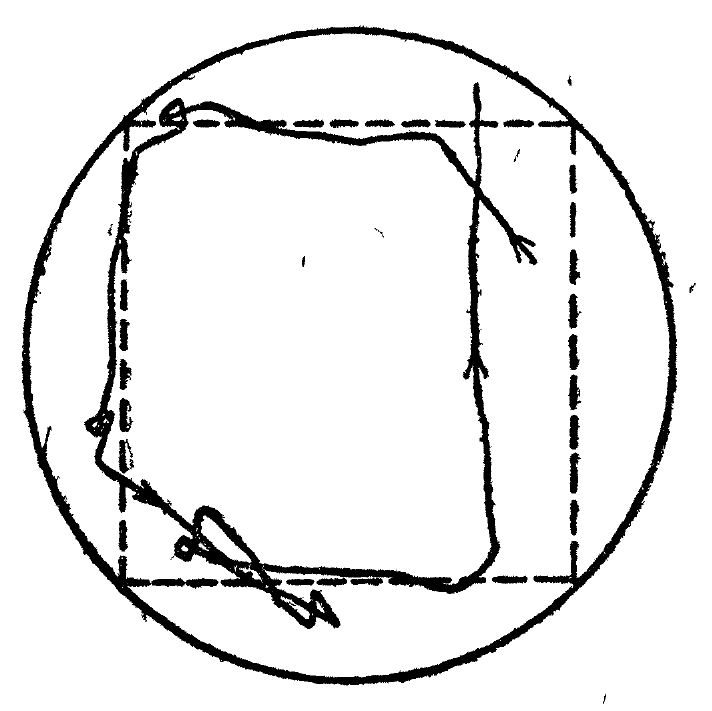
Figure 1. Course followed by a Paramecium after transfer from a square container to a circular container corresponding to the square’s circumscribed circle (after Bramstedt).
Subsequently Alverdes’s pupil Soest carried out training experiments similar to Bramstedt’s, using ciliates such as Paramecium, Stentor, Stylonchia and Spirostomum (11). First, punishment with direct-current electrical stimulation led Paramecium to avoid light; here too, however, the reverse training to avoid darkness was unsuccessful. He also used water at 25°C, the optimum temperature for Paramecium, and at the much colder temperature of 5°C. Attempts to associate darkness with cold or light with the optimum temperature failed, as did the reverse combinations of light with cold or darkness with the optimum temperature. At least a situation in which the dark place is cold and the light place is at the optimum temperature would seem natural to Paramecium. If training with this combination failed, Bramstedt’s view described above cannot be sound.
In Stylonchia, it was found that the roughness or smoothness of the floor does not necessarily serve as an unconditioned stimulus: this depends on the individual and on the degree of roughness or smoothness. Using suitably prepared floors, it was possible to train the animals to avoid the rough surface and move towards the smooth one, with current or vibration as the punishing stimulus. The reverse training, to avoid the smooth surface through vibration, was again unsuccessful. Soest simply ascribes this to an innate tendency of the animal, and his failure to pursue the matter further is unsatisfactory. Spirostomum could likewise be trained to avoid light by electrical or mechanical [4] stimulation, but successful training to avoid darkness was reportedly exceptional.
Finally, in Stentor, the experimental method differs between freely swimming and attached animals. In either case, however, it is reported that, after training in which weak light stimulation is paired with electrical stimulation, the animals come to respond by escape or contraction even to light too weak ordinarily to elicit a response. In the attached species Stentor polymorphus, training reportedly produced contraction both when light intensity was raised and when it was lowered. Soest also experimented on a species of rhabdocoel flatworm; I shall describe that work later.
Looking over the work of Bramstedt, Soest and others, the question that above all attracts our attention is why training so often succeeds in one direction and fails in the reverse. Paramecium, for instance, cannot be conditioned to avoid darkness with either temperature or electrical stimulation, and there are many similar examples among other protozoa. Before readily interpreting this as due to a situation unnatural to the animal, or to an innate tendency, I believe we must examine these experiments rigorously from every angle and ask whether they really are training experiments.
Koehler’s pupil Grabowski repeated Bramstedt’s experiments on Paramecium. He accepted that Bramstedt’s experimental results were broadly correct, but nevertheless concluded that experiments of this kind cannot demonstrate a capacity for learning (8). After one or two hours of “training” pairing light with warmth or darkness with coolness, Paramecium does, as Bramstedt observed, avoid light and remain in darkness even when the temperature difference is removed. With continued observation, however, the animals cease to turn back in response to the light–dark boundary. The boundary at which they turn back gradually advances into the light half of the drop, and after about an hour the time spent in the light and dark halves is approximately equal. This boundary moves with the outline of a diffusing substance, showing that Paramecium is responding to some chemical stimulus rather than to light.
Grabowski considers that the gas content of the warm half naturally decreases during “training”. Even after the temperature difference has been removed, Paramecium, while this chemical gradient persists, [5] responds to it and spends longer in the dark half. It merely appears to have been trained to light and darkness. As evidence, he reports removing the “trained” Paramecium at the end of the “training” period, or keeping the drop under “training” conditions from the outset without any Paramecium. When fresh individuals were introduced as the temperature difference was removed, they too avoided light and spent longer in darkness, despite having had no previous “training”.
If this view is correct, the failure of “training” pairing light with coolness or darkness with warmth would seem inexplicable. Grabowski, however, examined Bramstedt’s results and repeated the experiments himself, pointing out that such “training” does in fact slightly lengthen the time spent in the light. Moreover, observation of Paramecium with both the light and dark halves kept warm reveals a tendency to remain longer in the dark half. Raising the temperature may therefore bring out negative phototaxis [陰性走光性]. In any event, the conclusion is that Paramecium is merely behaving in immediate response to changes in environmental factors, and the experimenter is mistaken in treating this as the result of learning.
In Grabowski’s view, the claim that Paramecium recognises the shape and size of a space has likewise received no demonstration. Even individuals kept in a large container and never “trained” to a square sometimes follow a course like that in Figure 1 when transferred to a round container. Moreover, when a partition placed in a container is removed, Paramecium immediately moves along a course corresponding to the dimensions of the new space. He goes so far as to say that attributing spatial learning to Paramecium is merely a product of the experimenter’s imagination.
Faced with this severe attack by Grabowski, the Alverdes school scrambled to defend itself. At the congress of the German Zoological Society held in Rostock in the summer of 1939, Alverdes first gave a lecture defending his pupils. Bramstedt then presented subsequent research intended to refute Grabowski (2).
According to Bramstedt, water currents are constantly visible in the drop under training conditions, so a “chemical gradient” cannot be maintained. [6] After training, moreover, the points at which Paramecium turns back to avoid light are irregular; they do not move as a boundary line. Stirring a drop kept under training conditions with a glass needle to disturb the “chemical gradient”, or making the light–warm half dark and the dark–cool half light after training, leaves the result unchanged: Paramecium avoids light. Finally, introducing untrained Paramecium into a drop that has been kept under training conditions yields, contrary to Grabowski, approximately equal times in light and darkness. On spatial learning too, Bramstedt produced numerous records of movement courses and argued emphatically that Grabowski’s criticisms were unfounded.
Grabowski was absent from the Rostock congress, so Koehler took his place in a fierce debate with Alverdes, Bramstedt, Diebschlag and others. Koehler argued that, alongside chemical gradients, the sensitising action [増感作用] of the unconditioned stimulus deserved attention, and cited Sgonina’s research on this subject (10).*
Translator’s note *. 増感作用 is translated “sensitisation”: stimulation increases the animal’s responsiveness to a further stimulus. Honjo’s central question is whether an observed change requires an association between paired stimuli, or can arise from increased sensitivity alone. “Sensitising action” retains his emphasis on what the stimulus does. Return.
Sgonina observed that Paramecium in a capillary tube, stimulated every ten seconds with an induced current, came to collect in greater numbers in the dark half than in the light half. The number gathering in the dark half was also greater when current had first been passed through the water alone and Paramecium introduced afterwards. He further found that, after repeated vibratory stimulation, Paramecium likewise avoided light and gathered in greater numbers in darkness when the drop was subsequently divided into light and dark halves. Unconditioned stimuli such as current and vibration may thus be understood to increase sensitivity to light stimulation—a sensitising action—with negative phototaxis released as a result.
Alverdes and his colleagues maintained that there was no such sensitisation, and the Rostock congress finally ended with the two sides parting without agreement. Their experimental data actually disagree in quite a number of cases. Unless experiments are performed in the presence of both parties, as Koehler proposed, it would probably be impossible to declare either side the winner. Even so, a question such as spatial learning seems destined to end in an exchange of fruitless assertions.
Subsequently Diebschlag acknowledged that a chemical gradient forms when a high temperature of 50°C is used, but still maintained that under Bramstedt’s experimental conditions his [7] results were correct (4). The Alverdes–Koehler controversy, too, was engulfed by the war in Europe. We do not at present know what became of it, but I imagine the day when this problem is completely resolved is still far off.
One further point must be made here: even if a capacity for learning were recognised in Paramecium, this would have no bearing on the problem of learning in cells in general. It is common knowledge among zoologists that protozoa should not be regarded as equivalent to the cells of metazoa. Although made up of one cell, a protozoan is a supracellular being [超細胞的存在].* The problem of cellular learning must therefore be studied from an entirely different standpoint, apart from protozoa. What I now vaguely speculate is that it might be connected with the problems of immunity and allergy.
Translator’s note *. By “supracellular being”, Honjo stresses the organisation and activities of a complete organism within one cell. The term here supports his distinction between a whole protozoan and a constituent cell of a multicellular animal; it does not describe an organism made of several cells. Return.
Flatworms
In zoological classification, sponges and coelenterates follow the protozoa, but learning in these animals appears not yet to have been studied. In the flatworms, which come next, Soest, mentioned above, trained the lower rhabdocoel Stenostomum to avoid light, using electrical stimulation as punishment. Here too it was difficult to train the animals to avoid darkness. Soest interprets this as due to the animal’s negative phototaxis acting in opposition. In any case, the experimental results differ little from those for protozoa, so sensitisation and the other problems raised there arise here too. The capacity for learning in Stenostomum cannot be said to have been conclusively demonstrated.
In experiments on the polyclad Leptoplana, Hovey reportedly found that mechanical stimulation of the head could train the animal to avoid light, but that individuals without a brain lost this capacity for learning. Turning next to the triclads, Alverdes’s pupil Dilk carried out the following assortment of training experiments on planarians (5).
First, using vibration as the punishing stimulus, it was easy to train planarians to avoid rough or corrugated floors and remain on a smooth one; the reverse training, however, scarcely ever succeeded. Next, by suddenly illuminating the animals while applying vibratory stimulation, [8] it was possible to train them so that light alone elicited stopping or other responses. This failed when weak diffuse light was used. Yet when diffuse light was paired with vibration or current as the punishing stimulus, the animals could be trained to avoid a smooth surface in favour of a rough or corrugated one. Vibratory stimulation could also train them to avoid a vertical surface in favour of a horizontal one. Finally, training to avoid light, with current as punishment, succeeded; the reverse training to avoid darkness was again reportedly difficult.
Dilk concludes that training in the direction of increasing stimulation—rough surfaces, light, vertical surfaces and so forth—gives clearer results than training in the opposite direction. This is a wholly ad hoc and empty statement. He also says that, when two subthreshold stimuli are paired as a punishing stimulus, their combined action allows training in the reverse direction, towards weaker stimulation, to succeed. But why should the summation of two subthreshold stimuli make such an effective punishing stimulus?
Examination of Dilk’s experimental results raises various questions. In particular, it can be pointed out that he gives little consideration to sensitisation. According to Sgonina, mentioned above, sensitisation is in fact extremely pronounced in planarians too. In experiments using contact with a brush as the unconditioned stimulus and illumination as the conditioned stimulus, repeated presentation of either the unconditioned or the conditioned stimulus alone eventually produces stopping or contraction in response to illumination, just as pairing the two stimuli does. We must therefore say that the capacity for learning in planarians also remains in question.
Annelids
After the flatworms come the roundworms, trochophorate animals and so on, but these have received no study at all. Annelida is the phylum containing earthworms, leeches, polychaete worms and the like. For earthworms there are Yerkes’s famous experiments. Yerkes constructed a T-shaped maze like that in Figure 2. If an earthworm turned left, it encountered sandpaper, and if it tried to pass beyond this, it received an electric shock. After twenty to a hundred training trials in this apparatus, the worm reportedly always avoided the left and turned [9] right, a habit that persisted even after its head was cut off.
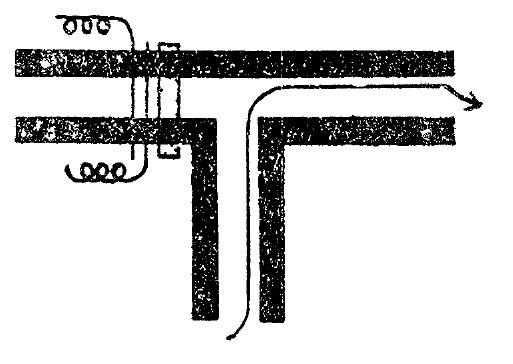
Figure 2. Maze experiment with an earthworm (after Yerkes).
Later Heck repeated Yerkes’s experiments and confirmed his results. After training a worm to turn right, however, he moved the sandpaper and electrodes to the right-hand side. The worm continued to turn right and did not stop even on touching the sandpaper. It was therefore clear that placing sandpaper before the electrodes served no purpose. Moreover, it was extremely difficult to retrain an individual trained to turn right so that it turned left. There is thus considerable doubt whether the earthworm had actually learnt the maze. Heck reports that individuals whose six anterior segments had been removed from the outset could also be trained. The acquisition of such a habit must therefore be of a lower order than learning, and should probably be explained as the expression of a neural process such as facilitation [疏通].* Indeed, as Figure 2 itself shows, the worm follows the right-hand wall from the beginning and displays no behaviour discriminating left from right.
Translator’s note *. 疏通 is rendered “facilitation” in the phrase “a neural process such as facilitation”. Honjo invokes an easier passage or activation along an existing response pathway as a possible explanation for habit acquisition. His “probably” and “such as” leave the precise process open. Return.
Recently Alverdes’s pupil Raabe has studied learning in the aquatic worm Lumbriculus (9). Lumbriculus habitually burrows head first into mud, leaving the tip of its tail slightly exposed. Using vibration, contact, current and the like as punishing stimuli, Raabe trained it to withdraw the tail tip in response to illumination or shadow. Again, training was much more successful with illumination than with shadow; Raabe explains this by the worm’s inherent tendency to prefer darkness. According to Raabe, the learning process depends on such conditions as the intensity, temporal separation and frequency of the conditioned and unconditioned stimuli, and cannot be explained by sensitisation alone. Removal of twelve to thirty-one anterior segments makes training difficult but still possible. By contrast, when thirty-two to forty-nine posterior segments are removed, training—at least to avoid light—is reportedly easier than in normal animals.
Such, in outline, are Raabe’s findings. I do not think they suffice to establish a capacity for learning in the worm. It has long been well known that responses to illumination and shadow are strengthened by stimuli such as vibration. If this summation of stimuli has a residual effect, it would be unsurprising for the animal to respond for a while to illumination or shadow alone. Raabe’s statement that training is easier in individuals originally sensitive to the conditioned stimulus [10] may indeed be taken to suggest that this is merely apparent learning.
Learning in leeches has not yet been studied, but Copeland has conclusively demonstrated a capacity for learning in polychaete worms. A worm housed in a glass tube extends to the mouth of the tube when given food. Copeland presented an illumination stimulus before giving food and repeated this twice daily. By the fifth day, illumination alone brought the worm to the tube’s mouth, clearly showing that an association had formed between illumination and food. A conditioned response [條件反應] to shadow was also readily established in the same way. There is thus no room for doubt that polychaete worms possess a capacity for learning.
The fact that learning can first be clearly demonstrated in polychaete worms is extremely interesting in relation to the internal morphology of the central nervous system. The corpora pedunculata, regarded as organs of association in higher arthropods, first appear in the brains of polychaete annelids. In this respect, morphology and function may be said to correspond very closely.*
Translator’s note *. Corpora pedunculata names the brain structures that Honjo describes here as organs of association. The Latin anatomical term is retained so that the particular structures remain identifiable. “First” follows the ordering of animal groups used in his survey. Return.
Echinoderms
In echinoderms the central nervous system is generally not very well developed, and the effectors—spines, pedicellariae, tube feet and so forth—show pronounced reflexes independent of it. Hence the view that their actions should be explained as the co-operation of reflexes, as in Uexküll’s name for them, a “republic of reflexes” [反射共和國]. On the other hand, as Preyer first observed, a starfish can escape skilfully even when pinned at the base of an arm, and this behaviour becomes faster with repeated experiments. Similar escape experiments have been carried out on brittle stars, and echinoderms are said to possess the capacity for such behaviour controlled as a whole. Alverdes’s pupil Diebschlag supported this latter view and went on to perform experiments intended to demonstrate learning in echinoderms (3).
Diebschlag trained starfish, brittle stars, sea urchins and others to discriminate rough from smooth floors, or light from darkness, by punishing them through stimulation with the pedicellariae of another starfish. Many points in his results are unclear, but he reports that [11] training often led them to turn back at boundaries between rough and smooth, or light and dark, which they had previously crossed without any response. Whether genuine associations formed in these cases is doubtful, however; Diebschlag too can be faulted for overlooking sensitisation. For instance, a starfish could be trained to avoid a rough floor in favour of a corrugated one, but the reverse training failed. Such cases suggest that the experimental methods used to study learning in echinoderms require examination just as those for protozoa do.
Molluscs
Among molluscs, squid and octopuses possess a highly centralised nervous system and well-developed sense organs such as the eyes. There is no doubt that their psychological capacities are comparable to those of lower vertebrates. The capacity for learning is in question among lower forms such as chitons, bivalves and gastropods, but there appears as yet to be no research on chitons or bivalves.
Gastropods are often used in maze experiments and are said to have a capacity for learning, but difficulties like those pointed out for earthworms may be present here too. From maze experiments with an aquatic gastropod called Ampullarna, Fischel maintains that its remembering the maze is not a matter of associating external stimuli: a habit of this kind has merely been formed on the basis of its own sense of movement (6).* Whether maze learning in gastropods belongs in the same category as that in earthworms remains a question for future research.
Translator’s note *. The source prints Ampullarna here and again in the following paragraph. Ampullaria is likely intended: Hediger’s contemporary account in Actas Ciba 1 (January 1937), p. 9 calls Fischel’s river snail Ampullaria, and a photograph credited to Fischel is captioned Ampullaria gigas. The printed spelling is retained. Fischel’s cited 1931 paper has not been inspected to establish its exact identification. Return.
Fischel also attached a tin plate part way up the wall of the vessel climbed by Ampullarna. Whenever the snail touched it, he stimulated the animal with a needle so that it fell. After about forty training trials, the snail sometimes avoided the plate and dropped merely upon touching it. Such responses gradually became more numerous, reportedly yielding a typical learning curve. Fischel says this too is not genuine learning. Since performance progressively improved during training lasting more than twenty days, however, it seems to me rather odd to withhold the name of learning from it.
In the foregoing I have attempted a general introduction to the principal recent studies of learning across all animal phyla, apart from vertebrates and arthropods, whose capacity for learning is undisputed. [12] Except for certain annelids and molluscs, whether the great majority of lower animals possess a capacity for learning remains an open question. Quite a number of animal groups have received no study at all. There is therefore much to expect from future research in this field.
On reviewing the research to date, I believe that experiments on learning in lower animals must give particular attention to the following points.
1. Keep the experimental conditions for learning simple. It is unsuitable, in lower animals whose very capacity for learning is at issue, to adopt methods used with higher animals without reflection and set complicated problems that can be solved through various cues. In this sense, maze and escape experiments are unsuitable. We must first investigate whether the simplest conditioned responses can be established. Here too, the simultaneous presentation of two or more unconditioned stimuli, or of two or more conditioned stimuli, should be avoided.
2. Use positive training [陽性訓練] as far as possible. Negative training [陰性訓練], in which the animal is punished by the unconditioned stimulus, is undesirable, just as it is in higher animals.* Of course, where feeding habits prevent the use of food as the unconditioned stimulus, as with ciliates and bivalves, this cannot be helped. Even then, training should as far as possible use an unconditioned stimulus that does not shock the animal.
Translator’s note *. “Positive” and “negative” follow Honjo’s contrast between training with food and training through punishment. His positive training is exemplified by the illumination–food pairing in the polychaete experiments; negative training includes the vibration and electric-shock procedures described in preceding sections. Return.
3. The conditioned stimulus must be unambiguous. It is unwise to use as a conditioned stimulus something to which the animal may respond unconditionally in certain circumstances. The conditioned stimulus must be one to which the animal clearly does not originally respond. If no such ideal stimulus can be found, I believe it is better not to press ahead with the training.
4. Carry out rigorous control experiments [對照實驗]. Even when a conditioned response appears to have been established, the training situation may affect the animal through sensitisation or other processes. Rigorous control experiments must therefore examine the situation from various angles. Where the results of the controls are doubtful, it is appropriate to attempt an explanation in terms of neural processes of a lower order than association.
Many studies by the Alverdes school neglect the points set out above, so it is natural that Koehler and his colleagues should have criticised them sharply. [13] Nevertheless, even if Koehler and his colleagues are right, the animals show responses that experimenters can mistake for conditioned responses. Perhaps somewhere here, then, lies a preliminary stage of learning.
References *
- Bramstedt, Fr. “Dressurversuche mit Paramecium caudatum und Stylonchia mytilus” [Training experiments with Paramecium caudatum and Stylonchia mytilus]. Z. verg. Physiol., 22 (1935).
- Bramstedt, Fr. “Über die Dressurfähigkeit der Ciliaten” [On the trainability of ciliates]. Verh. deutsch. zool. Gesells., 1939 (1939).
- Diebschlag, E. “Ganzheitliches Verhalten und Lernen bei Echinodermen” [Behaviour as a whole and learning in echinoderms]. Z. verg. Physiol., 25 (1938).
- Diebschlag, E. “Über die Lernfähigkeit von Paramecium caudatum” [On the capacity for learning in Paramecium caudatum]. Zool. Anz., 130 (1940).
- Dilk, F. “Ausbildung von Assoziationen bei Planaria gonocephala (Dugés)” [Formation of associations in Planaria gonocephala (Dugés)]. Z. verg. Physiol., 25 (1937).
- Fischel, W. “Dressurversuche an Schnecken” [Training experiments on snails]. Z. verg. Physiol., 15 (1931).
- French, J. W. “Trial and error learning in Paramecium.” J. exp. Psychol., 26 (1940).
- Grabowski, U. “Experimentelle Untersuchungen über das angebliche Lernvermögen von Paramecium” [Experimental investigations of the alleged capacity for learning in Paramecium]. Z. Tierpsychol., 2 (1939).*
Translator’s note *. In reference 8 the scan appears to print “vou” where German requires “von” (“of”). The title is presented with “von” as an editorial correction; the checked transcription preserves the printed form. The bibliography’s other details follow Honjo’s list, with line-wrap hyphenation removed. English bracketed titles are new translations. Return.
- Raabe, S. “Zur Analyse der Assoziationsbildung bei Lumbriculus variegatus Müll.” [Towards an analysis of association formation in Lumbriculus variegatus Müll.]. Z. verg. Physiol., 26 (1939).
- Sgonina, K. “Vergleichende Untersuchungen über die Sensibilisierung und den bedingten Reflex” [Comparative investigations of sensitisation and the conditioned reflex]. Z. Tierpsychol., 3 (1939).
- Soest, H. “Dressurversuche mit Ciliaten und rhabdocoelen Turbellarien” [Training experiments with ciliates and rhabdocoel turbellarians]. Z. verg. Physiol., 24 (1937).
(Manuscript received 16 January 1948.)
Author’s note *. Works from 1930 and earlier have been omitted. Return.
About this edition
本城 市次郎, “下等動物の學習”, 動物心理学年報 2 (1948), pp. 1–13. Complete English translation of the thirteen-page article, including both figures, all eleven references, the author’s bibliography note and received date.
English translation. Version 0.1, reading proof, 7 November 2026. The Japanese page images control the translation; a checked transcription preserves historical orthography. Translator’s notes explain contextual terms and textual decisions beside the relevant passages.
The author’s historical classifications and experimental assessments are retained. The printed genus spelling Ampullarna is preserved with a local note at its occurrence. The author-name reading Ichijiro Honjo is supported by Yoshizawa’s first-person account of the founding of the Japanese Photobiology Association, p. 2.
Original publication and Japanese source · Author-name evidence
Source heading and byline
Learning in Lower Animals
Article
Ichijiro Honjo [本城市次郎]
Department of Zoology, Kyoto University