Source: Insectes Sociaux 6, no. 1 (1959), pp. 41–80; legends pp. 81–83 and plates I–VII
Contents
Complete translated title: Nest Reconstruction and Coordination between Individuals in Bellicositermes natalensis and Cubitermes sp. The Theory of Stigmergy: An Attempt to Interpret the Behaviour of Termite Builders.
Contents of the original paper
Page numbers below refer to the original publication.
- I. Introduction, p. 41.
- II. Reconstruction by Cubitermes, p. 43:
- reconstruction proper, p. 43;
- behaviour in relation to the group, p. 46;
- individual behaviour, p. 49;
- activities other than reconstruction, p. 51.
- III. Reconstruction by Bellicositermes natalensis, p. 53.
- IV. The mechanism correlating individual tasks
and the purported regulation, p. 57:
- the phase of non-coordination, p. 57—
- A. The stimulating situation, p. 57;
- B. Uncoordinated activities, p. 59;
- C. The localisation of earth deposits, p. 60.
- The phase of coordination, p. 61—
- A. Critical earth-pellet density and the direction of behaviour, p. 61;
- B. Stigmergy and simultaneous stimulations, p. 62;
- C. The nature of the stimuli acting on builders: odour-forms, p. 66;
- D. The tendency towards unity, p. 67;
- E. The role of memory in construction, p. 67;
- F. An attempt at synthesis, p. 68.
- the phase of non-coordination, p. 57—
- V. Termite behaviour compared with that of solitary animals, p. 73.
- VI. Fundamental characteristics of social-insect behaviour, p. 76.
- VII. Authors cited, p. 80.
- Legends to plates I–VII, p. 81.
I. Introduction
[41] Many termites build nests of earth or faecal carton. Some raise their structures above ground; others leave them buried in the depths.
Some of their constructions pass through a succession of stages corresponding to the colony’s degree of development. This is the case with Bellicositermes natalensis, Acanthotermes acanthothorax and probably many others (Grassé and Noirot, 1951 c).
[42] Apparently, a structure as complex and at the same time as unified as the nest of most termites must require, for its completion, collective behaviour governed by definite rules to which individuals must conform.
How, then, are individual tasks coordinated so as to produce a coherent, unified structure, approximately constant in its shape and volume?
In a memoir published in 1940,* which went unnoticed owing to the difficulties of the time, I posed the problem and reported the results of an initial analysis, conducted by inducing a population of workers and a royal pair to reconstruct their nest.
* Translator’s note. “1940” is printed here. The later discussion and the bibliography date Grassé’s earlier nest-reconstruction memoir to 1939. The discrepancy is retained.
In the present work I offer further results and propose a new explanation of social coordination during the work performed by the workers. Drawing on the facts revealed by experiment, I also propose a general interpretation of the behaviour of social insects, endeavouring to bring out its fundamental characteristics.
The observations and experiments were made during a research expedition to equatorial Africa, financed by the Fondation Singer-Polignac, to which I express my warm and sincere gratitude.
The experiments reported here were carried out in premises kindly placed at my disposal by the Institute for Research into Cotton and Textiles at Bambari (Oubangui).
Termites, normally light-shunning and sensitive to the slightest mechanical disturbance, are difficult to observe. In nature, except under rare and fortunate circumstances, it is difficult to follow and analyse their building behaviour.
But if a group of workers is taken out of the nest and placed in a closed enclosure supplied with building materials, after a longer or shorter interval, during which the animals adapt to their new conditions and overcome the disturbance caused by a sudden change of environment, they begin work and build a nest that restores conditions resembling those of their natural habitat.
Our first experiments, in the Ivory Coast, concerned two species with a very corpulent queen incapable of moving: Cephalotermes rectangularis and Bellicositermes natalensis. Their respective building materials are faecal mortar and clayey earth, or even pure clay.
Our new investigations in Oubangui again concerned the Natal termite and a Cubitermes with a mushroom-shaped nest, whose species we did not identify precisely.
The queen of Cubitermes, whose abdomen is less enlarged by physogastry† than that of Bellicositermes, retains enough mobility to pass from one point in the nest [43] to another. No particular chamber is reserved for her exclusive use, unlike the arrangement in the nests of Cephalotermes and Bellicositermes.
† Translator’s note. Physogastry refers here to the greatly enlarged abdomen of the reproductive queen. The difference in degree matters to these experiments: the Cubitermes queen remains mobile, while the Bellicositermes queen stays in one place.
II. Reconstruction by Cubitermes
1. Reconstruction proper
We shall first examine nest reconstruction by Cubitermes. To establish the facts precisely, we shall describe one of our experiments as a point of reference.
7.20 a.m. 350 workers, 3 soldiers, a few larvae at various stages of development and a very agile queen are introduced into a Petri dish with an internal diameter of 19 cm and a height of 3.5 cm. The bottom is covered with a layer of humus between 3 and 5 mm thick. The dish is closed with its transparent lid; observation takes place in dim light. The carefully conducted change of residence has not greatly disturbed the insects, which frequently rock their bodies vigorously. A few minutes after being introduced into the Petri dish they dig short galleries in the humus, but this work is soon interrupted.
7.32 a.m. A few workers stick earth pellets to the vertical glass wall; they place them as high as they can, standing on their hind legs. Some climb on clods of earth, as though to attach their pellet as high as possible. This behaviour arranges the pellets in an approximately horizontal line, or, more precisely, along a line parallel to the surface of the humus and reproducing its irregularities. A few pellets are nevertheless deposited below the general line.
The number at work is small, no more than a few dozen individuals. The other workers frequently lick one another. The queen strongly attracts the Cubitermes in her vicinity. Several perch on her back and are carried along; others lick her vigorously. Licking of the anogenital region is often interrupted, and individuals that have performed it become the object of trophallactic solicitations from their fellows.*
* Translator’s note. Trophallaxis is the exchange of liquid between individuals. Grassé describes the mouth-to-mouth transfer of a drop in detail on p. 52, distinguishing it from licking.
7.38 a.m. The workers continue their task: each carries its earth pellet apparently without concern for its neighbours. At this point no coordination between individual tasks is evident. Pellets are only exceptionally placed side by side, and seemingly by chance.
7.43 a.m. The first deposits of pellets on upright clods of earth, at varying distances from the glass wall, are now observed. They gave me the impression of being made at random; the worker places, or tries to place, its pellet at the very summit of the clod.
[44] Several pellets may be deposited on the same clod. Because the workers tend to place them as high as possible, they accumulate one above another and very quickly form an upright pillar.
The pillars constitute centres of attraction for the workers, at least for a time. Their attraction is not very strong, however, since workers unload their pellet on clods near the pillars and do not return to them.
8.08 a.m. In the case described here, work is particularly substantial on the side of the dish facing the light. On the vertical glass wall, the workers continue sticking pellets that trace an almost continuous horizontal line. It is then that workers, starting from this line, construct a sheet of pellets approximately perpendicular to the vertical plane of the glass wall.
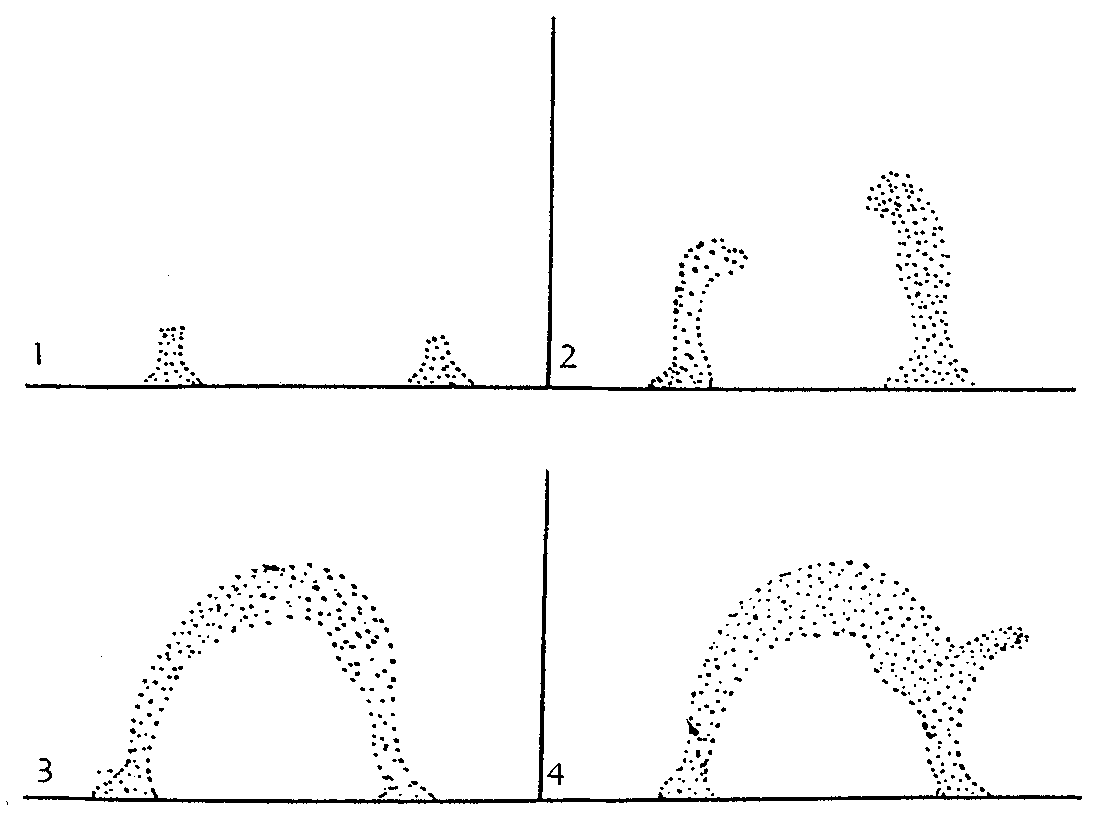
Once the pillars reach a height of 3–4 mm, they are extended at the top by a sheet or leaf of roughly conical shape; in miniature they resemble an umbrella turned inside out by the wind. From the cone’s upper rim, sheets of pellets extend in an approximately horizontal direction.
As I previously described for Bellicositermes and Cephalotermes, sheets extending from neighbouring pillars grow towards one another, join precisely and form an arch or vault (fig. 1). The horizontal sheets extending from pillars similarly meet the sheets attached to the vertical glass wall. In this way a covered area of very irregular shape is formed.
As construction progresses, the number of workers increases and individual activity rises. In the same interval [45] (4–5 minutes), the number of pellets transported by a given worker rises from 3 to 5.
Everything happens as though the masonry already completed, that is, an accumulation of earth pellets soaked in saliva, itself constituted a stimulus that both releases the workers’ responses and directs them in a particular way.
8.53 a.m. Work on the side away from the light is substantial but very poorly executed. Several pillars have been erected, but the sheets or branches extending from their summits fall as a result of clumsy manoeuvres by the builders. The proportion of workers at work keeps increasing.
Some workers, without hesitation, place their pellet on the edge of an opening between two sheets, or at the tip of a connecting branch.
9.25 a.m. Thus far the queen has not acted upon the Cubitermes as a stimulus to build in a particular way. At 9.25, however, she becomes stationary. Workers then build feverishly on either side of her body, using the neighbouring clods directly to erect pillars.
9.35 a.m. Numerous workers erect pillars here and there towards the central region of the Petri dish. Their activity is very uncoordinated, and they abandon tasks they have begun.
9.40 a.m. The queen resumes her disorderly wanderings, escorted by several workers, some perched on her back. She moves away from the construction site, but construction does not stop and continues at the same pace.
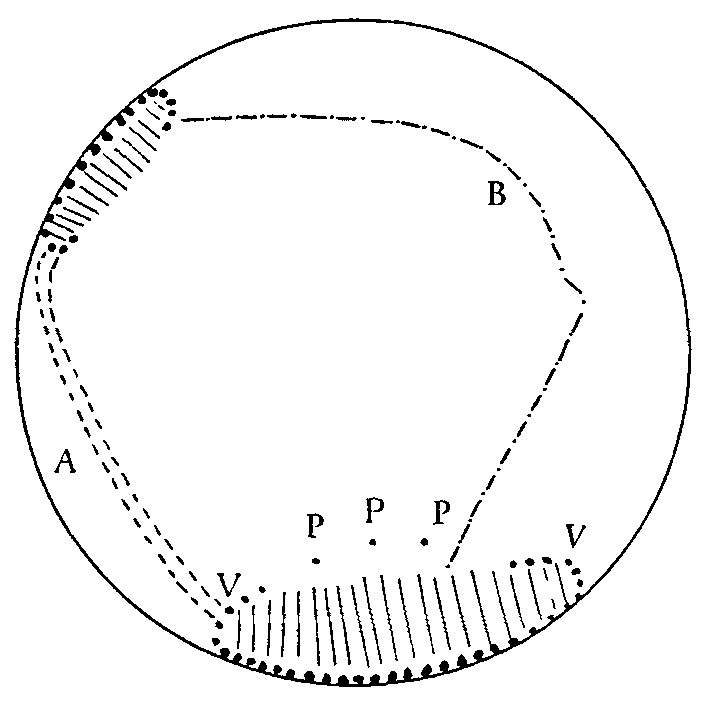
A new kind of activity now appears. Numerous workers “trot” over the surface of the humus. They arrange themselves one behind another in single file (compare the Bellicositermes carousel), always following the same trail, which describes roughly two-thirds of a circle, starting from the northern worksite (the light-facing side) and ending to the south-west at a site with little activity. Traffic moves in both directions (see also figure 3, which concerns another group of workers).
9.45 a.m. Building activity becomes increasingly intense, and the number of workers at work has greatly increased: it now exceeds the number of idle individuals.
Even at this hour some individual behaviour still displays indecision. A few workers holding an earth pellet in their mouths raise their heads and move them in every direction, as though exploring the surrounding air. They then move about, go from one pillar to another, hesitate and finally stick their pellet to the top of a pillar.
11.40 a.m. The northern part of the Petri dish is completely roofed over. The trail is bordered by pillars; construction continues actively along its sides.
2.30 p.m. Work has almost completely stopped. The trail [46] is now roofed over for a length of 8 cm from the northern construction.
Reconstructions were followed for several days. As the nest is built, cohesion between its various parts increases. It tends to become a whole. First, broad covered galleries connect constructions that were initially separate; then cells are built on the roofs of the different constructions and between them. Growing in thickness and area, the nest finally forms a perfectly unified whole.
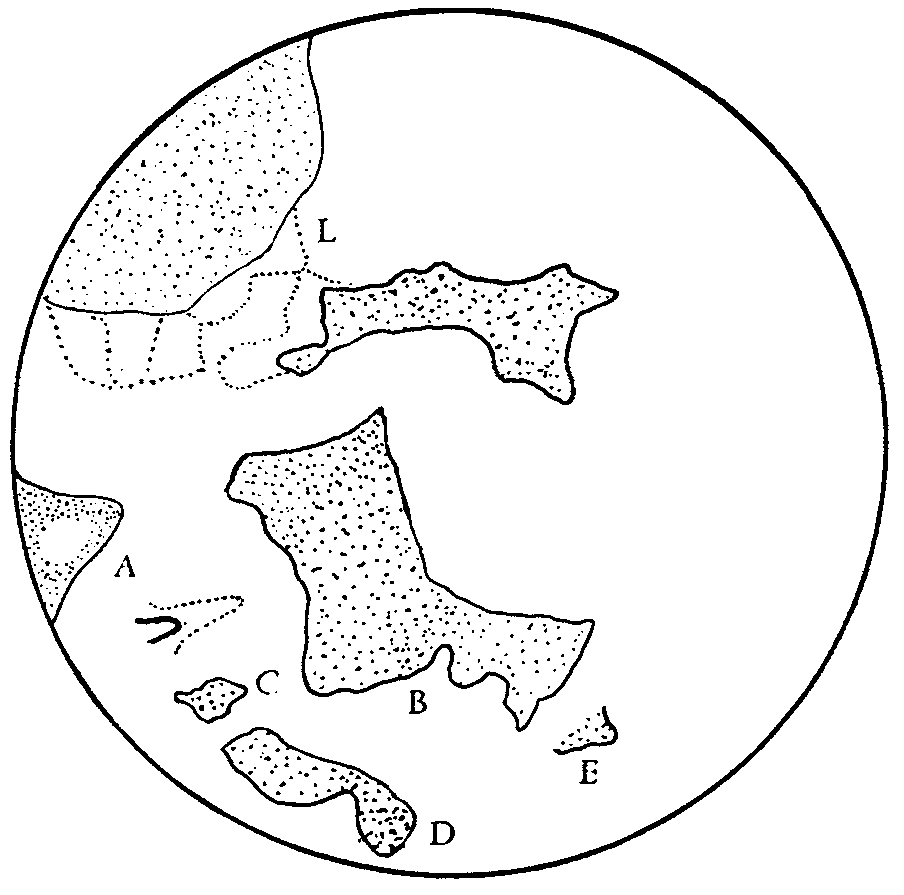
The initial structures [ébauches] become completely united in large populations; in small ones their union may remain partial. Some initial structures are then abandoned and remain outside the nest, which incorporates only one group of them (fig. 2). Apart from this, however, unity is ultimately achieved: the colony is one, and a single nest shelters all the individuals placed in the container.
Once the unity of the nest is established, the Cubitermes clear and excavate their passageways until they reach the glass bottom. They strengthen their constructions, though to a lesser degree than Bellicositermes.
2. Behaviour in relation to the group
Not all the termites introduced into the Petri dish immediately take part in construction; the proportion of builders is smaller in Cubitermes than in Bellicositermes. Activity varies from one colony to another. One nest of our Cubitermes far surpassed the others in its eagerness to work.
[47] As the construction takes shape, the number of workers engaged increases, and everyone’s activity grows. A “contagion of work” is undeniable. This is a very marked group effect [effet de groupe],* akin to the social facilitation mentioned by many authors in connection with various activities.
* Translator’s note. The group effect concerns changes associated with the presence and number of companions. Stigmergy, developed later in the paper, identifies stimulation by the material work itself. Grassé connects these effects while keeping their mechanisms distinct.
How does number condition work? To find out, we placed groups of Cubitermes workers in small Petri dishes whose bottoms were covered with a layer of humus. These groups comprised 2, 5 or 10 workers selected at random, but in perfect health. They generally became active much later than groups numbering a few hundred individuals, and their work was slow.
Six and a half hours after introduction into the Petri dish, the group of 10 individuals had begun a small sheet attached to the wall. After the same interval, the group of 5 had merely stuck pellets to the vertical wall; the group of 2 had done likewise, but with fewer pellets.
After fourteen hours, the group of 10 had built a short horizontal sheet of earth extending from the line of pellets stuck to the glass wall. After the same time, the groups of 5 and 2 individuals had done nothing further; the insects remained in contact with one another (a thigmotropic response).
Thirty-nine hours after the start of the experiment, the group of 10 had slightly enlarged the horizontal sheet, partly joining it to the glass lid.
The groups of 2 had not stuck any new earth pellets to the wall of the dish, but the workers were seen digging holes in the humus. The groups of 5 had built nothing, although the number of pellets stuck to the wall had increased slightly; they had, however, dug several shafts along the glass wall and a short gallery extending from the bottom of the shafts.
Thus all the workers placed in the dishes displayed some building activity. The groups of 2 and 5 merely stuck earth pellets to the vertical walls of the Petri dish; the groups of 10 began a horizontal sheet attached to a line of pellets deposited on the vertical wall. In all these small groups, activity was intermittent and disorderly; between depositing pellets, the workers attempted to dig.
Various trials showed us that a group of at least 50 individuals succeeds in producing a coherent nest; below that number, the work is begun but does not reach completion, stopping part-way through. It does not seem that small groups fail because their capacity for work is too low. Their failure results from insufficient social stimulation: the insects become apathetic and gradually work only from time to time; the discontinuity of their tasks is accompanied by a decline in the incitement to act.
[48] An isolated termite can bore a gallery and deposit a few earth pellets, but does not build, for reasons explained below.
Groups of 100 workers, even without queens, proved perfectly capable of rebuilding a unified nest (fig. 3).
One fact struck us forcibly: at the beginning of construction, the number of workers not actively participating is high, ranging from a quarter to half the population. We can thus be certain that workers do not all have the same capacity to respond to the new situation in which they find themselves.
Why do these workers fail to take part? Recalling the behavioural phases described by Deleurance in Polistes (1957), one might readily imagine that these individuals are not in a phase of building behaviour. Such an explanation is mistaken.
In fact, an individual that spends half an hour wandering over the bottom of the Petri dish, grooming its antennae, making trophallactic approaches to its fellows, and so on, eventually joins the construction and builds normally. These appear to be individuals less sensitive than the others to peripheral stimulation.
The stimulating action of the working group upon the individual is evident. We observe:
- That the number at work increases as construction advances;
- That individual activity increases all the more as the number working grows.
Group effect, social stimulation? Call it what you will.
At the start of the experiments, the most active group is also the most numerous. Here again everything seems to depend on the stimulation caused by the kneaded earth pellets. In populous groups, a large number of pellets is deposited from the outset; stimulation of workers and non-workers is correspondingly stronger, and the incitement to build correspondingly more effective.
3. Individual behaviour
[49] Close observation of marked individuals revealed interesting facts about the sequence of their actions. Here are some notes from our experimental notebook. A worker is marked with a small spot of colour at 8.50 a.m.; contact with the paint excites it, producing disorderly movements and running in every direction. Three minutes later, however, at 8.53, it has calmed down and is licking one of its fellows.
At 8.54 it begins digging in a hole begun and abandoned by other workers. With earth taken from the bottom it kneads pellets, which it deposits here and there around the opening, separately rather than one on top of another.
At 8.57 it leaves the hole and encounters another worker, whose head and antennae it licks. It then wanders for a minute and resumes digging in another cavity, where six workers are already at work.
At 9.01 it leaves the hole carrying an earth pellet in its mouth. It wanders for about twenty seconds and sticks its pellet to the vertical glass wall. For several minutes it walks here and there, attempting to dig into the humus at various points.
At 9.09 it joins a group digging and building near the glass wall.
At 9.11 it takes a pellet and deposits it far from the worksite, at the diametrically opposite end of the Petri dish.
At 9.13 and 9.16 there are two bouts of mutual licking with its fellows.
At 9.17 it joins the main worksite, which has developed while our worker was behaving as just described. For ten minutes* it remains there, moving little: it digs, takes earth and deposits its pellets on an approximately horizontal sheet attached to the vertical wall of the Petri dish.
* Translator’s note. The printed account gives arrival at 9.17, a stay of ten minutes and departure at 9.23. Those times span six minutes. The source does not establish which figure is in error; all three readings are retained.
At 9.23 it leaves the worksite and deposits its pellet far away. After about ten minutes of disorderly activity, it rejoins the site and works there until 9.46. It then leaves the group and returns after making a circuit of the dish. At this point it begins a long bout of licking with companions that have stopped working at the site and are licking one another.
This observation, confirmed in its main outlines by others, shows:
- That the worker’s activities at the beginning of reconstruction are extremely disconnected and varied;
- That the worker joins a working group only temporarily;
- That it is capable of several tasks: excavation and building;
- That exploration and licking remain important activities;
- That pauses, during which the individual is motionless, divide its activity [50] into stretches of unequal duration. A worker building at a site with several others may, after depositing its pellet, remain motionless, often for many minutes, at the worksite itself, while its companions continue moving around it. Walking, like work, is interrupted by periods of rest of varying duration: 2, 5 or 8 minutes;
- That initially the worker’s activity is entirely undirected and has all the characteristics of an unoriented response to a sum of stimuli (a stimulating situation [situation stimulante]) associated with the change in environment and social conditions.
Observation of individual animals enabled us to establish that the builders do not work in teams with a definite and stable membership. A group building at a particular site (3 or 4 pillars, a sheet of earth, for example) is not stable: it accepts any newcomer that deposits its burden. Usually a worker returns several times to the same workplace, but after a while leaves and goes to build or dig elsewhere. In our view, this is one of reconstruction’s most characteristic features. At first sight, such a degree of individual freedom might appear incompatible with coordination of individual tasks. Yet it is not, since the nest is ultimately successful and has a unified structure. We believe we can offer a satisfactory explanation.
Excavation is an activity in its own right; that is, it is not exclusively associated with obtaining building materials. Workers are often seen digging a gallery without using the excavated material for building.
Behaviour varies in detail from one individual to another. Here are some of the variations we observed.
Workers take up materials with their mandibles, but roll and grind them for a variable time between their mouthparts, sometimes drawing them deep into the cibarium. The kneaded pellets are extremely adhesive: the slightest contact between them produces a relatively strong bond.
When depositing material at a worksite, the worker does not always behave in the same way. Most often it simply inserts the pellet between those already in place, or sticks it to them. At other times it presses its pellet firmly against the part already built, swinging its head from right to left and back again.
The materials of a pillar, partition or sheet are often taken up again by a worker, which then seizes not one pellet but a mass of 4, 5 or 6, together much larger than its own head. Such work appeared to us generally to make the constructed part more regular.
A worker that has just deposited a pellet does not always leave immediately to fetch another. It remains at the worksite, here smoothing a stretch of wall or the shaft of a pillar, there pulling off a pellet and [51] depositing it elsewhere. Sometimes, having disposed of its mortar, it brings pellets together and tidies the neighbouring material.
Although workers generally show some hesitation in choosing where to deposit their mortar, it is not uncommon to see one insert its pellet straight away into a space left within a construction, without probing and without touching the masonry with its antennae.
In general, workers do not carry much material over long distances. To analyse their work more precisely, we supplied materials of different colours (red and ochre clays, whitish micaceous kaolinite, black humus). Materials of each colour are used almost where they lie. Mixtures are rather rare and small in amount. Red clay was especially favoured by the builders.
Cubitermes, humus-eating termites, possess a long, capacious hindgut full of fluid faecal paste, which they use as building material. From time to time a worker, whether or not it has just been building, turns halfway round, brings the tip of its abdomen close to the summit of a pillar or the edge of a sheet under construction, and exudes from its anus a drop of faecal paste, which becomes incorporated into the structure just like an earth pellet soaked in saliva. Cubitermes use faecal matter dexterously.
The precision of their behaviour suggests that the posterior tip of the abdomen bears touch receptors and perhaps chemoreceptors, which inform the insect and automatically guide its actions.
4. Activities other than reconstruction
The workers’ antennae move continually, without necessarily touching surrounding objects. The amplitude and rhythm of their movements vary: amplitude increases and rhythm accelerates during periods of intense work.
Licking between individuals is common. Workers and final-instar nymphs engage in it. Soldiers were seen being licked by their companions; we did not observe them licking another individual. They appear to have lost this behaviour along with many others. Final-instar nymphs were several times observed licking one another.
A worker leaving a worksite meets a companion and rubs its antennae. The companion responds with the same touches. Licking generally begins after this preamble, after contact has been established through the antennae (plates I and II).
Very often licking involves groups of three or even five individuals rather than a pair (fig. 3, plate II). Generally [52] one individual is passive, allowing itself to be licked. Less frequently, licking is mutual.
Trophallactic exchanges continue even at the height of construction. Two workers position themselves face to face, their mouths approximately at right angles to one another and their mouthparts deeply interlocking. A large drop of clear liquid can be seen emerging between one’s mandibles and being sucked up by the other (plates I and II). This posture differs from that adopted by individuals licking each other’s mouthparts. Workers that have licked the queen’s anovulvar region receive trophallactic solicitations from companions they encounter during their wanderings. Sometimes four or five workers solicit saliva from one that has licked the queen; naturally it cannot satisfy all of them at once.
Final-instar nymphs lick one another and sometimes carry a younger larva between their mandibles. They are much less active than the workers. I have never seen them building or digging.
From time to time, the workers feed larvae a drop of saliva directly mouth to mouth (fig. 1, plate I, trl).
The queen remains attractive to the workers even while construction is in full swing. When she moves, several workers escort her, some perched on her back. The individuals following her are not always the same: here, as at the worksites, the group’s membership varies with the workers’ arrivals and departures (plates I and II).
Although the queen’s anovulvar region is the most attractive, it is not the only part licked: the entire body, head and mouthparts are licked very frequently and vigorously.
As construction progresses, workers continue attending the queen, who lays eggs at regular intervals. An egg takes a few tens of seconds to emerge from the vulva. Sometimes a worker seizes it between its mandibles before it is completely free; sometimes the released egg adheres to the edge of the genital opening, remaining there for twenty to thirty seconds before being removed by the first worker to come into contact with it. Workers only a few millimetres away had not reacted to its emergence. The worker pushes the egg deep into its oral cavity, so deep that it often appears to swallow it. It turns it over and over in its mouth for almost a minute, then moves away from the queen and deposits the egg in a small cavity in the ground. The walk with the egg in its mouth quite often lasts several minutes.
Dead nestmates are sometimes eaten while construction continues. In fact, this cannibalism is unsurprising except in its timing, since it is common practice. As I have written in earlier publications, every healthy termite colony normally eats its dead: to waste nothing is the rule of the termite nest.
III. Reconstruction by Bellicositermes natalensis
[53] We repeated the experiment of nest reconstruction in the presence of the queen with Bellicositermes natalensis.
A large queen (9 cm long), accompanied by the inhabitants of two royal cells,1 is introduced into a Petri dish 25 cm in diameter and 4 cm high. The population consists of several hundred small workers, a few hundred large workers, several dozen small soldiers and the queen. It numbers more than 1,200 individuals in all.
1. Mixed populations of Natal termites show no hostility towards one another. The queen is instantly “adopted” by all the workers present. There is no intraspecific incompatibility. Tolerance ceases when individuals of different species are involved. Fighting to the death is the rule: thus workers and soldiers of Microcerotermes parvus, whose nest extended into the base of the “mushroom” of one of our Cubitermes nests, were mercilessly killed by the latter’s workers whenever they were brought together.
The insects have several heaps of almost soft clay and fragments of fungus comb at their disposal; a pad of absorbent cotton wool soaked in water keeps the humidity high. The Petri dish is closed with its lid.
10.10 a.m. The colony is installed. Intense disturbance, manifested in disorderly agitation, lasts about twenty minutes, then gradually subsides.
10.50 a.m. Seventeen pillars are arranged in an ellipse around the queen. From the upper edge of a heap of clay situated to the left and in front of the queen, a large group of workers begins building a sheet (placard) of clay2 extending backwards, parallel to her left flank. This sheet is about 3 or 4 mm above the ground and parallel to it. Photograph 6, Plate III, was taken at 11.28 a.m.
2. This placard is a sheet made of clay pellets, of the same type as that built by Bellicositermes workers around the pieces of wood they gnaw.
11.34 a.m. The first pillar erected near the queen is extended at its summit by an oblique sheet turned towards her. On the right, matching the construction on the left and starting from the heap of clay, a built sheet roughly follows the queen’s front outline and at this moment measures 35 mm in length. From its free edge, workers lean towards the queen, rise on their middle and hind legs and manage to touch her with their mouthparts.
11.39 a.m. From almost all the pillars arranged around the queen, small sheets or beams of clay pellets extend towards the enormous female.
At the same time, a construction site with 600 to 700 excited workers has opened directly above the heap of clay, which [54] will be covered with a sheet of clay in less than an hour. As the heap is in contact with the vertical wall of the container, the pellets deposited in a line on that wall have served as the starting point for the covering sheet.
11.46 a.m. The spans and sheets extending from the pillars have already grown considerably, while no worker is attending to the pillars distant from the queen’s head. During the work, workers almost constantly lick the queen’s anovulvar region avidly; a slightly opalescent liquid seeps from the anus. But the same individuals do not always perform this task: one of them, on leaving it, takes an earth pellet and deposits it on a pillar.
The queen increasingly attracts the workers at work around her. Photograph 7, Plate III, was taken at 12.02 p.m.*
* Translator’s note. The text prints “photograph 17, Plate III”. Plate III contains photographs 6 and 7; photograph 7’s legend gives 1 hour 52 minutes after the 10.10 a.m. start, agreeing with 12.02 p.m. The reference is therefore corrected to photograph 7.
12.12 p.m. Construction continues at the same rapid pace. The covering sheet on the left has advanced considerably towards the rear. Standing on their legs, sometimes on the hind legs alone, workers reach from the tops of the walls towards the queen, licking her or touching her with their antennae.
On several pillars a single worker is at work, always placing its pellets towards the queen (double stimulation; see p. 59).
From this moment, the eggs are removed as they emerge from the vulva and do not stick together. As before, workers lick the queen’s posterior extremity, but no trophallactic exchange is observed.
1.35 p.m. Pillars 5 and 6, to the queen’s left, have been united by two lateral arches extending from their summits; filling of the space bounded by the two upright pillars and the two arches has not yet begun. An oblique sheet of clay extends from the inner side of the arches.
A new pillar is erected 1.5 cm from the queen’s posterior extremity. Workers on the edges of the clay sheets near the queen, even when unable to lick her, touch her for a long time with their antennae. Photograph 8, Plate IV, was taken at 1.33 p.m.
1.40 p.m. Building activity increases and becomes feverish. The ellipse of pillars is almost complete. Between it and a heap of clay behind the queen, workers erect a pillar on the left and another on the right: the first beginnings of a corridor that will connect the royal cell to the construction on the heap of plastic material.
1.48 p.m. The pillars on the left side of the royal cell, joined by a sheet of clay, are reinforced externally by five buttress-like structures. The last posterior pillar on the right, which had collapsed under the weight of the builders, is rebuilt; a lateral arch and an arch turned towards the queen extend from it. All the pillars on the right are joined in their turn by a low continuous wall. Workers constantly cling to the edge of this wall, many upside down, as though gauging the distance separating it from the queen.
[55] The royal cell, now well begun, is connected at front and rear to the “chambers” built on the heaps of plastic material by corridors leading into them. From this moment, above the clay sheets or placards covering these heaps, workers begin building cells, placing pillars here and there that widen towards their summits. Upright sheets forming partitions and oblique sheets forming ceilings will later extend from them.
1.55 p.m. Only four isolated pillars remain within the elliptical enclosure, behind and to the right of the queen. The fragments of fungus comb are beginning to be covered by a sheet of clay and thus tend to become incorporated into the new nest.
1.58 p.m. The corridor from the royal cell to the southern construction rises over the heap of material. Two pairs of pillars mark its course and are incorporated into a wall that is continuous at the sides and slopes inwards at the top.
At this point only small workers are seen at work. Several builders of the royal cell lean towards the queen; some fall onto her, fail to hold on and roll to the ground. They lick her frantically. The gauging posture very probably expresses an attempt to reach and lick the queen. One has the impression that the workers are then subject to conflicting stimulations: one impelling them to build, the other to lick the queen.
2.04 p.m. A small pillar is added beside the rearmost pillar on the left. The queen’s head and the anterior part of her abdomen are now hidden by the roof.
2.08 p.m. Ten workers are working simultaneously on the crest of the royal-cell wall and on the rear connecting corridor.
2.40 p.m. The wall of the cell, continuous with that of this corridor, supports a ceiling that already covers the queen’s posterior tip. The wall on the right and rear side of the royal cell still has gaps between the pillars. Workers are enlarging the ceiling to cover the queen. Several walk over her back, on which five clay pellets have been deposited. Photograph 9, Plate IV, was taken at exactly 2.40 p.m.
2.46 p.m. Four of the five pellets are removed. Workers build the cell’s roof from inside, rather than outside; several are in a “gauging” posture.
The space that remained open between the royal-cell wall on the left and the first pillar of the rear connecting corridor is filled by a vertical partition whose initial structure was a cord of pellets laid directly on the ground. The five buttresses against the left wall are partly covered and help delimit small cells.
2.50 p.m. The wall on the left is continuous between the cell and the rear corridor. A construction resting directly on the glass bottom unites the rightmost fungus comb with a “patch” of [56] plastic material from a natural nest of Bellicositermes natalensis.
The fungus combs are increasingly covered.
2.53 p.m. The leftmost clay “patch” becomes the starting point for a new construction.
3.18 p.m. Construction continues at an increasingly rapid pace. The left lip of the opening in the royal-cell roof advances much faster than the right. Only two gaps remain in the cell’s enclosing wall, one towards the front, the other to the queen’s right rear. On either side of the latter, workers erect two remarkably tall pillars. Photograph 10, Plate V, was taken at 3.25 p.m.
4.10 p.m. The rear connecting corridor is completely continuous with the royal cell. The left lip of the opening in the cell’s roof coincides with the queen’s mid-dorsal line. The right lip is less advanced. Only the queen’s posterior dorsal region remains uncovered. A wide gap persists between the two right rear pillars; however, the closing wall is beginning on their sides.
At this stage workers are already erecting pillars on the royal-cell ceiling: three towards the front, two on the mid-dorsal line, one at the junction of the cell and rear corridor, one large pillar on the right side (in front of the gap), and three small ones on the left buttresses.
Several workers are occupied in erecting numerous pillars on the sheets covering the building materials; this anticipates the construction of a first storey of cells resting on the ground-floor ceiling. Photograph 11, Plate V, was taken at 4.40 p.m.
6.23 p.m. The queen is entirely hidden from view. The pillars erected on the royal-cell roof widen at their summits into cups or craters and delimit the future cells. On the heaps of material, the first storey of cells is almost finished. Photograph 12, Plate VI, was taken at precisely 6.23 p.m.
The most important fact is that all the constructions, originally separate, are now united by a broad covered gallery running alongside the pad of absorbent cotton wool and the right edge of the filter paper, and ending at a broad cellular sheet applied to the glass bottom and continuous with the fragments of fungus comb.
The restoration of a unified nest and colony has taken no more than eight hours.
11.35 p.m. Cellular construction has advanced considerably. The pillars on the royal cell have become sheets curved into shells. Some neighbouring pillars meet through their sheets, forming perfect semicircular arches. Junctions between spans or shells form before our eyes. They are very numerous and admirably distinct.
Covering of the glass walls with clay pellets is well under way. Above the heaps of clay, on the underside of the Petri-dish lid, pellets lie almost side by side and form a continuous coating.
[57] During the night the activity of the Bellicositermes has not slackened. Towards daybreak the sheets erected above the royal cell, starting from its arches, are in places 3 cm high. Tall pillars rise almost everywhere; some reach the dish’s lid. Only the part of the glass bottom on the extreme left is still free of construction.
During the following hours the workers have chiefly occupied themselves with strengthening their building by substantial additions of clay pellets. The royal-cell wall is well over 1 mm thick and has been made homogeneous; the pellets, pressed together and smoothed by the workers’ mouthparts (hypopharynx), no longer appear clearly separate.
IV. The mechanism correlating individual tasks and the purported regulation
In 1939 I wrote of reconstruction: “A particular olfactory sensation perceived may correspond to a particular directed reaction: for example, depositing mortar at a specific point, or extending a partition to reach another partition. We should then have a succession of reflexes, all rigorously determined, resulting in the construction of a coherent building, erected according to a logical plan. We should remain within the domain of automatism, which undeniably plays a very important part in the behaviour of all arthropods. But this interpretation is open to numerous criticisms and takes no account of the facts as a whole.”
I now believe myself able to explain this apparently extraordinarily complex behaviour within the framework of the purest automatism.
We have recognised several phases in nest reconstruction. They are more than a teaching device: they correspond to distinct stimulating situations and involve different responses.
1. The phase of non-coordination
A. The stimulating situation
The new situation into which termites removed from their natal nest are suddenly placed disturbs them greatly.1 The abrupt change in their surroundings—change in atmospheric humidity, exposure to light, passage from a [58] confined space with narrow galleries satisfying the insect’s need for contact to an unconfined space where the termites experience little or no physical contact with walls—inflicts a sudden shock on them, a veritable trauma to behaviour.* They respond with disorderly, frantic motor activity.
1. Termites, like most if not all insects, are very “emotional”, and this characteristic should not be underestimated. They are less so than mole crickets, for example, which become genuinely frantic when captured and empty their hindgut so violently that they eliminate most of their internal parasites at one stroke.
* Translator’s note. Thigmotaxis is a response to physical contact. Here the narrow nest galleries provide contact with surrounding surfaces; removal into an open container changes that condition together with light, humidity and air movement.
Once the disturbance is overcome, the new situation has a very marked stimulating action on the workers, though not on all of them: it incites them either to dig cavities in the ground or to build sheets of earth, partitions and cells.
This situation appears highly exceptional. But on closer examination, is it as exceptional as it seems?
When termites have to repair a breach in the nest wall—made by a person or a burrowing animal such as an aardvark, or caused by erosion bringing down a turret of the cathedral nest of Bellicositermes natalensis, for example—they encounter a set of stimuli very similar to those to which we subject them. Differences in stimulation arise more from quantitative factors than from differences in kind.
The mechanical vibration accompanying an attack on the nest with a pick provokes a response of a more or less taxic kind: soldiers and workers are attracted towards the tool’s point of impact. The entry and turbulence of outside air certainly influence workers and soldiers. It is known that fanning a breach, even a small one, in the wall with a banana leaf or a sheet of cardboard brings large numbers of major soldiers running; they are highly sensitive to mechanical vibrations and air movement (Grassé, 1937).1
1. If, in a reconstruction experiment, the Petri-dish lid is lifted, even with infinite care, the arrival of fresh air very quickly stops work in progress; if even a light breath of air passes over the open dish, all work stops instantly. This is solely a response to air movement, not a change in humidity: air at 86% relative humidity is as effective as air at only 30%, or even less!
In the very curious case of colony division, or sociotomy, as practised by Anoplotermes and Trinervitermes (Grassé and Noirot, 1948), the insects encounter conditions very similar to those imposed on our Bellicositermes and Cubitermes. Construction begins ex nihilo.
We shall have occasion to repeat that construction, whether entirely new or consisting of repairs, follows the same technique. This comprises three distinct acts: (1) taking up earth; (2) kneading it; (3) carrying and placing the pellet.
The third is of greatest interest to the present study.
In fact, we regard the situation into which we place termites outside their original nest as a sum of supernormal stimuli with heightened effectiveness.
Building activity is nevertheless not released in all [59] the individuals in our groups. Apparently some individuals, more sensitive than others, are the first to respond to the stimuli acting upon them. Building activity appears as a response to a set of external stimuli and, in nest repair and work ex nihilo, does not depend on an “internal drive”; it would not be appetitive in nature.
B. Uncoordinated activities
The individual activities caused by the change of situation, once the emotional disturbance has been overcome, are certainly uncoordinated at the outset. Evidence for this is provided by:
- The random scattering of earth pellets at the beginning of reconstruction;
- The independent and incoherent behaviour of the workers at work;
- The individual’s complete indifference to the acts of its fellows.
At the very beginning of reconstruction, each individual performs a task—digging or depositing pellets—that does not appear directed towards a definite end. This activity constantly gives the impression of an automatic response to complex stimulation: a response sufficient unto itself and independent of the influence of any companion. It thus differs from swarming, which follows a chain-like sequence [séquence caténaire] (Grassé, 1942).
The same individual may dig and then build. Here is one example among many: a worker that has just been digging takes a pellet between its mandibles, carries it and deposits it on the glass wall or a clod of earth. It removes a pellet from work just completed by its fellows and puts it elsewhere. It presses its head against the work, moving it from right to left and back again, making the masonry more coherent. It defecates and deposits its drop of faecal mortar, generally at a high point, shortly after carrying and placing an earth pellet on a clod or on the glass wall, and so on.
In general, digging soon becomes secondary while construction expands. Nevertheless, even long after construction begins, individuals continue digging without building. Digging is observed when the new nest is complete (see p. 46). It therefore constitutes an activity in its own right, and use of the excavated material is not necessarily associated with it. Besides, as already stated, most workers use earth or clay lying on the surface nearby and do not always extract material from deeper layers.
The queen’s presence has a considerable effect on workers, which we studied earlier (Grassé, 1944), but we are certain that she is not the only stimulus inciting them to build. Removal from the natal termite nest and exposure to open air and light suffice to release their building activity in her absence. This does not mean that the queen has no indirect influence [60] on reconstruction; as we explain below, she unquestionably plays a part in the spatial localisation of individual tasks.
C. The localisation of earth pellets
The non-coordination of the acts performed by the various builders is evident at the outset. Yet, without any diminution of this non-coordination, pellets are found to be deposited in some places rather than others. Very approximately, everything happens as though the insect obeyed some topographical stimulus. Deposits are often made at high points in the places where the insect moves: clods of earth, the upper edge of a heap of clay, the upright glass wall. The insect appears influenced by negative geotaxis, which incites it to move to elevated places and deposit its burden there.
Thus, although the acts of different individuals remain uncoordinated, pellet deposits automatically become concentrated in certain places through a geotactic response, without any volition on the part of those performing them.
Pellets are admittedly deposited on the glass bottom or the layer of humus, but deposits on horizontal surfaces are relatively few compared with those on the upright wall and the summits of clods.
A worker that has just grasped a particle of earth between its mandibles, kneading it and moistening it more or less with saliva, either remains there or moves away. Both possibilities are observed. Workers are quite often seen wandering over the bottom of the dish with their mouths full of earth, giving the impression of “not knowing where to unload their burden”. In such cases, deposition on a horizontal surface is not uncommon.
Let us now examine other causes that favour the gathering, at the same points in space, of pellets kneaded by the builders.
The stimulating situations in the Cubitermes and Bellicositermes containers are not identical. In the former, the queen moves relatively easily and remains only briefly at any one point; she does not constitute a stimulus fixing several workers’ activity in a particular region for long. Nevertheless, she concentrates workers’ activity sufficiently to incite them to deposit their pellets on flat horizontal surfaces in her immediate vicinity. This is the case with area Ai (photograph 1, Plate I), where pellets were placed while the queen paused nearby. This area of pellets subsequently became the starting point for an oblique sheet.
The obese queen of Bellicositermes does not move from her place. She attracts her offspring so strongly that they display particular behaviour near her (Grassé, 1944–1945). She stimulates workers’ activity and, simply by being present in an exposed place, imperiously incites them to build.
[61] What happens, then, at the start of reconstruction by Bellicositermes? Workers attracted by their queen deposit clay pellets at a fixed distance (12–15 mm) from her body. Before long, the pellets trace a discontinuous line parallel to her outline. Because she attracts them so strongly, numerous workers are at work around her. This powerfully concentrates the activities of many individuals in one place.
Heaps of plastic material (clay) also appreciably concentrate individual activities in both Cubitermes and Bellicositermes groups.
Workers’ “photophobia” leads some of them towards the least illuminated areas, but plays a minimal role in the spatial localisation of individual tasks.1 Were there not, in the same Petri dish, two worksites, one in the darkest area and the other in the most brightly lit?
1. We showed earlier that workers in the open air and in the queen’s presence overcome their negative phototaxis (see Grassé, 1944–1945) and work. Direct exposure to sunlight rapidly kills most termites.
The gathering of earth pellets in a limited area has two further causes, which come into play chiefly after the preceding causes have made their effects felt:
A. The attraction exerted on workers by freshly deposited pellets—the action of saliva and wet earth—an attraction often of considerable importance.
B. The workers’ tendency, a rather loose one, to return to places where they have worked; this is associated with a certain memory of places (see p. 67).
2. The phase of coordination
A. Critical pellet density and the direction of behaviour
What we are certain of is that individual behaviour remains random and uncoordinated as long as the number of earth pellets in a given area remains small. We regret not having thought, while we had the opportunity, of precisely determining the minimum density that causes the change in behaviour.
Until this density is reached, the worker, responding to its stimulating situation, digs the ground or makes earth pellets which it deposits here and there, especially at elevated points. Such activity cannot result in the building of a nest.
A worker belonging to a small group remains in an unchanged stimulating situation, because the critical pellet density is not reached owing to the small number at work: construction consequently cannot progress. For work to [62] continue, stimulation must change through the creation of new stimuli—in this case new constructions modified by the work performed by the workers. This makes clear the role and meaning of what we later call stigmergy.
Everything changes when pellets become sufficiently numerous at a given point in space to become, themselves, significant stimuli [stimuli significatifs].1 The vague, diffuse stimulation of the beginning is replaced by infinitely more precise excitation. We have observed with certainty that a heap of earth pellets acts upon building workers as a centre of attraction: it constitutes a truly social stimulus.
1. Not all stimuli registered by sensory organs are equally “response-producing”. A small number have the property of provoking a specific response generally integrated into normal behaviour. We have called these privileged stimuli significant stimuli (Grassé, 1944). As we have shown, they release the responses characteristic of the species. They correspond to the sign stimuli of the objectivist school (Lorenz–Tinbergen), but extend far beyond that excessively restricted category.
B. Stigmergy and simultaneous stimulations
But there is more. Pellets gathered in a heap and pellets arranged in a line do not release the same response. The stimulus’s form acquires the significant power of directing construction. It therefore plays a crucial role in the building’s subsequent development.
a. Pellets deposited side by side and one above another to form a little heap, on a rise in the ground or on a horizontal surface (near the queen in Bellicositermes), are the starting point for pillars. As study of their construction shows, the pillars in turn become the stimulus directing the workers’ activity. Here is evidence: individuals that were not previously working on a pillar approach it, climb it and, perched at its summit, deposit their pellet or a drop of faecal mortar.
b. As soon as pellets lie close together and form an approximately straight line, they release a new building activity: the making of a horizontal, vertical or oblique sheet, depending on the line’s position. If the supporting surface is vertical, as with the Petri dish’s side walls, the sheet will be horizontal or oblique; if the supporting surface is horizontal, the sheet will be vertical. Two stimuli then direct the worker’s activity simultaneously: (1) the work accomplished by its fellows; (2) the position of that work’s material support.
When sheets and pillars reach a certain size, they acquire new stimulating properties, particularly evident in the latter.
When a pillar measures 4–5 mm (±1) high in Cubitermes, or 5–6 mm (±1) in Bellicositermes [near the queen], workers stop its upward growth, except in circumstances studied below. This height, which we shall call critical, marks the change in [63] stimulation.
It matters for the subsequent work. To be sure that stimulation really changes, consider the behaviour of workers newly arriving on a pillar of critical height, that is, workers that have not previously helped erect it: they deposit pellets no longer on its summit, but laterally, at the edge of its upper cross-section. These lateral pellets become the starting point for the oblique arches and conical sheets described elsewhere.
Construction of isolated sheets stops quite soon; another stimulus must intervene if it is to continue.
In fact, the isolated pillar, like the isolated sheet, soon loses its value as a significant stimulus. Workers abandon it. For work to continue, other pillars and sheets must be nearby. This is another characteristic of this social behaviour, of this construction, an eminently collective work.
Consider two neighbouring pillars, separated by 4–6 mm in Cubitermes or 5–10 mm in Bellicositermes, that have reached their critical height. A worker perched at the summit encounters two stimuli: one comes from the pillar on which it stands and incites it to build an arch; the other comes from the neighbouring pillar and directs the placement of its pellet or pellets.
Careful examination of individuals working alone convinces the observer that events proceed as follows. On reaching the summit of a pillar of critical height, the worker deposits its pellet around the summit’s edge rather than on top. Pellets brought successively by workers and placed in the same position form a circular line, a rim on which new deposits will be made, thus forming a sheet shaped like a more or less open cone—the overturned umbrella already mentioned in the descriptive account. If the pillar is isolated, fairly distant from a construction, or near several pillars (more than two), workers act as just described. But if it is close to one or two pillars, pellets are deposited only, or almost only, towards the neighbouring pillar or pillars. Action at a distance is evident. The builder therefore encounters two stimulations, one from its supporting pillar and the other from the neighbouring pillar—or the queen, in Bellicositermes. The point where the pellet is deposited depends on both stimulations, each acting upon the other.
Workers raising the enclosing wall around the queen likewise encounter two stimuli: stimulation by the pillars and attraction by the queen. Their behaviour reflects this: arches and earth sheets are always built towards her.
It is known that the combination or conflict of stimuli of different kinds acting simultaneously on the same individual produces a modified resultant response. I believe I was the first to study this situation and its consequences (1923), in connection with interference between phototaxis and geotaxis in acridid Orthoptera. Its interest [64] is all the greater because under natural conditions an animal is rarely subject to a single physicochemical agent. Close analysis is needed of interference both between taxes and between taxes and purely reflex responses. Despite its importance for understanding and interpreting animal behaviour, this subject has prompted little research.
Table showing responses to the principal significant stimuli during reconstruction.
| Stimulating situation (sum of stimuli), or isolated stimulus | Response |
|---|---|
| 1. Removal from the natal nest.1 Exposure to light and open air. Change in atmospheric humidity. | A. Excavation; or B. Taking up and kneading earth; depositing the pellet. |
| 2. Pellets deposited very close together on the ground, or even agglomerated. | Erection of a pillar. |
| 3. Pellets deposited in a line, close together (critical density reached): a) on a horizontal plane; b) on a vertical plane. | Construction of: a) a vertical sheet; b) an oblique sheet (upwards from below) or a horizontal sheet. |
| 4. An isolated pillar, or numerous equidistant pillars, having reached the critical height. | Construction of arches or a conical sheet. |
| 5. Two neighbouring pillars or three pillars in a line. One or more pillars and the queen. | Construction of converging arches. |
| 6. Openings between pillars, between partitions or in the partitions themselves. | Filling in. |
1. The emotional response is disregarded here.
Double stimulation perfectly explains the adjustments of constructions which, if it is disregarded, appear to be governed by a special faculty not very different from what J.-H. Fabre called “discernment” in instinct.
Here are two pillars under construction that have reached their [65] critical height. The workers’ situations on each are identical: they are subject to double stimulation from their supporting pillar and the neighbouring one. The former incites them to deposit the pellet on the edge of its summit; the latter directs it towards the other pillar. Although the work is performed by constantly changing workers that have no relations with one another, the very properties of the stimuli make the constructions—arches or sheets—converge precisely towards one another. The facts are very easy to verify, and sheets and arches join accurately and apparently without difficulty (see especially Plate VII).
The consequence of this type of stimulation is automatically to regulate the progress of the work.
The coordination of tasks and the regulation of construction do not depend directly on the workers, but on the constructions themselves. The worker does not direct its work; it is guided by it. We give the name stigmergy [stigmergie] to this particular kind of stimulation (stigma, prick; ergon, work, product of work = stimulating work).*
* Translator’s note. The parenthetical word formation and “stimulating work” are Grassé’s own gloss. In the mechanism described here, the material result of work supplies the stimulus for a subsequent building response, whether by the same worker or another.
What complicates matters, while enabling nest construction and reconstruction within a framework of complete automatism, is precisely the simultaneous influence of several significant stimuli. We have shown two acting together, and we are certain that sometimes more act upon the worker at the same instant.
Further support for our explanation of building behaviour through stigmergy comes from observing the conduct of individual builders. It has revealed beyond dispute that they do not build in teams. Each worker simply responds individually and automatically to the stimuli acting upon it.
The influence of two stimuli sometimes has unexpected consequences. Consider two neighbouring pillars, one built on a flat horizontal surface, the other on top of a mound of humus, as often happens in our experimental dishes. When both reach their normal critical height, their summits are at very different levels. In this case the pillar on the mound stops rising, while the pillar on the flat surface continues upwards. Arch construction on the lower pillar will begin only when its height is slightly below that of the upper pillar. Is it legitimate to speak of regulation in such a case? We think not.† In our view, the directing action of the neighbouring pillar—form-odour, see p. 66—simply predominates: in this case its stimulus overrides the cessation of upward building and the lateral deposition of pellets. Everything depends on the stimulating properties of the constructions, rather than on the termites’ adaptation to a particular situation. Here again, observing the making of these heightened pillars by workers that begin work only once the critical height has been reached shows that automatic responses to the two stimuli are involved.
† Translator’s note. Grassé distinguishes an additional regulating faculty from the automatic adjustment produced by stimulation. His rejection of “regulation” here coexists with his explicit acceptance of automatic regulation on p. 71, and with the closing account on p. 77.
[66] Sometimes pillars erected above the royal chamber rise until they touch the Petri dish’s glass lid; their height is then 30 mm. Stimulation from the lid has influenced the insect’s behaviour without greatly departing from its norm.
C. The nature of the stimuli acting on builders
Behaviour as just described is possible only if the worker has information about the shape of its support and surrounding objects.
Recall that Cubitermes and Bellicositermes workers have neither eyes nor even optic ganglia: they are absolutely blind. During construction, their information consists chiefly of olfactory stimuli. These also play a predominant role in termite behaviour, particularly orientation and recognition of places. We have shown that species collecting food in the open mark their trails with excrement, providing olfactory landmarks, just as the black rat marks its passage with jets of urine (Grassé and Noirot, 1951).
How do pellets of earth or excrement act on workers? As we wrote in 1939, smell is probably the sense involved. The significant odours here come from earth contaminated with saliva or faecal matter. When construction consists solely of earth kneaded between the mouthparts, saliva alone is involved. We are certain that workers assess their distances from odour sources. Repeated observation of numerous workers has established for us that they can perceive gaps between the materials of a pillar or sheet under construction. Neither labial nor maxillary palps intervene: with its mouth full of earth, the insect does not apply them to surrounding objects. Deposition very often occurs without prior antennal palpation.
The building probably has a particular odour owing to the saliva with which its materials have been moistened. Remember that saliva, which plays a very important role in trophallactic exchanges, has stimulating and attractive properties whose extent observation has repeatedly shown us—licking, and so forth.
The junctions of arches and sheets, so easy to observe, clearly attest that workers’ activities are released by stimulation at a distance produced by the constructions themselves, undoubtedly by the odours they emit.
I can only refer the reader to my 1939 memoir concerning olfactory perceptions that inform termites about objects’ shapes and distances from the insect. Auguste Forel’s conclusions (1921) concerning ants’ topochemical sense apply perfectly to termites, which seem to use this sense even more than ants. An experimental investigation of smell in Isoptera is plainly [67] needed to make our knowledge more precise, but its role in building work cannot be doubted.
We therefore do not hesitate to declare that workers’ behaviour during reconstruction results from what we shall henceforth call, for want of a clearer term, odour-form stimuli [stimuli odeurs-formes].*
* Translator’s note. “Odour-form” preserves Grassé’s combined spatial and olfactory concept: the worker is said to obtain information about an object’s form and distance through smell. His reference to Forel’s topochemical sense belongs to this account; the passage also expressly calls for experimental investigation.
That topochemical information releases a response presents no difficulty. But that this response is “adapted” to the stimulating situation raises another problem: the formation of instincts and their incorporation into the species’ inheritance. This belongs to evolutionary theory.
D. The tendency towards unity
In the building behaviour of Termitidae, a tendency to unite distant initial structures and merge them is very often manifest. This tendency is natural, for it is observed both in nest construction and enlargement and in reconstruction ab initio. Perhaps, under more complex circumstances, it expresses the influence of two stimuli acting simultaneously on the builders?
This is possible, indeed probable. Yet when more is involved than simply making two initial structures converge or merge, another mechanism must be acknowledged. This often happens: a typical example is the reconstruction diagrammed in Figure 3.* Workers built two initial structures at points so distant that they could not join them directly. Yet the two groups of builders, which had never become isolated from one another—workers went to work now at one site, now at the other—connected the sites by (1) a gallery dug through the humus and (2) a surface trail. Too absorbed in analysing construction proper, we did not carefully analyse the factors determining either the digging of the gallery or the establishment of the trail. But the union of distant initial structures presents an important problem for study.
* Translator’s note. The printed references here are “Figure 2” and, in the paragraph about abandoned structures below, “Figure 3”. They are transposed. Figure 3 shows underground gallery A and surface trail B; Figure 2 contains region L and the abandoned initial structures. The reading references are corrected accordingly.
The construction of initially independent structures and the exchange of workers moving between them confirm our thesis that the work guides the actor, rather than the actor foreseeing it and carrying it out through a sequence of inevitable acts.
Let us add that initial structures do not always merge. Thus Figure 2 diagrams a nest reconstruction in which five or six initial structures, although quite substantial, were abandoned and remained unconnected to the new nest, which was confined to the portion incorporating the initial structures in region L.
E. The role of memory in construction
An appreciable element in termites’ building work is memory of places. We have repeatedly observed that a worker taking [68] earth some distance from where it previously deposited a pellet, though it does not automatically return to its former worksite, nevertheless tends to do so. The farther the insect has travelled from the site to collect earth, the more it “forgets” to return. In fact, at the most active sites workers take the materials nearest their workplace. The same tendency to obtain building materials on the spot is observed when a breach in the nest wall is repaired (Bellicositermes). This probably reflects the strength of the stimuli inciting the insect to build. In enlargement work matters are different, since the materials used come from deep, even very deep layers. By boring, we established that in Oubangui, in the Bambari region, Bellicositermes rex workers had incorporated into their mound clayey materials taken from 12 metres below the nest! We know (Grassé and Noirot, 1948) that termites descend to the water table to collect water. The memory bringing the insect from the collecting place back to the worksite is highly developed here. In Macrotermitinae, the subfamily to which Bellicositermes belongs, workers display a curious behaviour I described in 1944: they replace materials taken at collecting sites—wood or herbivore excrement—with an equal volume of clayey earth. The journey from collecting place to the place where the harvest is deposited—combs or heaps of sawdust within the inhabited nest—is followed by a return journey, the insect carrying a large ball of saliva-soaked earth in its mouth. This earth may be taken from the inhabited nest itself (see Grassé, 1937, 1944), but more probably from somewhere deep in the surrounding territory. Food collection and earth transport appear to be performed by the same workers operating at the site outside the termite nest. This coming and going implies an accurate memory of places, of the worksite’s position and of the quantity of earth to be taken.
F. An attempt at synthesis
Whereas in 1939, marvelling at the precision of the reconstructors’ behaviour, we imagined that a special faculty enabled them to act, regulate and harmonise their tasks, today we think otherwise: everything can be explained through a fundamental automatism of response.
To explain our change of opinion, repeated observation of termites enlarging their nests under natural conditions or repairing them after an accident has opened our eyes.
We watched nest enlargement after rain by Bellicositermes rex in Oubangui, builders of those gigantic mounds that give the country’s savannahs so curious an appearance. At night and daybreak, workers perforate the thick earthen armour enclosing the nest in many places near the mound’s summit. Outside, over an area of a few square decimetres, they erect hundreds of pillars, approximately equidistant, and connect them by broad [69] arches identical to those erected by Bellicositermes natalensis workers around their queen removed from her cell, or at some distance from her on heaps of clay (see p. 53). The situation closely resembles that encountered during reconstruction with pillars erected near one another. The arches extending from pillar to pillar join into a continuous irregular sheet, on which the insects build a second course of pillars. Between pillars they build partitions pierced with holes; successive layers of thin-walled cells are thus superimposed.1 Later the cells are filled with earth, and the light construction is replaced by a solid block traversed by a few galleries.
1. A precise analysis of this interesting behaviour will be found in another work written jointly with Ch. Noirot.
The important point is that Bellicositermes repairing their nest or building it ex nihilo around their queen removed from her royal chamber use a technique very similar to that employed in normal construction and enlargement of their dwelling.
Inside some Bellicositermes natalensis nests I observed substantial cellular constructions in the large ascending chimneys (Grassé, 1944), identical to those in our Petri dishes, reducing and partitioning the chimneys’ cavities. We conclude that the frequent internal transformations of their nests are achieved using the same technique as reconstruction ex nihilo.
This technique is also used by termites taxonomically very distant from Bellicositermes: Trinervitermes, when enlarging their above-ground domes.
Here is a precise example concerning Trinervitermes bettonianus. On 22 November 1956 at Bossembélé (Oubangui-Chari), after heavy rain accompanying a storm had thoroughly wetted the ground, workers were seen at work outside from 5 p.m. At about 8 p.m. I observed workers emerging in very large numbers from the domes through numerous openings they had bored. On the dome itself, generally its flanks, they erected many rather narrow pillars, slightly widened at their bases, 8–12 mm high and spreading at their summits into thin earthen sheets or arches. Sheets or arches on neighbouring pillars extended towards one another (Plate VII, photographs 18–20) and finally joined at their edges or free ends.
The Trinervitermes build more or less perforated upright partitions from pillar to pillar, thus delimiting small cells. They superimpose several storeys of cells, the ceiling of one serving as the floor of the next. Upper storeys contain progressively fewer cells, so the new construction takes on an overall domed shape. Subsequently, workers [70] strengthen their building, and the cells acquire thick partitions. Through internal alterations and further additions of material, more or less spacious, irregularly shaped chambers replace cells in certain places. Later alterations erase every trace of the addition: old dome and new part then appear of one piece, and the annex is no longer discernible.
In these different cases—reconstruction ex nihilo, local repair, enlargement and internal alteration—termites are certainly not subject to the same stimuli or incitements to build. During internal alterations an “appetitive drive” may be the insect’s principal motive force. This, however, is pure hypothesis on our part: social behaviour and its modifications are insufficiently known to justify excluding every incitement to build associated with an external factor. Above-ground nests are enlarged at night after showers. The period of storms preceding the rainy season is the period of great building activity. How does a Bellicositermes rex, in its inhabited nest beneath an earthen mass 1–2 m thick, perceive that a shower has moistened the dome’s surface? We do not know, but it does perceive it. Numerous workers emerge and build. This would fit well with automatic information transmitted to the nest’s inhabitants by groups of workers gathering food outside the nest, though not in the open air, and travelling through the underground and surface galleries of the surrounding territory.
In nest enlargement, a kind of “social pressure” probably disposes the worker to build, while the final releasers are the humidity of the outside air and the wetting of the earth covering the nest. In enlargement and internal alteration, materials are not obtained on the spot but from deeper layers, sometimes apparently from the water table. This behaviour differs considerably from that of workers repairing their nest or building it ex nihilo.
Repair and total reconstruction also show similarities. In both, the insects are accidentally and suddenly placed in a new situation, characterised by abrupt contact with open air and exposure to light. Materials are at hand. When a breach is made in the wall of a Bellicositermes natalensis cathedral nest or a Bellicositermes rex mound nest, deposits seem initially to be localised almost at random, with the same preference for elevated points—the edges of openings (Plate VI, photographs 13–17).
There is, after all, no reason for surprise that workers respond similarly even when situations differ. We know that the same response can quite often be released by different stimuli. Close analysis of the various [71] stimulating situations may also reveal one or more significant stimuli shared between them.
In fact, through their extensive range of responses, termites can automatically, within the domain of innate behaviour, restore situations that appear so exceptional that the opportuneness of their behaviour gives the impression of being both adapted to the situation and guided by an intuitive understanding of it.
After close, though still imperfect, analysis of reconstruction behaviour, such an interpretation appears illusory. More than ever we are convinced of the automatism of the insect’s responses. But, as stated in 1954, this does not exclude important regulations of behaviour through the sole intervention of innate and automatic responses.
The mass of the construction—the density of earth pellets on a given surface and the size of pellet heaps—and also its form release specific responses in workers. These responses are as automatic as those of a sphecid wasp confronting the cricket it preys upon.
What distinguishes the behaviour of Bellicositermes, Cephalotermes and Cubitermes workers—the only ones subjected to sustained observation—from that of insects such as Polistes (Deleurance, 1957) is that its various component responses can be released at any moment. There seem to be no irreversible phases in these termites’ behaviour.
The sudden, violent psychosomatic shock accompanying transfer from the termite nest to a Petri dish may also erase any tendency to perform only one particular task. Observations of individuals performing the most varied acts in any order do not support the idea of irreducible, irreversible behavioural phases.
Taken individually, the insect does not build a sheet or pillar: it places its pellet in a position such that the work will, as the case may be, serve to form a pillar, arch or sheet.
A worker newly arriving at a site passes a pillar of critical height and deposits its pellet as though beginning an arch. The very stimulating quality of the pillar makes the response automatically appropriate.
Reconstruction is possible because the responses are independent of one another. The sole important guide is the material work accomplished, which itself becomes the significant stimulus and, as it changes, determines responses of a different kind and directs the work.
The termite’s behaviour lacks the “chain-like” character of a sphecid’s.* In chain-like behaviour the appropriate stimulus must occur at the right moment, and only if this temporal condition is met does it become significant. Steiner’s penetrating analysis (1958) of the behaviour of [72] Liris nigra towards its victim, a cricket, provides an excellent demonstration, particularly in the case of the so-called privileged areas. Behaviour of this kind is incompatible with the flexibility and adaptability that reconstructors must possess to the highest degree. Termites’ behaviour owes these qualities far more to the looseness of the connections between elementary responses than to modifications of those responses themselves. The termite escapes the dominion of the stereotyped sequence, which holds the behaviour of predatory Hymenoptera and many other insects in a vice.
* Translator’s note. “Chain-like” describes dependence on a fixed sequence of preceding acts and timely stimuli. Grassé contrasts this with the relatively independent building responses available to a termite worker; coordination then arises through changes in the construction.
Behavioural precision depends on peripheral stimulation—a solid of a particular form, size and odour—releasing a response that automatically proves appropriate to construction.
Superficial observation might suggest the objection that our interpretation attributes too extensive a range of responses to the insect. Note that the kinds of response are fewer than might be supposed, and the same significant stimuli recur in apparently different situations.
No one can deny that Isoptera, social since time immemorial, possess complex behaviour. In truth, however, its complexity depends far more on the combinations and arrangements of responses than on their number. Responses differ chiefly in the position given to materials. With very little variety in technique, termites produce profoundly different constructions. Their possible responses depend above all on stimulation associated with constructions’ shapes; termites have become most highly developed in this domain of perception.
Construction proceeds in an order sufficiently rigorous to impose on the observer the idea that termites work according to a plan. This idea is very probably an illusion, and the problem of the plan, at least in termites, appears to us a false problem. The sequence of stages through which every building passes does not arise from a cascading change in the builders’ behaviour: this is the profound difference from the behaviour of a solitary building insect or a Polistes wasp.
The plan in reconstruction, and probably construction, is the very consequence of successive stimuli varying as form changes. We imagine a plan where there are simply responses to distinct successive stimulations. In truth, without a cascading sequence of responses, construction follows an order depending solely on the correspondence between certain stimuli—mostly, if not all, of the odour-form type—and the insect’s responses. Once again, the great problem is not the plan, whose reality we deny, but the correspondence between responses and stimuli, the establishment of these responses and their incorporation into the hereditary endowment.
[73] As the work progresses, it releases the responses enabling the insect to complete it, naturally without knowing that it is acting to accomplish a particular task important to the species.
Considered individually, the insect does not build a sheet or pillar: it places its pellet in a position such that the work will become a pillar, arch or sheet. A worker newly arriving at a site passes a pillar of critical height and deposits its pellet as though beginning an arch. The very stimulating quality of the pillar and neighbouring pillars makes the response automatically appropriate to the stimulus.
V. Termite behaviour compared with that of solitary animals
Comparing the behaviour of building termites with that of solitary or social animals as described by adherents of Lorenz–Tinbergen’s so-called “objectivist” theory reveals appreciable differences:
- The response of termite workers depends on neither a previous stimulation nor a previous response;
- The responses are independent of one another;
- The building behaviour of termite workers shows no organisation depending on the actors considered in themselves. In other words, the hierarchical response scheme conceived by Tinbergen is absent in termites.
Everything happens as though these insects possessed a keyboard of responses, each key independent of the others and corresponding to a particular significant stimulus.
Constructions release appropriate responses in physiologically comparable individuals; each state of the construction itself constitutes a significant stimulus for the building insect.
Termite workers retain the ability at any moment to give the appropriate, specific response to the excitation they experience. They are neither influenced nor determined by the previous act they have just performed. They present themselves, in a sense, “fresh” and fully receptive to the stigmergic or social stimulus. The response does not “saturate” their capacity to respond.
Comparing the acts of a group of building workers with those of partners in a courtship display brings out the difference between the behaviours.
When, during construction, the completed work happens to reach a state A, it acquires the value of a significant stimulus, which [74] releases response R in an individual S (the responder). But S acts on R, modifying and transforming it into a new significant stimulus A₁, which in turn releases response R₁ in an individual S or Sₙ, and so on (see Figure 4). Sₙ denotes any individual.
In building workers, responses R, R₁, R₂, Rₙ can be supplied by any individual, provided it carries an earth pellet in its mouth or has faecal mortar available.
In courtship displays, stimulation comes from each partner and is essentially “gestural”. Stimuli and responses follow one another in a rigorous order, each determining the other.
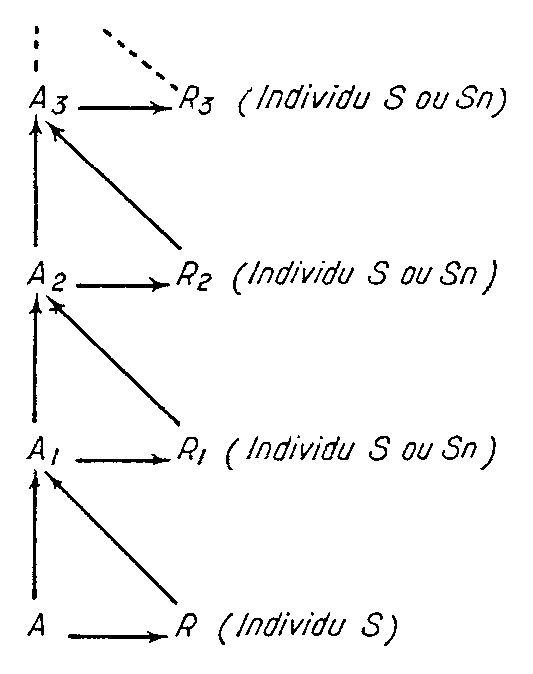
Diagram key: A, A₁, A₂ and A₃ are successive significant stimuli; R, R₁, R₂ and R₃ are responses. “Individu S” means “individual S”; “Individu S ou Sₙ” means “individual S or Sₙ”, where Sₙ may be any individual.
In stigmergy, the individual, through its work—an automatic response to a particular significant stimulus—creates a new stimulation that will act on itself or any companion. The situation and mode of stimulation differ considerably from those in displays involving reciprocal, complementary activities.
Whereas during construction the individual behaviour of termites is determined solely by the product of work, the courtship display and nuptial promenade following swarming belong to the type of reciprocal, chain-like individual stimulation (Grassé, 1942).1 Food-collecting activities, always collective in termites—isolated “scouts” and [75] “discoverers” never occur in Isoptera—have not yet undergone detailed behavioural analysis, so we cannot take them into account here.
1. We consider only normal behaviour here. We have shown that whole phases of courtship may be omitted without altering subsequent behaviour (Grassé, 1942).
Termite behaviour shows great variety in its kinds of stimuli and its relations with them: stigmergy, reciprocal stimulation and perhaps other mechanisms determine it, while always keeping it within the domain of automatism.
Naturally, group effects, in which olfactory stimulation and licking probably play important roles, contribute their share of modifications to behaviour—probably indirect, but very important, as in caste determination.
Taxic responses associated with simple stimuli—light, heat, mechanical vibrations—are more or less well integrated into normal behaviour, in which their intervention is undeniable.
Considered as a whole, termite behaviour cannot be explained by a single system, objectivist or otherwise. It comprises large sets of responses arising from mechanisms of different types. One may wonder whether much the same is true of almost all animals.
There is no longer any need to invoke relations between individuals or a plan followed by the termites. Our explanation dispenses with these supposed necessities. Stigmergy as we describe it is sufficient in itself, and answers problems simpler and more accessible than was believed before this study.
Prudence nevertheless counsels against excluding every possibility of cooperation or information between workers. We have, however, observed nothing comparable to bee dances, which constitute an automatic information code.
Swaying and trembling movements by workers and soldiers are certainly frequent during construction. We reported earlier (1937) that these movements respond to a mechanical vibration transmitted through the substrate, registered by the genual organs in the legs. But they are more than this: a worker at a building site, escorting the queen or walking along a trail may stop and sway without any mechanical vibration having stimulated it. Swaying is contagious, and generally some nearby workers enter the same trance in their turn. Presumably vibrations of the support and sounds caused by the swaying individual release the same response in its companions. The simultaneous responses of Bellicositermes soldiers to a sudden blow against the nest wall or the ground—when working in the surrounding territory or beneath earthen sheets—are fully significant in this respect.
In the absence of any vibration perceptible to us, swaying then seems spontaneous and due to an internal impulse. Since it is difficult to identify and distinguish with certainty the stimuli acting [76] on termites during reconstruction, one hesitates to be fully affirmative.
Our studies of swaying have not been sufficiently thorough to rule out a role in coordinating individual tasks, or the possibility that it is more than a simple alarm signal.* It would be tempting to imagine termites communicating by tapping their support, like prisoners conversing from one cell to another through taps corresponding to letters. We do not believe this, because when workers build, when they join two arches—that is, when their acts must necessarily agree—they do not tremble.
* Translator’s note. The printed sentence’s nested negatives are awkward (“repousser l’idée qu’il ne joue pas quelque rôle”). The reading follows the surrounding qualification: Grassé leaves a possible coordinating role open, then argues against interpreting the movements as a code comparable to letters.
It is quite evident that stigmergy during construction, as revealed by observation and experiment, is, all things considered, a very complete adaptation to social life. Without it, reconstruction does not appear to us scientifically explicable. The breaking up of the response scheme into simple responses appropriate to particular stimuli—the objects fashioned by workers, that is, the product of social activity—results from a very advanced adaptation to a particular way of life.
Differences between social and solitary animals concern physiology—group effect (Grassé, 1946, 1958), or intrinsic characteristics—and behaviour. In termites we even see that stimulation during construction is social in nature: it orders individuals’ responses by itself and, through automatism and the most complete individual unconsciousness, produces a perfectly coherent work giving the illusion of following a definite plan.
Here, as in many other matters, the major problem is evolutionary. How could such behavioural automatism become established, and how did it become hereditary? These are eternal questions which, in our view, cannot at present be answered. It is already a great deal to pose problems, and above all to pose them correctly.
VI. Fundamental characteristics of social-insect behaviour
The social condition has not undergone continuous evolution, for it appears only here and there in the animal kingdom. Within each taxonomic unit where it has developed, its evolution has followed particular paths that have given it a character of its own.
[77] Termite societies differ in many respects from those of Hymenoptera, and among the latter, societies of Apoidea differ in many features from those of Vespoidea. Within a single genus some species may remain solitary, others become more or less social, and still others form complex societies. We have in mind the immense genus Halictus, which has produced, in species such as Halictus marginatus, perennial societies of a highly original kind (Quénu, 1958).
Nevertheless, despite their entirely independent origins, social insects seem to share certain fundamental behavioural characteristics. This is probably a convergence, of which the history of natural lineages offers so many examples in evolution; but it probably reflects the fact that social life is possible only under certain conditions.
- Mutual attraction [interattraction] is present in all insect societies. It has been clearly demonstrated in termites (Verron, 1957) and bees (Lecomte, 1949, 1950). Everything suggests that it exists with equal intensity in ants and wasps. Recall that the stimuli responsible for mutual attraction differ among social insects: although most often chemical in nature, through olfactory reception, they are also associated with vision—form and movement.
- The social companion, through itself and its acts, constitutes a sum of significant stimuli for its fellow, which reciprocally exerts an action of the same kind upon it. The “objectivists” understood this general characteristic of the social animal because they observed it in vertebrates, their experimental material. But Tinbergen (1942, 1953) considerably restricted its scope by concentrating chiefly on sexual phenomena, which represent only a very partial aspect of sociability. Sexual displays, studied with particular interest and great skill by the objectivists, are not exclusive to social animals: they are known with just as much elaboration and flourish in solitary animals. They are only one particular aspect of sociability, precisely one in which chain-like behaviour is the rule.
- The products of social insects’ work have stimulating properties both for the builder and for its companions.
These three major characteristics suffice to maintain the colony, sustain fundamental activities and automatically coordinate individual tasks. Given the very properties of significant stimuli, there is no need to imagine an additional regulating power: regulation here coincides with stimulation itself and the very close adaptation of responses to it.
Summary translated from the French Résumé
[78] 1. This memoir describes the behaviour of termite workers (Cubitermes sp. and Bellicositermes natalensis) rebuilding a nest. The newly observed facts agree with the author’s earlier observations on Cephalotermes rectangularis and Bellicositermes natalensis in the Ivory Coast. The precise joining of arches and sheets extending from distinct, distant initial structures is confirmed. Individual behaviour has been subjected to precise analysis.
2. The principal lessons of the experiments and observations are:
- Builders do not form a working team;
- At the outset, individual tasks are uncoordinated and related to an overall stimulating situation;
- Workers are then indifferent to the acts of their fellows;
- When earth pellets reach a certain density on a restricted surface or along a line, they constitute a new stimulus that attracts workers and determines where further pellets are deposited. Heaps and lines of pellets become the starting points of pillars and sheets respectively;
- Pillars and sheets in turn become new significant stimuli;
- Building behaviour is, in many circumstances, conditioned by two significant stimuli, or sometimes more. Responses to several stimuli acting simultaneously on groups of workers working at a distance from one another suffice to explain the joining of their respective works;
- Stimulation of workers by the very work they perform—significant stimulation releasing precise, adapted responses—has been named stigmergy;
- Stigmergy suffices to explain correlations between the tasks performed and permits us to dispense with every notion of plan and regulation;
- The stimuli intervening most strongly in construction are olfactory. We adopt, with modifications, the concept of “odour-form” stimuli introduced into biology by Forel in connection with ant behaviour under the name of the topochemical sense;
- Termite workers’ responses to the various stimuli during nest reconstruction are not arranged in a sequence and are independent of one another;
- Social insects appear to have behaviour dominated by (1) mutual attraction; (2) the social companion acting as a set of significant stimuli—see swarming and nuptial promenades; (3) stigmergy associated with the work performed by workers.
Original English Summary
[79] The following English summary appeared with the original paper; its translator is not credited. Its wording is retained separately from the new translation of the French Résumé.*
* Translator’s note. Item b prints “simulative situation”. The French summary, translated above, says “stimulating situation”. Other substantive differences are retained: item h in French mentions both plan and regulation, while the original English mentions a plan alone; item i in French identifies the strongest stimuli as olfactory, while the original English makes a broader statement about the determining stimuli. The affiliation is retained in its original French.
- The behaviour of the Termite workers (Cubitermes sp., and Bellicositermes natalensis) rebuilding a nest is described. These new observations are in close agreement with those previously made by the author on Cephalotermes rectangularis and on Bellicositermes natalensis in the Ivory Coast. The exact way by which the arches are joined as well as the blades originating from distinct and distant foundations is confirmed. The behaviour of the individual termites has been fully analyzed.
- The main points which can be established from these experiments and observations are as follows:
- Masons do not constitute a working team;
- In the beginning, individual tasks are uncoordinated and related to a general simulative situation;
- The workers are then indifferent to the behaviour of their companions;
- When earth-pellets achieve a certain density on a restricted area or on a single line, they constitute a new stimulus which somehow attracts the workers and determines the points where new pellets are to be deposited. The heaps and lines of pellets become respectively the starting point of pillars and blades;
- In turn, the latter become new determinant stimuli;
- Building behaviour is in most circumstances conditioned by two significant stimuli and sometimes more. Responses to various stimuli reacting simultaneously on groups of workers separated from each other enable us to explain the synchronization of the various individual tasks;
- The stimulation of the workers by the very performances they have achieved is a significant one inducing accurate and adaptable response, and has been named stigmergy;
- Stigmergy clearly explains the correlation between the tasks achieved and does not require any further explanation involving a given plan;
- The determining stimuli in nest-building are of olfactive origin. We retain with some restrictions Forel’s notion of “odour-form” stimuli which he introduced in biological nomenclature applied to ant-behaviour (topochemical sense);
- The responses of the termite-workers to various stimuli during the rebuilding of their nest do not follow a regular sequence and are independent of each other;
- It seems that social insects show a type of behaviour dominated 1° by the interattraction; 2° by the fact that the social companion acts as a series of determinant stimuli (e.g. swarm, nuptial flight); 3° by the stigmergy in relation with the workers industry.
Mission scientifique Singer-Polignac, Afrique équatoriale, 1956–1957, et Laboratoire d’Évolution des Êtres organisés, 105, boulevard Raspail, Paris (6e).
VII. Authors cited
[80] Bibliographic titles and publication details are retained in their original languages. The entries below follow the printed bibliography.
1938 a. Chen (S. C.). Social modification of the activity of ants in nest building (Physiol. Zoöl., 10, 420–436). — 1938 b. The leaders and followers among the ants in nest building (Ibid., 10, 437–455).
1957. Deleurance (E.-P.). Contribution à l’étude biologique des Polistes (Hyménop. Vespidés). I. L’activité de construction (Ann. Sc. Nat., Zool. Biol. Anim., 11e série, 19, 91–222).
1921. Forel (A.). Le monde social des Fourmis. Kundig, édit., Genève, 1, 121; 2, 9–26.
1923. Grassé (P.-P.). Sur le phototropisme de quelques Criquets (C. R. Soc. Biol., Paris, 89, 898–899). — 1937. Recherches sur la systématique et la biologie des Termites de l’Afrique-Occidentale française (Ann. Soc. Entom. France, 106, 1–100). — 1939. La reconstruction du nid et le travail collectif chez les Termites supérieurs (Journ. de Psychologie, 370–396). — 1942. L’essaimage des Termites. Essai d’analyse causale d’un complexe instinctif (Bull. Biol. France et Belg., 76, 347–382). — 1944. Les Insectes et leur univers. Confér. Palais de la découverte, 21 pages. Paris. — 1944–1945. Recherches sur la biologie des Termites champignonnistes (Macrotermitinæ) [Ann. Sc. Nat., Zool. Biol. anim., 11e série, 6, 97–172; 7, 115–146]. — 1946. Sociétés animales et effet de groupe (Experientia, 2). — 1952. La régulation sociale chez les Isoptères et les Hyménoptères. Colloques internationaux du C. N. R. S., XXXV Structure et physiologie des sociétés animales, C. N. R. S., édit., Paris, 323–331. — 1954. La régulation des activités instinctives considérée surtout chez les Insectes. Colloque Fondation Singer-Polignac (L’instinct dans le comportement des animaux et de l’homme, Masson, édit., Paris, 561–575). — 1958. L’effet de groupe sur l’animal et sur l’Homme (Journ. de Psycho., 129–150).
1958. Grassé (P.-P.) et Noirot (Ch.). La « climatisation » de la termitière par ses habitants et le transport d’eau (C. R. Acad. Sc., Paris, 227, 869–871). — 1951 a. La sociotomie (Behaviour, 3, 146–166). — 1951 b. Orientation et routes chez les Termites. Le « balisage » des pistes (Année psychologique, 50e année, 273–280). — 1951 c. Nouvelles recherches sur la biologie des Termites champignonnistes (Macrotermitinæ) (Ann. Sc. Nat., Zool., Biol. Anim., 11e série, 13, 291–342). — 1958. Construction et architecture chez les Termites champignonnistes (Macrotermitinæ) (Proceed. Xth intern. Congress of Ent., Montréal, 1956, 2, 515–520).
1949. Lecomte (J.). L’interattraction chez l’Abeille (C. R. Acad. Sc., Paris, 229, 857–858). — 1950. Attraction entre reine et ouvrières d’Abeilles (Apis mellifica) (Ibid., 231, 802–804).
1958. Quénu (C.). Sur l’existence de castes chez Halictus marginatus Brullé (Insecte Hyménoptère) (C. R. Acad. Sc., Paris, 246, 1294–1296).
1958. Steiner (A.). Contribution à l’étude biologique de Sphégides (Hyménoptères). La valeur réactogène différentielle des diverses régions corporelles du Grillon, proie de Liris nigra (C. R. Acad. Sc., Paris, 247, 970–972).
1942. Tinbergen (N.). An objectivistic study of the innate behaviour of animals (Bibliotheca biotheoretica, 1, 39–98). — 1953. L’étude de l’instinct. Un vol., 308 p., Payot, édit., Paris (traduction de l’édition anglaise de 1950).
1957. Verron (H.). Interattraction olfactive chez Calotermes flavicollis I. (Insectes sociaux, 4, 25–30).
Legends and photographic plates
[81] Legends to the plates.1
1. The costs of these illustrations were met by a generous grant from the Fondation Singer-Polignac in Paris. I thank it most warmly.
Edition note on reproduction size: the author’s life-size fractions and magnifications below describe the original printed reproductions. Images in this PDF and on screen are resized for reading; their displayed dimensions do not preserve those scales.
Plate I
Plate I
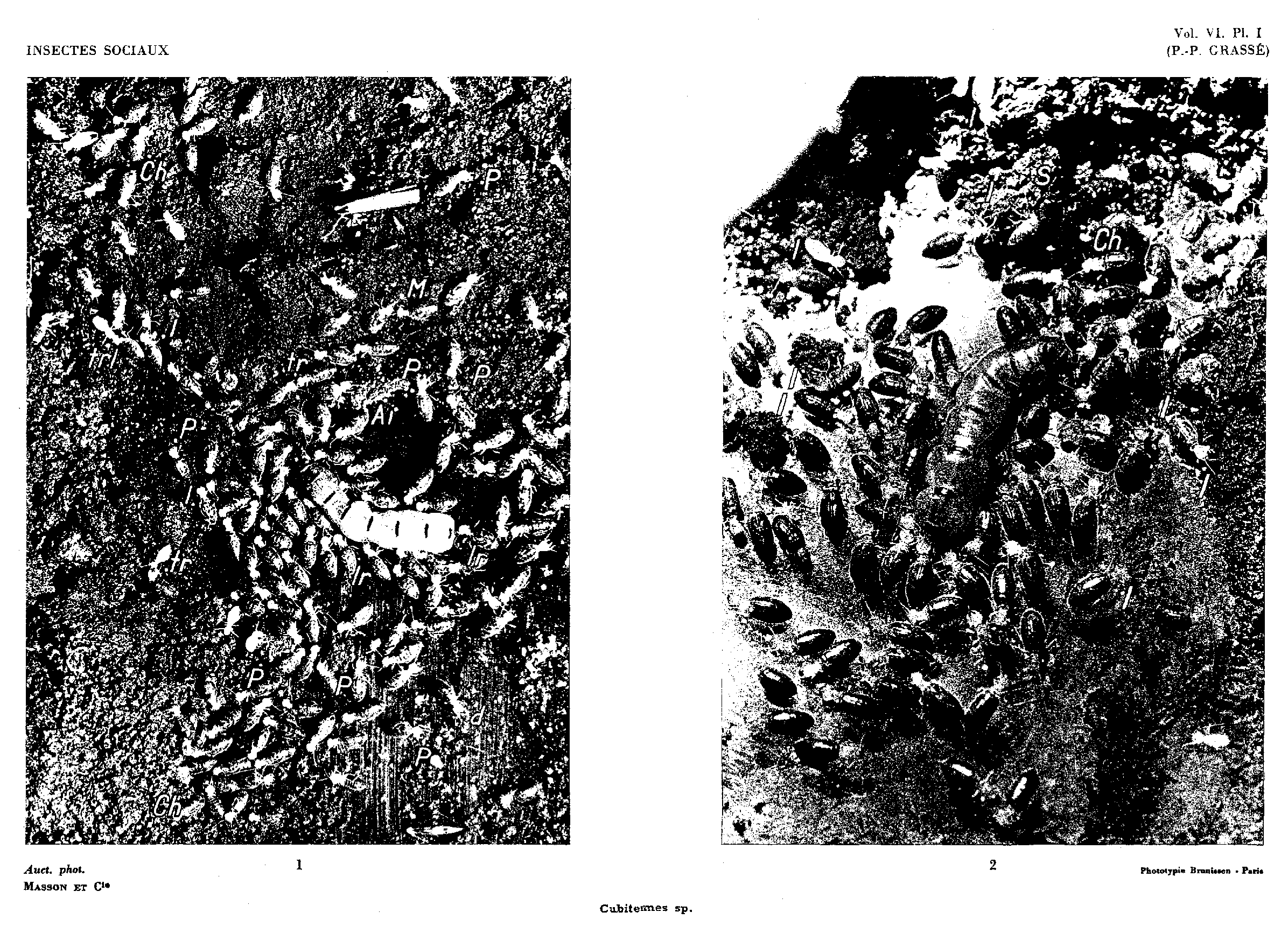
Nest reconstruction by Cubitermes sp.
Photograph 1. Two hours fifteen minutes after the beginning of nest founding. Population comprising 350 workers, 3 soldiers, a queen, several dozen larvae and a few nymphs. Ai, area covered with earth pellets on which a sheet of pellets will rise; Ch, worksite; d, worker depositing an earth pellet; lr, licking of the queen; l, licking between workers; P, pillars under construction; trl, larva being fed mouth to mouth.
Photograph 2. Two hours forty-seven minutes after the beginning of founding. Note that most workers are working alone at this moment; they are indicated by I. Ch, worksite; S, soldier. Three workers lick the queen’s anovulvar region.
Plate II
Plate II
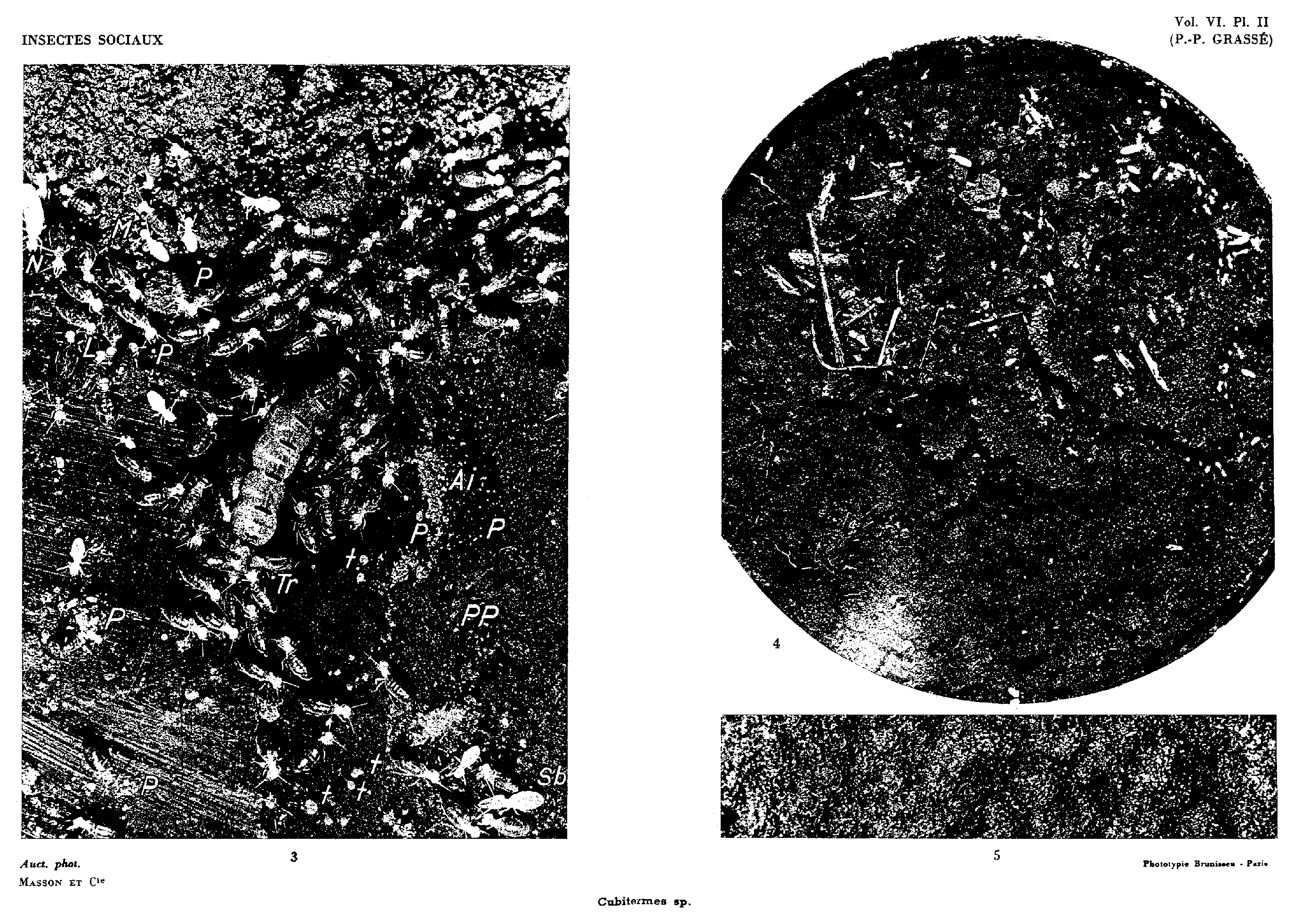
Photograph 3. Two hours thirty minutes after the beginning of founding. The same letters as above, with the addition of t, small heaps of pellets beginning pillars; Tr, trophallaxis between workers, some of which have just licked the queen’s anovulvar region; PP, a line of pillars whose joined “caps” form a roof.
Photograph 4. The almost reconstructed nest viewed from above, fifteen hours thirty minutes after installation. A wide slit remains open; workers are closing it. A little below the centre of the Petri dish, note two clay sheets forming two festoons: these are roofs of future cells forming a first storey above the “ground floor”. Numerous larvae and nymphs remain outside the nest; all will subsequently be carried inside, and no individual will be “forgotten”. This contrasts with repairs to breaches in the termite-nest wall, where soldiers and some workers are left outside and thus condemned to an early death.
Photograph 5. A highly magnified view of the outer surface of the new construction. The adjoining, partly fused pellets are clearly distinguishable.
Shared introduction to Plates III–VI
Bellicositermes natalensis
Seven successive views of nest reconstruction. Only the part built around the queen is shown. These photographs were taken with the camera vertically above the subject, so the pillars are foreshortened and appear as simple heaps of pellets. To obtain clear images, the Petri-dish lid had to be removed. Although this was done with great care, workers interrupted their work as soon as open air reached them, explaining the small number of individuals in these photographs. All are small workers, which form the great majority in termite nests, and small soldiers. On average the photographs are four-fifths life size.
Plate III
Plate III
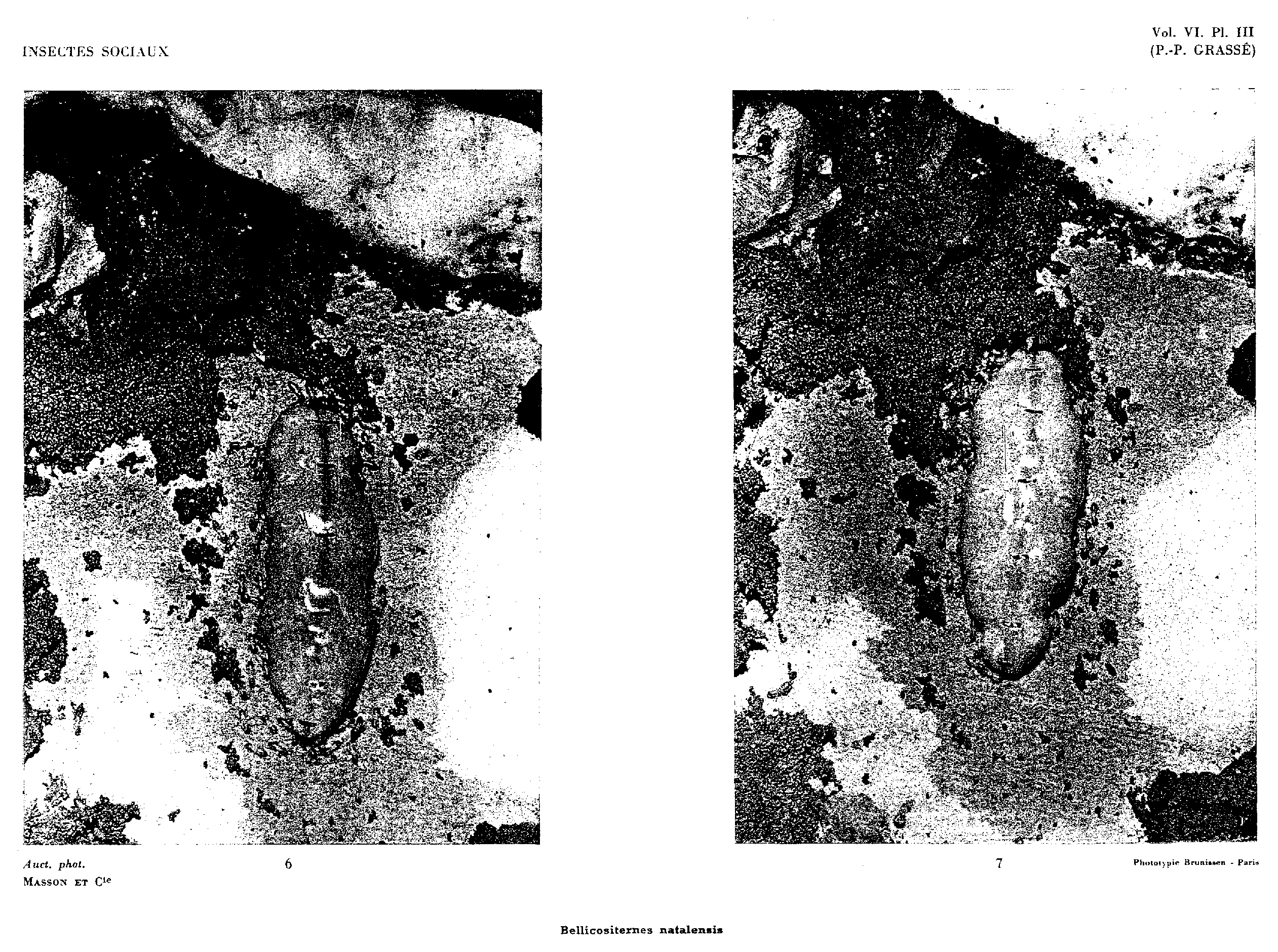
[82] Photograph 6. State of reconstruction one hour eighteen minutes after the group was installed in the Petri dish. At upper left is the block of clay, with a sheet of pellets (placard) inserted along its upper left edge and extending backwards. At upper right is a mass of absorbent cotton wool soaked in water; workers have deposited a few clay pellets on it. In front and to the right of the queen, connected to the clay block’s vertical wall, a second sheet extends out and has already reached two or three pillars joined by a sheet of pellets.
Photograph 7. One hour fifty-two minutes after founding. Broad arches or sheets extend towards the queen from pillars on her left and especially in front. The two anterior sheets have united and already hide her head and thorax.
The arches and sheets extending from the pillars on the left have grown considerably.
Numerous workers can be seen nestled beneath the queen. This position persists throughout the work and is by no means an escape response. Behind and a little to the left of the queen are two isolated pillars that will become the starting point for the covered corridor shown in photograph 9.
Plate IV
Plate IV
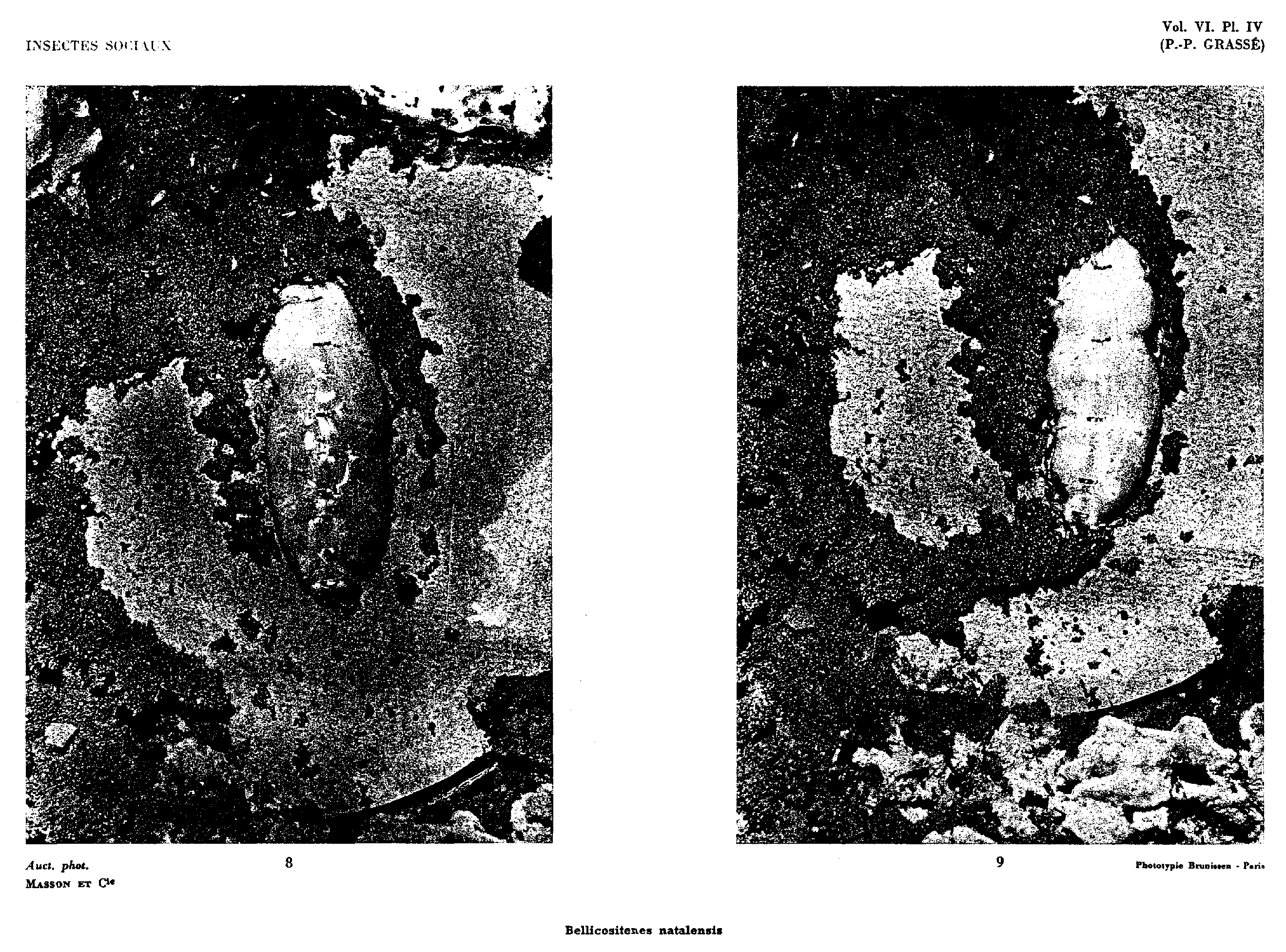
Photograph 8. Three hours twenty-three minutes after founding. Regular advance of sheets and arches. Several new pillars have been erected behind the queen. At the very bottom left, note an oblique sheet under construction. A well-formed pillar that rose in the empty space to the queen’s left, visible in photograph 7, has been removed by workers and used as material. A small worker is in the “gauging” posture on the left, level with the queen’s first abdominal tergite.
Photograph 9. Four hours thirty minutes after founding. Pillars behind the queen have served as the starting point for a broad covered corridor connecting the initial royal chamber to the sheet extending from the heap of clay behind and to the left. To the queen’s right, note two very distinct pillars sending arches towards one another. A broad covered corridor extends from behind the queen downwards and to the left, connecting the construction around her with a heap of clay. Already, on the clay sheet above and to her left, a pillar has been erected from which another sheet is beginning; it has joined the clay block at the front and extends freely backwards. Towards the top left, between the queen’s first and second abdominal tergites, a small worker is seen in the “gauging” posture on her body.
Plate V
Plate V
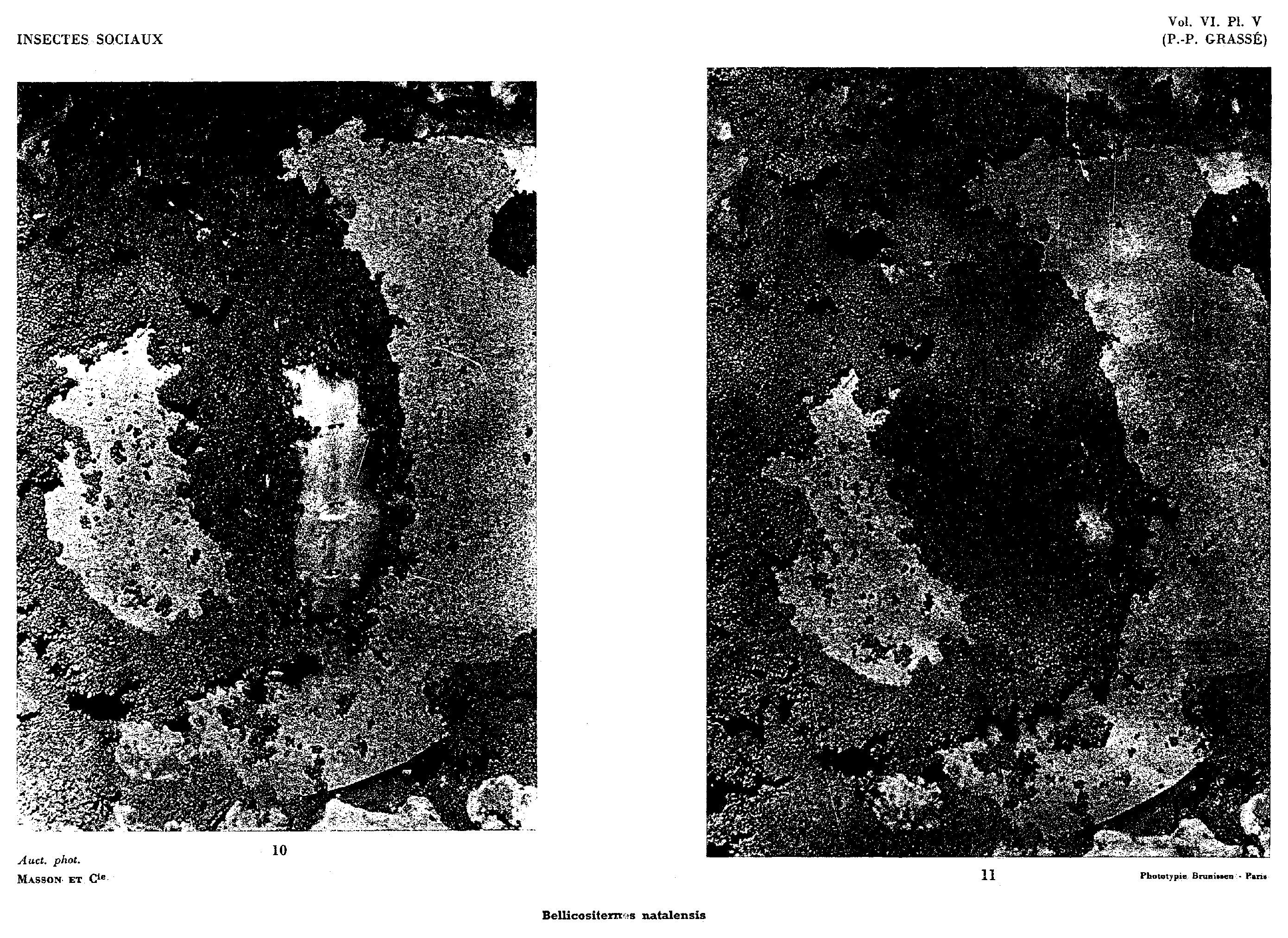
Photograph 10. Five hours fifteen minutes after founding. The queen has moved the tip of her abdomen slightly to the right. The chamber wall remains incomplete on the right and towards the rear. Numerous new pillars. On the edges of the constructions to the queen’s left and around the heaps of clay, new upright, more or less oblique sheets are strongly beginning to form.
Photograph 11. Six hours thirty minutes after founding. The queen is almost entirely covered. In the upper part of the photograph, construction of pillars and upright sheets above the new nest’s “ground floor” is in full swing. Clearly visible sheets are being built on the right side of the royal chamber. Note that here and there a few pellets continue to be deposited on the Petri-dish bottom.
Plate VI
Plate VI
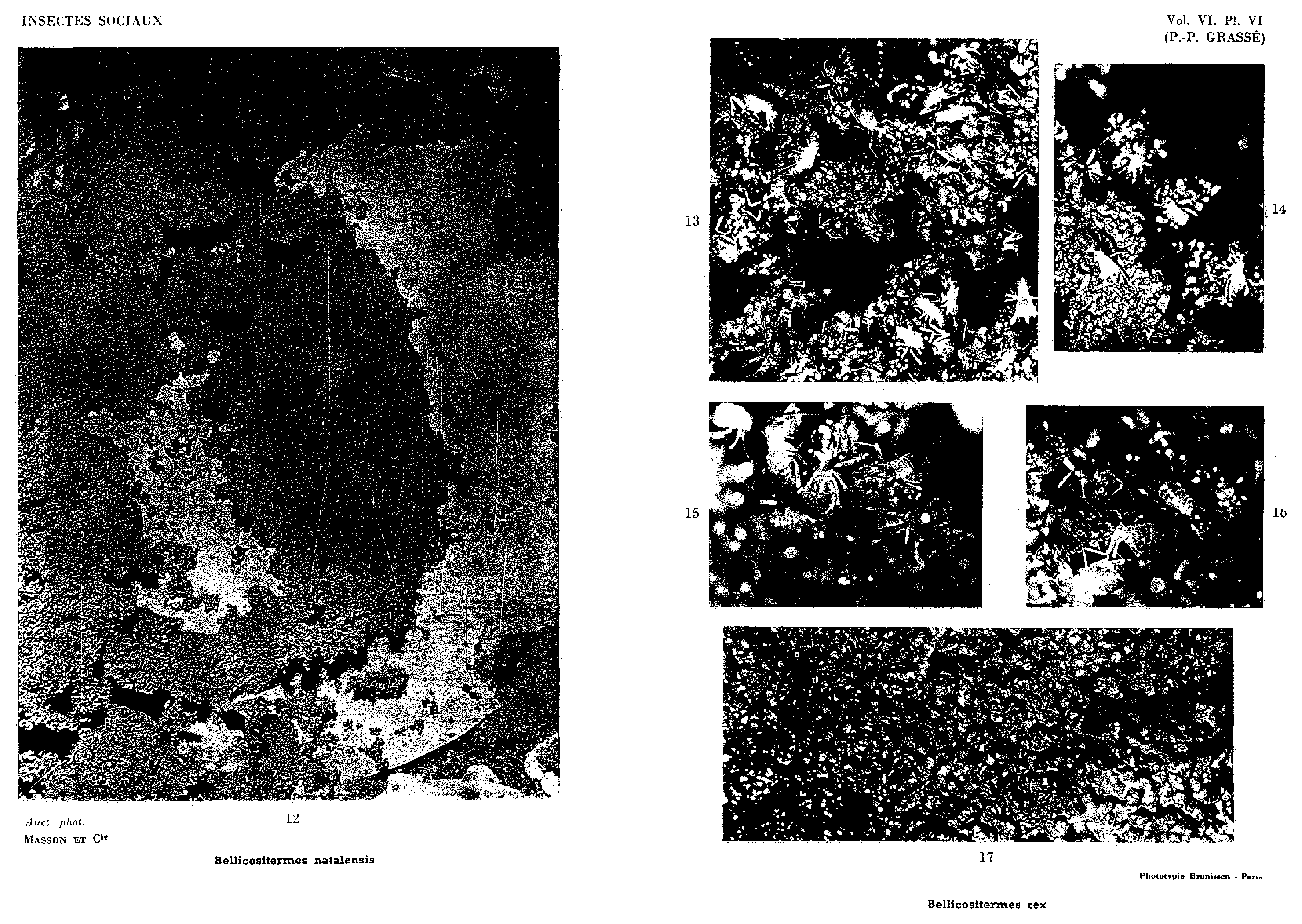
[83] Photograph 12. Eight hours thirteen minutes after founding. The queen is entirely covered. At bottom left are (1) a sheet connected to a pillar by an arch of pellets; (2) farther right, a fine large arch joining two large pillars and a small one. Pillar Pl in photograph 11 has become a subconical sheet comparable to a conch shell.
Photographs 13–17. Bellicositermes rex. 1–4 p.m. Small and large workers closing a breach made in their nest and clearly showing their method of work. Between the mandibles of several individuals an earth pellet can be seen. In this species the pellet is almost diluted in water. Photograph 17 shows, enlarged, a sheet of adjoining pellets; these very plastic, water-soaked pellets reflect the light of the electronic flash.
Plate VII
Plate VII
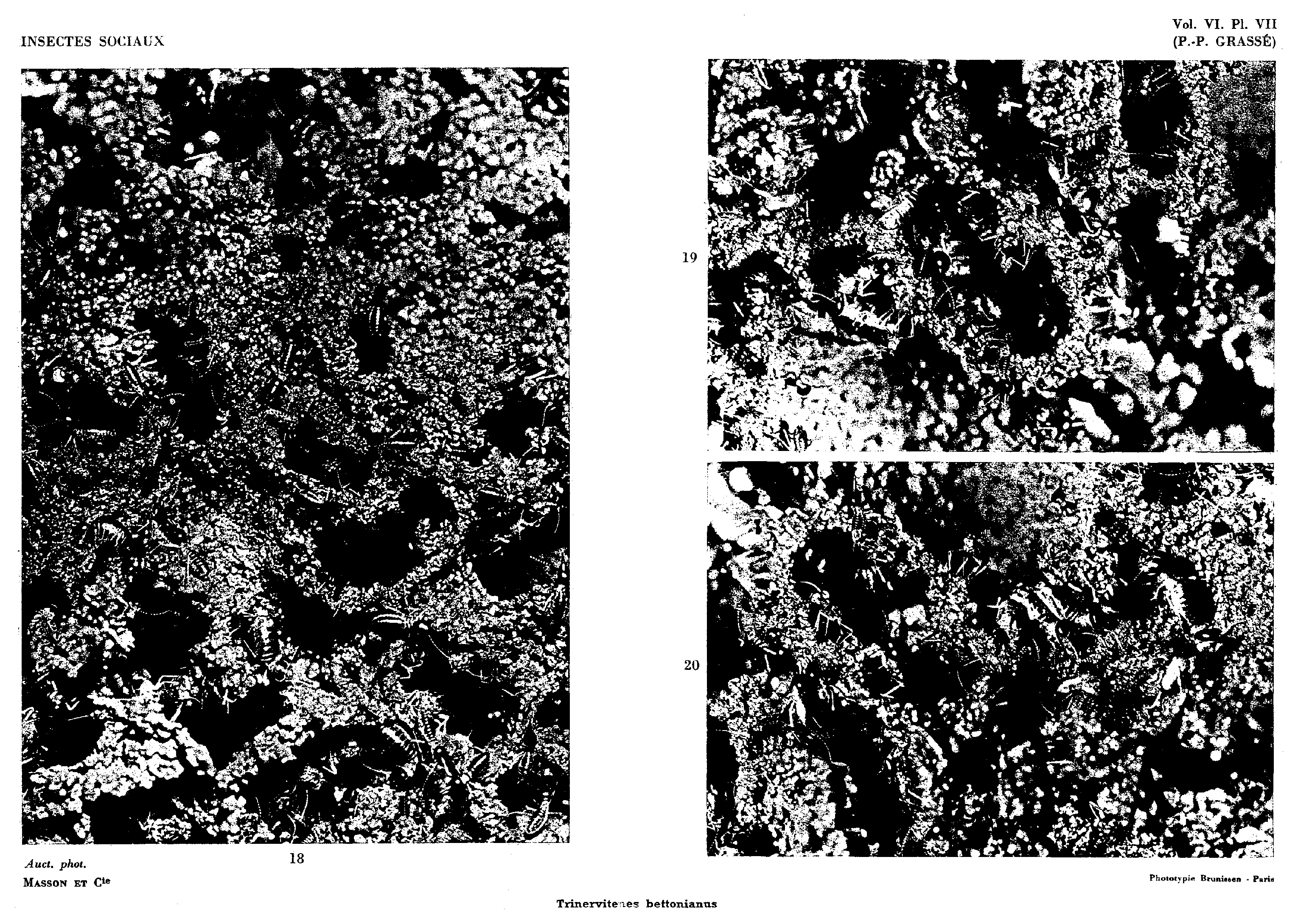
Trinervitermes bettonianus
Workers enlarging the above-ground dome of their nest at night (22 November, after a heavy thunderstorm shower, Bossembélé, Oubangui-Chari).
Photograph 18. A portion of the part under construction viewed from above, with considerable foreshortening. Surfaces marked P correspond to the expanded terminal part of a pillar. The arches extending from them join, and those extending from pillar to pillar are clearly visible; on some the point of junction can be recognised. At J, a solitary worker is finishing the union of two arches that have come into contact. In the upper part of the photograph, spaces between arches are almost closed; a few navel-like perforations remain. Numerous nasute soldiers are scattered over the worksite. With heads raised, they are ready to discharge a jet of sticky secretion; they take no part in construction. (Life size, ×1.33.)
Photographs 19 and 20. Details of the same worksite at higher magnification. In photograph 19, at J, a bridge thrown between two arches that were not converging can be seen very clearly. (Life size, ×2.4.)
About this edition
Pierre-P. Grassé’s paper appeared in Insectes Sociaux 6, no. 1 (March 1959), pp. 41–80, under the title La reconstruction du nid et les coordinations interindividuelles chez Bellicositermes natalensis et Cubitermes sp. La théorie de la stigmergie : Essai d’interprétation du comportement des termites constructeurs. The separately catalogued supplement contains the legends, pp. 81–83, and plates I–VII. Publisher records: main paper and legends and plates.
This complete illustrated English reading proof includes four text figures, seven photographic plates, all twenty photographs, the stimulus–response table and all ten original authorial notes. The text figures retain their positions in the discussion; the plates follow the bibliography, with translated legends beside them. Shared legend introductions and grouped captions are preserved. Original printed page numbers appear in square brackets; they refer to the French publication. The plate images are facsimiles, rotated upright. Historical reproduction scales refer to the original printing.
The translation uses British English, retains historical scientific names and translates quotations as Grassé transmits them. “Significant stimuli” preserves his distinction from the narrower “sign stimuli”; “odour-form” preserves the combined spatial and olfactory account. The French Résumé is translated independently, followed by the original English Summary as a separate historical text. Bibliographic titles and the original affiliation remain in their source languages.
Authorial notes retain their printed numbers. Translator’s notes are identified and use symbols reset at headings; internal links distinguish repeated marks. Demonstrable printed errors are corrected with explanatory notes giving the printed readings. Unresolved chronological and bibliographic discrepancies are retained and explained where relevant.
English translation and reading notes by Codex, an AI assistant; editorial direction by Bird. Version 0.1, 21 October 2026. Prepared through source comparison, English readability review, a reading-note review and inspection of the generated editions. The original sources and translation decisions are retained with the project records. No new licence is asserted for the historical text or illustrations.