Source: Bulletin de la Classe des sciences 60 (1974), pp. 1531–1549
Contents
Address
Marcel Florkin, Director of the Class
[1531] In the sense of passage through a succession of phases, the term evolution has now acquired a very general meaning in scientific language, encompassing every aspect of the Universe: the concept of evolution reigns in cosmology and statistical physics as well as in biology. As early as 1913, my teacher Lawrence Henderson, in a book that made a considerable impact,[1531.1] had formulated the idea that the processes of cosmic evolution and those of biological evolution are expressions of a single reality. This common principle could be grasped only half a century later, after our colleagues Glansdorff and Prigogine[1531.2] had formulated the entropic criterion for the evolution of open systems.
When we consider the evolution of organisms within the comprehensive theory of generalised evolution, we define it by the increase in information (or negentropy) discernible [1532] during phylogenesis—that is, the changes organisms display as the sequence of their genealogical tree unfolds. The various biological disciplines, and palaeontology in a particularly fundamental way, have contributed to constructing that genealogical tree.
Considered at the molecular level of integration, generalised evolution is an inevitable process. Although random, the process is governed by the statistical causality arising from the nature of the molecular entities it involves. These aspects have been treated in my colleague Ernest Schoffeniels’s book L’Anti-hasard,[1532.1] to which I refer you.
However great the naturalist’s admiration for the general theories of thermodynamics, he is aware that they can teach him nothing about the nature of evolution considered as an existential process. The term is used here in the sense of a reaction by the philosophy of organisms against the philosophy of ideas.
Let us acknowledge it plainly: biologists are particularly concerned with what Broca in 1867 called transformism [transformisme],[1532.2] a term by which he meant that species are transformed into other species.[T1] Since these were taxonomic entities described and defined by considering aspects of form, it was natural for biologists to make form the pre-eminent reality. Moreover, the method of recourse to comparative morphology and comparative embryology led to the construction of a natural system of classification and phylogeny of organisms. By its breadth, extent and relevance, this system gives great satisfaction to those minds it satisfies and encourages to pursue its refinement. I have so often insisted in the past on the importance and intrinsic value of this system, and thereby incurred such bitter reproaches on so many occasions from adherents of molecular biology and biochemical genetics, that I feel at ease in suggesting that the system founded on comparative morphology and comparative embryogeny—whatever its value and importance, which I take pride in having [1533] always proclaimed—nevertheless displays a feature of the infancy of sciences: it rests on the data of immediate experience and the images of primary phenomenology, that is, on an intellectual inheritance from the eighteenth century.[1533.1] In a word, this admirable intellectual achievement nevertheless leaves the natural aspirations of curious minds unsatisfied.
And yet genetic biochemistry and molecular biology have revealed the involvement in hereditary transmission of biomolecules which I ask your permission to call serial [sérielles], since, as in serial music, a series provides the material for developments. These developments, initiated at the level of the series of purine or pyrimidine bases found within deoxyribonucleic acid, are epigenetic in nature[1533.2]—that is, they proceed by the addition of parts—and consist in aspects of transcription and translation leading to the production of protein polypeptide chains, that is, serially ordered molecules [molécules sériées].[T2] Among the latter are the enzymes that mark out the assembly lines governing the synthesis of the many biomolecules other than polynucleotides and proteins. Molecular biosemiotics takes the signification of biomolecules as its subject.[T3]
When Wiener wrote that an organism can be regarded as a language, he meant that the concepts of information and cybernetics have a legitimate place in the consideration of organisms. Whereas information science is concerned with the extensive and quantitative aspects of information, it is the intensive aspects of information that [1534] constitute the subject of semiotics.[1534.1] In accordance with a usage established in the literature, we shall give the name semiology to studies of different forms of communication embedded in the social body, such as human language, the alphabet of deaf-mutes, symbolic rites, maritime signalling, and so on. Semiology—linguistic, symbolic and otherwise—is only one chapter of semiotics. Biosemiotics is another, of which we consider here only the aspect apprehended at the molecular level of integration: the subject of molecular biosemiotics.
Linguistic semiology is concerned with linguistic signs, that is, psychological entities relating to mental acoustic images and concepts at the level of the receiver’s brain. Human language conveys ideas, as do other aspects of communication embedded in the social body and representing substitutes for human experience that can be transmitted in space and time. I would therefore ask you to banish the improper use of the term “language” from molecular biosemiotics.[1534.2] If you will agree, we shall give up applying specifically linguistic concepts, such as word, sentence and so forth, to biosemiotic aspects. Whereas linguistic semiology is concerned with human psychological phenomena and the communication of concepts, molecular biosemiotics studies existential aspects of cells, and the relata it subjects to analysis are not uniformly of the nature of a signal.[T4]
This does not prevent us from using concepts first employed in the study of linguistic semiology when their extension exceeds that field and covers other areas of semiotics. This is the case, for example, with several concepts introduced by Ferdinand de Saussure,[1534.1] such as signifier and signified, synchronic and diachronic, system and syntagm. In Saussure’s thought, these concepts do not originate in the consideration of psychological facts, but have their source in existential aspects of the natural sciences. Thus, [1535] when defining the concept of signifier, Saussure notes that water, H₂O, signifies in a way belonging neither to hydrogen nor to oxygen, of which it is nevertheless a combination. As for synchrony and diachrony, Saussure borrows them from the theory of evolution. These concepts should therefore be situated in the general context of semiotics, or the science of signification, of which linguistics and biosemiotics are particular branches. By contrast, the concept of a word is specifically linguistic, since it represents the smallest unit of denotation. It is a cultural unit that must not be confused with the material and functional—and non-denoting—units of molecular biosemiotics. The same applies to the sentence and to discourse, which belong to dialectical logic rather than, as in biosemiotics, structural logic.
Molecular biosemiotics is an aspect of molecular biology, not of the human sciences. Saussure[1535.1] says so: in linguistics, the sign, which he regards as the association of signifier and signified, is arbitrary as regards the relation between these two faces. This is not the case for the sign of molecular biosemiotics, in which the relation between signifier and signified is governed by the laws of material nature, and particularly those of chemistry and physics. The minimal configuration (signifier) bearing biological activity (signified) will be called a bioseme (unit of signification). Within the bioseme, the theme of signification consists in the association of signifier and signified. The system of signification involves not only this sign but a receiver, forming with it a pair of relata. Signification, for its part, may be sequential, structural, functional, protective, conjunctive, motor, signalling, catalytic, regulatory, modulatory, initiating, repressive, releasing, and so on.[1535.2][T9]
[1536] Within the Macedonian phalanx, the term syntagm[1536.1] (suntagma) denotes a compact unit formed from different categories of warriors arranged in several ranks and pointing their weapons in different directions. A biosyntagm will be defined as a unit of signification higher than a bioseme, composed of signifying units associated in a relation of reciprocal solidarity—or, in other words, as an associative configuration of biosemes. One biomolecule may bear several biosyntagms, and one biosyntagm may encompass several biomolecules. Cistrons,[1536.2] operons,[1536.3] the DNA double helix,[1536.4] and the enzymes of biosynthetic metabolic chains are biosyntagms at the molecular level of integration. These biosyntagms consist of aspects [1537] of signification which, in each case, are interdependent and display a relation of the whole to its components.
The biosemiotic aspect of the biochemical continuum[1537.1] is the most extensive biosyntagm conceivable at the level of planet Earth. Within the domain of polypeptide chains and their associations, we may distinguish, in particular, primary biosyntagms whose biosemes are directly linked to the amino-acid sequence. An example of a primary biosyntagm is ACTH, the vertebrate polypeptide hormone composed of 39 amino-acid residues and secreted by the pars intermedia of the pituitary. There is a close structural relation between ACTH (adrenocorticotropic hormone) and MSH (melanocyte-stimulating hormone). ACTH and MSH share a common sequence:
(bioseme 1 in Fig. 1).[T5] The signified of this bioseme (intensified in amphibians by bioseme 2) consists in the dispersion of melanin granules within melanophores. ACTH also contains bioseme 5 (17, 18, 20), which is the bioseme active at the corticosteroid level. This effect manifests itself through a series of stages. ACTH, through the operation of its bioseme 5, increases the production of cyclic AMP, activating phosphorylase. The production of G-1-P and G-6-P from glycogen is consequently increased and, because of the resulting increase in G-6-P catabolism, production of NADPH, which participates in several stages of corticosteroid biosynthesis, is increased. But ACTH’s action at the level of the [1538] adrenal cortex involves its binding, through the formation of a pair of relata, to a protein in that tissue. Recognition of the specific site or sites (still unknown) is ensured by bioseme 4 (15–18), a recognition with which biosemes 6 (19–24) and 8 [1539] (34–39) are associated. Bioseme 7 (25–33), called the specion by Hechter and Braun,[1539.1] constitutes the mark of the species and, together with bioseme 8, is responsible, according to Schwyzer,[1539.1] for the production of specific antibodies. In tertiary biosyntagms, biosemes result from relations established between distant portions of the same polypeptide chain as a consequence of its spontaneous folding back upon itself. This is the case, for example, with myoglobin, whose relata are the haemoprotein molecules on the one hand and oxygen on the other. This relation of signification is ensured by a framework holding the haem iron in place in a coordination structure, and is realised at the level of N atoms situated on the porphyrin and on the globin.
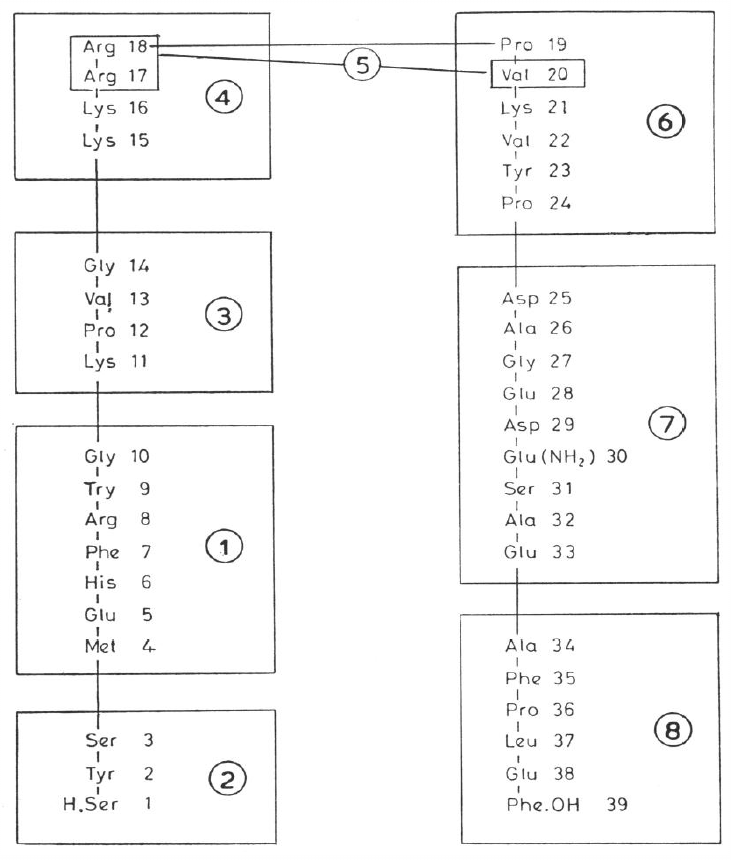
The source diagram preserves the residue symbols and eight numbered regions. “Try” denotes tryptophan; H and OH mark the chain termini. Residue numbering follows the printed diagram.
Quaternary biosyntagms consist of several polypeptide chains associated by residual valences, in which spatial relations are established between the biosemes borne by the different chains (examples:[1539.1] E. coli alkaline phosphatase; glutamine synthetase; pyruvic dehydrogenase; tryptophan synthetase; the complex involved in fatty-acid biosynthesis). So far we have considered biosemes associated within biosyntagms constituted by polypeptide chains—that is, molecules serially ordered under the influence of the flow of information originating in serial molecules that bear the series. In the course of the flow from the series to the serially ordered chains, several biosyntagms are encountered: the secondary biosyntagm of DNA, the tertiary biosyntagm of tRNA and the primary biosyntagm of mRNA. The sequencing action of these polynucleotides has been the subject of many excellent accounts of molecular biology, as has the genetic code governing the pairs of relata between mRNA, tRNA and ribosomes during the flow of information from DNA to proteins. In transcription, a section of one strand of the DNA double helix is transcribed into mRNA. In this case, the biosemes are the bases constituting the section of the exposed strand. During the translation of mRNA into amino-acid sequences, the biosemes are the codons (base triplets) in mRNA and the anticodons in tRNA.[1539.1]
Chromosomes, for their part, are complex biosyntagms formed from molecules of DNA, RNA and proteins.
[1540] By catenary biosyntagms [biosyntagmes caténaires] we mean the sequences of enzymatic actions involved in a metabolic pathway.[T6] Whatever an organism’s position in phylogeny, its cells are equipped with a catenary biosyntagm that may be called central, because it is the source not only of the cell’s acquisition of free energy in the form of energy-rich ATP bonds but also of a series of metabolic extensions. In particular, the intermediate stages of the central catenary biosyntagm provide the starting points of metabolic chains present in organisms generally, which we shall therefore call primary catenary biosyntagms. Other chains, initiated at an intermediate of the central catenary biosyntagm or of a primary catenary biosyntagm, are not present in all categories of organisms. For this reason they will be called secondary catenary biosyntagms (Fig. 2).
A modification of the signified may result from a change in configuration (signifier) induced by the binding of a ligand. This is the case, as we shall see, when the binding of α-lactalbumin to molecules of acetylglucosamine synthetase induces a configurational change in that enzyme, conferring lactose synthetase activity upon it. Alongside modifications of a signified following a configurational change resulting from ligand binding, such binding may also bring about modulation—that is, a quantitative change in the signified. The existence of the integrated multiplicity of an organism’s catenary biosyntagms involves regulation at the level of the genome, in which the majority of the DNA molecules of a chromosome participate. On the other hand, modulation of the intensity of the signified of an effector enzyme belonging to a catenary biosyntagm generally involves a change in molecular configuration induced by ligand binding at a defined site in the primary sequence of the enzymatic protein. Feedback within a catenary biosyntagm is a frequent example of this form of modulation of the signified. The enzyme whose signified is modulated is called an allosteric enzyme. In certain allosteric enzymes, the active site and the allosteric sites, which are defined segments of the amino-acid sequence, lie on different polypeptide chains within the quaternary biosyntagm. What [1541] I have presented so far, much too elliptically, belongs to synchronic molecular biosemiotics, which accounts for an organism’s development and maintenance during its existence.
I have tried to present an organism to you in the form of a complex biosyntagm. Historically, this biosyntagm first appeared to biologists, within immediate experience, in the guise of form and functions. Subsequently, however, biologists recognised the existence of molecular configurations underlying these aspects, which they recognised as the expression of a molecular order, apparent, for example, in the order in which amino acids are aligned within polypeptide chains.
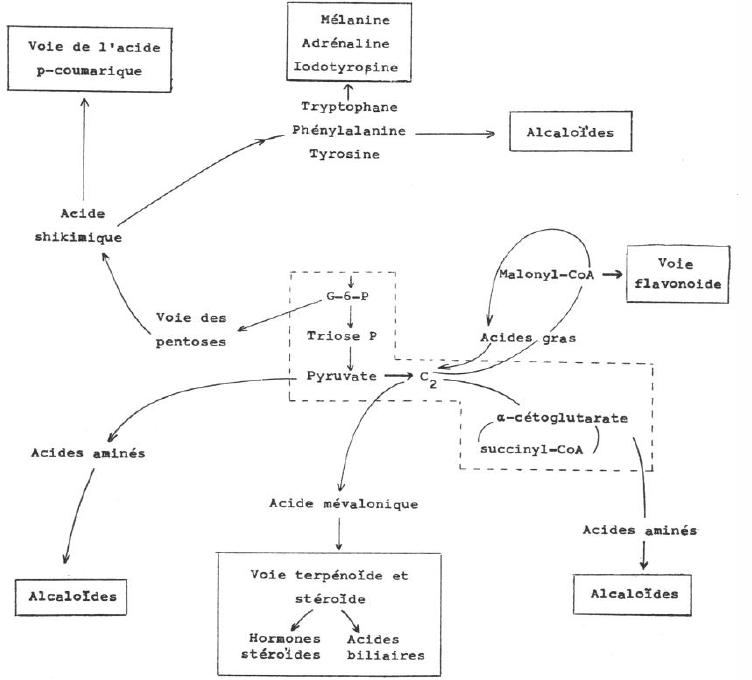
Figure labels: voie = pathway; acide p-coumarique = p-coumaric acid; mélanine = melanin; adrénaline = adrenaline; iodotyrosine = iodotyrosine; tryptophane = tryptophan; phénylalanine = phenylalanine; tyrosine = tyrosine; acide shikimique = shikimic acid; pentoses = pentoses; acides gras = fatty acids; acides aminés = amino acids; alcaloïdes = alkaloids; voie flavonoïde = flavonoid pathway; acide mévalonique = mevalonic acid; voie terpénoïde et stéroïde = terpenoid and steroid pathway; hormones stéroïdes = steroid hormones; acides biliaires = bile acids; α-cétoglutarate = α-ketoglutarate. G-6-P, triose P, pyruvate, C₂, malonyl-CoA and succinyl-CoA retain their diagram notation.
[1542] In a short book published in 1944, L’Évolution biochimique (Paris, Masson, 1944), I introduced the notion of molecular transformism underlying the transformism of organisms, before the advent of molecular biology, which came to provide brilliant confirmations of this concept. The notion of biochemical evolution was at first fiercely opposed. Despite appearances, it still has determined opponents. Here again we are dealing with epigenetic aspects, and I myself have proposed replacing the expression “biochemical evolution” with “diachronic molecular epigenesis”,[1542.1] and employing the concepts of molecular biosemiotics in the study of this epigenesis.[1542.2]
In comparative biochemistry, we shall call biomolecules isologous when they are related from the chemical point of view. When this relationship can be recognised as incapable of being an effect of chance and as attributable to molecular transformism, we shall recognise it as the sign of a homology.[1542.3] Whereas there are degrees of isology, homology, a genetic concept, either exists or does not: it implies a common origin within a molecular lineage in the course of molecular transformism. A degree of isology greater than probability allows us to predict reveals the homology of serial and serially ordered biomolecules such as nucleic acids and protein polypeptide chains. The term analogy will apply to biomolecules displaying the same biochemical activity (Fig. 3). Determination of the primary structure of a series of proteins—that is, [1543] of the sequence of amino acids entering into their composition—has already made it possible to recognise a number of protein lineages (Table I).
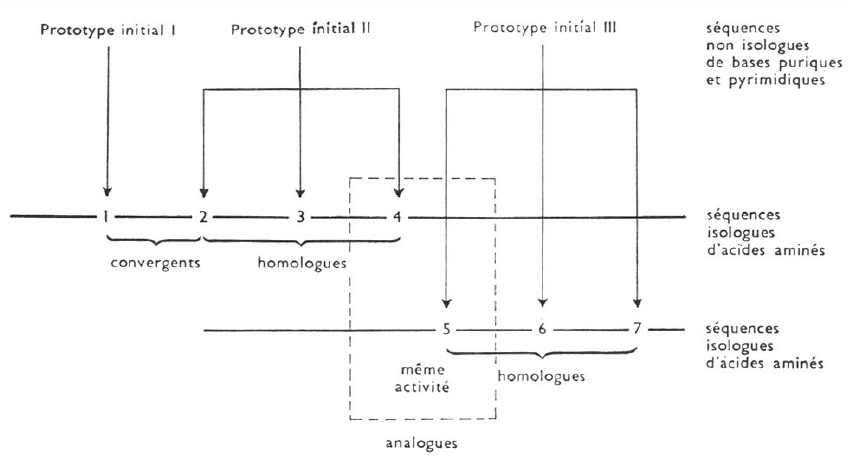
Figure labels: prototype initial = initial prototype; séquences non isologues de bases puriques et pyrimidiques = non-isologous sequences of purine and pyrimidine bases; séquences isologues d’acides aminés = isologous amino-acid sequences; convergents = convergent; homologues = homologous; même activité = same activity; analogues = analogous.
From a lineage, one can reconstruct the genealogy of the organisms to which the proteins belong (Fig. 4). Whatever lineage is chosen, the method of comparing amino-acid sequences and their degrees of isology yields the same genealogical tree that biologists established on the basis of comparing forms and knowledge of embryogeny. This is another reason for placing greater confidence in classical phylogeny, and also a reason for regarding organismic transformism and molecular transformism as two aspects of one natural reality.
[1544] Table I. Polypeptide-chain lineages (references in Dayhoff; see note 1531 (2)).
- All cytochromes c.
- Two scorpion neurotoxins.
- The various chains of a haemerythrin.
- Melittin (bee venom)—bombinin (amphibian skin).
- Eledoisin (cephalopod venom)—physalaemin, phyllomedusin, ranatensin, alytesin, bombesin (amphibian skin)—substance P of the mammalian hypothalamus.
- Type I and type II snake toxins; secretin; glucagon.
- Amphibian kinins—mammalian kinins.
- Caerulein, phyllocaerulein (amphibian skin)—pepsin, gastrin, rennin, cholecystokinin, pancreozymin.
- Trypsin, chymotrypsin, elastase, thrombin, plasmin, kallikrein, haptoglobin β, activator of carboxypeptidase A.
- Ribonuclease, lysozyme, α-lactalbumin.
- Prolactin, growth hormone, placental lactogenic hormone.
- Glumitocin, isotocin, mesotocin, oxytocin, arginine vasopressin, lysine vasopressin.
- Trout iridines IA, IB and II; salmon salmines AI and AII; herring clupeines YI, YII and Z.
- Pepsitensinogen, angiotensinogen.
- Insulin A, insulin B.
- Trypsin inhibitor, kallikrein inactivator.
- ACTH, MSH, LPH (all C regions homologous; all V regions homologous; V and C have a very distant common ancestor).
- Myoglobins; haemoglobins.
- β chain of TSH and β chain of LH.
The table transmits the source’s historical grouping, including the parenthesis attached to ACTH, MSH and LPH.
Genetic biochemistry has revealed a series of aspects of the process involved in the diachronic epigenesis of serial or serially ordered molecules: point mutations, duplication of a gene followed by variations in one or more of the resulting genes, formation of hybrid genes, lengthening or shortening of the DNA chain, and so on.[1544.1] In the study of serial and serially ordered molecules, a genuine system can be established whose guiding concept is homology. To illustrate the significance of such a system, we may draw a comparison from architecture. If we compare the columns of various ancient temples, we are led, [1545] for example, to distinguish the Doric from the Corinthian order by establishing relations of substitutive association. By contrast, a column of an ancient temple, whatever its position in the system, stands in a certain relation to other parts of the building—to the architrave, for example. This yields a syntagmatic relation of the same order as that prevailing, for instance, between biosemes associated in a primary biosyntagm, or between the enzymes of a catenary biosyntagm, whatever their place in the polypeptide lineages.
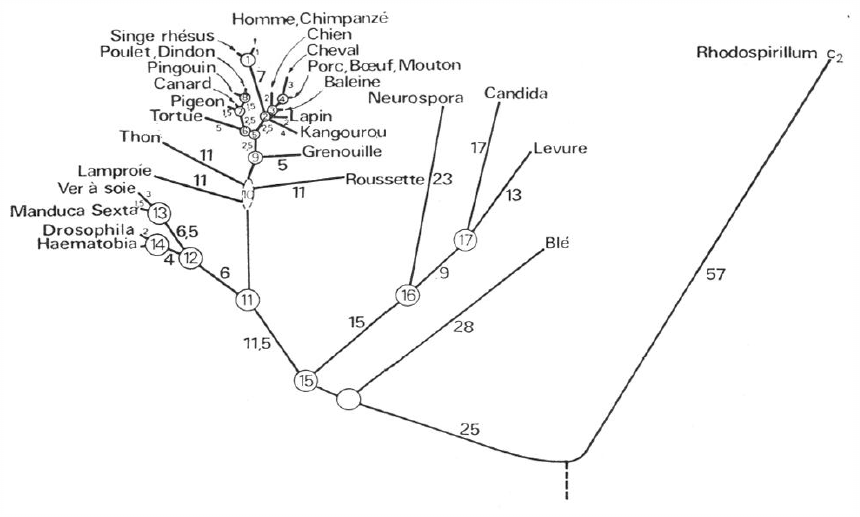
Figure labels: homme, chimpanzé = human, chimpanzee; singe rhésus = rhesus monkey; poulet, dindon = chicken, turkey; pingouin = penguin; canard = duck; pigeon = pigeon; tortue = turtle; thon = tuna; lamproie = lamprey; ver à soie = silkworm; chien = dog; cheval = horse; porc, bœuf, mouton = pig, ox, sheep; baleine = whale; lapin = rabbit; kangourou = kangaroo; grenouille = frog; roussette = dogfish; levure = yeast; blé = wheat. The scientific names Manduca sexta, Drosophila, Haematobia, Neurospora, Candida and Rhodospirillum c₂ are retained.
Cases of molecular transformism are recognised in which only the signifier varies, the signified being maintained. Cytochrome c is an example (Fig. 4). Much more attractive to the transformist are cases in which both molecular signifier and signified vary during phylogeny, and which may be called commutations.
[1546] To understand the transformism of catenary biosyntagms, we must go beyond the teachings of genetic biochemistry and enter the forest of Brocéliande that is comparative biochemistry.[T7]
In what precedes, I have presented, among the concepts of biosemiotics, that of homology applied to the serial or serially ordered molecules of nucleic acids and polypeptide chains. More delicate is the recognition of homology when considering the many non-serially ordered molecules resulting from the biosynthetic activity of assembly lines formed from enzymes, which are protein in nature and each result from a particular flow of information. The concept of homology can be extended to catenary biosyntagms displaying the same sequence of enzymes and whose constituent enzymes are homologous from one species of organism to another. The products of the operation of homologous enzymatic chains will be recognised as displaying indirect homology (Pauling and Zuckerkandl’s episemantides[1546.1]), as opposed to the direct homology of serial or serially ordered macromolecules (Pauling and Zuckerkandl’s semantides[1546.1]).
Half a century of investigations has led to the recognition that primary catenary biosyntagms—the main roads traversing the depths of the forest—have not, over time, despite the multiplicity of point mutations, undergone essential modifications of their chain-like aspect, and that their number has remained limited. What transformism has essentially accomplished at the backbone of catenary biosyntagms consists in the refinement of allosteric regulation. Thus it is essentially through an evolution of regulation that transformism has exerted its effects in this domain.[1546.2] By contrast, a profusion of lateral or terminal extensions, or lateral or terminal deletions, can be seen to bring about variations in catenary biosyntagms. This principle, which I proposed long ago[1546.1] under the rather poorly chosen name of biochemical orthogenesis, locates variations in catenary biosyntagms at the level of lateral or terminal extensions of a limited number of major pathways, which [1547] do not multiply during molecular transformism. This principle is now confirmed by a great many observations, although, as in all aspects of biology, we must always remain alert to the possibility of convergence. Another aspect of the same concept is recognised in the frequent observation of a collinearity between the biosynthesis of biomolecules and their phylogeny—that is, their transformism during the transformism of organisms. In the case of the catenary biosyntagm of porphyrin biosynthesis, Granick[1547.1] expressed this strikingly when he wrote: “Biosynthesis recapitulates biogenesis.” But the most striking example of this collinearity is provided by the terpenoid and steroid pathway, particularly at the extension that results in bile-acid biosynthesis, a synthesis present in vertebrates and studied in exemplary fashion by Haslewood.[1547.1]
The emergence of a terminal or lateral metabolic extension on a catenary biosyntagm presupposes the extraction of new bearers of biosemes from the system of protein lineages. I would like to take as an example, in vertebrates, the emergence of a lateral extension of the catenary biosyntagm of galactolipid synthesis: the extension governing another aspect of the biochemistry of lactation, lactose biosynthesis. The stages of diachronic molecular epigenesis in this emergence are represented in Fig. 5, prepared from results obtained by various authors, notably Brew.[1547.1] The enzyme involved in the lateral extension is extracted from the system of protein lineages during a commutation—that is, a mutation bringing about a change in both signifier and signified. The particular aspect of extraction from lineages here takes the form of a commutation of lysozyme into α-lactalbumin, presumably during a duplication of an ancestral gene. Alongside the maintenance of lysozyme in the biosyntagm of mureins, this gave rise to a new gene, that of α-lactalbumin, which, through its binding as a ligand, produces a configurational change in the acetylglucosamine synthetase belonging to the catenary biosyntagm of glycoprotein biosynthesis. This configurational modification resulting from [1548] ligand binding brings about a modification of the signified of the acetylglucosamine synthetase molecules at which this binding occurs. The complex bears the bioseme or biosemes corresponding to the signified of lactose synthetase, which catalyses lactose formation from glucose and one of the intermediates of the galactolipid pathway, UDP-galactose.[T8] There is nothing mysterious about the signified. Once identified, it falls within the chemical properties of the biomolecule. Detectable at the formation of a pair of relata, it has nevertheless often escaped the chemist who studies molecular species isolated in a pure state. As very many examples from the study of signification at the biomolecular level show, the signified considered within molecular biosemiotics involves aspects of molecular configuration at the level of a pair of relata: the pair established between the molecular sign (signifier + signified) and the molecular receiver. There is no doubt that introducing the concepts of molecular biosemiotics, at the level of both diachronic and synchronic molecular epigenesis, broadens the path leading to the reduction to chemical and physical laws of concepts long regarded as specifically biological in nature.
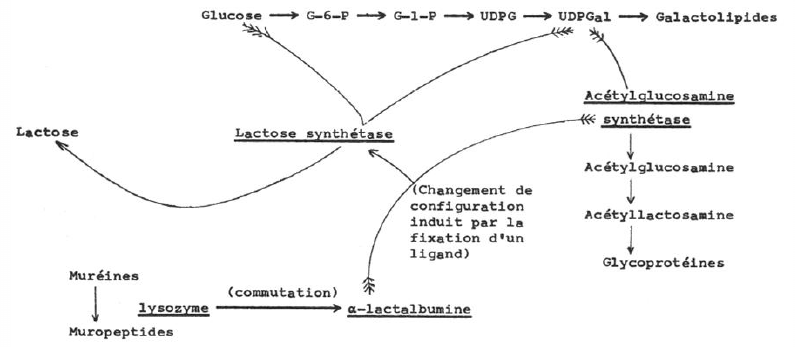
Figure labels: galactolipides = galactolipids; lactose synthétase = lactose synthetase; acétylglucosamine synthétase = acetylglucosamine synthetase; acétylglucosamine = acetylglucosamine; acétyllactosamine = acetyllactosamine; glycoprotéines = glycoproteins; muréines = mureins; muropeptides = muropeptides; changement de configuration induit par la fixation d’un ligand = configurational change induced by ligand binding; commutation = commutation. Glucose, G-6-P, G-1-P, UDPG, UDPGal, lactose, lysozyme and α-lactalbumin retain their diagram notation.
[1549] But, you will rightly say, knowledge of the methods of diachronic molecular epigenesis, even rationalised through recourse to the concepts of molecular biosemiotics, does not illuminate the whole concept of molecular transformism, since that concept is in fact defined by mutations accepted at the level of the phylogeny of organisms. To delineate this aspect, we can no longer consider one particular biomolecule, but must consider the totality of biomolecules forming an organism. It is at the level of this totality that the changes occur which bring about divergences within the gene pool of populations. These divergences result from the differential selection, through differential reproduction, of genetic variations within populations. Differential selection exerts its pressure at the level of the totality of biomolecular signifieds forming an individual in the population in which genetic divergence occurs.
Biomolecules evolve. Their diachronic molecular epigenesis brings about variations in their signifier or, in the case of commutations, variations in both their signifier and signified. As genetic biochemistry teaches us, these variations are variations in molecular order or its extensions at the level of catenary biosyntagms, which evolve not towards a multiplication of their number but, as comparative biochemistry teaches us, towards a proliferation of terminal or lateral extensions.[1549.1]
The phylogenesis of organisms and the phylogenesis of molecules are concordant. At the level of population genetics, selection pressure acts, in particular, upon the totality of an organism’s signifieds, whether recognisable at the molecular level of integration or at more complex levels of integration.
About this edition
Marcel Florkin, “La biosémiotique moléculaire et le transformisme biomoléculaire”, Bulletin de la Classe des sciences 60 (1974), pp. 1531–1549. Original publication. Version 0.1.
Bracketed numbers mark the original page boundaries. Source notes retain their original labels, qualified by page where numbering restarts. Figures and the lineage table are placed at the nearest paragraph boundary; their French labels are accompanied by English keys. Translator’s notes use T labels. The distinction between serial and serially ordered molecules follows Florkin’s terminology; historical biochemical descriptions and classifications are retained, with local explanations where needed.
T1. “Transformism” preserves Florkin’s distinction between the transformation of species or molecular lineages and the much wider notion of evolution as passage through successive phases. It does not by itself specify a particular mechanism of inheritance or selection.↩︎
T2. Sériel describes the sequence-bearing starting material; sérié describes the molecular sequence ordered through the information flow. Rendering both simply as “serial” would obscure the distinction Florkin draws between nucleic-acid series and the polypeptide chains produced through transcription and translation. “Epigenetic” here means development through successive formation of parts, as opposed to preformation; it is not restricted to the later specialist sense of heritable changes in gene regulation.↩︎
T3. “Signification” is retained as a technical term because Florkin defines it through molecular configurations and biological activities in relation. It does not here imply conscious interpretation or a linguistic message.↩︎
T4. Relata are the terms or entities standing in a relation. Florkin’s “pair of relata” is the interacting molecular sign and receiver, considered together.↩︎
T9. In the source note on this passage, the statement about Sinn and Bedeutung is retained as printed. The two expressions in its example refer to the same person while presenting him differently; the sentence appears to reverse the distinction just introduced.↩︎
T5. The sequence retains the printed abbreviation “Try” for tryptophan, normally abbreviated Trp today. The historical account of ACTH and its proposed functional regions is preserved.↩︎
T6. “Catenary” means arranged as a chain. Here the chain is a sequence of enzymatic actions constituting a metabolic pathway; it need not be a physically continuous chain of enzyme molecules.↩︎
T7. Brocéliande is the legendary forest of Arthurian romance. The image prepares Florkin’s contrast between established metabolic “main roads” and their many lateral and terminal extensions.↩︎
T8. The enzyme name “acetylglucosamine synthetase” is retained from the source. The passage describes a change in the activity of an enzyme complex brought about by α-lactalbumin binding, and uses that example to distinguish a change in signified from a merely quantitative modulation. Its nomenclature should be read as part of this historical account.↩︎