Containment and many-sidedness: a comparative study of Jain and Aristotelian logics
Introduction
Where we have the Philosopher, Aristotle, Jain philosophy has Mallavadi—literally, “Theory Wrestler.” It is said that around 300 A.D. Mallavadi once debated a Buddhist philosopher for six straight days and nights, with the argument ending only when his opponent dropped dead.1 Burch, ‘Seven-valued logic in Jain philosophy,’ p. 76. When we turn to his writings, we can perhaps see how this might happen. His most impressive text, the Nayacara or “Wheel of Isms,” outlines a meta-theory of all possible theories; each chapter outlines a possible form, as illustrated by actual theories; and each is then refuted at the start of the next.2 Ibid, p. 76. The twelfth and final chapter is refuted by the first, thus creating an eternal cycle of argument and refutation. Now, we might well call him a sophist, even if only to avoid having to debate him; but how are we to make this case? If we are to understand Mallavadi, or those like him, then the obvious place to begin would be with Jain logic—something like but not ours. This essay will examine Aristotelian and Jain logics from the perspective of their background metaphorics and in light of a series of puzzles. The focus here will be the classical logic, represented by Aristotle, as a logic of containment; and Jain logic, in line with the doctrine of anekāntavāda, as a logic of ‘many-sidedness.’ These structures will be inspected to determine that which they respectively highlight and hide, with particular attention to the problem of vagueness as a hard case that has tested the limits of each.
All formal logic entails a specific metaphysics, one which from within may appear entirely natural but is usually by no means the only option. Indeed, even formal logic itself has not been a historical necessity. Instead we find that the ancient history of formal logic has been constrained to Greece and India, and there are linguistic differences specific to the Proto-Indo-European root that may explain its preponderance in this specific branch.3 Bocheński, A History of Formal Logic, p. 10. While there may have been intellectual trends approximating this elsewhere, none ever coalesced into anything quite like a formal logic. One suggestion is that the default subject-verb-object word order of Indo-European languages—which include Sanskrit, Greek, and English alike—tends towards the objectification of knowledge:
This structure implies that all action arises in a separate entity, the subject, and that, in cases described by a transitive verb, this action crosses over the space between them to another separate entity, the object.4 Bohm, Wholeness and the Implicate Order, p. 36.
Bohm points, for instance, to the sentence ‘It is raining’:
Where is the ‘It’ that would, according to the sentence, be ‘the rainer that is doing the raining’? Clearly, it is more accurate to say: ‘Rain is going on.’5 Ibid, p. 37.
That the Indo-European word order thus tends towards the fragmentation of knowledge into enduring objects may render such languages particularly amenable to intellectual techniques approximating formal logic—or perhaps simply to our recognising them as such. Whatever the case, within those Greek and Indian branches of logic that did develop into something resembling a formal logic, there are both broad similarities and stark differences. To begin, however, we might now return to the historical roots of the Greek logic which has constituted so important an aspect of our cultural inheritance.
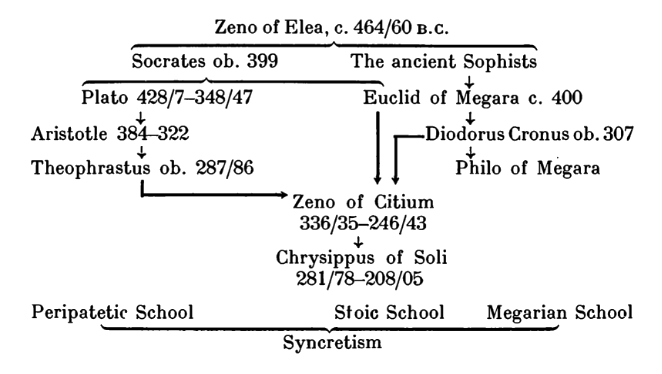
We might note Zeno’s position at the top of this chart and ask, what of Parmenides? For here our investigation touches on metaphysics and in this Zeno was a student of Parmenides. His famous paradoxes were intended to defend the views of his teacher. Of Parmenides we might recall that he spoken of two ways: that of truth and that of opinion. To the former he accorded little, what fragments remain paint a relatively simple picture—albeit one which may be hard to grasp, which was perhaps precisely the point. Parmenides insisted on the impossibility of our ever truly grasping Being, which he saw as the eternal and changeless ground of all existence. We might see this way of truth as an apophatic prior, an imagistic limit of knowledge by which we orient ourselves when speaking in the other way—that of appearance and opinion. Now in the way of opinion, here we would find all formal logic. Parmenides saw there was very little of positive substance that could be said of Being beyond his apophatic imagery. What mattered was less a proposition drawn from this truth than the transformation of thought that ensued on acquiring a proper metaphysical ground. How then do we find Zeno of Elea attributed by Aristotle as the ‘founder of dialectic’?6 Ibid, p. 26. Some evidence of this can be found in his paradoxes, now thought of as logical paradoxes. These were initially intended only as objections to pluralism rather than as proofs of the utility of logic—and yet, true enough, our adversaries are often the best teachers. Zeno’s distinctively logical defence of Parmenides may thus be seen as providing a template for later thought, then divorced from its original context. This would explain the influence accorded to Parmenides and Zeno in the founding of Greek logic. While they did not advocate directly for it as a formal method, they were the progenitors of a style of argument that would eventually, in the hands of Aristotle, take the form of classical logic as we know it.
Here we might compare Parmenides to Plato, who rejected the incomprehensible wholeness of Being; instead he posited an idealism in which being was somehow distributed between supernatural ideas. Of course, he never precisely defines these ideas or outlines how to distinguish them from normal ideas. Still, the idea stuck. Aristotle was a student at Plato’s academy and his philosophy can be understood as an answer to this question implicit in Plato: how are we to sort between mere ideas and Truth? This, say some, is the task of logic. Here we will discuss two forms of logics, specifically that of Aristotle and Jainism. These are true alternatives, rather than mere extensions, insofar as each particular metaphysics corresponds to differences in their respective background metaphorics. By this we mean that the inferential structure and basic principles of each can be seen to follow systematically from their central image schemas: for Aristotle, that of containment; and for Jain logic, that of anekāntavāda or many-sidedness. We will begin, therefore, by setting out these two forms and highlighting their primary features—and in particular, the ways in which they differ. For each we will begin, as stated, with their central background metaphoric. This entails our considering the language used to describe them, particularly the respective image schemas which underly each, as something more than figurative. Instead we will trace the ways in which the structures of these logic can be seen to follow from these schemas. This line is drawn from work in cognitive linguistics which demonstrates the possibility of ‘generative analogies’—wherein more concrete image schemas are drawn upon to provide an inferential structure for abstract thought. Broadly, we will find that containment and many-sidedness lead to very different logical structures with their own respective strengths and weaknesses.
The Aristotelian logic of containment
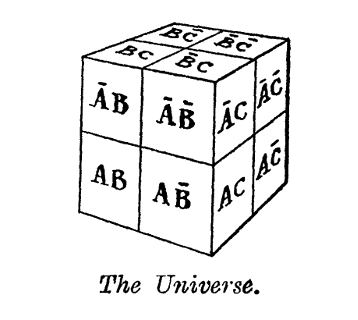
Even logic must set out from some point—in other words, must always entail some basic metaphysics. We will here address this specifically in terms of a background metaphoric, something akin to the eponymous ‘figure in the carpet’ in the story by Henry James:
It stretches, this little trick of mine, from book to book, and everything else, comparatively, plays over the surface of it. The order, the form, the texture of my books will perhaps some day constitute for the initiated a complete representation of it.7 James, The Figure in the Carpet, p. 23–24.
The idea, in other words, is that the figurative language in which a logic is couched is more than mere ornament or illustration—rather it can be seen as expressive of the inferential form which that logic takes. This notion springs from work in cognitive linguistics, particularly by Lakoff and Johnson.8 See Lakoff and Johnson, Metaphors We Live By and Philosophy in the Flesh. The central insight is that metaphor involves the mapping from a concrete domain onto one more abstract so as to provide an inferential structure upon which thought can then be scaffolded.9 Lakoff and Johnson, Metaphors We Live By, p. 61. Electricity, for instance, be understood mathematically or by folk metaphor—as flowing waters or teeming crowds.10 Gentner & Gentner, ‘Flowing waters or teeming crowds: mental models of electricity.’ These alternative metaphorical understandings of electricity are correlated, moreover, with relative variations in performance on experimental tasks designed to isolate the respective strengths and weaknesses of their mappings. Each metaphor hides as much as it highlights; e.g., the crowd metaphor has no structural analogue for batteries and hence struggles on questions which specifically test this aspect. Of course, here we are not concerned with electricity but logic. But for our purposes, the above case nevertheless provides a strong proof of concept from which we may proceed.
For Aristotelian logic, this fundament is expressed by a metaphorics of containment. This can be seen, for instance, in Aristotle’s describing predication as analogous to inclusion in a container: “That one term should be included in another, as in a whole, is the same as for the other to be predicated of all of the first.”11 Aristotle, Prior Analytics 24b. Aristotle understands predication, in other words, as containment. Something similar is found even of the syllogism, wherein the background metaphorics of containment is also made explicit by Aristotle:
Whenever three terms are so related to one another that the last is contained in the middle as in a whole, and the middle is either contained in, or excluded from, the first as in or from a whole, the extremes must be related by a perfect syllogism. I call that term “middle” which is itself contained in another and contains another in itself.12 Aristotle, Prior Analytics 25b.
This leads Lakoff and Johnson to characterise Aristotelian logic as a “container logic,” wherein categories are understood metaphorically as containers.13 Lakoff & Johnson, Philosophy in the Flesh, p. 380. But whereas one might suppose Aristotle to be speaking metaphorically or figuratively, they further find that this container schema can be plausibly seen to systematically determine the form of his three basic principles of logic: the law of the excluded middle, modus ponens, and modus tollens.
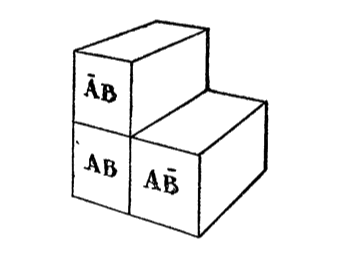
We can see the basic image schema of containment, in other words, as a generative analogy which systematically informs reasoning downstream from it. Taking particular note of the word ‘generative’ here, we may now turn briefly to the ‘paradox of the syllogism’ as outlined by Gilman:
The syllogism has been a paradox ever since it was invented. The conclusion, if it impose itself upon us, does not, in the usual phrase, “go beyond” the premises; yet it seems to give us new knowledge. The deduction of mathematics, strictly so-called, form an immense body of necessary truth before unsuspected, yet they all consist of propositions each of which is already “contained in” previous propositions. This is assuredly a disconcerting difficulty and one not finally overcome by the current explanation that a syllogism “brings out” the necessity of a conclusion that was not before in our minds. If it was not before in our minds, how is it necessary? The puzzle remains.14 Gilman, ‘The paradox of the syllogism solved by spatial construction,’ p. 38.
Gilman sought to resolve this paradox by a method well aligned with that which we have here put forward:
Propositions and the syllogism in which they are combined may be represented as spatial facts; and the representation proves to give a visible answer to the question of how the syllogism advances while compelling thought.15 Ibid, p. 38.
Taken together, we might thus argue that the metaphorics of containment determines not only the particular form of Aristotelian logic—and of all logics which adopt its basic structure—but that, in doing so, this schema also provides the generative capacity for logical inference that we thereby acquire. The knowledge ‘produced’ by a syllogism is knowledge by virtue of its concordance with the metaphorics of containment, whence also it derives its apparent necessity—insofar as the actual behaviour of natural phenomena is not itself constructed but emerges from the relatively consistent laws of materiality in our immediate experience. This is the basic view which informs our approach to the container logic of Aristotle and the Jain logic of anekāntavāda alike.
The inferential structure of container logic
Turning now to the particulars, we foremost note the close analogy between the containment schema and the three basic principles of Aristotle’s logic:
| (From Lakoff & Johnson16 Lakoff & Johnson, Philosophy in the Flesh, p. 380–381. Note: “Version 1 in each case arises if A in the container logic is itself a container, and version 2 arises if it is not.” ) | Container logic | Aristotelian logic |
|---|---|---|
| The law of the excluded middle | ”Given a container and an entity, the entity is either inside or outside and not both at once.” | “An object cannot both have a property and its negative (in the same respect at the same time).” |
| Modus ponens | ”If Container A is inside Container B, and Entity C is inside Container A, then Entity C is inside Container B.” | “If all B’s are C’s and all A’s are B’s, then all A’s are C’s.” / “If all B’s are C’s and some A is a B, then that A is a C.” |
| Modus tollens | ”If Container A is inside Container B and Entity C is outside Container B, then Entity C is outside Container A.” | “If all B’s are C’s, and no A’s are C’s, then no A’s are B’s.” / “If all B’s are C’s and some A is not C, then that A is not a B.” |
Missing from this analysis is the principle of bivalence, which we may here take together with the law of the excluded middle. These two, understood in terms of the metaphorics of containment, can be seen to follow from our ordinary experience of physical containers. This is in line with Lakoff and Johnson’s argument, that metaphors are understood by the virtue of their experiential basis—the schematic structure of which is then carried over in a systematic fashion from the concrete base domain (containers) to the abstract target domain (logic).17 Lakoff & Johnson, Philosophy in the Flesh, p. 57–58. Hence we find that for any physical object in relation to a particular container, the law of bivalence clearly applies: either the object must be inside the container or outside of it. Here, however, it is not so much a logical principle or rule as the blunt necessity of being. We might understand this as Aristotle’s meaning when he claimed his logic merely reflected that of nature—in some sense, it does. Similarly, the physical boundaries of container give rise to the law of the excluded middle. We do not tend to find that the contents of our filing cabinet have somehow fused with the metal of its walls. While these doctrines of container logic are separable in abstract, in terms of our concrete experience of actual containers—from which, we argue, such a logic derives its inferential structure and generative force—each simply highlight different aspects of the same image schema. This would explain Haack’s comments, for instance, that attempts to evade paradoxes by ditching one so often remain open to the a reformulation of the same objection in terms of the other.18 Haack, Deviant Logic, p. 83–84, 114. Our argument, in other words, is that while these are separably in terms of abstract discussion they are, in fact, interwoven aspects of the inferential structure which underlies the perceived epistemic force of container logic.
The idea here is that this background metaphoric of containment reflects the metaphysical point of departure for Aristotle’s logic; as well as all those that follow him in this respect, whether directly or otherwise. But as a corollary to this, just as alternative metaphors for electricity entail measurable differences in reasoning performance, there seems the possibility of alternative starting points for logic itself.19 Gentner & Gentner, ‘Flowing waters or teeming crowds: mental models of electricity.’ These could give rise to forms of logic with radically different inferential structures. Here we intend to argue that Jain logic represents precisely such a possibility—and that, moreover, this renders it an entirely different form of logic from that which we will here call classical container logic. When it comes to logic, however, we are in a different position from the experimental case—here we have no absolute mathematical reference point against which to judge reasoning performance. How then are we to evaluate or judge between alternative logics? In many respects, our position here is akin to the Jain parable of the blind men and the elephant.
The Jain logic of many-sidedness
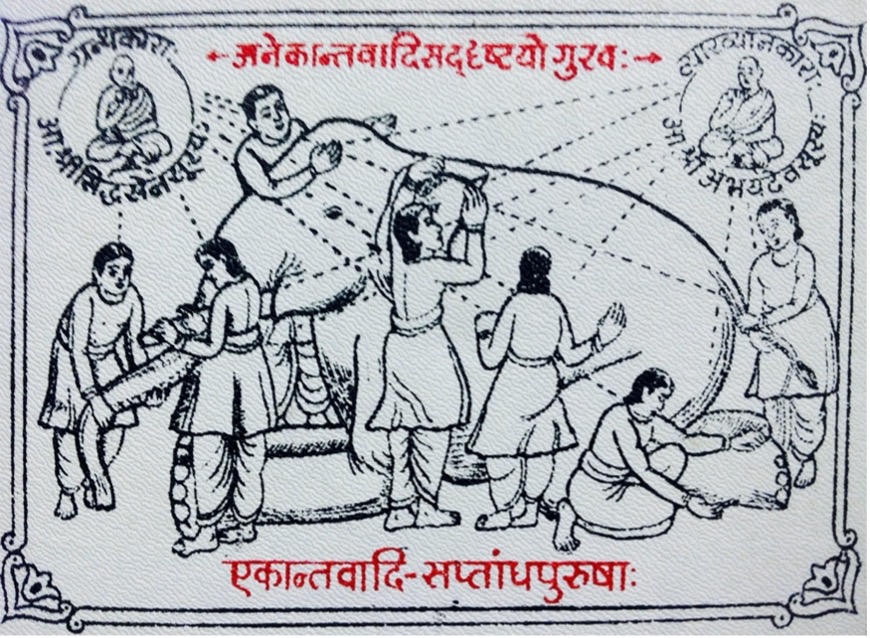
Where Aristotelian logic takes containment as its background metaphoric, Jain logic follows from the doctrine of anekāntavāda or many-sidedness.20 Burch, p. 72. And while Jainism may be largely unfamiliar for many of us most are perhaps familiar with one of its parables, albeit likely without knowing its source: the blind men and the elephant. The basic story has several blind men seeking out an elephant to discover what it is like, whereupon each identifies a single aspect and from this seeks to extrapolate its nature. One touches the elephant’s side, for instance, and exclaims that it is like a wall; another its tale, concluding it is like a rope; and so on. This parable was put into poetic form by John Godfrey Saxe, who put the moral thus:
So, oft in theologic wars The disputants, I ween, Rail on in utter ignorance Of what each other mean, And prate about an Elephant Not one of them has seen!21 Saxe, The Blind Men and the Elephant.
Of course, those of us that can see the elephant thereby understand that each man has grasped only a single aspect of the whole. But in Jain philosophy, this parable is intended to convey a far more fundamental truth about reality itself—in other words, that in our relation to reality we are all akin to blind men grasping at single aspects and mistaking them for the whole. Indeed, we can see this basic metaphor as giving rise to the basic structure of Jain logic.
As Aristotle’s logic followed from his background metaphoric of containment, so too with Jain logic and anekāntavāda. Hence we find many-sidedness reflected in, for instance, the Jain ‘theory of theories’ or nayavāda:
We should distinguish a theory in general (naya), which is a point of view; a wrong theory (durnaya), which in comprehending one point of view rejects all others; and a right theory (sunaya), which recognizes its own limitation as valid only somehow (syāt) and the alternative validity of other points of view.22 Burch, p. 73.
Taken together, nayavāda (the theory of standpoints) and syādvāda (the conditional dialectic) provide the basic logical machinery for the operation of anekāntavāda. Dancy describes the law of non-contradiction as not so much a rule of inference as a structural limit of the proper working of (container) logic.23 Dancy, Sense and Contradiction, p. 11. We must be careful here not to give the impression that Jain logic is characterised by an outright acceptance of contradiction. That is not what is meant here, as will become clear in due time. This is, however, a common misconception. But as can be seen even in the above quote about nayavāda, the Jains take great care to circumscribe every naya is relative to its appropriate standpoint. The same can be said for how Jain logic is shaped by its background metaphoric of many-sidedness, whence arises the perspectival limits outlined in the twin doctrines of syādvāda and nayavāda. These do not so much say what ought to be inferred or how, rather they are the basic structure within which all Jain logic must operate.
Nayavāda (the theory of standpoints)
Padmarajiah describes anekāntavāda as a bird, of which the first wing is nayavāda or the theory of standpoints. While focus will be on the second wing, that of syādvāda, it would be best to here at least adumbrate the whole bird. The theory of standpoints, in brief, can be seen to follow as half of a systematic implementation of the fundamental insight of anekāntavāda. While theoretically there are infinite perspectives from which a thing might be perceived, Jain philosophers sought to provide “a methodological scheme consisting of seven ways of looking at reality.”24 Padmarajiah, A Comparative Study of the Jaina Theories of Reality and Knowledge, p. 313. This entails a broad categorisation of nayas (standpoints) into categories that deal with different aspects of reality. We might best illustrate this by comparing two such viewpoints: saṅgrahanaya (the class view) and vyavahāranaya (the standpoint of the particular). Saṅgrahanaya “concerns itself with the general or the class character of a factual situation,” for instance:
… when point to a solitary tree at some distance from you, you observe to a stranger asking for direction, “turn left near the tree there,” it is not relevant to the occasion to mention whether “the tree there” is mango, banyan, or any other, although “the tree” must be one of these.25 Ibid, p. 317.
This can be directly contrasted with the standpoint of the particular, or vyavahāranaya, which concerns precisely those particularities which saṅgrahanaya overlooks in general perspective. Of course, here as much as the prior case, the aspects thus highlighted are understood to exist in relation to those hidden by the standpoint adopted. Each standpoint is only a partial truth that ultimately depends on its interrelation to the manifold reality more broadly. Padmarajiah illustrates vyavahāranaya by returning once again to the mango:
For example, when a person is asked to bring a mango fruit he attempts to bring mango, but not any other fruit, although he is aware of the fact that mango is only a species in the genus of fruit.26 Ibid, p. 318.
The two nayas discussed thus far, saṅgrahanaya and vyavahāranaya, can be distinguished as concerning “the durable side of concrete reality.”27 Ibid, p. 318. Beyond these, there are a further four which concern the momentary nature of things. These can be further split, with only one entailing direct reference to ontology and the others involving purely verbal concerns. Ṛjusūtra (the standpoint of momentariness) is even narrower than vyavahāranaya in that it treats not only the thing as particular but also in its particular appearance in that moment: “for instance, [when] we treat an actor, who is enacting the role of a king on stage, as the king for the moment.”28 Padmarajiah, p. 319–20. Of the verbal nayas, we might take up two in comparison to demonstrate their focus. Śabdanaya (the standpoint of synonyms) takes the meaning of a word as equivalent across synonymic forms; hence, “the words Indra, Śakra, and Purandara denote one and the same individual in the same manner as the words globe, orb and sphere denote one and the same circular entity.”29 Ibid, p. 321. Samabhirūdhanaya, in contrast, separates the meaning of apparent synonyms by reference to their respective etymological roots:
The synonyms Indra, Śakra and Purandara denote, according to the convention approach of śabdanaya, the same individual whereas they do not do so if their difference in their etymological derivation is taken into consideration. Indra, for instance, signifies one who is ‘all prosperous’ and the other two names signify one who is ‘the all powerful’ and ‘the destroyer of the enemies’ respectively.30 Ibid, p. 321–322.
First there is the analytic method of nayavāda, whereby reality is decomposed into various standpoints; then follows a synthetic method in the form of syādvāda—to which we now turn.
Syādvāda (the conditional dialectic)
The second wing of anekāntavāda is that of syādvāda. This entails a synthetic method—as opposed to the analytic nayavāda—which “further investigates the various strands of the truth delivered by a naya, and integrates them into a consistent and comprehensive synthesis.”31 Ibid, p. 333. While we shortly address the theory of predication which follows from this, first there are two preliminary terms of the utmost importance: ‘syāt’ and ‘eva.’ Priest suggests the former, syāt—from which syādvāda receives its meaning—may translated colloquially as “perhaps” or “may be.”32 Priest, ‘Jaina logic: a contemporary perspective,’ p. 264. We must be careful here to clarify that such colloquial definitions have no place in Jain logic, the importance of properly defining syāt if we are to understand Jain logic can hardly be overstated. Taking these two definitions, then, why are they inappropriate?
These definitions—“perhaps” and, in particular, “maybe”—must be clearly distinguished on the basis of their suggesting a question of epistemology or probability. This ambiguity threatens incoherence with the central ideal of anekāntavāda. Specifically, these translations leave open the possibility of one way or the other in which, in actuality, it perhaps is or may be. This can be seen as making it more a problem of epistemology, one that may be surmounted someday. And yet here the proper implication is not that of an epistemological query; rather syāt reflects a metaphysical truth about the fundamental nature of reality—i.e., anekāntavāda. Just as we saw for the logic of containment, here too the basic structure reflects its corresponding metaphoric. The universe which emerges from anekāntavāda via the operation of syādvāda is manifold and many-sided. While a basic sense of containment remains, this is subsumed within a wider system which must be understood on its own terms rather than by superimposing our own:
It is of paramount importance that a philosophical theory or method must be first understood in terms of its own canons or motives before it is subjected to any critical examination by alien criteria.33 Padmarajiah, p. 372.
It is concerning, therefore, to see Priest comment at the very outset: “the mathematical techniques developed in the West can be applied just as well to traditional Indian logic.”34 Priest, p. 263. Here we might think of Chesterton’s comment that the head can be beaten until it fits the hat.35 Chesterton, What’s Wrong with the World, p. 14. For our part, we intend to make no such assumptions—instead our aim is only to allow the metaphoric of anekāntavāda to unfold itself as we consider in turns it many sides and manifold aspects. Throughout this process we have little choice but to proceed by egocentric anchoring and adjustment as the figure reveals itself. This is the particular importance of syāt for the unfamiliar: its presence is a constant reminder that every piece in Jain logic is laid upon the foundation of anekāntavāda.
Instead we will translate syāt, in line with Burch, as somehow. What is intended, in other words, is that syāt qualifies the proposition as conditionally true “from a certain point of view” or “in a certain sense.”36 Padmarajiah, p. 338. This emphasised by the second term: ‘eva’—which Padmarajiah translates as “only” or “certainly.”37 Ibid, p. 339. We thus find that for each standpoint the predicate is qualified as being ‘certain in some respect.’ This respect, we might add, is relative to the particular perspective assumed—eva does not apply beyond the proper bounds of each aspect as indicated by syāt. Of course, this clearly contradicts such translations of syāt that would impute to it anything to do with epistemology or probability—to thus combine syāt and eva would be contradictory to the point of nonsense. And yet time and again in Jain philosophy they are found together, surely we would not attribute such a basic confusion to so venerable a tradition. Instead, taken together, ‘eva’ and ‘syāt’ must be understood as securing in tandem the central notion of anekāntavāda in the peripheral machinery of Jain logic:
… whatever the aspect represented by a mode, under the conditional method of sevenfold predication the term ‘syāt’ is an invariable accompaniment of the mode for the very reason that it suggests that the determinate context of the mode is carved out as it were from the indeterminate richness of reality, and the term ‘eva’ holds forth the determinate context in its clear outline.38 Padmarajiah, p. 340.
Padmarajiah further notes that these terms are better seen as verbal reminders than fundamental ingredients. They instead serve mainly to signify the implicit structure of anekāntavāda upon which the whole edifice of Jain logic is built. Even where they are not stated expressly, their meaning is carried through by the ever-present doctrine of anekāntavāda.
We have here noted that Burch translates syāt as somehow; and moreover, that we must be careful in translating Jain terms to ensure they align with the doctrine of anekāntavāda. The idea, in other words, is that the question a proposition asks—and hence its possible answer—is determined by the many-sidedness of that to which it is intended to correspond. When we look at a tree, for instance, it is not whether one or the other side is the tree’s true face; rather it is somehow this when we stand here, that when we stand there. We might imagine two people standing on opposite sides of a tree and arguing which was its front, which the back. Neither is solely correct. Somehow each is its front, somehow each is its back, somehow it is indeterminate. If we took syāt as meaning “maybe” or “perhaps” instead, this would suggest that one side—perhaps in the mind of God, for instance—may well be the ‘true’ front or back of the tree. To accept this would be to neglect anekāntavāda, as the central concept of Jainism; it is only via reorienting ourselves from this basis in many-sidedness that we can come towards a respectful understanding of its particularity. Jain logic is no mere superficial reformulation of that with which we are familiar but is rather the considered product of a philosophical civilisation at least as ancient as the Greeks.
Saptabhaṅgī (the theory of sevenfold predication)
Saptabhaṅgī is the ‘theory of sevenfold predication.’39 Padmarajiah, p. 334. Burch has interpreted this as representing a seven-valued logic, with each predicate corresponding to a truth-value.40 Burch, p. 80–81. He has further opposed this to the two standard values of classical logic, which he describes as emerging from the law of the excluded middle. As opposed to this law, also known as the law of the excluded third, he proposes that Jainism has a “law of the excluded eighth.”41 Burch, p. 81. Again, we must keep in mind the earlier call to understand Jain logic on its own terms. While Burch deserves credit for bringing early attention to Jain philosophy in the United States, we can here call into question this understanding of saptabhaṅgī. Specifically, if each predicate is qualified with ‘syāt eva’—and is thus certain insofar as its particular standpoint applies—how can call these “truth-values” in anything like the standard sense of the term? A better view might be to see the categorisation of nayas into sunaya (wrong theory) and durnaya (right theory). ‘Syāt eva’ is, moreover, held to be implicit in the metaphysical foundations of the entire Jain logical structure. All this points to a perspective where, instead of seven truth-values, there is in fact only one throughout all seven modes of predication: namely, syāt eva. While each predication is ineluctably relative to a certain standpoint it is simultaneously taken to be certain—so long as it remains within its proper bounds. Following this, it is perhaps more accurate to say that there are two truth-values: partial and improper. One way to interpret this is by considering that anekāntavāda alters even the meaning of truth itself. Jain philosophy does not see truth as anything resembling a definite container. Indeed, from this perspective the very idea of a “truth-value” can be seen as itself an artifact of the basic container schema—with the truth value representing the binary of containment. Jain logic, in contrast, is much less interested in determining whether a proposition falls within this or that container, true or false; rather it follows the singular syāt eva in tracing the many sides of reality throughout the saptabhaṅgī.
Contrary to Burch, therefore, saptabhaṅgī holds simply that for any single thing there are at least seven alternative angles from which it can be seen; and hence, several partials aspects which can be highlighted. From the central doctrine of anekāntavāda, moreover, this theory inherits the basic notions of many-sidedness and relative truth: each angle is true in itself but no further than that—precisely as signified by syāt eva. The theory of sevenfold prediction, in other words, aims to systematically synthesise the several angles of any given reality so that its manifold nature might thus be verbally illumined. This effort is conducted under the principle of anekāntavāda, which fundamentally informs the particular shape of this logical method. Saptabhaṅgī foremost entails seven modes or predications, which Padmarajiah illustrates with reference to his staple example—a jar.
The seven modes are:
- In a certain sense, the jar is.
- In a certain sense, the jar is not.
- In a certain sense, the jar is and is not.
- In a certain sense, the jar is inexpressible.
- In a certain sense, the jar is and is inexpressible.
- In a certain sense, the jar is not and is inexpressible.
- In a certain sense, the jar is, is not and is inexpressible.42 Padmarajiah, p. 341–342.
It is immediately obvious that there are three primary concepts here: is (asti), is not (nasti), and is inexpressible (avaktavya). These are further combined, either explicitly or expressly, with ‘syāt’ and ‘eva.’ Notably, the third predicate should be understood as including ‘syāt’ twice: somehow the jar is, somehow the jar is not. This resolves the objection often levelled at the third predicate, wherein it is alleged to be contradictory. Instead what is held is that somehow (in one respect) the jar, for instance, is and somehow (in another respect) it is not. There is thus no contradiction here insofar as the dual-syāt holds these aspects apart as much when they are expressed sequentially as between, for instance, the first and second predicate. The same holds true throughout the saptabhaṅgī, whereby apparent contradictions are confined to their partial standpoints by the ever-present syāt.
To further demonstrate the method of sevenfold predication in its application to concrete case, we will here quote an example from Burch:
Did Lincoln free the slaves? [1] Somehow he did, since he signed the Emancipation Proclamation; [2] somehow he did not, since they were legally freed by the Thirteenth Amendment; [3] somehow it is indeterminate, if you consider both these events simultaneously, and wonder whether the slaves were free meanwhile; [4] somehow he did and did not, if you consider the two events successively, as in writing a history; [5] somehow he did and it is indeterminate, if you are discussing the proclamation and its consequences; [6] somehow he did not and it is indeterminate, if you consider the amendment with reference to the ambiguous status of the previously emancipated slaves; [7] somehow he did and did not and it is indeterminate, if you propose to give an account of the proclamation and its constitutional sanction and its immediate effect on the status of the slaves.43 Burch, p. 87.
Of these modes of predication, the third and fourth strikes as the most unusual. One question, as we have noted, is whether the third predicate entails a contradiction. Here we must keep in mind, to begin, the qualifier syāt—which is present twice in the third predicate as syāt asti (it is) and syāt nasti (it is not). From this we see the contradiction is only apparent, that the third predicate is instead to be understood as entailing the successive consideration of separate aspects from the respective viewpoints which circumscribe their reality. This is emphasised by the specific formulation of syāt but also follows more broadly from the implicit metaphoric of many-sidedness per the central doctrine of anekāntavāda. We might thus better describe saptabhaṅgī as representing not a many-valued logic but a many-angled logic.
Avaktavya
We might here examine in particular also the fourth predicate: avaktavya. There is some question here as to meaning of this, much of which hinges on the notion of syāt as already addressed. Priest, for instance, suggests this may best be understood as meaning “both true and false.”44 Priest, p. 268. Of course, were this the case then we might suspect avaktavya of being redundant in light of the third predication. Priest concludes—after considering also “neither true nor false,” and finding these arguments unsuccessful: “It may well be that different Jains conceptualised [this] in different ways, or were even just plain confused about the matter.”45 Priest, p. 269. Priest, we have noted, stated at the outset his intent to bring Jain logic into accord with the mathematical techniques of Western logic; and moreover, that “the Jaina ideas can be made perfectly rigorous with the techniques of modern logic.”46 Priest, p. 263. At this we might instead wonder whether it is not Priest himself that is confused. He notes early on, for instance, that he knows no Sanskrit and hopes “that the present project can be accomplished without straying too far beyond the bounds of my limitations.”47 Priest, p. 263–264. And yet here we find him, mere pages later, effectively accusing the entire lineage of Jain philosophers of being confused.
To actually understand avaktavya we might instead look to some various translations of the term: ‘unutterable’ according to Thomas, ‘indescribable’ according to Dhruva, ‘inexpressible’ according to Matilal.48 Jain, ‘Saptabhaṅgī: the Jaina theory of sevenfold predication,’ p. 391. Most importantly, however, we must take the term itself seriously. For Priest, upon encountering avaktavya, which he translates as “non-assertable,” immediately sets about searching for an answer as if it was all a simple mistake—we will not follow this line. Instead we may note that each of the various translations we have thus far encountered draws our attention to the individual rather than the object of their predication. This aligns with the etymological root of avaktavya: “to speak.”49 Jain, p. 391. The concern, therefore, is with the speaker rather than the object of their predication. There are two ways of interpreting this: either as normative or descriptive.50 Jain, p. 391. One interpretation is that it is simply impossible for a speaker to say, and this is reinforced by early commentary which emphasises a thing is “unable to be stated”—and hence, avaktavya—“from the lack of all forms of expression.”51 Dhruva in Jain, p. 392. Alternatively, avaktavya could be read as a normative principle: that to say as much is prohibited. This seems possible, and insofar as Jainism saw their careful logic as essentially ethical it even seems likely. Either way, these aspects of avaktavya are not exclusive. There is a sense in which one ought not purport to say what cannot be said, hence the normative follows from the prescriptive.
One way to understand avaktavya, and particularly its relation to the third predication, is by returning to anekāntavāda. Taking up again our earlier example of a tree, consider the simple claim that this (x) is the front of the tree. We can easily see how, were we standing before it, this would be true. And we can also see that somehow, if we go around the other side of the tree, it would not be true—now this (y) is the front of the tree and that (x) is not. But if we return to our original position, we find that somehow this and that are each the front of the tree. Or consider an alternative language, wherein front and back are projected onto objects in the opposition way to English. Even from the same standpoint, an individual who spoke such a language—for instance, the Hausas of Sub-Saharan Africa whose front-back orientation is the opposite of ours—might claim that this (x) was the back of the tree.52 Lakoff & Johnson, Metaphors We Live By, p. 161. The problem here is that we project front and back upon objects such as trees metaphorically. There is no literal front or back of a tree, though we may understand them as having as much for our purposes by analogy with our embodied experience and of interacting with others similarly embodied. The application of ‘front’ and ‘back’ to such an object, therefore, depends on our deictic frame of reference and the orientational structure of our language. We may readily say that somehow, from one standpoint, this (x) is the front of the tree; and somehow from another, that (y) is its front—and hence this (x) is not. This is the form of the third predication: the sequential consideration of asti (is) and nasti (is not).
Meanwhile the fourth predication, avaktavya, entails not a sequential contemplation of standpoints but rather the “desire to express a single entity with,” for instance, “the two attributes existence and nonexistence, applied simultaneously.”53 Dhruva in Jain, p. 392. The emphasis here is mine, so as to the clarify that the predication of avaktavya is impelled by an almost meta-logical or linguistic consideration. As noted, we may say “is” and then “is not”—but we cannot simultaneously say both. We may well vary the order of terms, but one must be said first and only then the other. This leads to the sense in which avaktavya expresses an actual impossibility. Of course, the possibility is not so much actual as it is linguistic—and this impossibility is in a sense averted, or at least contained, by the predicate of avaktavya. We may not be able to say, but at least we can say that—i.e., that it is ‘unutterable.’ This is the possibility to which Dhruva points in his commentary:
The gist of the passage in the text is to show how avaktavya arises from attempting to combine simultaneously and with equal prominence the sattva [existent] and the asattva [non-existent]. There is no word in the language to do this … but supposing there were such a word, still it would present the two to the mind one after and the other… [There] is no single word to express sattva and asattva simultaneously combined.54 Dhruva in Jain, p. 396.
In other words, “it is not so much the lack of a single word that forces the introduction of avaktavya, but the lack of any expression in the language to present these predicates to the mind simultaneously rather than successively.”55 Jain, p. 396.
Identity and difference
Abide with me; Fast falls the eventide.56 Hymn quoted by Padmarajiah, p. 131.
These two lines provide the point of departure for this section, wherein we will seek to situate Jainism in terms of its response to the problem of being and becoming. We will also attempt to triangulate Jainism more broadly by sketching its position in relation to several other answers to this question. We can see the Indian philosophy of Advaitism as stressing the first line in their metaphysics of absolute being (“Abide with me”), whereas that of Buddhism instead emphasises the latter in their metaphysics of becoming (“Fast falls the eventide”). Parallels to these views are also found in Greek philosophy, particularly as ascribed to Parmenides and Heraclitus respectively. We can see Advaitism and Parmenides as claiming identity alone is absolute, in other words, whereas Buddhism and Heraclitus claim the same but for difference. The identity-view is essentially that all which exists is a changeless unity; and hence, that all change is illusory and without true reality: “It is the acknowledgement of the absolute as the only true reality, which is identity par excellence, that makes Advaitism the exemplar of the identity-view in Indian philosophy.”57 Padmarajiah, p. 34. Turning to Greek philosophy, a similar perspective is often attributed to Parmenides. We can describe Advaitism, in other words, as emphasising the ultimate reality of permanence and identity—i.e., the absolute being of substance. The difference-view, on the other hand, is precisely the reverse of this; wherein it is stability and unity which are mere appearance while change and difference are the only absolute reality. As Padmarajiah puts it: “Buddhism is a philosophy of total change or difference which divorces from the true or ultimate reality all notions like permanence, identity, generality and the subject-object relation, assigning them to the subjective realm of ‘mental construction.’”58 Padmarajiah, p. 38–39. This is basically akin to the viewpoint espoused in Heraclitus’s famous quote, as related by Plato: “You could not step twice into the same river.”59 Plato, Cratylus, 402a. We might describe this view, in contrast to that of Advaitism, as asserting the ultimate reality of change, difference, and particularity—i.e., the absolute becoming of process.
Of course, neither perspective—the absolute being of Advaitism, the absolute becoming of Buddhism—can admit anything to their opponent, who occupies precisely the opposite position. But as Padmarajiah notes, nor can either do away entirely with the ghost of the alternative they seek to reject. Much of the theoretical effort required of the respective advocates of these extremes seems to result from their attempt to make an exclusively one-sided case by exorcising this ghost. And yet these extreme efforts, while unsuccessful, are not without value—if only in the lesson they offer:
The failure of each of the two great systems so far considered is at once grand and fruitful—grand because of the depth of insight each has revealed in bringing out a massive system of thought into which some of the sublime elements of human thinking are wrought and fruitful because each has exhausted all the weapons it could possibly bring into its fight against the other and thereby shown how the inadequate postulates with which it started inevitably lead to a partial reading of the secrets of complex reality.60 Padmarajiah, p. 58.
While Advaitism and Buddhism exclusively locate ultimate reality in identity and difference respectively, this all-or-nothing route is not the only possible response. There are also those that accept both identity and difference, for instance, but wherein one is subordinated to the other. We will here take up one such example, as presented by Padmarajiah: that of Hegel.61 Padmarajiah, p. 98. This is particularly interesting insofar as it comes close to Jainism and should be more familiar than examples drawn from Indian philosophy. To begin, Hegelian and Jain philosophy alike exclude neither identity nor difference. Instead Hegel posits “a sturdy constructive synthesis of identity-in-difference which alone, according to him, is the ‘truth’ of reality.”62 Padmarajiah, p. 101. They differ, however, insofar as Hegel seeks this synthesis in the Absolute Idea. This is the absolute identity from which all difference derives its reality, the stability towards which all change necessarily strives. And yet on this point, Hegel’s can be distinguished from Jainism. For one, Hegel here subordinates the reality of difference to the identity of the Absolute from which all reality is derived.63 Padmarajiah, p. 102. Jainism, in contrast, sees the absolute reality as neither constituted by thought, as in Hegelian idealism, nor derived from any such Absolute Idea as that which Hegel posits. Instead thought comprehends facets of absolute reality which exists in itself rather than as a merely derivative instance of the teleological process of self-transcendence towards the Absolute, as in Hegel. Ultimately these two diverge primarily insofar as Hegel, while accepting identity and difference alike—as opposed to the aforementioned cases of Advaitism and Buddhism—nevertheless subordinates all difference to the identity of his Absolute Idea.
We may here present the Jain perspective, which begins at a similar point that of Hegel, wherein neither identity nor difference alone is asserted as absolute. But unlike with Hegel, as has just been noted, neither identity nor difference are subordinated to the other:
There is an inherent urge in the ‘moments’ or alternatives, under the Hegelian dialectic, for conjunction, synthesis or integration. The moments, which are least inclusive wholes, mutually integrate themselves into a wider synthetic whole. Thus they have the character of self-transcendence or self-dissolution stamped on them. We may, therefore, characterise this Hegelian synthesis as a conjunctive dialectic, or conjunctive synthesis. Under the Jaina dialectic, on the contrary, each ‘moment’ or alternative, of experience, is conserved alongside other ‘moments’ in its distinctive individuality. In the total fabric of experience the ‘moments’ are, therefore, neither transcended nor annihilated but preserved, in all their distinctness, displaying a complex network of relation to other ‘moments’ of experience. We may, therefore, describe the Jaina dialectic as the disjunctive synthesis or the disjunctive dialectic.64 Padmarajiah, p. 102–103.
This brings us to Jain perspective on identity and difference, which follows from the central Jain doctrine of anekāntavāda or many-sidedness which we have already outlined.65 Padmarajiah, p. 123. On this view, neither identity nor difference is inherently opposed or in any way repugnant to the other. Indeed, neither of two can be treated solely as the absolute reality—as in the examples thus far discussed of Advaitism, Buddhism, etc.—without showing the “ragged edges” of the other.66 Padmarajiah, p. 152. When it comes to identity and difference from the Jain perspective of anekāntavāda, in other words, “one without the other is not so much half real as unreal.”67 Padmarajiah, p. 153. This redirects inquiry from the question of which is true and which is false—insofar as we accept that somehow both are true, somehow both are false, somehow it is indeterminate—to examining the somehow; that is, to investigating how and to what extent each aspect is real rather than simply arguing for a prior posited according to whatever intellectual faith one subscribes to.
Hard cases
A logical theory may be tested by its capacity for dealing with puzzles, and it is a wholesome plan, in thinking about logic, to stock the mind with as many puzzles as possible, since these serve much as the same purpose as is served by experiments in physical science.68 Russell, ‘On Denoting,’ p. 47.
Here we will centre the comparison specifically around what we have described as the respective ‘background metaphorics’ of Aristotelian and Jain logic—i.e., containment and many-sidedness. In particular, we will examine the relation between these implicit structures and the performance of each logic in the cases under consideration. The problem of vagueness, for instance, will be shown to emerge from how container logic characterises the meaning of a proposition in terms of the definite boundaries entailed by its implicit metaphoric of containment. The two principle doctrines of container logic are the principle of bivalence and the law of the excluded middle. Of course, these are separable only in abstract; from the perspective of that concrete image schema from which they flow, they are properly seen as two sides of the same coin. The law of the excluded middle follows from the solidity of the container’s boundary, for instance, and the principle of bivalence from there being only two possible positions relative to its interior—inside or outside.
Vagueness
We will begin with the problem of vagueness, for which we will use an example from Aristotle: “There will be a sea-battle tomorrow.” While this case is usually associated with the problem of future contingents, which here alas must be left aside, our focus here will instead be on the problem of vagueness for which it will also fairly serve our turn. Suppose, for instance, that the situation tomorrow was such that we were uncertain as to whether there was actually a sea battle. Maybe we knew someone who had set out to fight in it, or had even seen the ships leaving, but had yet to hear any first-hand reports or see any evidence either way. Or alternatively, perhaps something happened—imagine we were even there—and yet could we not imagine cases in which we might somehow still be unsure as to whether there had been a sea battle: would a mutiny being put down by ships on the same side count as a sea battle; or what if one side so completely trounced the other that many claimed to call it a battle was overly generous? This problem of vagueness requires we turn from questions of logical form and focus instead on the terms and propositions themselves. There are obvious cases in which a sea-battle was planned, for instance, and everything goes ahead accordingly. Here we can imagine all will be readily satisfied that a sea-battle did, in fact, occur. But there are also cases, such as those here gestured at, in which the applicability of ‘sea-battle’ to the events which actually transpired seems irreparably ambiguous—this is the problem of vagueness.
Haack adumbrates the problem of vagueness as involving uncertainty as to the application of a predicate, which may arise in one of two ways:
- The qualifications for being F are imprecise.
- The qualifications for being F are precise, but there is difficulty in determining whether certain subjects satisfy them.69 Haack, Deviant Logic, p. 110.
The first of these, in which the proposition is imprecise, can be clarified by three further categories whereby this might be the case:
(a) The qualifications are complex … and it is indeterminate how many of the qualifications must be satisfied, and how the qualifications are to be weighted. Alston gives the example of the qualifications for a cultural entity counting as a religion; does, e.g. a culture which embodies belief in supernatural beings but lacks ritual, count as religious?
(b) The qualifications are complex, and in certain cases conflicting. Quine gives the example of the qualifications for one river’s being a tributary of another; does, e.g. a river which is shorter, but greater in volume than another which it joins, count as a tributary?
(c) The qualifications are simple … but in certain cases it is indeterminate whether the condition, or one of the conditions, is satisfied. An example, which appears in a number of writers, might be colour predicates: how closely, e.g. does an English pillar-box if it is to count as red?70 Ibid, p. 111.
These are the terms which Haack uses to define vagueness and delimit it from, for instance, a failure of reference or the problem of future contingents. Such predicates are vague, in other words, as fall within (1) or (2) as outlined above—as are any predicates whose qualifications involve such predicates. Of these two, Haack limits the problem for which logical reform may be necessary to deal with vagueness as in (1) as outlined above:
In the case of uncertainty of type (2) the failure is epistemological, the failure to discover the truth-value of a sentence; whereas with uncertainty of type (1), the failure is more radical, the failure of a sentence to be true or false.71 Ibid, p. 113.
This form of vagueness is foremost held by Haack to threaten the principle of bivalence, whereby it is assumed that any proposition is either true or false. And yet in cases of type (1) uncertainty, this principles seems unavoidably violated. The classic example here is the Sorites paradox:
… given that one grain of sand doesn’t amount to a heap, and given that adding one grain to something less than a heap doesn’t make it a heap, it follows that no amount of sand is a heap.72 Ibid, p. 113.
Arguments from this paradox, or those similarly constructed using other vague predicates, have led many to propose that this may pose enough of a threat to classical logic to demand some response. Of course, precisely what form such a response should take is far from obvious. Haack notes that most assume that the law of the excluded middle is as much implicated in the problem of vagueness as the principle of bivalence.73 Haack, Deviant Logic, p. 114.
There have been two major reactions to the problem of vagueness. While some have claimed this calls for logical reform, others have simply rejected the notion that these cases are even relevant to logic. Here Haack urges a conservative approach, whereby we must first evaluate two questions before doing anything radical: “are the arguments discussed sound? and, if they are, is there any way of coping with vagueness short of modification of logic?”74 Ibid, p. 115. As to the first, none have yet shown this argument is manifestly mistaken. There are some that choose to bite the bullet, accepting the problem but denying its impact. This seems be Russell’s response:
All traditional logic habitually assumes that precise symbols are being employed. It is therefore not applicable to this terrestrial life, but only to an imagined celestial existence … logic takes us nearer to heaven than most other studies.75 Russell in Haack, Deviant Logic, p. 116.
Haack suggests that Russell sees logic as simply inapplicable to vague statements, which she dubs the ‘no-item’ strategy: “that vague sentences are simply outside the scope of logic, so logic need not be modified to cope with them.”76 Haack, Deviant Logic, p. 117. While this is certainly arguable, we might question whether vagueness can be so precisely defined as to make this distinction itself sound. This response seems to subsume the entire problem under a variant of type (1) uncertainty wherein the issue is presumed to be an epistemological question of whether a term is vague or not—and hence, whether it falls within the scope of logic. And of course, this entails a second-order problem: that vagueness may itself be ill-defined in certain scenarios. Suppose, for instance, there is some disagreement as to whether or not a proposition is vaguely rendered. Even here, one option may be to ask one of the parties to put forward something more precise—which brings us to the second line of responses to the problem of vagueness.
For those that take the problem of vagueness as resulting from the imprecise form of a given proposition, the solution has generally been to call for greater precision. The question thus becomes, in other words, a matter of “how common a phenomenon vagueness is, and to what extent it can be eliminated.”77 Ibid, p. 119. We might note here, in line with Hart, that a certain “penumbra of doubt”—together with a “core of certainty”—is necessary for predicates to be forward-facing and applicable to scenarios as yet unknown.78 Hart, The Concept of Law, p. 123. Benjamin, for instance, argues that the precision necessary to overcome any and all vagueness would be impossible; that is to say, a certain indeterminacy is necessary for a symbol to possess the capacity for future reference.79 Haack, Deviant Logic, p. 121. The qualification of a predicate can obviously be tightened—and should be, to the extent it is possible—but, as Duhem notes: “There is a sort of balance between precision and certainty; one cannot be increased except to the detriment of the other.”80 Duhem in Haack, Deviant Logic, p. 123. Constructing more specific statements—particularly where this certainty is accomplished by reference to some precise quantitative qualification, as in substituting “197.6578 cm” for “tall”—eventually reaches the point where it certainty exceeds the coarse capacity of an ordinary observer to discriminate. Haack points out that this has the effect, as noted of the prior argument for inapplicability, of converting the type (1) uncertainty into type (2); it then becomes an epistemological problem—hence again avoiding any impetus to alter logic to cope with its demands.
Here we may step back a moment to consider the relative contribution of the metaphoric of containment to the problem of vagueness. Aristotle, as Lakoff and Johnson note, understands categories to be containers—hence, by their metaphorical mapping from concrete to abstract, as entailing definite boundaries. And yet we find as much is impossible to prove, where are these boundaries and how are they to be demarcated? The problem of vagueness, in other words, lights up this questionable assumption. This explains, moreover, why Haack notes that the problem implies difficulties for both the law of excluded middle and the principle of bivalence. These ‘difficulties’ take the form of those who criticise one or the other aspect as causing the problem of vagueness, and hence call for the local reform of this aspect. As we have already argued, the excluded middle and bivalence are two sides of the same coin—that is, of the implicit image schema which endows container logic with its inferential structure. This structure, as it turns out, maps only imperfectly onto our abstract understanding of categories; although, for the most part—and in particular, for basic-level categories such as cat or hat—it proves adequate to the task. It is only at the edges that the utility of this analogy breaks down; and hence, that it is called into question. We can see the two responses outlined above as seeking to preserve the container scheme by either dismissing these instances as outside the bounds of logic or placing the burden upon those that formulate the statement. Neither of these, of course, can be seen to offer any ultimate solution. Instead these strategies are better understood as taking aiming at the calls for logical reform rather than the problem of vagueness itself. The argument, in other words, is that while this does present a significant problem, there are means closer at hand which can more or less adequately address it—and hence, that the situation is not severe enough to justify the upset which logical reform would inevitably entail.
Of course, there is nevertheless another option: that which is offered by the Jain metaphoric of many-sidedness. While this response entails a logical form, for which we have yet made no certain case, it would be illuminating for our purposes to consider this prospective solution. Where container logic holds to the notion of abstract universals with definite and objectively ascertainable boundaries, the Jain perspective always centres each particular in its relation to the universal. This follows from anekāntavāda and, more specifically, can be seen as directly signified by syāt and eva. Here we can understand Jain logic as differing in its aim insofar as it takes a different background metaphoric as its point of departure. While Jainism retains the notion of an objective reality as essential, nowhere is this found outside the strictures of nayavāda. Each aspect thus identified by ‘syāt eva,’ in other words, certainly exists in some sense as an objective reality; yet none exists except as relative to some particular standpoint. Here a central difference between the two perspectives comes into light. While the Jain and Aristotle were realists alike, there remains a subtle difference: containment implies an objectivist realism, whereas many-sidedness is instead relativist. It is perhaps on account of this that Padmarajiah likes to brand that anekāntavāda is the most thoroughly consistent form of realism. Objectivist realism, as that upon which container logic rests, is characterised by a negation which neglects apparently contradictory aspects of the real. It is possible that container logic may well approximate the method and results of many-sidedness in some cases by a careful dialectic of certainty and precision. And yet everywhere this will be in spite of itself, driven down dark alleys by objections and resurgent contradictions rather than going willingly as syādvāda urges the Jain.
Earlier we raised the question of whether Lincoln freed the slaves, here will repeat part of this excerpt:
Did Lincoln free the slaves? Somehow he did, since he signed the Emancipation Proclamation; somehow he did not, since they were legally freed by the Thirteenth Amendment; somehow it is indeterminate, if you consider both these events simultaneously, and wonder whether the slaves were free meanwhile; somehow he did and did not, if you consider the two events successively, as in writing a history…81 Burch, p. 87.
From the standpoint of container logic, in contrast, either Lincoln did or did not free the slaves. Otherwise our interlocutor may complain that we have been vague—perhaps its qualifications are somehow complex or contradictory—and hence demand a more precise statement. Or they may simply accept it as coherent with their perspective; yet never asking why or to what extent, whether there might be some further distinction. Meanwhile, the Jain logician has already leapt far down the path—spurred on by means of the conditional dialectic and untrammelled by the formalism of containment. Each aspect is somehow true in its own respect, though others may be also. Many-sidedness hence seeks relative breadth and depth, whereas container logic tends instead towards objective certainty and precision. Of course, this is surmountable in many cases. Mathematics, in particular, and certain sciences are far more easily able to overcome the problem of vagueness. There the bounds of a container can be defined quantitatively and determined in accordance with empirical means. It is natural, therefore, that perhaps the primary difference noted by Priest of Jain logic is that it has none of the mathematical machinery which has been built upon the foundation of Aristotelian logic.82 Priest, p. 263. The implication is usually that this has been the result of some philosophical neglect or failure to stay apace with advancements in ‘Logic.’ Rather we might well wonder whether such an approach would even align with anekāntavāda. There is a clear sense in which the relative realism of Jain logic tends more towards establishing a qualitative wholeness than the seeking the quantitative precision which objective realism impels.
Beyond vagueness
We have seen that in each response to the problem of vagueness, the strategy of container logic is to convert what appears an ontological difficulty into an epistemological one. The problem is reframed: either the proposition is insufficiently precise, or the determination of vagueness is itself unclear. In either case, the metaphoric of containment is preserved by displacing the difficulty onto the speaker rather than the structure.
There are domains, however, where this strategy seems to reach a limit. The wave-particle duality of light is perhaps the most prominent case. Light has been found to act like a wave in certain situations and a particle in others; “neither the corpuscle interpretation nor the wave interpretation can be carried through without causal anomalies.”83 Reichenbach, Philosophic Foundations of Quantum Mechanics, p. 32. This cannot be dealt with as the problem of vagueness was—the difficulty here is not imprecision of predicate nor failure of determination. Few physicists today regard it as a matter to be resolved by more careful definition. If the problem is genuinely ontological—if nature itself resists the binary of containment—then we face a different order of difficulty.
Burch has sketched how saptabhaṅgī might handle the variety of experimental evidence concerning the behaviour of light, tracing each mode of predication through the interplay of wave and particle aspects.84 Burch, p. 88–89. Whether this amounts to a genuine logical accommodation or merely a redescription remains an open question—as does whether quantum indeterminacy demands logical reform at all, or something else entirely. But the pattern is suggestive. Container logic’s great strength—its capacity for objective certainty—may also be its limitation wherever reality proves, as the Jains would have it, irreducibly many-sided. As Burch puts it: “if light exhibits illogical behaviour, so much the worse for our logic.”85 Burch, p. 88.
Conclusion
And it is all one to me Where I am to begin; for I shall return there again.86 Parmenides, Fragments, p. 59.
We might here turn back to our beginning and recall Parmenides, from whom Aristotle’s descent—and hence, that of his container logic—can be traced through Zeno and Plato. Parmenides, as we have noted, was known for his metaphysics of absolute and incomprehensible Being. This alone was his apophatic ‘Way of Truth,’ and all else he described as mere mortal beliefs in the ‘Way of Seeming.’87 Parmenides, Fragments, p. 61. From there, of course, Plato sought to overturn this impasse. Note, however, that whatever his answers to Zeno—they were no knock-down argument. Instead the ghost of Parmenides remained lodged within Greek philosophy like something caught in one’s throat, and much of what followed thereafter may well be interpreted as determined by the foundation he set. But here we might suggest, and this is the point of our return to Parmenides, that there were two paths based on the stones he laid. Jainism might thus be understood as a logic in the spirit of Parmenides’ way of opinion. Plato, in contrast, and hence all that followed against this fundamental doctrine in Parmenides. They maintained his emphasis on being—and the dialectical form of his student, Zeno—but sought otherwise to storm the heavens that Parmenides had held as being beyond man’s ken. Here we might see Jainism as offering an alternative path that might well have been taken, one which can be fairly described as a logic intended to guide us in the way of opinion—and one which more or less respects the limits set by Parmenides.
Where Aristotle sought to offer knowledge, Parmenides was more circumspect about the possibility of truth beyond the apophatic. Of course, this did not stop him from venturing an effort at answering questions such as cosmology—and yet in doing so, he definitively described his words as mere opinion. Earlier we situated Parmenides as analogous to Advaitism, and hence as in absolute opposition to Jainism; yet here we might reinterpret their relation somewhat.88 This is a particularly interesting line in light of David Bohm’s Wholeness and the Implicate Order, which can be seen as providing a structure in which Parmenides and Jainism can be united—moreover, in a way which was originally formatted by Bohm in response to the problems posed by quantum mechanics. Of course, his theory has since then sadly been more or less ignored. The significance of Jain logic which has emerged in the course of our analysis is that it functions primarily to guide us in the way of relative opinion. Indeed, throughout Parmenides exceedingly dense and cryptic poem we find many notes which seem to resonate with aspects of Jainism more broadly. This ought not be surprised, insofar as Jain philosophy was formulated in response to a quite similar philosophy. And yet there is surely an absolutist dogmatism in Advaitism which is lacking in the strange mixture of divine revelation and mortal humility which characterises the fragments of Parmenides. While he claims to define once and for all the nature of Being, never does he use this revelation for clout in the way of opinion. Rather the two aspects of his philosophy remain throughout clearly separated, and in addressing the ‘Way of Seeming’ his tone is far closer to that of the Jain philosophers than Aristotle or the Advaitists:
Here I stop my trustworthy speech to you and thought About truth; from here onwards learn mortal beliefs, Listening to the deceitful ordering of my words.89 Parmenides, Fragments, p. 75.
Where containment purports to grasp being itself, anekāntavāda acknowledges that we can only ever see a single side at a time. These are each basically realist, but they set out from incompatible grounds: an objectivist realism that sorts the world into definite containers, and a relativist realism that traces its manifold aspects. As we have argued, these are not arbitrary preferences but follow from the respective image schemas in which each logic is couched—and from which each derives its inferential structure.
The comparison has not been intended to establish the superiority of one logic over the other. What it has shown is that the difference between them runs deeper than a loosened constraint or an additional truth-value—they proceed from different metaphysical grounds and are structured by different images of what it means to know. The problem of vagueness illuminates this difference without resolving it. Container logic strains against vagueness but can, for the most part, manage; many-sidedness accommodates it naturally but at the cost of the objective precision that container logic affords. Neither advantage is without its shadow.
What remains is the suggestion with which we began: that from the same questions about being and appearance, identity and difference, there were at least two paths forward. The path of containment was taken—through Plato and Aristotle and all that follows from their logic. The other, something closer to the way of opinion as Parmenides understood it—circumspect, many-sided, attentive to the limits of what can be said—was not taken in the West, though it was always there. In Jain logic we find perhaps the clearest expression of what such a path looks like. That it exists at all, as a genuine alternative rather than a mere variation, is worth knowing.
Footnotes
-
Burch, ‘Seven-valued logic in Jain philosophy,’ p. 76. ↩
-
Ibid, p. 76. ↩
-
Bocheński, A History of Formal Logic, p. 10. ↩
-
Bohm, Wholeness and the Implicate Order, p. 36. ↩
-
Ibid, p. 37. ↩
-
Ibid, p. 26. ↩
-
James, The Figure in the Carpet, p. 23–24. ↩
-
See Lakoff and Johnson, Metaphors We Live By and Philosophy in the Flesh. ↩
-
Lakoff and Johnson, Metaphors We Live By, p. 61. ↩
-
Gentner & Gentner, ‘Flowing waters or teeming crowds: mental models of electricity.’ ↩
-
Aristotle, Prior Analytics 24b. ↩
-
Aristotle, Prior Analytics 25b. ↩
-
Lakoff & Johnson, Philosophy in the Flesh, p. 380. ↩
-
Gilman, ‘The paradox of the syllogism solved by spatial construction,’ p. 38. ↩
-
Ibid, p. 38. ↩
-
Lakoff & Johnson, Philosophy in the Flesh, p. 380–381. Note: “Version 1 in each case arises if A in the container logic is itself a container, and version 2 arises if it is not.” ↩
-
Lakoff & Johnson, Philosophy in the Flesh, p. 57–58. ↩
-
Haack, Deviant Logic, p. 83–84, 114. ↩
-
Gentner & Gentner, ‘Flowing waters or teeming crowds: mental models of electricity.’ ↩
-
Burch, p. 72. ↩
-
Saxe, The Blind Men and the Elephant. ↩
-
Burch, p. 73. ↩
-
Dancy, Sense and Contradiction, p. 11. We must be careful here not to give the impression that Jain logic is characterised by an outright acceptance of contradiction. That is not what is meant here, as will become clear in due time. This is, however, a common misconception. But as can be seen even in the above quote about nayavāda, the Jains take great care to circumscribe every naya is relative to its appropriate standpoint. ↩
-
Padmarajiah, A Comparative Study of the Jaina Theories of Reality and Knowledge, p. 313. ↩
-
Ibid, p. 317. ↩
-
Ibid, p. 318. ↩
-
Ibid, p. 318. ↩
-
Padmarajiah, p. 319–20. ↩
-
Ibid, p. 321. ↩
-
Ibid, p. 321–322. ↩
-
Ibid, p. 333. ↩
-
Priest, ‘Jaina logic: a contemporary perspective,’ p. 264. ↩
-
Padmarajiah, p. 372. ↩
-
Priest, p. 263. ↩
-
Chesterton, What’s Wrong with the World, p. 14. ↩
-
Padmarajiah, p. 338. ↩
-
Ibid, p. 339. ↩
-
Padmarajiah, p. 340. ↩
-
Padmarajiah, p. 334. ↩
-
Burch, p. 80–81. ↩
-
Burch, p. 81. ↩
-
Padmarajiah, p. 341–342. ↩
-
Burch, p. 87. ↩
-
Priest, p. 268. ↩
-
Priest, p. 269. ↩
-
Priest, p. 263. ↩
-
Priest, p. 263–264. ↩
-
Jain, ‘Saptabhaṅgī: the Jaina theory of sevenfold predication,’ p. 391. ↩
-
Jain, p. 391. ↩
-
Jain, p. 391. ↩
-
Dhruva in Jain, p. 392. ↩
-
Lakoff & Johnson, Metaphors We Live By, p. 161. ↩
-
Dhruva in Jain, p. 392. ↩
-
Dhruva in Jain, p. 396. ↩
-
Jain, p. 396. ↩
-
Hymn quoted by Padmarajiah, p. 131. ↩
-
Padmarajiah, p. 34. ↩
-
Padmarajiah, p. 38–39. ↩
-
Plato, Cratylus, 402a. ↩
-
Padmarajiah, p. 58. ↩
-
Padmarajiah, p. 98. ↩
-
Padmarajiah, p. 101. ↩
-
Padmarajiah, p. 102. ↩
-
Padmarajiah, p. 102–103. ↩
-
Padmarajiah, p. 123. ↩
-
Padmarajiah, p. 152. ↩
-
Padmarajiah, p. 153. ↩
-
Russell, ‘On Denoting,’ p. 47. ↩
-
Haack, Deviant Logic, p. 110. ↩
-
Ibid, p. 111. ↩
-
Ibid, p. 113. ↩
-
Ibid, p. 113. ↩
-
Haack, Deviant Logic, p. 114. ↩
-
Ibid, p. 115. ↩
-
Russell in Haack, Deviant Logic, p. 116. ↩
-
Haack, Deviant Logic, p. 117. ↩
-
Ibid, p. 119. ↩
-
Hart, The Concept of Law, p. 123. ↩
-
Haack, Deviant Logic, p. 121. ↩
-
Duhem in Haack, Deviant Logic, p. 123. ↩
-
Burch, p. 87. ↩
-
Priest, p. 263. ↩
-
Reichenbach, Philosophic Foundations of Quantum Mechanics, p. 32. ↩
-
Burch, p. 88–89. ↩
-
Burch, p. 88. ↩
-
Parmenides, Fragments, p. 59. ↩
-
Parmenides, Fragments, p. 61. ↩
-
This is a particularly interesting line in light of David Bohm’s Wholeness and the Implicate Order, which can be seen as providing a structure in which Parmenides and Jainism can be united—moreover, in a way which was originally formatted by Bohm in response to the problems posed by quantum mechanics. Of course, his theory has since then sadly been more or less ignored. ↩
-
Parmenides, Fragments, p. 75. ↩