Sensing at the Edges
A soft body of fourteen identical contractile cells, none of them specialised as a sensor and none as an effector, evolved to tell a cliff from a goal by walking up to the edge and feeling what happens. This page introduces the question, the system, and what the specimens actually did, with the figures and animations that make the behaviour legible. The paper, the code, and the specimen records live in the research repository, linked below.
The Question
Single cells were contractile, sensitive, and communicative long before there were multicellular bodies. When such cells came together, the question of how they coordinated could not be answered in the familiar way — by pointing to sensory cells, interneurons, and effectors — because none of those roles existed yet. The skin–brain thesis proposes that early sensorimotor coordination arose instead from the coupling of generic contractile cells whose ongoing patterned activity was perturbed by whatever the body ran into. Sensing, on that account, is not a stage that precedes acting; it is what happens to a body that is already moving.
This project asks whether such an arrangement can work at all. Not whether it is how animals began — the model cannot settle that — but whether a body of undifferentiated contractile cells can behave differently depending on what it encounters, before any cell has been made into a sensor or an effector.
The test is a small ecological one. A body sits on a raised plateau. Beyond one edge is a goal it should reach; beyond the other edge is a drop. The terrain is mirrored, so the goal lies to the left as often as to the right, and nothing tells the body which. A controller that always commits in one direction is therefore right half the time. To do better, a body has to set off, arrive at an edge, work out from the edge itself whether it is the goal side or the cliff, and reverse when it has gone the wrong way.
That is a harder demand than locomotion. Distributed controllers that make voxel bodies walk are well established, and flat-ground walking does not require sensing at all — an open-loop rhythm suffices. This task is built so that it does not suffice. The behaviour has to be conditional on a discrimination the body makes about its own situation, and the cliff is never a labelled input: terrain reaches the controller, if it reaches it at all, only as deformation of the body itself.
The System
A specimen is a fixed rectangle of soft voxels, seven cells long and two deep — a contractile sheet rather than a limbed robot. Every cell is the same kind of cell. Each contracts or extends along either axis by setting a target rest length for its springs, and each is soft enough to deform noticeably as load moves across the body.
Every cell also runs the same controller, with the same parameters: one shared parameter set for the whole body. That controller is a continuous-time recurrent neural network embedded in a neural-cellular-automaton update. The recurrent network supplies each cell’s internal dynamics; the cellular-automaton part supplies local communication, with signalling channels read from the immediate 3 × 3 neighbourhood through a small bank of spatial filters. A cell’s inputs are its own deformation, feedback from its own previous actions, and its neighbours’ filtered signals. Its outputs are two actuation commands and a set of signalling values written back to the grid.
Deformation comes in two modes. One reports how far a cell’s springs are from their reference length; the other reports how far they are from the length the cell is currently commanding. The second is a command-relative signal, and a stronger assumption than bare mechanosensation — it lets a cell compare the body it has against the body it asked for. It is included because at these stiffnesses the absolute excursions are small relative to the scale at which the controller reads them, and the conceptual cost is flagged rather than hidden.
Nothing in this arrangement names a role. No cell has a global coordinate, a terrain reading, or a privileged output. Whatever differentiation appears has to come from where a cell happens to sit, which neighbours it has, whether it lies on a boundary, and how the shared dynamics unfold from a deterministic identical start. Because the start is uniform and no cell knows its position, the asymmetries that turn internal rhythm into travel come from the edge of the body itself.
The shared rule is read as an evolvable artificial chemistry: a set of local influences among a cell’s internal variables, carved by selection rather than specified in advance. The reading is at the level of influence, not stoichiometry. The recurrent weight matrix says which internal variables affect which, with what sign and strength; it is not a reaction graph, and the model makes no claim to chemical faithfulness.
Only the controller evolves. The body is held fixed so that the experiment is about coordination rather than about searching over morphologies. Search is quality-diversity: separable CMA-ES emitters inside a CMA-MAE loop over a MAP-Elites archive indexed by behavioural descriptors, driven by a deliberately shaped fitness that rewards exploring toward the cliff side, reversing after a genuine wrong-side commitment, approaching the goal, and touching it, while penalising falls. The fitness is a constructive instrument for finding coordination regimes, not a model of sparse natural selection. Each archived specimen ships the resolved configuration that produced it, and that per-specimen snapshot is the authoritative record of how a given run was configured.
What the Specimens Do
Eight specimens were kept for analysis, drawn from five evolutionary runs. They are a selected cohort — archive elites chosen for study — not eight independent replicates of the search, and the figures below describe them rather than estimating how often the behaviour evolves. The evaluations are deterministic: a given terrain configuration produces the same episode every time, so an episode is a configuration rather than a repeated trial.
On the terrain family they were evolved on, the cohort does well: 43 of 48 episodes succeed, and every failure falls on the hardest distance pair. What this looks like is a rhythmic contractile wave that runs along the body and carries it forward; on meeting a cliff edge the body’s deformation pattern changes, it reverses, and it commits to the goal side. Specimens differ in how decisively they do it — some reverse sharply, others hesitate at the edge before settling.
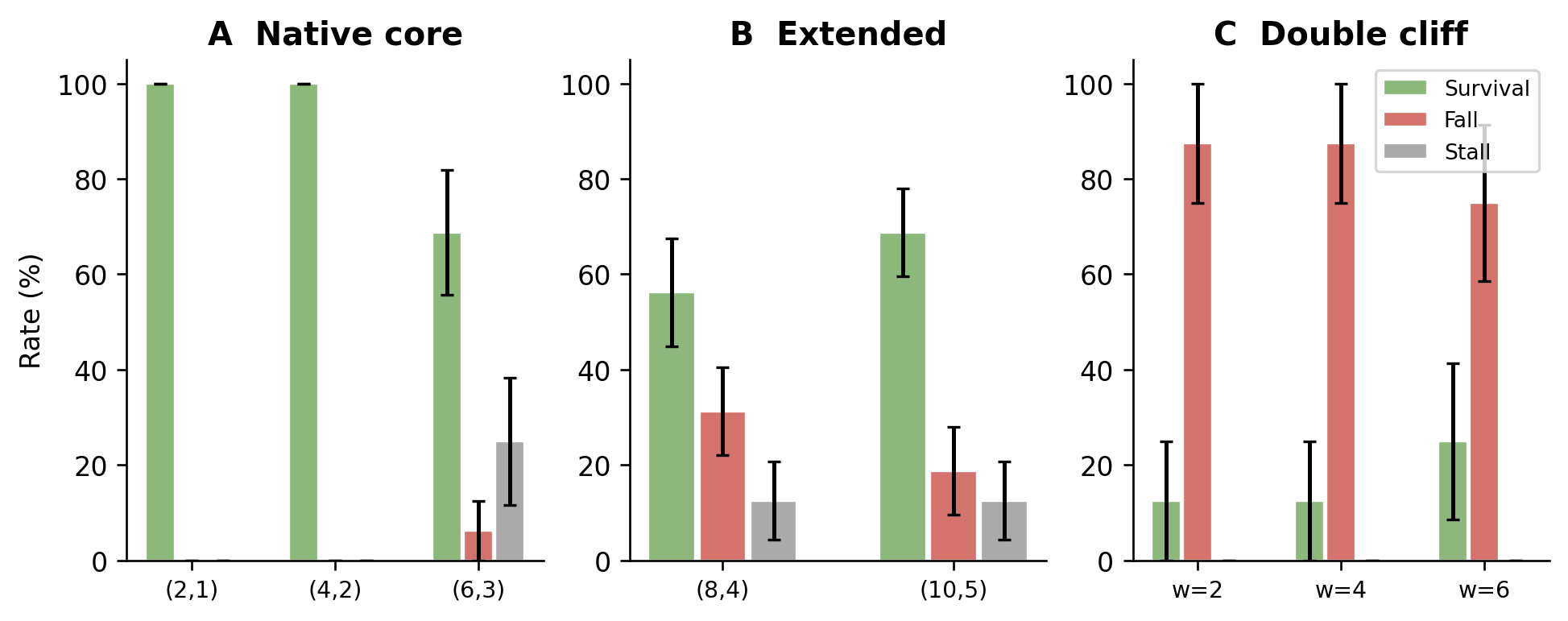
Away from that family the picture is weaker and far more variable. On longer goal and cliff distances the cohort succeeds on 20 of 32 episodes; because the terrain is mirrored, a body that simply commits one way and never senses would score half. The combined extended result does not clearly beat that baseline, and what does beat it is concentrated in a few specimens. Movement survives the change — the specimens still produce waves and still travel — but the discrimination transfers only partially.
The double-cliff surface is a survival test rather than a task: both edges drop away and there is nothing to reach. Here the cohort mostly fails, with four survivals across twenty-four episodes, three of them from a single specimen. The distribution is degenerate enough that it is reported as counts rather than as a mean.
| Assay | Endpoint | What it supports |
|---|---|---|
| Native intact | 43/48 success; 89.6% ± 12.4% SD | Strong performance in the selected cohort on the terrain family it was evolved on. |
| Extended intact | 20/32 success; 62.5% | Partial distance generalization, concentrated in a minority of specimens. |
| Double-cliff intact | 4/24 survivals | A harsh no-goal stress endpoint; S4 accounts for three of the four survivals. |
| Native deformation off | 23/48 success; 47.9% | Deformation usually matters, but the dependence is not universal. |
| Native Sobel-x off | 9/48 success; 18.8% | The largest single-filter signalling impairment in this cohort. |
What the behaviour is standing on
Two families of perturbation take the system apart while it runs. One removes the deformation input, cutting the only route by which terrain reaches a cell. The other removes signalling, cutting the cells off from one another.
Removing deformation roughly halves native success and raises falls sharply — measured within each specimen against its own intact baseline, a drop of about forty percentage points, with falls rising by more than thirty. Keeping either of the two deformation modes on its own preserves some of the performance, but neither restores it. So for most of the cohort the edge-contingent behaviour depends on deformation: take it away and the specimens keep moving but stop being safe near the edge.
Removing signalling impairs the behaviour in a different way. Disabling the Sobel-x filter produces the sharpest single-channel loss. Cutting all communication leaves the specimens stalling far more often than falling: without neighbour-to-neighbour signalling they tend to freeze rather than run off the edge. The failure patterns are suggestive, but the ablations do not isolate filter-specific functions; the filters are better read collectively as a signalling interface.
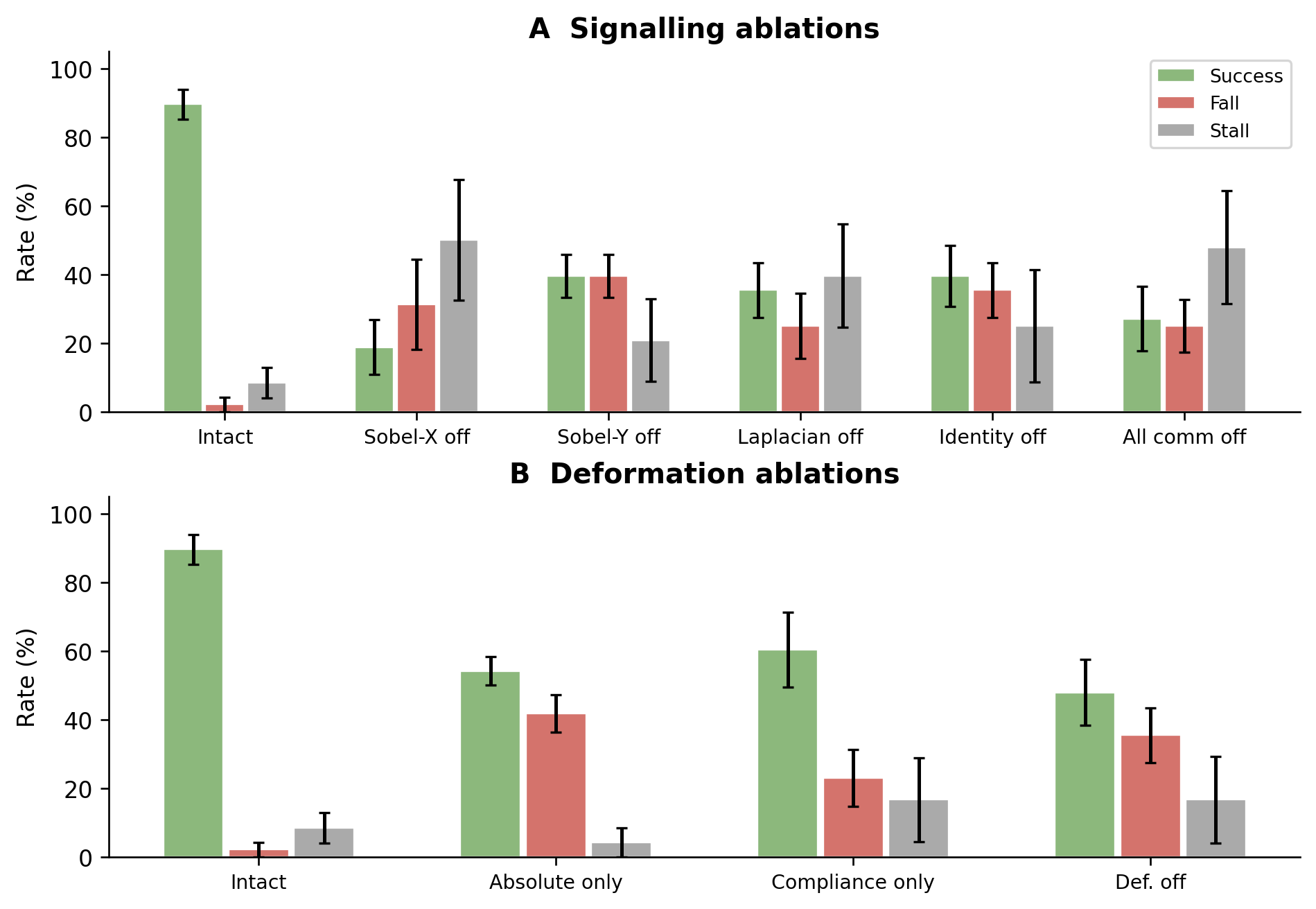
Taken together the two families point at a division of labour. Intercellular signalling appears to sustain the locomotor drive — remove it and the body stops driving. Deformation appears to supply the edge-sensitive modulation of that drive — remove it and the body keeps moving but loses the discrimination. Neither perturbation is fine-grained enough to attribute a function to any particular channel.
The body is part of the sensor
The same controllers were then dropped, unchanged, into three other bodies: one cell shorter, one cell longer, and one row deeper. Contractile locomotion survives the move — the waves still run, the bodies still travel. The discrimination does not. On every altered body, success lands at or below what a body would reach by committing in one direction and never sensing at all — and on the shortest of them, every specimen lands at precisely that baseline.
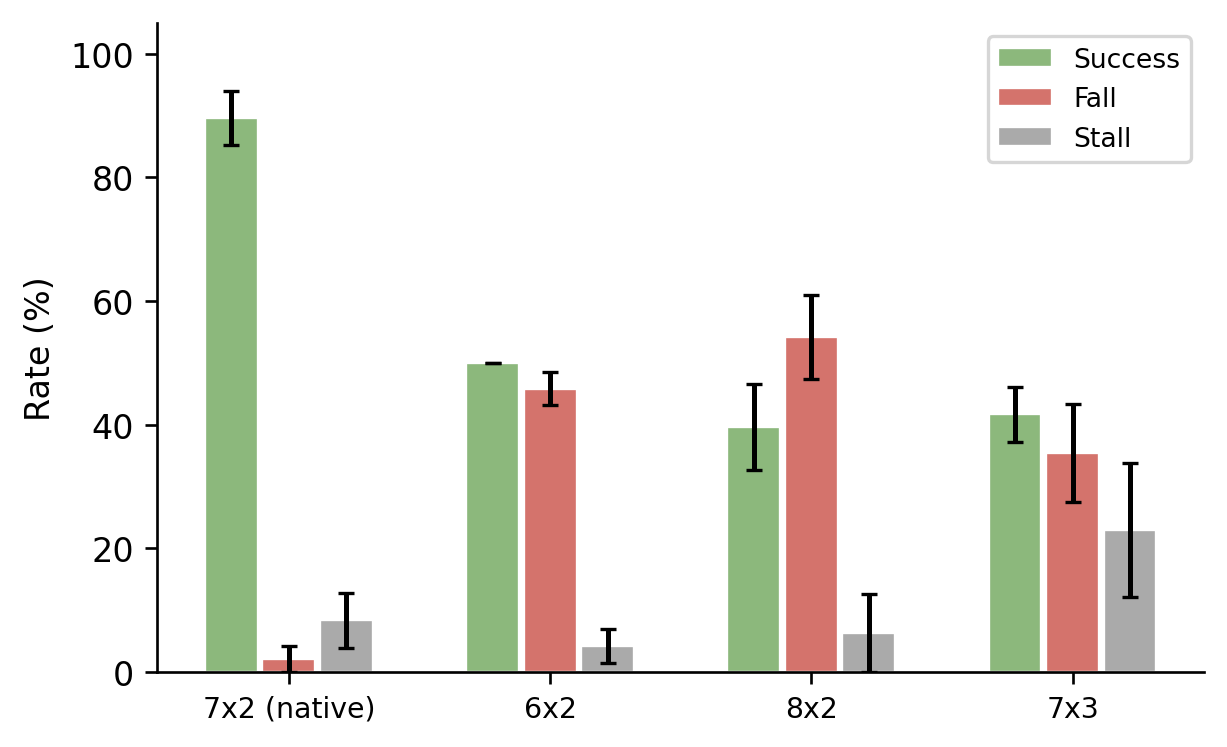
That pattern says something about where the behaviour lives. If the edge is felt through the body’s own mechanics, then a controller calibrated to one geometry will read another geometry wrongly: the same terrain feature produces different forces in a body of different proportions. On this reading the body is not the output device at the end of a control loop but part of the sensory interface itself. This is an interpretation of the transfer result, not a demonstration that any single body variable causes the behaviour.
| Body | Native-task success |
|---|---|
| 7 × 2, native | 43/48; 89.6% |
| 6 × 2 | 24/48; 50.0% |
| 8 × 2 | 19/48; 39.6% |
| 7 × 3 | 20/48; 41.7% |
S4: One Specimen, Followed Closely
The spread across the cohort is itself a finding: the same task, body, and substrate do not converge on one coordination strategy. At the far edge of that spread sits a specimen called S4, and it is worth following in detail. It entered the analysis as an ordinary archive elite, chosen before any ablation had been run; its distinctive status only became apparent afterwards. What follows is therefore a post-hoc study of a single case, characterised carefully rather than offered as typical.
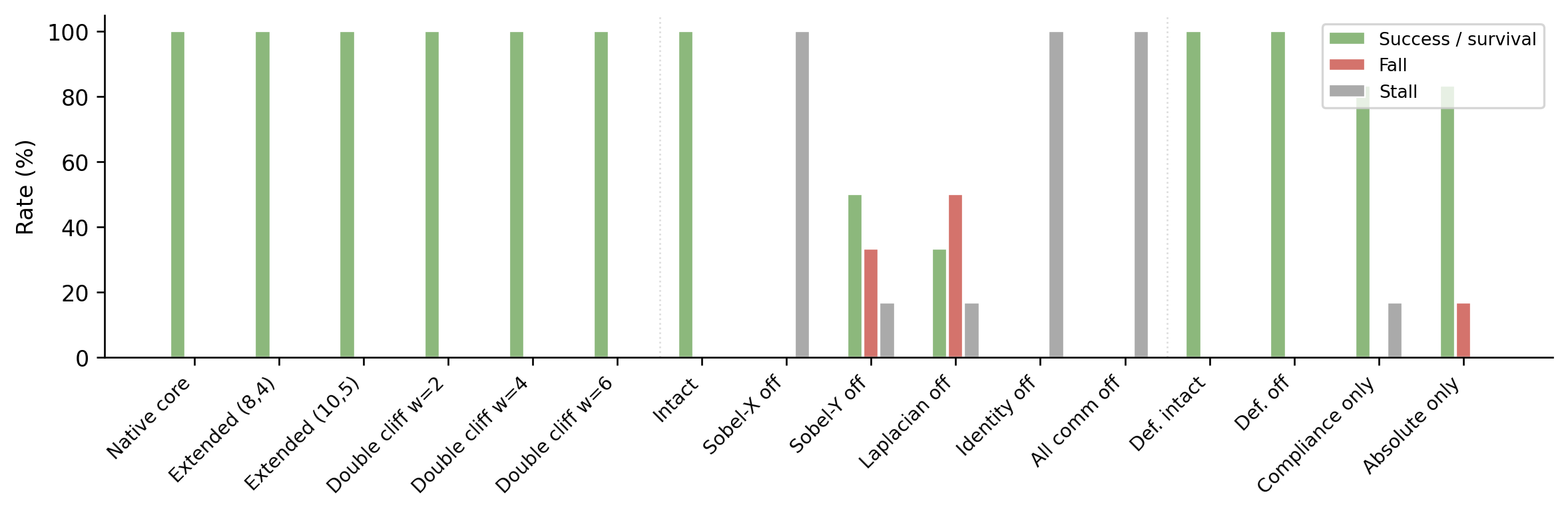
S4 is perfect on the native and extended terrains and survives all three double-cliff widths. What sets it apart is what happens when deformation is removed. For most of the cohort that ablation is close to fatal for edge safety; S4 keeps full native success without it. It is not simply insensitive to perturbation, either — it stalls completely when the Sobel-x filter or all communication is removed.
| S4 assay | Endpoint | Bounded reading |
|---|---|---|
| Native intact | 6/6 success | Complete native performance in the canonical analysis. |
| Extended intact | 4/4 success | Complete extended-distance performance in this specimen. |
| Double-cliff intact | 3/3 survival | Survival at all three tested widths; this is not goal completion. |
| Native deformation off | 6/6 success | Completion without deformation input on the canonical runtime. |
| Sobel-x off | 0/6 success; all stalls | This signalling filter is load-bearing for the tested behaviour. |
| All communication off | 0/6 success; all stalls | Intercellular communication is load-bearing for the tested behaviour. |
Four traces
In order: the intact controller on a native terrain; the same specimen completing the same task with its deformation input removed; survival on the widest double cliff; and the stall that follows removal of a single signalling filter.
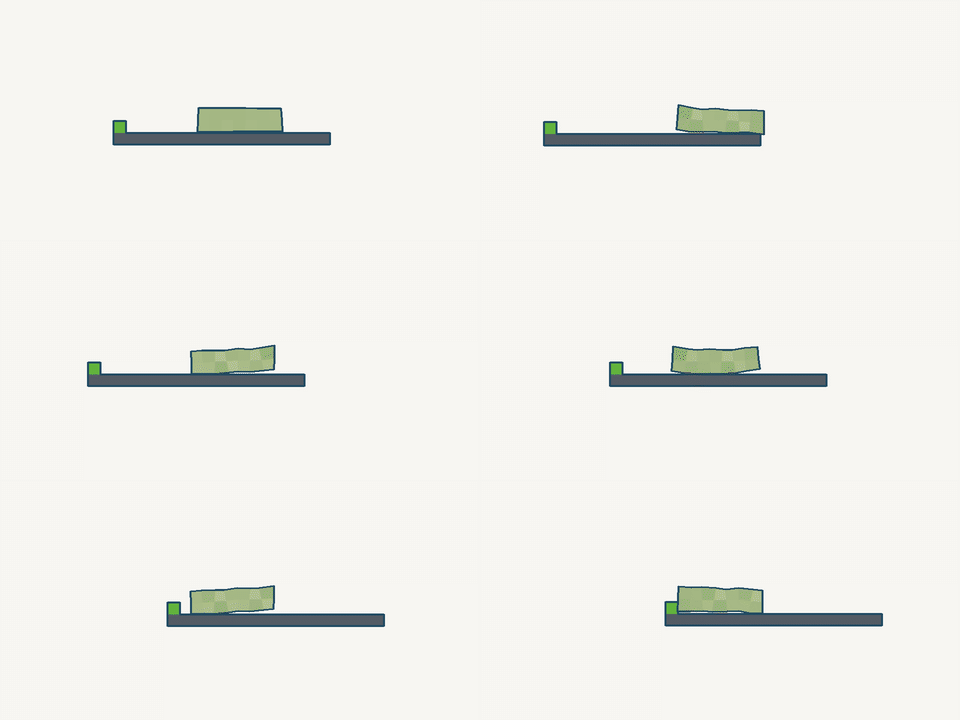
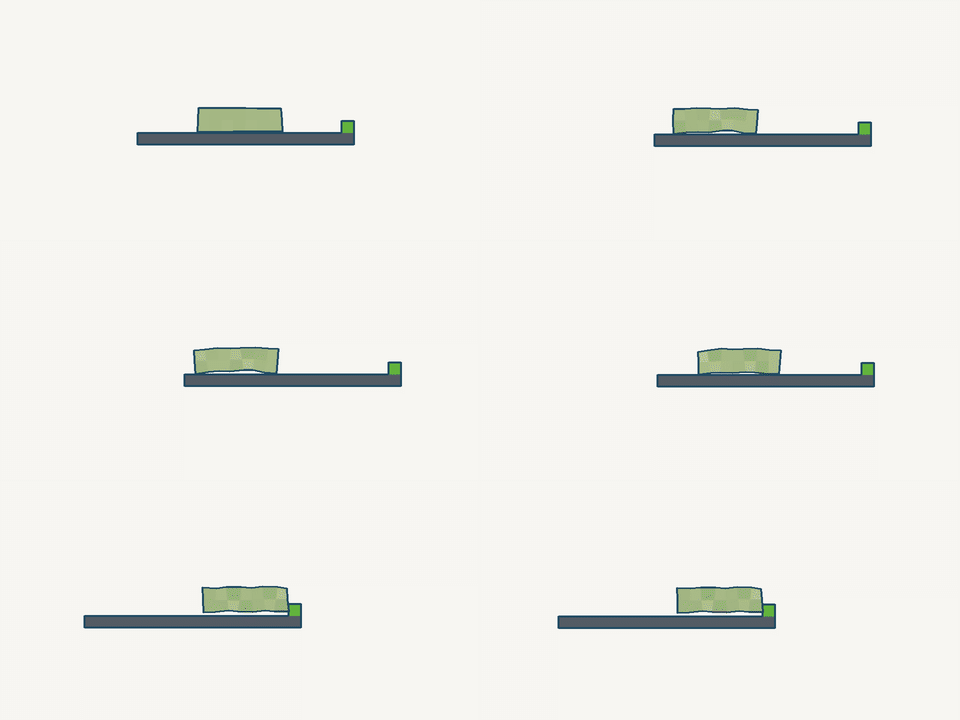
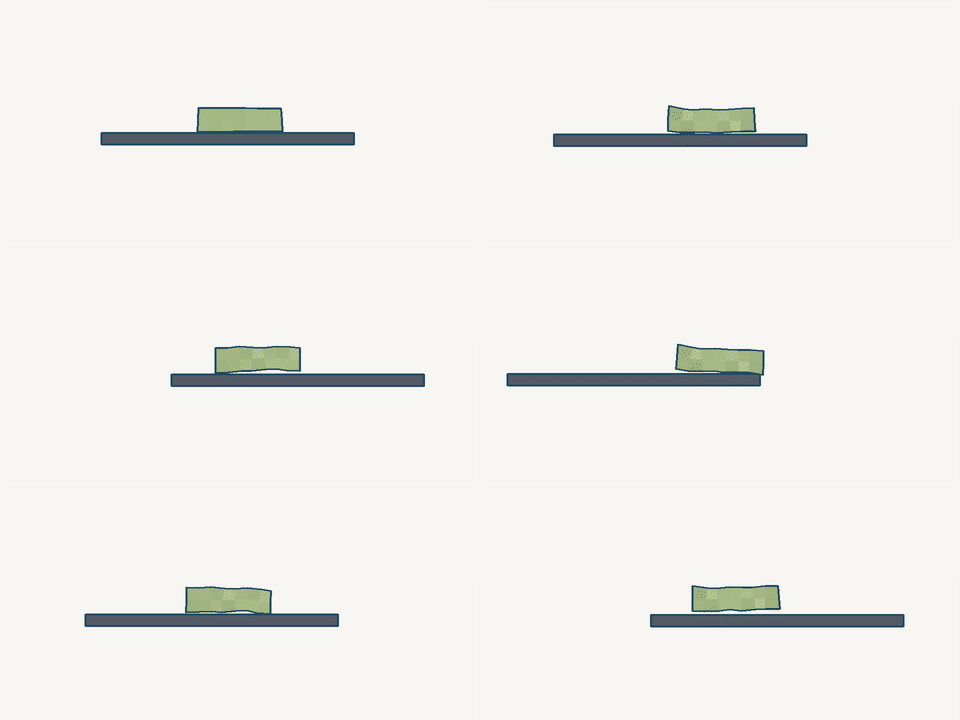
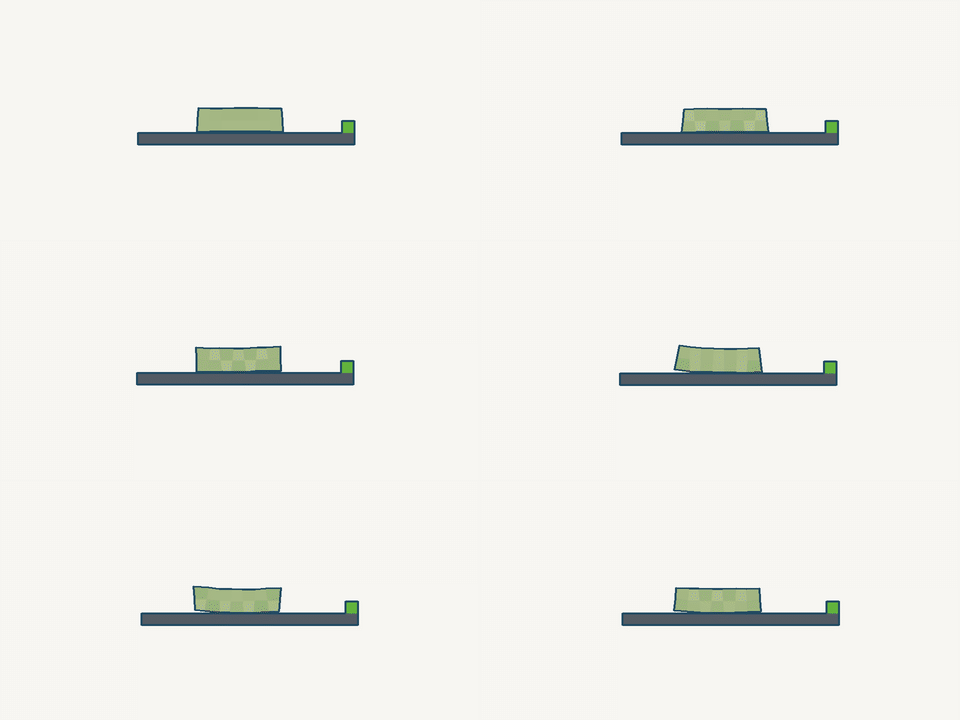
Reversing with no route into the controller
With deformation removed, terrain has no path to the controller at all. Within a fixed runtime, S4’s hidden state and action commands are identical across terrains that differ only in where the cliff is; the controller is running open-loop with respect to body and terrain. The body is not identical: it loses support at different moments and moves differently afterwards. That separation is what makes the case analysable, because anything distinguishing one terrain from another after release has to lie in the mechanics rather than in the controller.
Holding the goal, the plateau, and the controller fixed while sweeping the cliff distance, S4 releases from the edge and returns from it on every configuration, and the release tracks the physical edge rather than any internal clock: the further away the cliff, the later the release, monotonically. Replaying the same recorded commands on terrain that preserves support reproduces only brief directional excursions, not the sustained return. That makes a pure internal command-clock explanation less plausible and puts the loss of support at the centre of the account.
Held-out analyses then ask which streams contain information about the direction the body will later take. The mechanical streams — spring state and kinematics — distinguish it. The controller’s hidden signalling and action streams stay at chance. These analyses are observational: they show a dissociation between what the controller holds and what the body holds, and they do not establish a causal conduit.
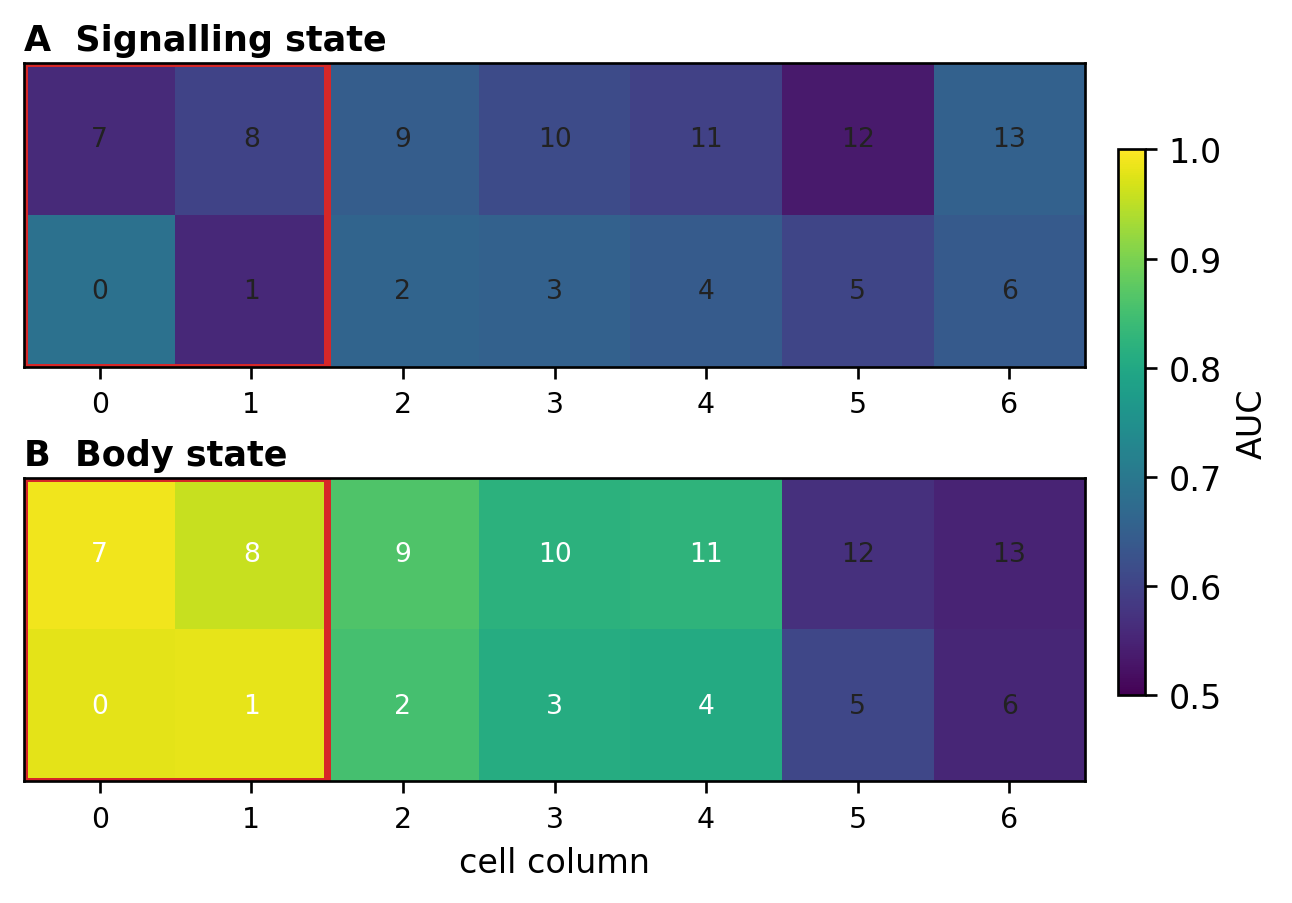
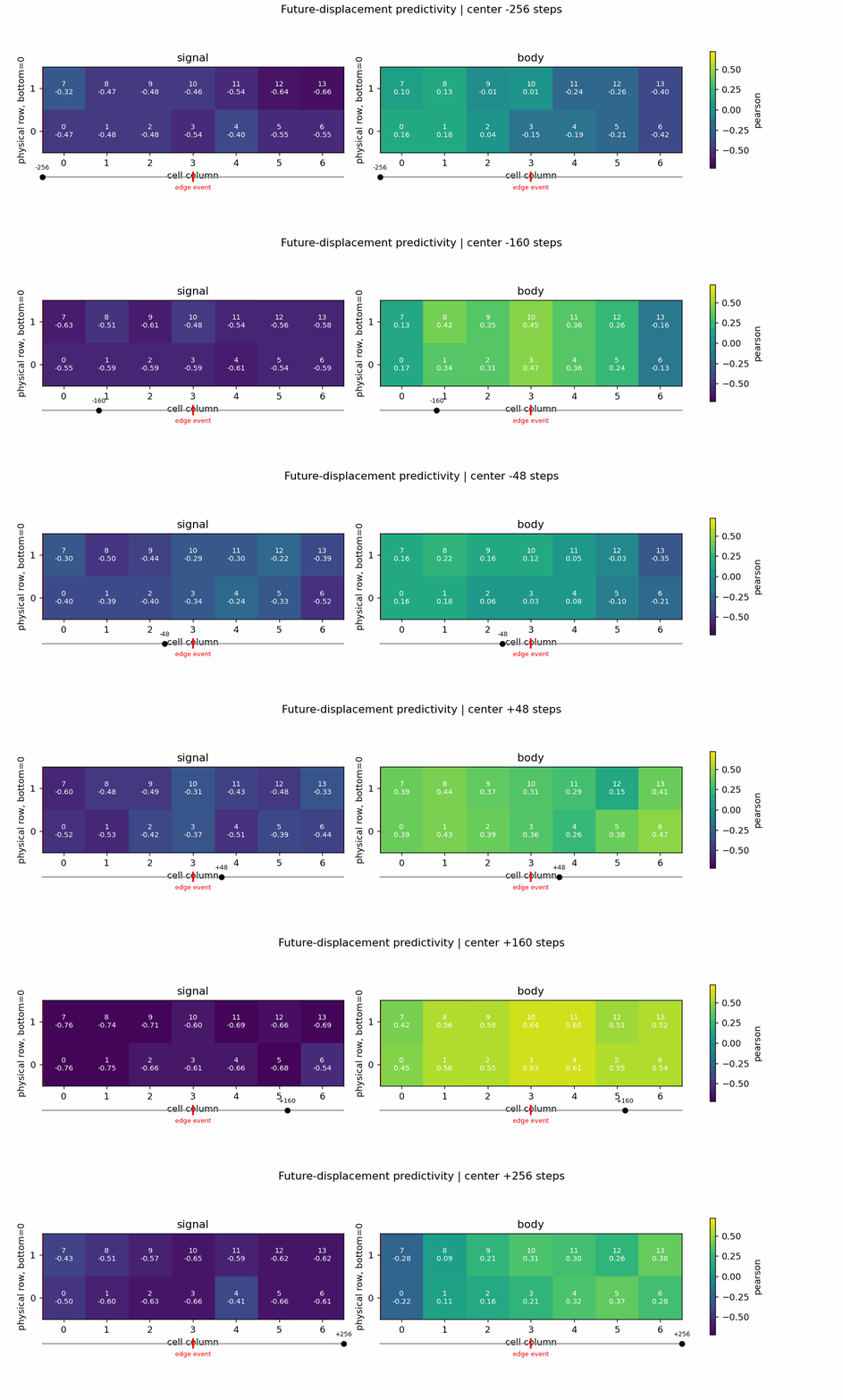
One thing the analyses do not show is a clean travelling mechanical wave running inward from the cliff-facing edge. What they support is a release-locked, body-wide change in the spring and kinematic streams. The conduit itself is not identified.
The interest of the case is not that deformation is dispensable in general — across the cohort it plainly is not — but that the same selection regime admits a second organization. In most specimens the controller senses the edge through deformation and modulates the drive. In S4 the controller supplies an ongoing drive and the loss of support redirects the driven body, with the environmental event acting as a mechanical cause rather than as information the controller receives.
How far the result holds
A later audit re-ran the deformation-off condition across several numerical backends, holding genotype, configuration, and seed fixed. One result is invariant: no episode in the audited matrix ends in a fall. Safety does not depend on the backend. Goal completion does. Several runtimes reproduce the archived result exactly; others complete far fewer trials, and the degradations take the form of stalling short of the edge or returning from it without finishing, never of falling.
| Runtime | Intact, 10 pairs | Deformation off, 10 pairs | Deformation off, native pairs |
|---|---|---|---|
| A100 40 GB | 20/20 | 15/20 | 12/12 |
| A100 80 GB | 20/20 | 15/20 | 12/12 |
| L4 | 20/20 | 15/20 | 12/12 |
| H100 | 18/20 | 5/20 | 4/12 |
| T4 | 20/20 | 10/20 | 6/12 |
The bounded reading is this. S4 shows that body trajectories can diverge across terrains while the controller’s traces do not, and that the divergence is safe wherever it was tested. Whether it ends in goal completion is sensitive to the numerical backend, and so is the direction of the body’s initial commitment. The dissociation survives the audit; the completion rate is a poised quantity and should be read as one.
What This Does and Does Not Show
The eight specimens are a selected analysis cohort from five source runs. They estimate neither the probability of evolving the behaviour nor its prevalence across independent searches. The claim they support is about capability, not about optimality or frequency: about the space of possibilities this regime admits rather than its tendency.
The task uses one fixed body, a shaped fitness, and a small terrain family. Generalization to longer distances, to altered bodies, and to symmetric-risk surfaces is limited. What is established is a synthetic possibility under those conditions, not a general-purpose edge sensor.
S4 is one specimen studied after selection. Its deformation-off safety is robust across the completed audit, but its goal completion and its initial direction of commitment depend on the numerical backend. The mechanistic analyses around it are observational and do not prove that a particular body stream causes the reversal.
The model is inspired by a proposal about early animal organization. It does not show that biological nervous systems developed by this route, and its artificial chemistry is a system of learned influences rather than a chemically faithful cell model.
Paper and Code
| Field | Detail |
|---|---|
| Title | Sensing at the edges: synthetic specimens for early contractile coordination. |
| Author | Ben Gaskin, University of Sydney. |
| Venue | ALIFE 2026 (ISAL) proceedings. |
| Status | Camera-ready and submitted; publication pending. |
| Licence | Creative Commons Attribution 4.0 International (CC BY 4.0). |
| gaskin_alife.pdf, at the root of the research repository. |
The research repository holds the training and analysis code, the curated specimen records — genome, evolved controller parameters, resolved configuration, and representative renders for each featured specimen — and the audit behind the backend-sensitivity result above. The simulator, JAX-EvoGym, is a separate public repository with its own documentation. The complete trace and assay archive is larger than either and is available on request.