Diaries, 1943–1945
Note on the Text
A translation in progress of Book 3 of Kolmogorov, the three-volume jubilee edition (Moscow: Fizmatlit, 2003), edited by A. N. Shiryaev — the diaries of 1 August 1943 to 12 March 1945. It is made from the printed pages of that edition; we have not seen the manuscript. A register of everyone named in the diary — with dates, household names, and a note on each — is kept separately.
Translated from: А. Н. Колмогоров, Звуков сердца тихое эхо… (Дневники 1943–1945), в кн.: Колмогоров. Юбилейное издание в трёх книгах, Книга 3, под ред. А. Н. Ширяева, Физматлит, Москва, 2003.
The printed page is the arbiter. Where he is inconsistent — dates headed one way and then another, a line of Goethe departing from the standard text because he was copying from a friend’s pocket edition — we transcribe what is printed and do not normalise. Errors of transmission we correct silently; errors in the ink we keep, because they are evidence.
Brackets. Angle brackets ⟨ ⟩ mark what the 2003 editors supplied — a reconstructed date, a traced citation. It is their convention and we have kept it; a reader who knows the Leiden system should note that there ⟨ ⟩ marks an editor’s restoration of a scribal omission, whereas here it marks editorial supply of any kind. Square brackets are ours. A bracketed word followed by a question mark — [greenish?] — is a doubtful reading of the page; uncertainty about a translation is never bracketed, but discussed in the margin.
Four voices in the margin. An unmarked note is the translator, glossing; [Translator’s note:] is the translator on the source and its transmission; [Editor’s note:] is the 2003 editors, translated; [Author’s note:] is Kolmogorov’s own footnotes to his own diary; [In the margin:] is something he wrote in the margin. Anything we add inside an editors’ note is marked —Trans.
Where the diary’s subject is language itself — where he scans a line’s metre, or weighs a translation — the passage stays in its own language, since that is what his marks describe, with a plain English crib set immediately below it. Goethe and Mann, whom he quotes in German, likewise stand as he wrote them, cribbed. The editors’ notes to the diary are translated, all of them; but the 2003 edition’s own Russian renderings of his German — made for that edition, by B. V. Zakhoder, Yu. M. Smirnov and N. G. Khimchenko, to do for a Russian reader what our English does for ours — are not reproduced. Where a Russian rendering is instead a fact of the diary’s world — something sung, recited, or argued over — it is content, and translated.
The drawings are text. Roughly a quarter of these folios carry his own hand — diagrams, sketches, facsimiles — and much of it is invisible to the scanned text layer. Those pages are reproduced as figures. On 1 January 1944 the drawing is the entry.
Third-party material: the entry of 6 September 1943 reproduces poems by Yu. M. Smirnov, copied out and scanned by Kolmogorov; they remain their author’s. See the register for a note on permission.
1943: August–December
Das Erlebte weiss jeder zu schätzen, am meisten der Denkende und Nachsinnende im Alter; er fühlt, mit Zuversicht und Behaglichkeit, dass ihm das niemand rauben kann.
— Goethe
What he has lived through, everyone knows how to value — most of all the man who thinks and reflects, in old age; he feels, with confidence and ease of mind, that this at least no one can rob him of.Kolmogorov copied both epigraphs into the front of the notebook himself, citing the Weimar edition: Goethes Werke: II, 6 (1891), p. 218.
Alles Gescheite ist schon gedacht worden, man muss nur versuchen es noch einmal zu denken.
— Goethe
Everything clever has already been thought; one must only try to think it once more.Goethes Werke: I, 42 (1907), p. 167.
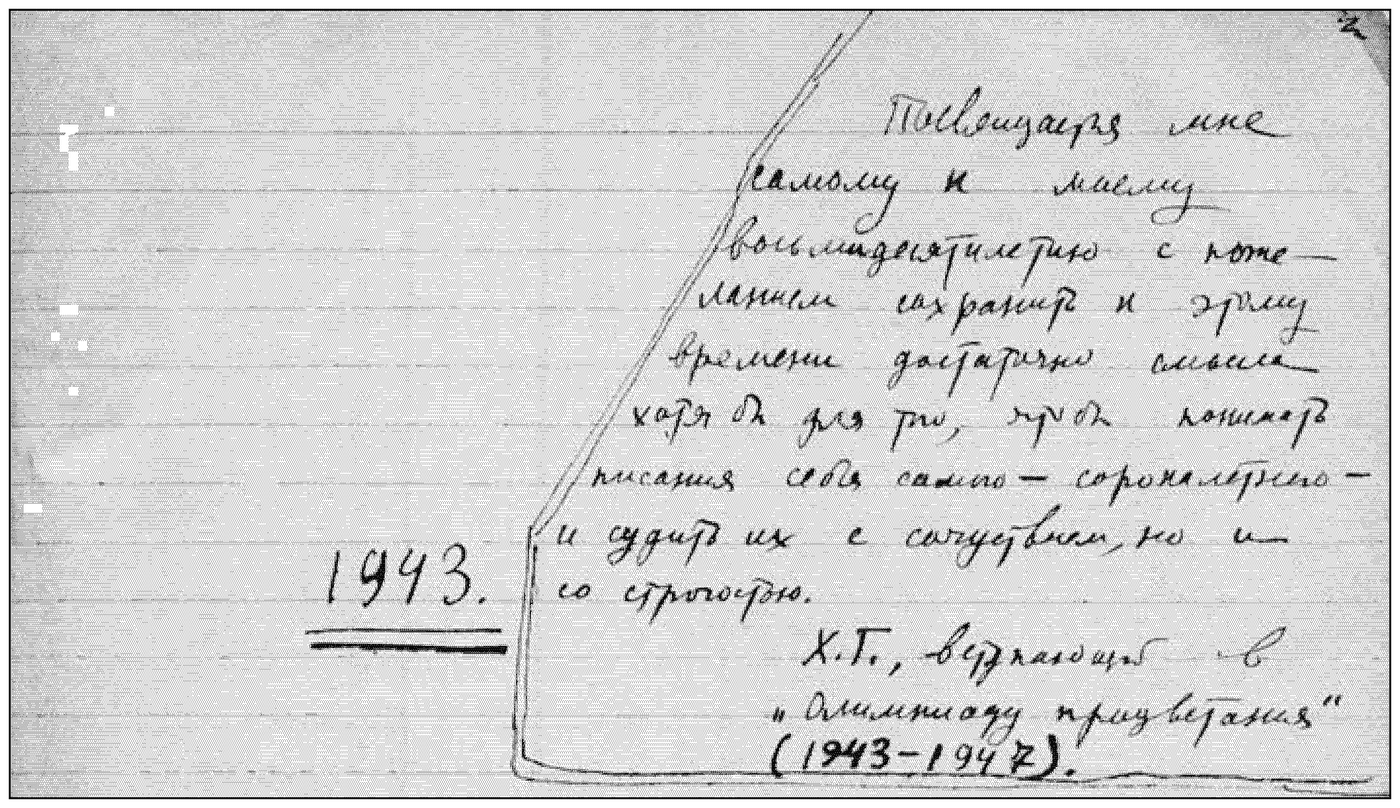
Dedicated to myself on my eightieth birthday, with the wish that by then I shall have kept sense enough, at least, to understand the writings of my own self — the forty-year-old — and to judge them with sympathy, but also with severity.
Kh.G., entering upon the “Olympiad of Flourishing” (1943–1947) [Editor’s note:] Kh.G. — this abbreviated signature beneath the dedication stands for Kholmogorsky Gus, the Kholmogory Goose, the household name of A. N. Kolmogorov. We leave without comment why Andrei Nikolaevich declares the coming four-year period (1943–1947) an Olympiad of Flourishing. The Kholmogory goose is a real Russian breed, and the name puns on his own surname. An Olympiad [Olimpiada] is, in classical reckoning, not a contest but the four-year interval between the Games, used by the Greek historians as a unit of dating — and 1943–1947 is exactly four years. The joke is compounded by the setting: a man announcing his own four-year plan, in the country of the Five-Year Plan. The same word returns in its ordinary modern sense on the diary’s very last page, where he is setting problems for the Moscow schools Mathematical Olympiad, which he founded. [Editor’s note:] On 25 April 1943 A. N. Kolmogorov turned forty.
Das Beste
Wenn dir’s in Kopf und Herzen schwirrt, Was willst du Bess’res haben! Wer nicht mehr liebt und nicht mehr irrt, Der lasse sich begraben.
— Goethe
The Best. — When in your head and heart it whirs, / What better would you have! / Who loves no more and no more errs, / Let him lie in his grave.Goethes Werke: I, 2 (1888), p. 282. Goethe’s irrt — errs, strays, wanders — opens a thread that runs through the whole first fortnight: it is the same verb behind Mann’s verdict on Tonio Kröger, ein verirrter Bürger, “a bourgeois gone astray”, which Kolmogorov turns on himself on 6 August to decide that he is instead a mathematician gone astray in the worlds of love.
August 1943
Sunday, 1 August 1943
New moon
Half past six in the morning. A slightly misty, but still sunny morning. Pusya[Editor’s note:] Pusya — the household name of Pavel Sergeevich Alexandrov. and Oleg have run off to bathe, while I sit at home on account of ill health (which is ending).
Anya again has a working day, and she will not come. I feel on this account both vexation and awkwardness (for the second time our Sunday “readings” will take place without Anya). [Editor’s note:] Anya — Anna Dmitrievna Kolmogorova (Egorova) — the wife of A. N. Kolmogorov.
Why does this notebook begin precisely now?
There are two reasonable grounds for it:
-
The idea of a diary as a disciplining device has long attracted me. To record what has been done, what one wants to change in one’s life, what needs to be done, and then to check the execution — the idea is not new, but it is equally useful at 16 and at 40.
-
Towards forty I have begun to feel more keenly how life flows ... and passes away; how far what has been lived through already has a value of its own in comparison with what still lies ahead (at 16, and indeed at 30, everything still presents itself as a preparation for a more significant future). Hence there has arisen the need to fix the present at the very moment of its passing over out of non-being, as that which has not yet been, into non-being, as that which has already gone by.
It is possible that a third ground, a more doubtful one, joins itself to these:
- It has been decided that the period of “psychological investigations” which began in February (see Kh.G., P.I.Ch. — “Love and Creative Work”)A bibliographic self-citation, in scholarly form, to his own unpublished manuscript: author (Kh.G. — the Kholmogory Goose, his household self-name), short title (P.I.Ch.), subtitle. The initials decode only through transliteration: Pyotr Ilyich Chaikovskii — the composer whose name English spells with a T. The deadpan is the form; he footnotes himself in his own private diary, under a joke pseudonym.[Editor’s note:] Kh.G., P.I.Ch. — a composition by A. N. Kolmogorov: Pyotr Ilyich Tchaikovsky. Love and Creative Work (written in connection with the fiftieth anniversary of the composer’s death, dedicated to P. S. Alexandrov; unpublished). is time to bring to a close. In July it brought both Pusya and me to a certain slackness. And so the setting-up of a diary, while pursuing the aims of the restoration of discipline, gives at the same time a more organised and regulated outlet to this passion for psychological investigations. Only let there not be too many of them!
Gradually there may appear in this notebook, besides the current short entries, memoirs too, and reflections, and psychological analyses — but only after order has been brought into life.
For now the immediate tasks are:
I) Quickly to deal with the immediate small jobs (gunnery, acceptance sampling, Lobachevsky). [Editor’s note:] Gunnery, acceptance sampling, Lobachevsky — see the Note to the entries of 16 August and 19 October 1943. Brakovka, here and throughout, is acceptance sampling — the problem, as the editors’ forward note of 19 October 1943 defines it, of constructing economical plans for inspecting batches of production, weighing two kinds of loss: accepting defective batches, and rejecting good ones. It is never defined in this month’s apparatus, only deferred forward.
II) To carry through smoothly all the family and household rearrangements (to bring Vera[Editor’s note:] Vera, Varya, Nadya — the sisters of Maria Yakovlevna Kolmogorova, Andrei Nikolaevich’s mother. Vera and Varya had to be brought from Kazan, where they had remained in the evacuation. and Varya, to take Varya to Nadya, to get Anya away from her job, and so on). [Editor’s note:] Yakov Stepanovich and Yuliya Ivanovna Kolmogorov had seven children — six daughters: Sofya, Vera, Nadezhda, Lyubov, Varvara, Maria, and a son, Stepan.
III) To establish constant and calm work on the great designs (the analysis course, turbulence, spectra).
And only then — the joining of mathematics with all the wealth of purely personal human interests and enthusiasms that has flourished these last two years.
For now, though, the main thing is:
-
Discipline in the carrying out of boring work.
-
Confident and consistent clearing of the ground for calm work on the great designs.
-
The struggle with “temptations” (sweets, reading at the wrong time), including immoderate writing in this notebook. (An agreement with Pusya on the limitation of chatter!)
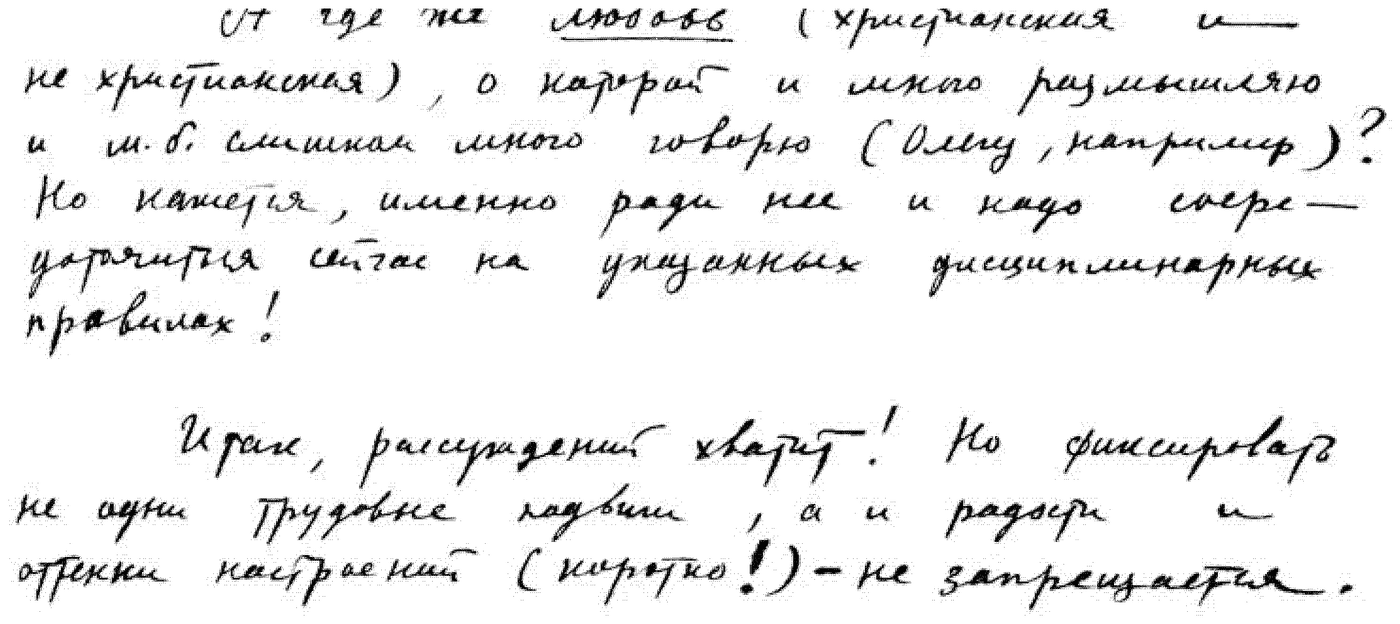
And where, then, is love (Christian and non-Christian), on which I reflect so much and of which I perhaps talk too much (to Oleg, for instance)? But it seems that it is precisely for its sake that one must now concentrate on the disciplinary rules set out above! These two paragraphs are not typeset in the 2003 edition: they are reproduced photographically, as a facsimile of the notebook page in Kolmogorov’s hand, and so are absent from the text layer of the scan. He underlines love himself. The word answers the three numbered points above it — the whole disciplinary programme is declared to be for love’s sake — and it is the same word that titles the Tchaikovsky essay cited three paragraphs earlier, and the same word he will pursue through Mann for the rest of the month.
And so, enough of reasoning! But to record not only labour feats, but analyses too, and shades of mood (briefly!) — is not forbidden. Trudovye podvigi, “labour feats” — the Stakhanovite phrase of the Soviet production campaign, applied to his own desk work. Of a piece with the “output” of 3 August and the “norm” of 2 August.
Monday, 2 August 1943
On Sunday from the morning, after breakfast, I sat down to occupy myself with the problems of acceptance sampling, but soon Anya arrived (the fears that this Sunday too would be declared a working day at Lyublino[Editor’s note:] At Lyublino was situated the Laboratory attached to the Lyublino filtration fields, in which A. D. Kolmogorova worked in those years. were not borne out). We walked down along the Klyazma[Editor’s note:] Klyazma — the next station (from Moscow) after Tarasovka on this line. In the settlement of Klyazma A.N. and P.S. lived (in the Alexandrovs’ family house, 27 Nekrasovskaya, or in the half of a house rented from V. A. Ponomareva) for several years before the purchase of the house at Komarovka. as far as the ski slopes, sat on the bank, bathed.
Before and after dinner I read “Tonio Kröger” to Anya and Oleg. We got as far as Tonio’s departure from his native town, further north. Anya was charmed at once by the first chapter (Hans Hansen). Then, probably, the “crumb of contempt” for people, so characteristic not only of Tonio but of Mann himself, disturbed Anya somewhat, but in conclusion she said that she “had not thought such works were possible in contemporary literature”.[Author’s note:] Just before this, on our walk, Anya was asking whether she was right in thinking that Russian literature of the nineteenth century (Turgenev, Tolstoy, Dostoevsky) is “special” and differs in principle from Western literature. [Translator’s note:] Kolmogorov footnotes himself with *) markers throughout the notebook, ruling the notes off below the entry. They are given here as [Author’s note:] sidenotes at their anchors; the sidenote number absorbs his asterisk. Krokhotka prezreniia — a crumb of contempt. He is quoting the Russian translation he is reading aloud; the diminutive krokhotka (“little crumb”) is the Russian translator’s vividness. He will quote Mann’s own German for the same phrase on 6 August, where it reads ein klein wenig Verachtung — “a little contempt”. The crumb is the translator’s, and he keeps it.
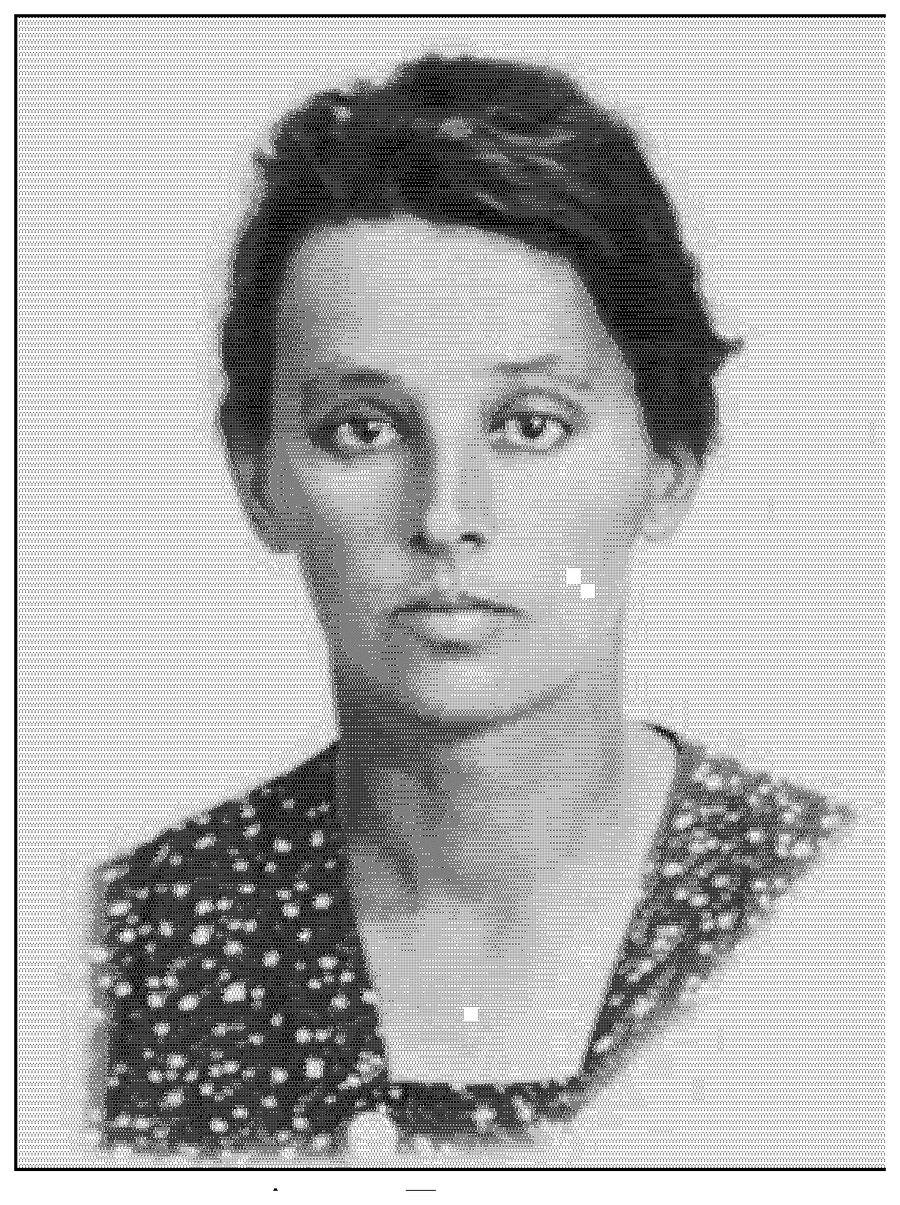
Oleg’s impressions of “Tonio Kröger” are not yet clear to me: I am afraid that he is too much inclined to judge a work by the “ideas” plainly expressed in it, and with such an attitude to the matter one can only get tangled up in Tonio’s utterances to Lizaveta Ivanovna. [Editor’s note:] Lizaveta Ivanovna — a character in Thomas Mann’s novella “Tonio Kröger”.
Pusya meanwhile was writing Lobachevsky. [Editor’s note:] Pusya was writing Lobachevsky — different things may be meant here: first, in 1943 there appeared a booklet by P. S. Alexandrov and A. N. Kolmogorov, Nikolai Ivanovich Lobachevsky. 1793–1943 (Moscow–Leningrad: GTTI); secondly, in the entry of 9 August 1943 an article by P. S. Alexandrov on the geometry of Lobachevsky is mentioned. Finally, on 6 October 1943 a lecture by P. S. Alexandrov on N. I. Lobachevsky took place at the Moscow House of Scientists, the written text of which is preserved in P.S.'s archive.
Subsequently it was proposed to publish this lecture in a mass edition (for schoolchildren), in connection with which the Central Committee of the Komsomol asked Academician N. N. Luzin to express his opinion of this lecture. In P. S. Alexandrov’s archive there is preserved a typewritten text of 5 pages under the title: “Remarks on the lecture of the Stalin Prize laureate, corresponding member of the USSR Academy of Sciences P. S. Alexandrov, ‘The great Russian mathematician Lobachevsky’, by Academician N. N. Luzin”. The text consists of 12 points and a conclusion, which we give here in full: “All the passages noted in Pavel Sergeevich’s lecture are especially telling, and combine a high contemporary scientific quality with the property of a beneficial influence upon young minds. The scientific quality, the pictorial vividness and the ‘accessibility’ to the consciousness of the listeners make Pavel Sergeevich’s lecture a valuable invention and an unconditional contribution to our national literature” (5 November 1945).
We dined with Pusya at the sanatorium. Then I fed Anya and Oleg at home. [Editor’s note:] At the sanatorium “Sosnovy Bor”, next to the Komarovka house, A. N. Kolmogorov and P. S. Alexandrov took their meals during the war on coupons (against their food ration cards).
Briefly discussed various provisioning matters with Anya. To Margarita Mikhailovna, on Anya’s proposal, her August dry dinner ration is being handed over, against July and August. This both corresponds to the established “norm” and removes the necessity of deciding what exactly to give away. Unfortunately, in the taking of such decisions jointly there is not to be observed in us a sufficient simplicity. I am perhaps insufficiently tactful, but Anya, unexpectedly given her extreme selflessness, displays a (in its essence highly egoistic) persistent wish not to soil herself in dry and calculating activity of this kind. [Editor’s note:] Margarita Mikhailovna (Egorova) — the mother of Anna Dmitrievna Kolmogorova (Egorova).
Incidentally, Anya about her “egoism”, and I about her “aristocratism of a special kind”, were talking in the morning apropos of her aversion to a bathing costume.
(Of Anya’s impressions of “Arrowsmith” later, when she finishes reading.)
I saw Anya off to Tarasovka for the 18.50 train almost as far as the footbridge. I went back because of the rain that was starting, while Oleg ran on barefoot with Anya further towards Tarasovka. [Editor’s note:] Tarasovka — the station nearest to Komarovka on the main branch of the Yaroslavl direction.
Then I saw Pusya off to Klyazma, had supper at the sanatorium, received S. V. Fomin (was somewhat excitedly talkative with him, as, for that matter, with many people just now), fed Oleg sour milk.
In conclusion of the day we cheerfully sawed and chopped firewood with Oleg and Shurka. [Editor’s note:] Marina — M. A. Kozlova, help with the household at the Komarovka house from the moment of its purchase. Shurka — her husband.
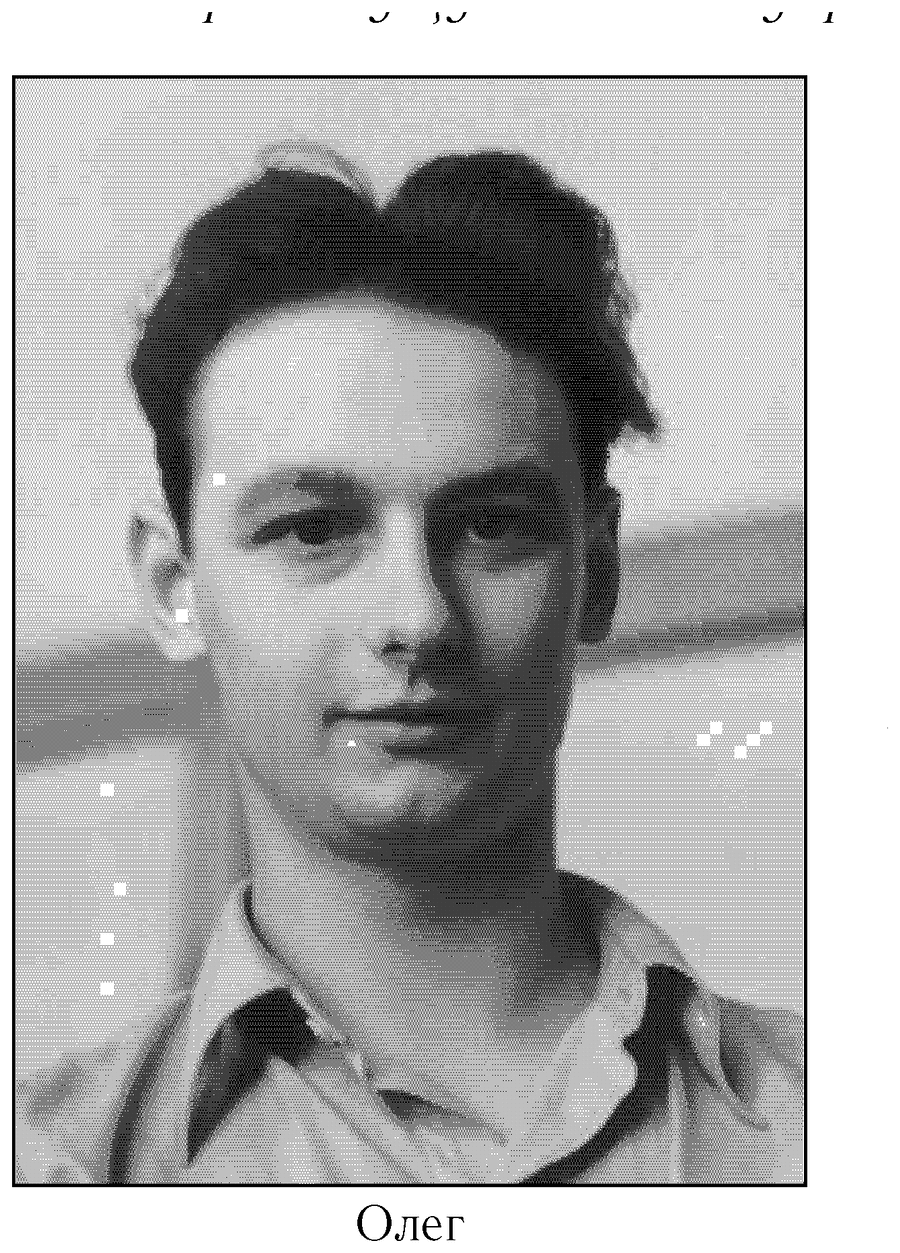
Oleg on this visit is livelier and more sure of himself. He managed his affairs of the preceding week well, once went to Lyublino to work (without Anya’s pressure, apparently). He has tanned a little and is coming little by little to a taste for going barefoot, for running, for demonstrating to Shurka and Marina his skill at sawing and chopping firewood. Sometimes he shows off a little, both with his tramp-like appearance with darned trousers and with his frightful tarpaulin coat.
Oleg’s declaration that among his comrades at Voskresenskoye[Editor’s note:] Voskresenskoye — a settlement in Bashkiria where Oleg Ivashev-Musatov was in the evacuation with the Moscow Art School at which he was studying. a “Karamazov spirit” prevailed, and that the majority of them had lost the human likeness just as Fyodor Pavlovich had (it was I who in conversation had insisted on the difference between Mitya, for example, and Fyodor Pavlovich[Editor’s note:] Fyodor Pavlovich, Mitya — characters in F. M. Dostoevsky’s “The Brothers Karamazov”. — whereas Oleg “likes nobody” there), alarmed both Pusya and me somewhat.
I asked Oleg whether he had read the “Gospel”. It turned out — no (so much for the absurdity of Seryozha‘s “religious-philosophical-ethical” upbringing!). [Editor’s note:] Seryozha — Sergei Nikolaevich (by passport Mikhailovich) Musatov — a painter, Oleg’s father. From 1936 he officially bore the surname Ivashev-Musatov (Ivasheva being his mother’s maiden name); he always signed his pictures “S. Musatov”.
After the somewhat offensive letter sent last Monday, I sent Seryozha a note with an invitation to come to Komarovka some time. [Editor’s note:] Komarovka is so situated that from Moscow one could get there by various means and routes: along the main line of the Northern (Yaroslavl) railway as far as Tarasovka station or Klyazma station; along the Shchelkovo branch of that line — as far as Bolshevo station, and then by the little steam train (the “cuckoo”) that runs to Ivanteevka. Nowadays a branch runs from Moscow through Bolshevo to Fryazino, and one can reach Komarovka by electric train, getting off at the platform “Fabrika 1 Maya”. In those days, though, the way from Tarasovka or from Klyazma (and often from Bolshevo too) was covered on foot. The inhabitants of Komarovka, as a rule, met their guests and saw them off to the station. Mentions of this occur often in the “Diaries”.
Towards dark Pusya came. Talked with him about his prospective doctoral candidates. Doktoranty — not doctoral students in the English sense. Under the Soviet two-doctorate system a doktorant already holds the kandidat degree and is working towards the higher doctorate, the doktor nauk. Fomin in 1943 already held the kandidat.
Tuesday, 3 August 1943
After the long wet from Monday morning, it is clear and sunny. Today the morning is cold and extraordinarily transparent (already autumnal), and in the daytime a heat.
In two days I have written 20 pages of “The Choice of a Rational System of Acceptance Sampling — I”. [Editor’s note:] “The Choice of a Rational System of Acceptance Sampling” — see the Note to the entry of 19 October 1943.
This is adequate output, but with my affairs in their neglected state one wants to work faster still. We bathe, we run, I chop firewood. On the whole, I am satisfied with these two days.
Pusya is writing Lobachevsky very slowly and with difficulty; for some reason he has come to loathe him utterly.
Today Spitsyn and his friend restored the electricity at Komarovka; at this moment he is sitting in the kitchen and trying to swindle us over the payment. How much more trouble and unpleasantness will this electricity cause? [Editor’s note:] Spitsyn, Nikolai Ivanovich — a neighbour at Komarovka, who sometimes helped with the household work.
A watch must be got hold of! The edition sets this line, and three others in the month, as short ruled or boxed blocks standing apart from the running text — marginal jottings rather than sentences of the entry. They are given here as set-off blocks.
Also — an exact regime of nutrition and physical culture is needed, so that there should be neither colitis, nor nervous “perfatigation”, nor sleeplessness! Perfatigatsiia — a macaronic mock-Latin coinage of his own (per-, thoroughly + fatigare, to weary), dressed as a clinical diagnosis and set between a real colitis and a real insomnia. The scare quotes are his: he knows it is not a word.
Friday, 6 August 1943
E. Scribe Le Verre d’eau A comedy in 5 acts
Queen Anne — E. M. Shatrova Duchess of Marlborough — E. N. Gogoleva Bolingbroke — M. F. Lenin Abigail — Slizhikova (?) Marquis de Toren — V. I. Diev
Designer — V. I. KozlinskyThe playbill stands boxed at the head of the entry, above the three-day catch-up. The “(?)” is in the source — his own uncertainty about the actress’s name, not a defect of the text. Scribe’s character is the Marquis de Torcy; “Toren” is as printed. The designer, V. I. Kozlinsky, is his Komarovka neighbour and a co-owner of the house.
Wednesday <4 August>
Morning — collection of provisions on the limits;
evening — the faculty council with the defence of Perepelkin’s doctoral dissertation, and a visit from Oleg with Yura[Editor’s note:] Yura — Yuri Mikhailovich Smirnov.. Limity — a privileged entitlement booklet issued to academicians and others of comparable standing, against which special provisions could be drawn. Not an ordinary ration book: the privilege is the point. The first of two Yuras in this household. This one is Yu. M. Smirnov — the topologist, the translator of Goethe whose verses Alexandrov edits through this month, and the Strausenok or “Little Ostrich” of the parody on 16 August. The editors gloss a second Yura on folio 43 — Yuri Andreevich Egorov, Anya’s nephew. In August every Yura named in the diary is Smirnov.
Thursday <5 August>
Morning — earthing up the potatoes and bathing with Oleg on the Sparrow Hills;
day — the savings bank, dinner at the House of Scientists, the library, Borya;
evening — “Le Verre d’eau” at the Maly Theatre (with Natasha[Editor’s note:] Natasha — Natalya Konstantinovna Gnedenko. and Borya[Editor’s note:] Borya — Boris Vladimirovich Gnedenko.).
At dinner at the House of Scientists I conversed with the younger Meiman (the mathematician), taking him for the elder (the political economist).
The taking of Oryol and Belgorod. 5 August 1943 — the close of the battle of Kursk, and the occasion of the first victory salute ever fired in Moscow. Four words, set in bold between double rules across the column, between the savings bank and the evening at the Maly. He does not push the war to the margin: he frames it like a communiqué — and gives it no more room than that.
Friday (today)
Morning — nonsense with the warm things; left for Komarovka by the 10.40 train.
Before dinner, conversations with Pusya on the bank of the little river, and bathing with a wash with soap; dinner at the sanatorium (I alone, Pusya’s term has already ended).
With Anya it is all the same: away from home she is bold (she neatly put down an insolent captain in the metro), but she is afraid of me and closes up. And when her unspoken grievances break through, she takes fright all the more and will say nothing by way of explanation. At this I get extraordinarily angry. So it was this morning too (with the warm things).
What does Anya like in “The Knight in the Panther’s Skin”? One would have thought this work was not in her style.
In general, apropos of Anya and Borya (with his Jerome K. Jerome), I reflected sadly on solitude and on my own fate. Probably, I am not “a bourgeois gone astray”, but, perhaps, “a mathematician gone astray (in the ‘worlds of love’)”...
(Pusya claims that he, on the contrary, is a dweller in those worlds gone astray in mathematics.) Lisaveta Ivanovna’s verdict on Tonio Kröger is ein verirrter Bürger, “a bourgeois gone astray” — a Bürger who strayed into art. Kolmogorov inverts it for himself, and Alexandrov inverts it once more. One verb carries all three. Alexandrov’s wit turns on the last word: obyvatel, “bourgeois”, literally means “one who dwells”, and the Russian switches to zhitel, “dweller”, at exactly that point.
Apparently one must, at last, begin to occupy oneself with mathematics and to preserve one’s own “Sehnsucht ist darin und schwermütiger Neid und ein klein wenig Verachtung und eine ganze keusche Seligkeit”. “Longing is in it, and melancholy envy, and a little contempt, and a whole chaste bliss.” From Mann’s “Tonio Kröger”. Ein klein wenig Verachtung — “a little contempt” — is the phrase he quoted on 2 August, in Russian, as a “crumb of contempt”: the crumb was the Russian translator’s touch, and he adopted it.
“Was ich getan habe, ist nichts, nicht viel, so gut wie nichts. Ich werde Besseres machen, Lisaweta, — dies ist ein Versprechen. Während ich schreibe, rauscht das Meer zu mir herauf, und ich schließe die Augen. Ich schaue in eine ungeborene und schemenhafte Welt hinein, die geordnet und gebildet sein will, ich sehe in ein Gewimmel von Schatten menschlicher Gestalten, die mir winken, daß ich sie banne und erlöse: tragische und lächerliche und solche, die beides zugleich sind, — und diesen bin ich sehr zugetan. Aber meine tiefste und verstohlenste Liebe gehört den Blonden und Blauäugigen, den hellen Lebendigen, den Glücklichen, Liebenswürdigen und Gewöhnlichen.” “What I have done is nothing, not much, as good as nothing. I shall do better, Lisaveta — this is a promise. While I write, the sea roars up to me, and I close my eyes. I look into an unborn and shadowy world that wants to be ordered and given form; I look into a swarming of shadows of human figures who beckon me to bind and redeem them: tragic and ridiculous, and some that are both at once — and to these I am much devoted. But my deepest and most secret love belongs to the fair-haired and blue-eyed, the bright living ones, the happy, the loveable and the ordinary.” From “Tonio Kröger”. The unborn world “that wants to be ordered and given form” is a design in his sense of the word: it stands to Mann’s writer exactly as the analysis course, turbulence and the spectra stand to him.
“Alle Wärme, alle Güte, aller Humor kommt aus ihr, und fast will mir scheinen, als sei sie jene Liebe selbst, von der geschrieben steht, daß einer mit Menschen- und Engelszungen reden könne und ohne sie doch nur ein tönendes Erz und eine klingende Schelle sei.” “All warmth, all goodness, all humour comes from it, and it almost seems to me as if it were that very love itself of which it is written that a man might speak with the tongues of men and of angels and yet, without it, be only a sounding brass and a tinkling cymbal.” From “Tonio Kröger”. [Translator’s note:] The pronoun dangles in Kolmogorov’s excerpt as it does not in Mann. Ihr and sie refer back to diese meine Bürgerliebe zum Menschlichen — “this bourgeois love of mine for the human” — which stands a few lines above the passage he copied out and is not reproduced here. Mann’s closing clause echoes 1 Corinthians 13:1; the English follows the Authorised Version’s “sounding brass” and “tinkling cymbal”, but keeps love, which is Luther’s Liebe and Mann’s word, rather than the Authorised Version’s “charity”.
I regret not having gone to the concert (I am not working anyway, and have polished off a bar of chocolate):
P. I. Tchaikovsky — Second Suite. Music for “The Snow Maiden”. Variations on a Rococo Theme. First Piano Concerto.
Oleg on the Sparrow Hills.
His fantasy (?) about our walk on the Sparrow Hills (some five years ago), when I astonished him by racing him.
Oleg worked sluggishly at the earthing up and the weeding (perhaps I had “talked him out”). It was hot. He tanned considerably in a single morning.
Verse, by his own admission, he knows little of. He loves Pushkin’s “Anchar”, and A. Tolstoy’s “Ilya Muromets” and “Potok-bogatyr”! More he cannot name.
Of a boy’s life with riding and vagabondage he “was envious at first, but then stopped”.
“Although I studied badly, I decided at once that I was cleverer than everybody.”
The view of Moscow from the Sparrow Hills was news to Oleg: “I didn’t think Moscow was so big” (!)
I read M. A. Kreines’s dissertation, “The Synthesis of Regular Toothed Mechanisms” — good, though elementary, new ideas.
At Pusya’s today S. V. Fomin — they will not release him to the doctorate until the end of the war.
A letter from Varvara Sergeevna. [Editor’s note:] Varvara Sergeevna Alexandrova — the sister of P. S. Alexandrov; at that time she remained in the evacuation in Kazan.
The transport in August only on the 10th–15th. From 1 August they have stopped giving dinners in the canteen to V.Ya. and V.Ya. [Editor’s note:] V.Ya. and V.Ya. — Vera Yakovlevna and Varvara Yakovlevna Kolmogorova, Andrei Nikolaevich’s aunts, were also in Kazan. What is meant is the necessity of transporting them back to Moscow.
How is all this return to Moscow to be organised?
Saturday, 7 August 1943
A somewhat misty, milky-sunny, warm day.
Over the morning and after dinner I edited the first 15 pages of Gubler’s work (wrote seven anew). Worked satisfactorily. [Editor’s note:] What is meant is I. A. Gubler’s article “The solution of the problem of firing with artificial dispersion for certain cases”. Published in the “Collection of articles on the theory of gunnery. I” under the editorship of A. N. Kolmogorov (A.N. calls it the “Gunnery Collection”). — Transactions of the V. A. Steklov Mathematical Institute of the USSR Academy of Sciences, 1945, vol. 12, pp. 67–94.
Pusya sluggishly writes Lobachevsky, edits Yura’s verses, and grieves over the Kazan difficulties.
Marina fell ill, and Shurka took her to the hospital in a droshky, accompanied by Spitsyn.
From Sergei Musatov a letter with notice of the possibility of coming to Komarovka only in a month, and of an intention to write to me further “on the questions raised”.
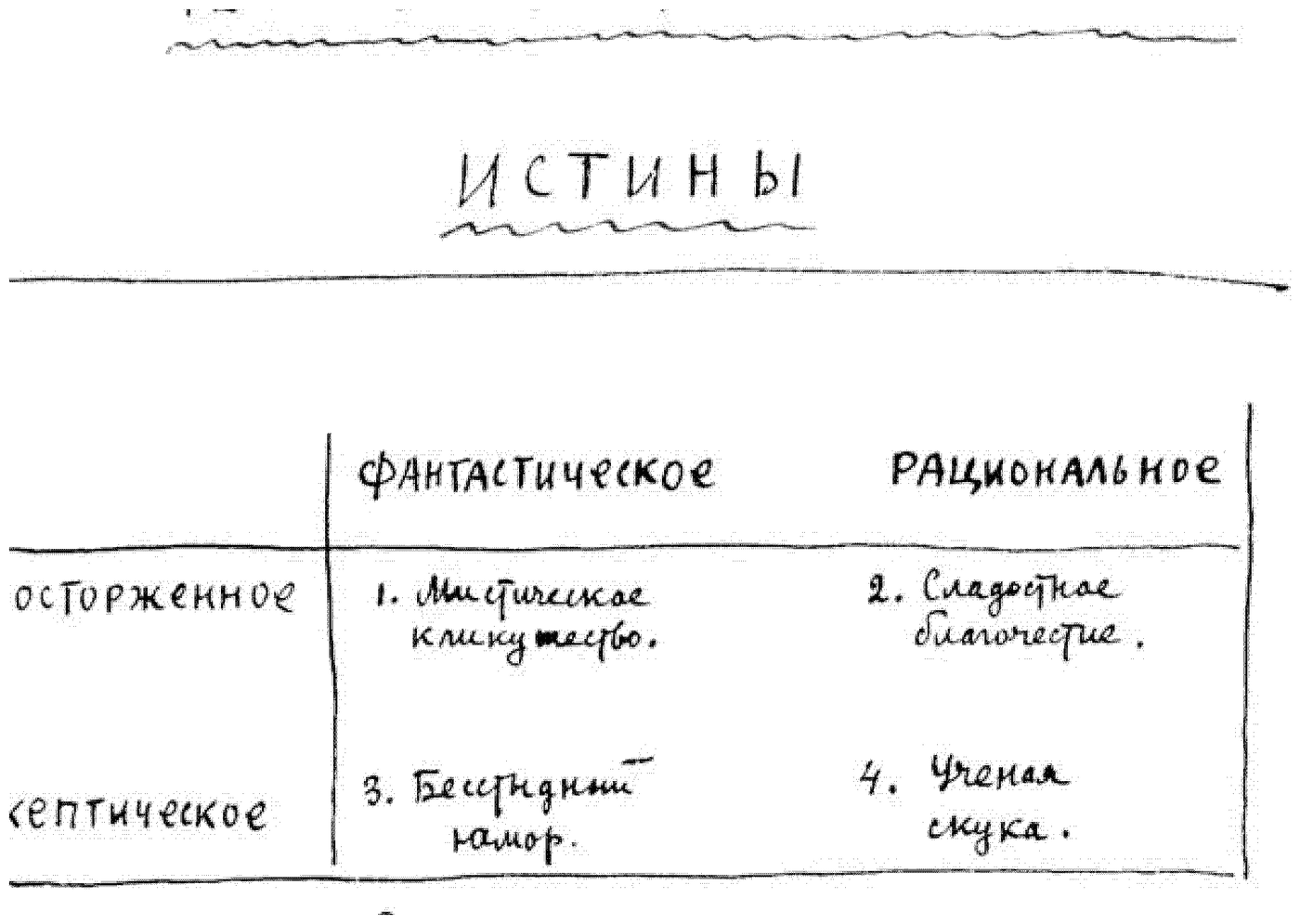
| FANTASTICAL | RATIONAL | |
|---|---|---|
| RAPTUROUS | 1. Mystical shrieking. | 2. Sweet piety. |
| SCEPTICAL | 3. Shameless humour. | 4. Learned tedium. |
Monday, 9 August 1943
Today a day of complete collapse: I saw Pusya and Oleg[Editor’s note:] Oleg — Oleg Sergeevich Ivashev-Musatov — the son of Anna Dmitrievna by her first marriage, to S. Ivashev-Musatov. off, read “Arrowsmith”, and did very little of Pusya’s article on the geometry of Lobachevsky. [Editor’s note:] The article on the geometry of Lobachevsky — what is meant is P. S. Alexandrov’s article “What is non-Euclidean geometry” in the book: Nikolai Ivanovich Lobachevsky. 1793–1943 (see also the Note to the entry of 2 August 1943).
After dinner I terribly wanted to sleep. Meanwhile, despite the fact that I got up at 5.30, I had slept not a little (on Sunday Oleg and I went to bed very early). Oleg turned up on Saturday from the cuckoo that comes in at eight o’clock, Anya — very late. So I fed them, each separately, Anya — having already got out of bed. The “cuckoo” — the little local steam train, named for its whistle, which ran from Bolshevo to Ivanteevka. Kept here as he has it: the 7.30 cuckoo, the 8.39 cuckoo.
Apparently Sunday tired me.
I acknowledge this as a fact and describe Sunday.
On Sunday I got up at half past five. The sun was only just breaking through the mist. I raised Oleg and took him bathing. With Pusya we prepared breakfast.
Then I worked for four hours. In four hours (8.30–12.30) I edited another 24 pages of Gubler (of them seven written anew).
Anya meanwhile kept house with taste and with pleasure, as she knows how.
Oleg puzzled a little over the conclusion of “Tonio Kröger”, copied out for him in German, and then ... dug out of the cupboard the fourth volume of Plato, which opens with the “Phaedrus”. Pusya came to inform me of this not entirely happy choice, but I could not find a way to intervene. When I passed through the library terrace where Oleg was sitting, he quickly hid the book.
I observed further that Oleg was standing under the birch in gloomy pensiveness. Soon, however, he had already passed on to the Small Soviet Encyclopaedia and the like. It has not so far been established whether it is connected with the reading of the “Phaedrus” that for the rest of the day Oleg was very animated and cheerful, but from time to time covered his face with his hands and then looked up at me in astonishment.
Then I finished reading “Tonio Kröger” to Anya and Oleg.
The dinner prepared by Anya (warmed-up soup, sanatorium leftovers, fried eggs with bread) was a success. At dinner Anya said that all the time, listening to “Tonio Kröger”, she had been waiting for “them, in the end, to throw themselves into each other’s arms”. Pusya and I could not restrain ourselves and asked with one voice: “And who are ‘they’?”
I took Anya bathing and saw her off to the 19.30 cuckoo before the sanatorium supper.
On the way to the cuckoo Anya asked seriously whether I love her. I said that if I get so angry and swear so, it is precisely because I love her.
After supper we sawed firewood with Oleg and bathed.
Before supper there had also been a thunderstorm — in general, the days are very colourful!
This morning at half past five we set off into a still greater mist to bathe. The blue mists in the west and the golden ones in the east, pierced through with sun, were really fine. Oleg settled himself many times, shading his eyes with his hand, standing and squatting, to examine them, having declared that “some savage might think that the end of the world was there”.
Then we swam downstream (towards the sun) as far as the fallen birch.
Swimming back, I examined Oleg, sitting against the background of the sunny mist with his feet in the water and smeared with duckweed — really, rather like a savage.
If only he could be like that more often!
With the 8.39 cuckoo Pusya and Oleg left together.
Anya found that in “Arrowsmith” “the problem of joining scientific work with family life is not solved”. Apropos of Gottlieb she pronounced: “It must be very interesting to work with passion like that”, but then dragged in Pavlov with his “modesty”.
She seriously hopes that S. P. Stroganov will be elected to the Academy of Sciences and is “sure that then they will set up a laboratory attached to the Academy”. There she would like to work.
This last week Anya has been occupied at Lyublino only with “the river”, i.e. the dissertation, but so far tells me nothing about it. I only fished out of her that she has decided to replace the “literature review” with the “present state of the question”.
A letter has been written to Seryozha about Oleg.
Tuesday, 10 August 1943
Comrade Kolmogorov!
Your acquaintance military technician Seliverstov, Nikolai Alexandrovich, was killed in the performance of his official duties on 22.07.43. His relatives have been informed.
Clerk of unit No. 92966 Sergeant-major
25.07.43[Editor’s note:] Seliverstov, Nikolai Alexandrovich (1902–1943), whom the death notice calls an “acquaintance”, was in fact a comrade and classmate of A. N. Kolmogorov at the gymnasium. Andrei Nikolaevich was especially close friends with his brother, Gleb Alexandrovich Seliverstov (he later worked with him jointly on the theory of trigonometric series; the result of that work was the well-known Kolmogorov–Seliverstov theorem). Both brothers were called up into the army, and both were killed. A. N. Kolmogorov corresponded with the Seliverstov brothers and kept their letters, visited their parents and helped them.
(The last (unsent) letter of Andrei Nikolaevich to Nikolai Seliverstov, which seems to us consonant with the diary entries of this time:) This parenthesis is the editors’ own voice, printed inside the body of the diary. The letter that follows was placed here by them, not by Kolmogorov: he did not file his dead friend’s unsent letter into his own notebook.
A letter of A. N. Kolmogorov to N. A. Seliverstov
(Typed, on two sides of half a sheet)
Komarovka, 12 July 1943
Dear Kolya!
To my last two letters I have had no answer from you, whether because they were lost, or because you have no time to write just now. I have only now realised that, not being prompted by the receipt of letters from you, I have not written to you for a very long time.
My life flows on as before. Tomorrow and the day after are the last examinations at the university. Then I shall be finishing off a piece of military-scientific work, and in August, presumably, I shall go to Kazan, in order to bring Vera and Varvara Yakovlevna from there to Moscow by the beginning of September.
Our life together with Anya has, over the past year, quite taken shape, but it will receive more final forms when, with Vera Yakovlevna’s arrival, Anya leaves her job at Lyublino (such are our plans); whereas for the present, despite our complete inner unity, we simply spend too little time together.
Anya’s relations with Vera Yakovlevna will undoubtedly turn out very good. The relations arising out of our joint existence at Komarovka with Pavel Sergeevich have, in essence, been established as good from the very beginning; the household details arising out of the undividedness of property that formerly existed between Pavel Sergeevich and myself are being put in order: at present, with my having the most various material obligations that do not concern Pavel Sergeevich, such undividedness would be burdensome to me.
Less satisfying to me are my relations with the Musatov family. These relations are unavoidably rather close, since Oleg lives with Polina Alexandrovna and studies painting with Seryozha, but is supplied with a money and food allowance and with clothing, and also has his washing done — by Anya and me. He spends Sundays with us at Komarovka, and approximately once a week, on a weekday, works with us on our vegetable plots (at Lyublino and on the Sparrow Hills).
The boy I have quite sincerely come to love, but to have to do with a fifteen-year-old person who, for example, at the present time:
is himself reading “The Brothers Karamazov”,
at his grandmother’s listens to a reading aloud of Anatole France’s “Thaïs” (I do not know how Polina Alexandrovna swallows and arranges it all there, but in reality “Thaïs” is a brilliant treatise on psychiatry, in which it is convincingly recounted how the whole frenzy of Christianity, with its self-tortures, its standing for years on a pillar, its mystical visions and diabolical wiles, arises on the soil of sexual experiences that find no outlet — such is precisely Anatole France’s design, and not my interpretation),
at Seryozha’s listens to “philosophical readings” from the writings of Vladimir Solovyov and the dialogues of Plato,
— is, as you yourself understand, not simple.
To tear him away from Polina Alexandrovna would probably be quite difficult. It is consoling that he treats her in many respects protectively, is very solicitous of her — this last month he cooked dinner daily for the whole dear family, and of Polina Alexandrovna he is continuously solicitous in all such respects. At present the family has divided into two parts, living in different places and with a strictly separate household: Seryozha with Alla, and Oleg — with Polina Alexandrovna.
For now I finish, and shall write about more abstract matters separately. I was at Alexander Nikolaevich’s and Nina Vasilievna’s a fortnight ago. With the coming of summer they (like all of us, to some degree) are naturally anxious about you and Gleb especially, but there is nothing to be done about that.
Write. Anya sends her greetings.
Your Andrei
Wednesday, 11 August 1943
I still cannot master myself and work properly.
Not even because of Kolya (although I think much about his death!), but because of a feeling of uncertainty in my family affairs.
I intend to ask Anya orally (and, for exactness, in writing too) approximately the following:
Dear Anya!
You and I intend to live together another forty years or so, if not more. Permit me therefore, in answer to your question (whether I really love you), to put a question to you as well, concerning these coming forty years:
Do you picture your future life in such a way that at the centre of it stand:
our common personal life together and our family,
our common circle of friends, including my closest comrades at work and my pupils,
my work, which you support by your cares,
or do you picture it somehow otherwise?
This “query” is made, to a known degree, in cancellation of my excessive nervousness and heat over various current occasions.
Saturday, 14 August 1943
2 p.m.
Yesterday I left Moscow by the 21.54 train.
The full moon approaches. The moon lit the little river at Tarasovka and the forest glades along the road to us most fantastically through the rapidly thickening mist.
I slept in until 10 in the morning, glancing out of the window at the poplars: at first they showed grey in the mist, quite colourless, then they drew themselves more clearly against a pale blue sky with cloudlets pink from the dawn, then the distant ones (Spitsyn’s) were lit by the sun; I got up when the forest behind the poplars was already being veiled in the haze proper to a hot day.
Marks on points 1)–3) (p. 4 [p. 28 in this edition]) for 1–14 August. The bracketed cross-reference is the editors’, mapping his notebook’s page 4 onto the printed edition’s page 28 — where the numbered points 1)–3) of 1 August indeed stand.
-
fair, [Author’s note:] See the current entries above.
-
good, [Author’s note:] That is, I took no new burdens upon myself.
-
poor. [Author’s note:] Immoderate consumption of sweets, writing in this notebook, and daydreaming at the wrong time.
To be added:
- regular physical culture, correct nutrition.
On Tuesday and Wednesday I finished Gubler, worked a little on my old gunnery writings.
On Wednesday I made my own dinner (Masha was away, Pusya in Moscow). [Editor’s note:] Masha (Marina) — M. A. Kozlova — help with the household at the Komarovka house from the moment of its purchase.
To Anya at Lyublino I came by 16.30. We observed on the little potato plot a potato jungle without the slightest sign of tubers: instead of forming tubers, the roots come out again to the surface and form green shoots with leaves. We earthed up and weeded the cabbage, which grows well. Anya recounted that her Tanya is being left by her husband (a university soil scientist who always seemed to me rather disgusting — and now his first name, patronymic and surname have slipped my mind). [Editor’s note:] Anya’s Tanya — apparently T. Nikolskaya — the niece of Nina Petrovna Nikolskaya, an acquaintance of A. D. Kolmogorova who looked after Oleg.
By Anya’s account, P.S. and Oleg do nothing but say “how Andrei, how Andrei”.
On Thursday with Oleg we quickly (by 11) finished the earthing up and the weeding, then bathed. With greater ease than before Oleg talked about Seryozha, Alla and so on. [Editor’s note:] Alla — the second wife of S. Musatov.
Called in at the institute, spoke with Bermant and Vasilkov, received money.
Dined at the House of Scientists. Was at Oleg’s with Polina[Editor’s note:] Polina Alexandrovna, P.A. — the mother of S. M. Musatov, Oleg’s grandmother. Ivasheva by birth, Musatova by her husband, from 1936 — Ivasheva-Musatova. Alexandrovna. (Oleg’s sketches for a “composition”, Seryozha’s spring landscape of 1941.) [Editor’s note:] Oleg Ivashev-Musatov intended to become, like his father, a painter, and studied at the Moscow Art School. Hence here and subsequently his artistic compositions are discussed.
At the Academy of Sciences spoke with Bruevich (acceptance sampling [see the Note to the entry of 19 Oct. 1943] — a report for Wednesday 25 August, the election of academicians, Anya’s safety in the event of her leaving her job, the flat).
Received also a limit book and the stipend.
On Friday we met Varvara Sergeevna. Pusya made a scene with Sergei[Editor’s note:] Sergei Lvovich — S. L. Sobolev. Lvovich. Was at the university at Azarov’s (Pusya’s room). Petrovsky is satisfied with the faculty’s affairs (112 people admitted, and so on). Dined, was at the Nyubergs’ (Kolya’s dissertation), at the philological faculty at Dean Gudzy’s on Lyova[Editor’s note:] Lyova — Lev Dmitrievich Egorov, the brother of A. D. Kolmogorova (Egorova).‘s affairs (Gudzy was deferential before an academician to the point of indecency), at Trubnikovsky Lane (handed over the paper for the house manager), at the Seliverstovs’ (did not find them in), at Varvara Sergeevna’s. [Editor’s note:] Yura — Yuri Andreevich Egorov, the nephew of A. D. Kolmogorova (Egorova). [Translator’s note:] The editors’ note on Yura is printed at the foot of this page, but no Yura occurs anywhere on it — the printed page confirms this is not a defect of the scan. It is given here at the Egorov family’s only mention. This second Yura, Anya’s nephew, is not the Yura of 4 and 7 August, who is Yu. M. Smirnov. [Editor’s note:] The Seliverstovs — Alexander Nikolaevich and Nina Vasilievna — the parents of Nikolai and Gleb Seliverstov, friends of A.N. since his gymnasium years. “Kolya’s dissertation” is unglossed, and the Kolya meant is presumably one of the Nyubergs — not the Kolya whose death notice stands three pages earlier.
For insufficient energy over Thursday–Friday I cannot reproach myself, although I still had to ask Oleg today to run to Gudzy and to the Academy of Sciences, and to leave Anya and Oleg on their own to collect on the ration cards.
Today over the morning I only wrote letters to Varya and Petya and inserted the formulae into the report on Nyuberg’s dissertation. [Editor’s note:] Petya — Pyotr Savvich Kuznetsov (1899–1968) — philologist, professor of Moscow State University, was brought up together with A.N. in his grandfather’s house from early childhood and then studied at the same gymnasium.
Monday, 16 August 1943
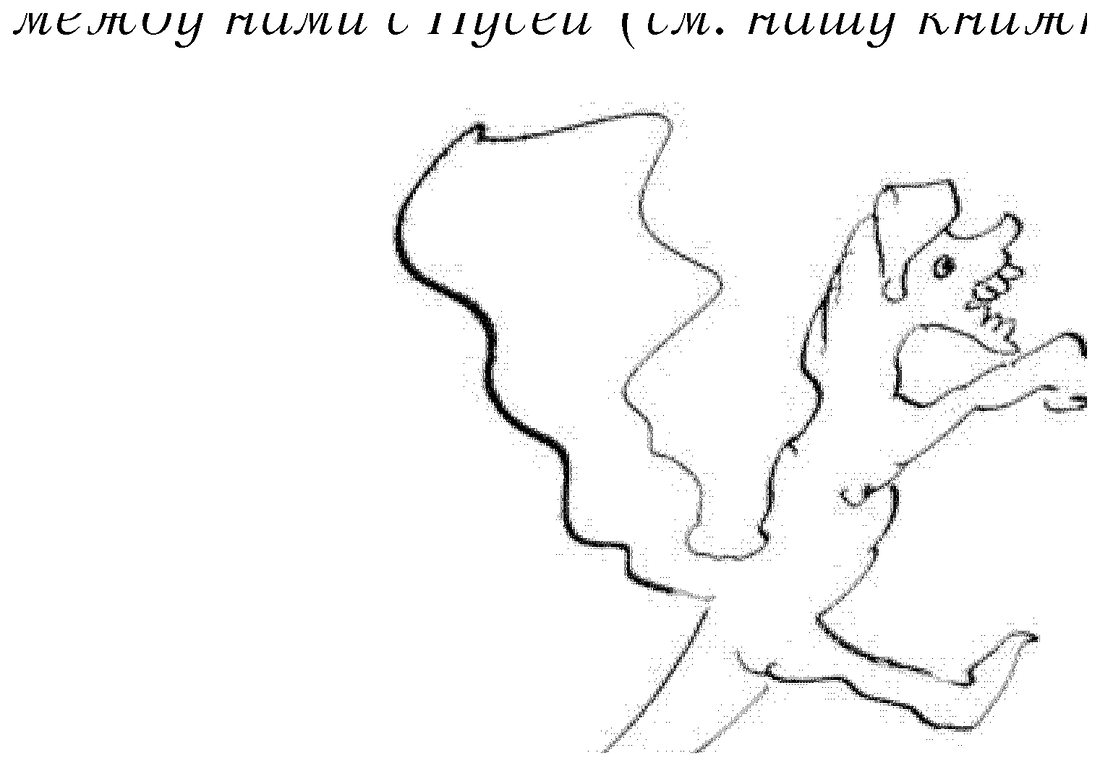
Sunday — a muddled day, ending with a certain scene between Pusya and me (see our picture-book). [Editor’s note:] Our picture-book — what is meant is one of the “artistic notebooks” (many of them survive in the Komarovka house), filled with pen drawings. Andrei Nikolaevich loved to draw in this way, and Pavel Sergeevich — to look these drawings over.
The conversation with Anya on the theme marked out earlier (see the entry for Wednesday, 11 August) went well. An affirmative answer seemed to Anya self-evident, and my doubts — idle.
But it was precisely our sitting shut away over this conversation at the moment of Varvara Sergeevna’s arrival that seemed to Pusya an inadmissible inattention to her.
Afterwards we sat very well, the three of us (with Anya and Oleg), over tea. With Pusya a complete reconciliation.
This morning rain and cold. We ran with Oleg to bathe by the little bridge (Pusya has boils on his leg). We wrestled. Oleg took “Arrowsmith” away to read.
I worked middlingly today — drew up the plan of the article “The number of hits with several shots and the general principles of assessing the effectiveness of a system of fire”.
It is coming out beautifully and interestingly. I wrote five pages and arranged ten out of the old material. The article ought to go first in the collection with which I am so tediously fussing.
Pusya in the daytime read Yura’s verses (his selection and light editing, 25 items).
Really, it seems to me precisely that which ought imperceptibly to take shape in contemporary good young people, and, consequently, being well made, to carry them along too. [Editor’s note:] The Collection of articles on the theory of gunnery appeared as a separate volume of the Transactions of the V. A. Steklov Mathematical Institute with the subtitle: “Collection of articles on the theory of gunnery. I” under the editorship of A. N. Kolmogorov (Leningrad–Moscow: USSR Academy of Sciences Press, 1945; 106 pp.). As Andrei Nikolaevich planned, the collection consists of four articles, a preface (unsigned) and an appendix (tables and diagrams). We give the titles of these articles: A. N. Kolmogorov, The number of hits with several shots and the general principles of assessing the effectiveness of a system of fire; A. N. Kolmogorov, Artificial dispersion in the case of destruction by a single hit and dispersion in one dimension; A. A. Sveshnikov, The determination of the best method of laying with artificial dispersion in firing (for certain particular cases); I. A. Gubler, The solution of the problem of firing with artificial dispersion for certain cases.

Where armfuls of autumn leaves The sunrise waters with red water, A little ostrich chick scrubs its feet Diligently with a loofah.[Editor’s note:] Strausenok [“Little Ostrich”] — the household name of Yu. M. Smirnov. [Editor’s note:] Here A.N. has made over Yesenin’s quatrain:
There, where the cabbage beds The sunrise waters with red water, A little maple chick sucks At its mother’s green udder. [Translator’s note:] The parody keeps Yesenin’s second line verbatim and twists the other three. Its hinge is a pun that cannot be carried across: Yesenin’s klenyonochek, “little maple chick”, becomes strausenochek, “little ostrich chick” — and Strausenok, “Little Ostrich”, is Yuri Smirnov’s household name, so the verses Alexandrov was editing that afternoon become the creature washing its feet. Both quatrains are anapaestic and rhyme akhapki/lapki, voskhod/tryot; the English keeps the sense and the bathos, not the metre.
September 1943
Monday, 6 September 1943
From the Poems of the Little Ostrich (August–September 1943)
| Небо покрыто тучами седыми | — ∪ ∪ — ∪ | — ∪ ∪ ∪ — ∪ |
| Ветер теряет силы в битве с ними … |
. . . . . . . . . . . . . . . . . . . .
The sky is covered over with grey clouds, / the wind is losing its strength in the battle with them …Read against the marks: nE-bo-po-krY-to | tU-cha-mi-se-dY-mi, stressed syllables capitalised. The row of dots is the source’s mark of omitted lines. [Editor’s note:] The notations occurring here and below — (—) for a stressed syllable in the line, (∪) for an unstressed syllable, and ( | ) the word-division mark [znak slovorazdela] — are those adopted in the analysis of verse. For example, the first of the lines marked up by Andrei Nikolaevich (p. 46):
нЕ-бо-по-крЫ-то | тУ-ча-ми-се-дЫ-ми
is written in the form:
— ∪ ∪ — ∪ — ∪ ∪ ∪ — ∪ [Translator’s note:] The note above stands at the foot of folio 49, four pages further on, but the editors themselves refer it back to this page, and it is anchored here. Two things follow from it and from nothing else in the month: the scansion is Kolmogorov’s own, not Smirnov’s and not the editors’; and | is a word-boundary, not a caesura — the weaker and more accurate term, which should not be upgraded. He marks only one of the three word-boundaries in the line. These poems are Smirnov’s own Russian verse, not his Goethe translations, and they are kept in Russian here because Kolmogorov’s marks scan Russian syllables: an English line of a different syllable-count would leave the marks describing nothing. [Editor’s note:] Little Ostrich [Strausenok] — the household name of Yu. M. Smirnov.
Я прошагиваю улицу За воротами ворота, Дом за домом. Надо мною вечер хмурится В небе черном.
Я жалею о потерянном И грущу, о чем не знаю сам. Я иду путем рассеянным Голошеим глупым страусом.
I stride the street away, / gate after gate, / house after house. / Above me the evening scowls / in the black sky. // I regret what has been lost / and grieve over I know not what myself. / I go by a scattered road, / a bare-necked stupid ostrich.The last line is where the nickname comes from: Strausenok, “Little Ostrich”, in the poet’s own self-description. Kolmogorov had already made it over into a parody of Yesenin on 16 August.
... Снова ранние зори Освещают леса и поля. В бледно-синем, чуть желтом просторе Розовеют, цветут тополя. Снова ветер, прохладный и свежий... Белой пеной плывут облака, Слыша зовы морских побережий... Им дорога вольна и легка.
... Again the early dawns / light up the woods and the fields. / In the pale-blue, faintly yellow expanse / the poplars turn pink, they blossom. // Again the wind, cool and fresh ... / The clouds swim by like white foam, / hearing the calls of the sea coasts ... / For them the road is free and light.
| Ряды прозрачных тополей | ∪ — ∪ — ∪ ∪ ∪ — |
| Под ветром рвутся вдаль. | ∪ — ∪ — ∪ — |
| Тоскливо пусто меж полей, | ∪ — ∪ — ∪ ∪ ∪ — |
| Сурова неба сталь. | ∪ — ∪ — ∪ — |
Rows of transparent poplars / strain away into the distance under the wind. / Between the fields it is drearily empty, / the steel of the sky is harsh.Read against the marks: ria-dY-pro-zrA-chnykh-to-po-lEi. No word-boundary is marked in this poem.
Мне двадцать один год. Мне жить бы, влюбляясь и радуясь! Смотреть бы только вперед, Не оглядываясь! Мне двадцать один год, А ветер свистит, непоседа, И в дальние страны зовет, Меня, соседа...
I am twenty-one years old. / I ought to be living, falling in love and rejoicing! / I ought to be looking only forward, / never glancing back! / I am twenty-one years old, / and the wind whistles, the fidget, / and calls me away to distant countries, / me, its neighbour ...Smirnov was indeed twenty-one.
От дум тяжелых не уйти Они стоят и смотрят строго: Беда и горе впереди, Тоска и дальняя дорога.
There is no getting away from heavy thoughts. / They stand and look on sternly: / trouble and grief ahead, / anguish and a long road.
За туманными далями снов Дни за днями упрямо толкутся...
. . . . . . . . . . . . . . . . . . . .
Beyond the misty distances of dreams / days upon days jostle stubbornly about ...
| Гнется березка стройная, | — ∪ ∪ — ∪ — ∪ ∪ |
| Листья роняя вниз. | — ∪ ∪ — ∪ — |
| Милая, беспокойная, | — ∪ ∪ ∪ ∪ — ∪ ∪ |
| Вспомни, прости и вернись! | — ∪ ∪ — ∪ ∪ — |
The slender little birch bends, / dropping its leaves down. / Dear one, restless one, / remember, forgive, and come back!Read against the marks: gnE-tsia-be-rE-zka-strOi-na-ia.
| Нет, не вернешься назад! | — ∪ ∪ — ∪ ∪ — |
| Мы разошлись. Прощай! | — ∪ ∪ — ∪ — |
| Чертят червонный закат | — ∪ ∪ — ∪ ∪ — |
| Линии птичьих стай. | — ∪ ∪ — ∪ — |
⇑
| е | ё | а |
| ы | и | а |
| е | о | а |
| и | и | а |
No, you will not come back! / We have parted. Farewell! / Lines of flocks of birds / trace across the scarlet sunset.Read against the marks: nEt-ne-ver-nE-shsia-na-zAd. [Editor’s note:] ⟨Here the stressed vowels of the last quatrain are written out.⟩ [Translator’s note:] A double-shafted arrow points up from the table at the quatrain above it, and each row gives the stressed vowels of one line, in order: нет / вернёшься / назад = е ё а; мы / разошлись / прощай = ы и а; чертят / червонный / закат = е о а; линии / птичьих / стай = и и а. On top of the metrical experiment he is reading the poem’s vowel colour down the column — which is a second reason the Russian must stay: an English quatrain would have different vowels, and the table would be describing a text that is not there.
Этим утром покой и прохлада. Побыстрее, сестренка, вставай! За окном суета и трамвай, И людей беспокойное стадо.
И спешить нам не нужно на службу: Ведь сегодня у нас выходной! Проведем его вместе с тобой, Обновим нашу старую дружбу!
Нам бы жить, чудакам, и смеяться... Дай, покрепче тебя обниму! Вижу, знаю: опять одному Вдалеке мне придется скитаться.
Погляди — распахнулось окно В мир иной без тоски и печали... Что таят недоступные дали, Нам с тобою узнать не дано.
This morning, quiet and coolness. / Quicker, little sister, get up! / Beyond the window, bustle and a tram, / and the restless herd of people. // And we need not hurry to our posts: / today, after all, is our day off! / We shall spend it together, you and I, / we shall renew our old friendship! // We ought to live, we oddities, and to laugh ... / Come, let me hug you tighter! / I see, I know: alone again / far away I shall have to wander. // Look — a window has flung open / into another world without anguish or sorrow ... / What the inaccessible distances hold, / it is not given to you and me to learn.
Если сердцу очень больно, Если сердцу тяжело, Друг обидел ли невольно, Заупрямился ль назло, Это все — ничего!
К берегам пойду зеленым, Где под солнечным лучом Летом знойным, опаленным, Хорошо — горячо!
Забияка-ветер гонит Стаи легких облаков, И березка ветки клонит Надо мной — высоко!
Все обиды и печали Улетают тихо вдаль. Вот и звезды заблистали И река — как сталь!
If the heart is in great pain, / if the heart is heavy, / whether a friend has hurt it without meaning to, / or has turned stubborn out of spite — / all that is nothing! // I shall go down to the green banks, / where under the ray of the sun, / in the sultry, scorched summer, / it is good — it is hot! // The bully-wind drives / flocks of light clouds, / and the little birch bends its branches / above me — high up! // All the hurts and the sorrows / fly quietly away into the distance. / See, the stars have begun to shine / and the river is like steel!
Каждую ночь барабанит дождь, И каждую ночь я слышу (Сквозь сон), как небо — лохматый пес — Когтями скребется в крышу.
Бездомный бродяга, холодный нос, Скулит, напевает тоскливо, И крупные капли собачьих слез По кровле бегут торопливо.
И странные сны, занятней задач, Каждую ночь мне снятся, Что будто по лестнице из неудач Упрямо хочу подняться.
Туда, где воля любым мечтам: Писать ли стихи иль влюбляться (Но чаще всего смеются там)... Ах, нужно только подняться!
Every night the rain drums, / and every night I hear / (through my sleep) how the sky — a shaggy dog — / scratches at the roof with its claws. // A homeless tramp, a cold nose, / it whines, it croons drearily, / and big drops of dog’s tears / run hurriedly along the roofing. // And strange dreams, more diverting than problems, / come to me every night: / that up a staircase made of failures / I stubbornly want to climb. // Up there, where any dream has its freedom: / whether to write verses or to fall in love / (but most often they laugh there) ... / Ah, one need only climb!
Я уезжать собрался. Недолго здесь прожил. Все нужные мне вещи В мешок свой уложил
Белье, бумаги, книжки, Соль, мыло и табак — Взял все, что очень нужно, А что и просто так.
Но самой нужной вещи Потерян даже след: Оставил где-то сердце — Назад дороги нет.
I made ready to leave. / I did not live here long. / All the things I needed / I packed into my bag: // linen, papers, little books, / salt, soap and tobacco — / I took everything much needed, / and some things just so. // But of the thing most needed / even the trace is lost: / I left my heart somewhere — / there is no road back.
Monday, 13 September 1943. Kazan
11 September 1943.
Telegram:
“A SLIGHT FRACTURE OF THE ARM COMPELS THE CANCELLATION OF THE TRIP =ALEXANDROV”Set in italic capitals between two rules, right-aligned. The = before the signature is telegraphic convention and is kept.
I left Moscow by the Academy carriage on the evening of the 6th.
Twenty days (16 August – 6 September) in Moscow and Komarovka were muddled and wearisome, though not so useless in the sense of work and of the stabilisation of family affairs as it seemed in the course of those days themselves.
-
I gave lectures on acceptance sampling at the Mathematical Institute and at Bruevich’s. Beyond that I have not yet worked. [Editor’s note:] The Collection of articles on the theory of gunnery — see the Note to the entry of 16 August 1943.
-
After a fashion I finished the collection of articles on the theory of gunnery, out of four articles (2 — mine, 1 — Sveshnikov’s, 1 — Gubler’s, my preface).
-
I wrote my own part (rather tedious, but it seems not useless) of Pusya‘s and my little book on Lobachevsky. [Editor’s note:] The little book on Lobachevsky came out in that same year, 1943: P. S. Alexandrov and A. N. Kolmogorov, Nikolai Ivanovich Lobachevsky. 1793–1943 (Moscow–Leningrad: Gostekhizdat, 1943, 100 pp.); the collection consists of two articles by P. S. Alexandrov (“Nikolai Ivanovich Lobachevsky. A short sketch of his life and activity” and “What is non-Euclidean geometry?”) and an article by A. N. Kolmogorov (“Lobachevsky and the mathematical thinking of the nineteenth century”).
-
I fussed a great deal over Yurka‘s poems. I even wrote him a whole treatise on the foundations of Russian versification, as an appendix to a letter. The treatise is mentioned, not reproduced; nothing of it survives in the notebook. The verses of the 6 September entry are its occasion.
-
Anya and I in Staropimenovsky moved into the former rooms of Mikhail Semyonovich, settled in there well, celebrated the house-warming, joined with our wedding anniversary, received Seryozha with Alla. [Editor’s note:] A. N. Kolmogorov and A. D. Egorova were married on 3 September 1942.
-
On one of the Sundays (4 September) with Borya[Editor’s note:] Borya — Boris Dmitrievich Egorov, the brother of A. D. Kolmogorova.‘s help we stacked the firewood Pusya had bought. Not the Borya of August, who is B. V. Gnedenko. From here to the end of the month every Borya is Anya’s brother.
-
I spent a very great deal of nervous energy on inducing Anya to occupy herself seriously with getting away from Lyublino. Just before my departure I was at Bruevich’s on this account, and he promised to sign the corresponding letter. Earlier Anya and I had been to S. N. Stroganov’s.
-
I was angry at the drag over Oleg‘s “holidays” at Komarovka. I was worried about his flu and the “complications on the heart” from that flu.
On the road and here I have read Lion Feuchtwanger’s “The Jewish War”. The modernisation of the ancient world is witty and, apparently, well-grounded: Editions which “sell out” in 300 or 4200 copies; the case of three innocent old men, like the case of the six Negro youths from Scarboro; universities, artillery, telegraphists — all this is sufficiently documented.
Pictures, of the sort of Josephus wandering about Jerusalem with the right of life for 70 people, are very vivid.
But on the whole — a repellent book, and the general conception
west — Rome, east — Jewry
is narrow: against a refined Judaism there comes forward only a coarse Rome, and not Turkey,
there is no Christianity at all.
The philosophy of the word, hostile to the visual and tangible image, is interesting. Josephus himself is extremely repellent, and, to my mind, it is difficult to find a more intelligent antisemitic book than this one. [Translator’s note:] The book is Lion Feuchtwanger’s Der jüdische Krieg (1932), the first novel of his Josephus trilogy, which Kolmogorov read in the Russian translation. Feuchtwanger (1884–1958) was a German-Jewish émigré antifascist, widely translated and celebrated in the USSR, and the novel’s design is philosemitic; Kolmogorov’s verdict inverts the book’s intention. Whether he means that the book is so intelligent that it serves antisemitism despite itself, or that it is intelligent and antisemitic in tendency, the sentence does not resolve. The centred lines are his summary of Feuchtwanger’s conception, which he calls narrow in the same sentence; they are not a schema of his own, and the sentence runs through them without resuming after the second. Iudeistvo in the display is the civilisational term, “Jewry”; iudaizm in the next clause is the religion, “Judaism” — the distinction is his. The “six Negro youths from Scarboro” is almost certainly the Scottsboro case (Alabama, 1931), which concerned nine defendants; the number and the spelling are as printed.
In Kazan the first days I slept myself out, packed things, was angry at the dirt and disorder at Vera and Varya‘s, though sometimes I talked well with them, was once at the Kazanka, talked with Anatoly Ivanovich about all sorts of things, and, on the whole, rested and came to myself. [Editor’s note:] Anatoly Ivanovich — A. I. Maltsev.
Yesterday I was at “La Traviata”. They sang decently.
Today I wrote letters to Petya, Pusya, Anya, Nadya.
Today I give a lecture on acceptance sampling at the local branch of the Institute.
I have re-read the preceding pages from 1 August. Interesting. To strain to restore the omitted days (were they not omitted because of Oleg’s flu?) in more detail is not worth while; better simply to write on. A four-sided ruled box. The diary auditing itself, a fortnight in: he reads his own notebook back from its first page and decides against backfilling. The days he means are 16 August – 6 September, which the numbered list above has just covered.
Tuesday, 14 September 1943. Kazan
Morning. Under the sun’s rays the hoar-frost is melting on the neighbouring roofs. It seems that at last there will be a clear sunny day.
Yesterday I appended to my lecture a little moral about applied mathematics:
At any given moment there exists only a thin layer [tonkii sloi] between the trivial and the inaccessible. It is in this layer that mathematical discoveries are made.
A commissioned [zakaznaia] applied problem is therefore in the majority of cases either solved trivially, or is not solved at all ... It is another matter if the applications are selected (or fitted up!) to suit the new mathematical apparatus that interests the given mathematician ... A ruled box, its first paragraph set bold and the continuation plain — the edition’s convention for these insets: the aphorism, then the gloss. Sloi is a geological word by descent (“that which is poured together”, a deposit), and it must stay a layer for Chebotaryov’s reply below to have anything to bite into. Zakaznaia is “made to order”; the pole he sets it against is podgoniaiutsia, “fitted up” — colloquially, to fudge. The exclamation mark admits the second sense, and is his.
Chebotaryov naturally observed that there is no such thing as any consecutive development of mathematics “in layers”, but that the researcher at random “bites into” some point of the region of the “unknown”, separate from everything known before. Vgryzaetsia — to bite or gnaw one’s way in; vgryzat’sia v porodu is what a drill or a miner does to a rock face. Kolmogorov lays down a stratum, Chebotaryov bites through it. Both halves of a mining image, split between two men, in scare quotes on both sides.
In the evening, however, Anatoly Ivanovich and I discussed the question of how long one would have had to wait for this or that mathematical discovery, if it had not been made by precisely the given mathematician.
Pro domo mea, I expressed the opinion that without me the everywhere-divergent Fourier–Lebesgue series would not have been constructed at all in the past 20 years. Pro domo mea — Latin, “as regards myself”; literally, “in defence of my own house”. The editors gloss it in Russian for their reader; the gloss is dropped and this is ours. He writes the surnames in Latin script and hangs a Russian case-ending on them with an apostrophe: ряд Fourier—Lebesgue’а, and below книгу Weyl’я, по Weyl’ю; on 29 September, со Schnellverschluss’ом. English has no equivalent gesture and the device is simply lost in translation. Noted once here.
As a more significant and more long-drawn-out example A.I. puts forward Hilbert’s theorem on a finite system of invariants.
A.I. (following Weyl) told of the general problem of a finite system of invariants for any group of linear transformations.
To destroy my backwardness over the whole area of linear algebra, invariants and continuous groups, one must read Weyl’s book — from it Anatoly Ivanovich and Lev[Editor’s note:] Lev Semyonovich — L. S. Pontryagin. Semyonovich draw all their sage wisdom. A second box, on the same page as the first, and every line of it underlined. The wholly-underlined boxes are resolutions rather than aphorisms.
Wednesday, 15 September 1943. Kazan
Bekehrte
Bei dem Glanz der Abendröthe Ging ich stillen Wald entlang, Damon sass und blies die Flöte, Dass es von den Felsen klang. So la la! le rala! Und er zog mich zu sich nieder Küsste mich so hold, so süss. Und ich sagte: blase wieder! Und der gute Junge blies. So la la! le rala! Meine Ruh’ ist nun verloren, Meine Freude floh davon, Und ich hör’ vor meinen Ohren, Immer nur den alten Ton, So la la! le rala!
Goethe
The Convert.— “By the glow of the evening red / I walked along the quiet wood; / Damon sat and blew the flute, / so that it rang back from the rocks. / So la la! le rala! / And he drew me down to him, / kissed me so sweetly, so sweet. / And I said: play again! / And the good boy played. / So la la! le rala! / My peace is now lost, / my joy has fled away, / and I hear before my ears / always only the old tune, / So la la! le rala!” Goethe’s speaker is a girl; Damon is a conventional shepherd’s name out of Greek pastoral. ⟨Goethes Werke: I, 1 (1887), S. 21⟩, per the editors’ note below. [Editor’s note:] Here J. W. Goethe is quoted from the Soviet one-volume edition (“from Pusya’s little book with the photograph of the flood of the Dnieper at Smolensk”), and the quotations differ somewhat from the edition of 1887, where this poem has the address ⟨Goethes Werke: I, 1 (1887), S. 21⟩. For A. N. Kolmogorov’s own remark on this score see the entry of 10 October 1943. [Translator’s note:] Because he is copying from a pocket Soviet one-volume Goethe, the German of folios 53–55 is textually variant from the Weimar edition, and the variants are given here exactly as printed, unemended: Bekehrte without Goethe’s article Die; Abendröthe; ss for ß throughout; and on the next page Mein Eingemeide for Eingeweide and Alle das Neigen for Alles. The divergence is evidence, not damage, and he remarks on it himself on 10 October 1943. One variant will not construe: Eigenthum‘s first line is printed “Ich weiss, das ich nichts angehört”, where the Weimar text reads “Ich weiß, daß mir nichts angehört” — “I know that nothing belongs to me”; the sidenote there renders that sense.
Eigenthum
Ich weiss, das ich nichts angehört, Als der Gedanke, der ungestört Aus meiner Seele will fliessen, Und jeder günstige Augenblick, Den mich ein liebendes Geschick Von Grund aus lässt geniessen.
Goethe
Property.— “I know that nothing belongs to me but the thought that wants to flow undisturbed out of my soul, and every favourable moment that a loving destiny lets me enjoy from the ground up.” The first line is given in the Weimar sense; see the note above. ⟨Goethes Werke: I, 1 (1887), S. 103⟩ — the address as printed beneath the poem, though the editors’ page-foot note gives S. 21 for “this poem”, which is most coherently Bekehrte.
Thursday, 16 September 1943. Kazan
Vier Jahreszeiten (Sommer)
19. Grausam erweiset sich Amor an mir! O, spielet, ihr Musen, Mit den Schmerzen, die er, spielend, im Busen erregt! 35. Warum bin ich vergänglich, o Zeus? So fragte die Schönheit. Macht’ ich doch, sagte der Gott, nur das Vergängliche schön. 36. Und die Liebe, die Blumen, der Thau und die Jugend vernahmen’s; Alle gingen sie weg, weinend, von Jupiters Thron. 37. Leben muss man und lieben; es endet Leben und Liebe. Schnittest du, Parze, doch nur beiden die Fäden zugleich!Four Seasons (Summer). — 19. “Cruelly does Amor show himself to me! O play, you Muses, with the pains that he, in play, stirs up in the breast!” 35. “Why am I transient, o Zeus? So asked Beauty. — Why, said the god, I made only the transient beautiful.” 36. “And Love, the flowers, the dew and Youth heard it; all of them went away, weeping, from Jupiter’s throne.” 37. “One must live and love; life and love come to an end. Would that you, Parca, cut both their threads at once!” ⟨Goethes Werke: I, 1 (1887), S. 348, 350⟩. He takes four epigrams out of the sequence and keeps Goethe’s numbers; the two page-references are for the two places he took them from. (Sommer) is letter-spaced in the source — the Russian razryadka, an emphasis device with no English equivalent; it is given as italics here, as everywhere in this edition.
Dieselbe
Nur wer die Sehnsucht kennt Weiss, was ich leide! Allein und abgetrennt Von aller Freude, Seh’ ich an’s Firmament, Nach jener Seite. Ach! Der mich liebt und kennt. Ist in der Weite. Es schwindelt mir, es brennt Mein Eingemeide. Nur wer die Sehnsucht kennt. Weiss, was ich leide![In the margin:] This is always sung by Pusya.
Only he who knows longing knows what I suffer! Alone and cut off from all joy, I look up at the firmament, towards that side. Ah! He who loves and knows me is far away. My head swims, my entrails burn. Only he who knows longing knows what I suffer!⟨Goethes Werke: I, 2 (1888), S. 114⟩. The title “Dieselbe” (“The same woman”) is his source’s running title for Mignon’s song, carried over from the poem preceding it there. [Editor’s note:] What “Pusya always sings” is a well-known romance (to Goethe’s words, in the translation of L. A. Mey, music by P. I. Tchaikovsky (1869)) — Mey’s quatrain runs: “No, only he who has known / the thirst for meetings / will understand how I suffered / and how I suffer still ...” [Translator’s note:] Tchaikovsky’s Op. 6 No. 6, known in English as “None but the Lonely Heart”. Alexandrov habitually sings the Tchaikovsky setting of the Goethe poem Kolmogorov is sitting in Kazan copying out — in the year Kolmogorov is writing Tchaikovsky. Love and Creative Work, dedicated to Alexandrov. The margin note is four words and ties the thread.
These last three days I have been sitting over Goethe’s verses (from Pusya‘s little book with the photograph of the flood of the Dnieper at Smolensk).
I am so absurdly made that formal analyses of rhythms and the like have, it seems, helped me to penetrate into the essence of Goethe’s poetry as well.
In any case, at the moment I am carried away by it to the utmost.
And the form too is astonishing! I am especially privately proud of the discovery of the unbroken dactyl [bespereboinyi daktil’] in “Rastlose Liebe”: Bez- (“without”) + pereboi. A pereboi is an interruption of a regular series of beats: of an engine, a misfire; of a pulse, an arrhythmia — pereboi v serdtse is the everyday Russian for heart palpitations; and in verse theory, a rhythmic inversion that breaks the established metre. So: a dactyl with no arrhythmia, in a month whose pages carry Oleg’s “complications on the heart”, “poor Oleshka with his heart”, Mandelstam speaking “with pain in his heart”, and an acute endocarditis — in a volume called The quiet sound of the heart. Offered as the translator’s inference, not asserted.
Dem Schnee, dem Regen, Dem Wind entgegen, Im Dampf der Klüfte, Durch Nebeldüfte, Immer zu! Immer zu! Ohne Rast und Ruh’!
Lieber durch Leiden Möcht’ ich mich schlagen, Als so viel Freuden des Lebens ertragen. Alle das Neigen von Herzen zu Herzen, Ach, wie so eigen Schaffet das Schmerzen!
Wie soll ich fliehen? Wälderwärts ziehen? Alles vergebens! Krone des Lebens, Glück ohne Ruh’, Liebe, bist du!
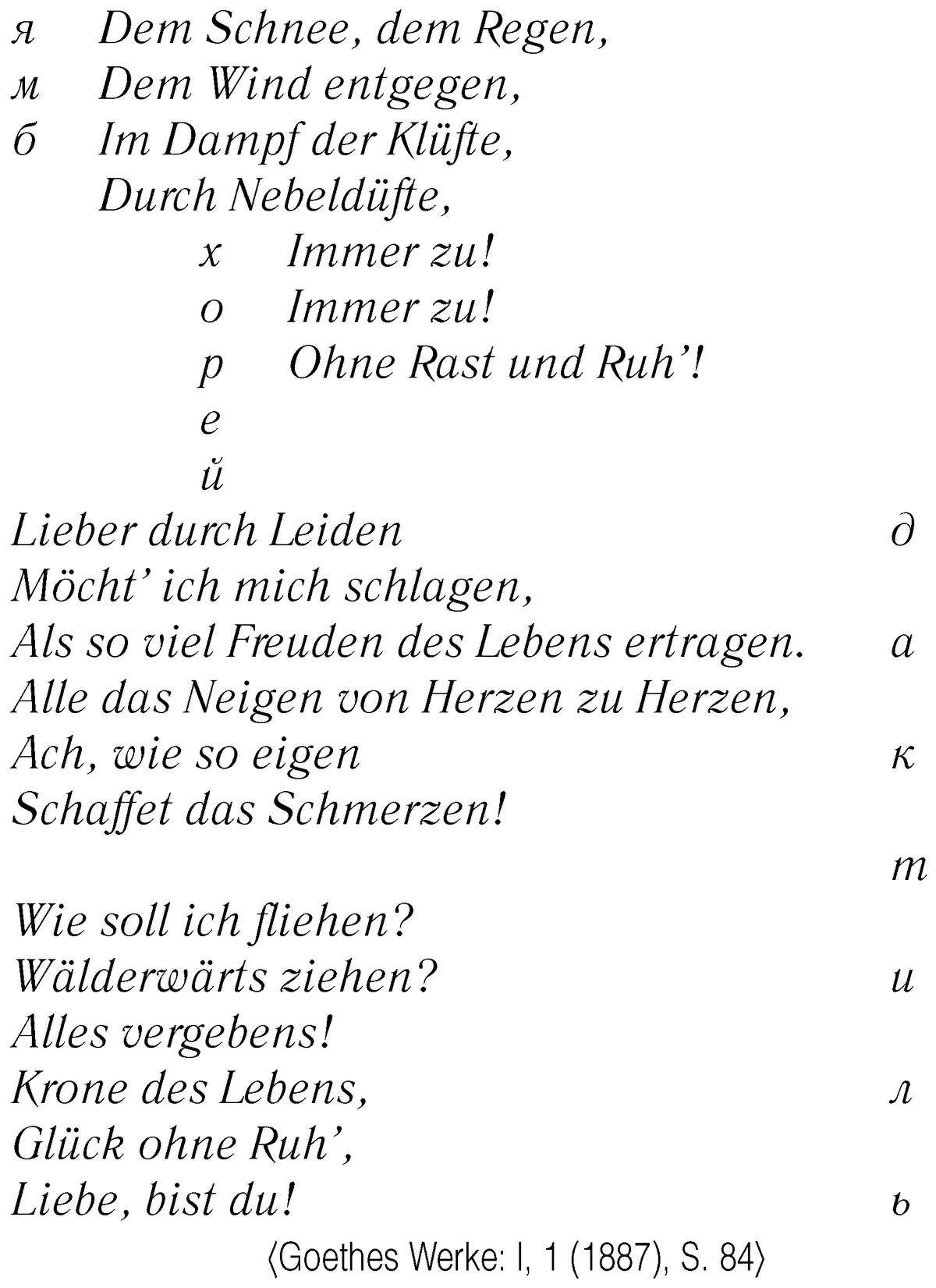
Towards the snow, towards the rain, into the teeth of the wind, in the vapour of the ravines, through mists of fog, ever onward! ever onward! without rest or repose! Sooner would I fight my way through sufferings than bear so many of life’s joys. All this inclining of heart to heart — ah, how strangely it makes pain! How shall I flee? Make for the woods? All in vain! Crown of life, happiness without rest — Love, that is you!
I wrote Yura a letter about the translations of Goethe’s verses.
It is possible that this is only a literary form, and that in fact it will not even be sent, as one already has been rejected [zabrakovano], written before my departure from Moscow. The verb is that of brakovka, acceptance sampling — the culling of defective goods — and he is applying it to his own letter, in the same week he lectures on acceptance sampling twice.
Saturday, 18 September 1943. On the road to Moscow
We travelled on a beautiful, sunny day.
The Volga, the Chuvash oak forests, the Observatory stay in the memory.
I read Vera Goethe’s verses — she knows them and loves them, with a good selection.
Sunday, 26 September 1943. Moscow
Early morning. I sit at the open window in the Moscow room.
By the little piece of sky visible on the right — pink clouds in little fleeces. Anya is still asleep.
Over the floor of the room is scattered the potato brought yesterday. On the table a disorder, among which the recently acquired “Problems of Form in the Fine Arts” of Hildebrand and “Bondage and Bondmen in the Muscovite State in the 17th Century” of Yakovlev. Adolf von Hildebrand, Das Problem der Form in der bildenden Kunst (1893); A. I. Yakovlev, Kholopstvo i kholopy v Moskovskom gosudarstve XVII v. (1943).
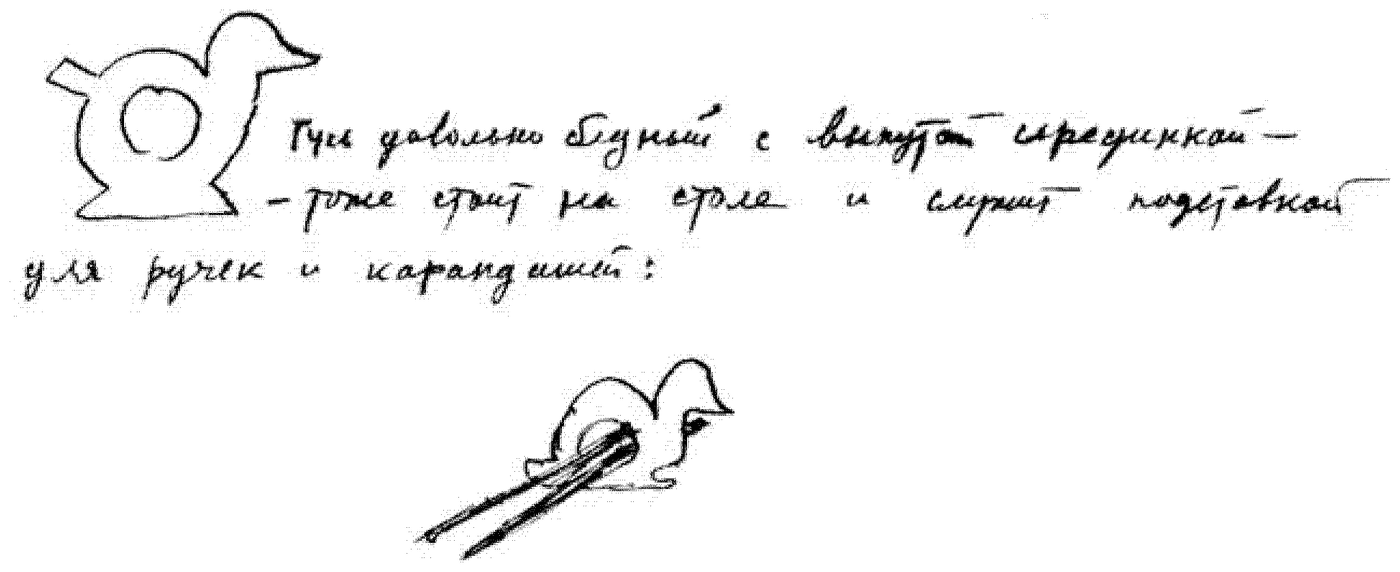
A goose, rather [brown?], with its middle taken out — it too stands on the table and serves as a stand for pens and pencils:
Yesterday may be counted a success. In the morning with Anya, Borya and Tatyana (spouse No. 2 of B. Egorov) we dug the potatoes on the Sparrow Hills. [Translator’s note:] This band of the page is not typeset: two pen drawings of a goose — the first hollowed out into an open oval, the second with two pens stuck into it — and three lines of Kolmogorov’s hand between them, reproduced photographically and therefore invisible to the scan’s text layer. The colon introduces the second drawing: text and drawing are one sentence. Tatyana, whom the next typeset paragraph discusses, is named nowhere but here. The word after “rather” will not resolve at any available resolution between buryi (“brown”) and burnyi (“stormy, wild”); sense favours the first, the strokes may favour the second, and it wants the original notebook. The Kholmogory Goose is his own emblem and his signature: here it is a piece of furniture on his desk, holding his pens.
Tatyana — a creature with painted little lips and a snub-nosed, though comely, physiognomy. On her return from the trip (Krasnodar, the Kuban stanitsas, Gelendzhik on the eve of the taking of Novorossiysk, Rostov-on-Don) she tries very hard to “enter into the family”. She has a good attitude to Dima. By the same thing is explained her readiness to go with us too. Having got herself up in a ski suit and flirting with her own appearance with a spade, [Editor’s note:] Tatyana — B. D. Egorov’s second wife. Dima — B. D. Egorov’s son by his first marriage.
she worked, however, well. With enthusiasm she told of the pleasures of camp and country life; asserted that she wants to live in the provinces (“if Boris agrees”).
The autumn day, damp and somewhat misty on the Sparrow Hills, was also very fine. And poor Oleshka with his heart and the prohibition of physical work stood all day in the queue at the Chief Administration of the Militia for permission for Vera Yakovlevna’s residence registration. [Editor’s note:] What is meant is the final return to Moscow from the evacuation to Kazan, where until this time Vera Yakovlevna and Varvara Yakovlevna had remained. The August errand, completed: on 1 August the second of his immediate tasks was “to bring Vera and Varya”. Oleshka is a new diminutive; August has only Oleg.
We caught a lorry and brought everything home (for 400 r.). I immediately changed and went off to the House of Scientists.
| First round | Second round | Third round | |
|---|---|---|---|
| Lebedev | 13 | — | — |
| Khristianovich | 9 | 14 | — |
| Alikhanov | 8 | 9 | 10 |
| Kurchatov | 7 | 7 | 6 |
| Smirnov | 4 | 5 | 6 |
| Lavrentiev | 2 | 2 | 2 |
| Landsberg | 1 | 3 | 2[Editor’s note:] At the House of Scientists there took place at that time the voting for the election of full members (academicians) for the Physico-Mathematical Division of the USSR Academy of Sciences. A.N. gives the results of that voting, round by round, here in the form of a table. The source underlines the count with which each man was elected; underlining is rendered as bold here and throughout the three election tables. The Smirnov of these tallies is V. I. Smirnov, the Leningrad analyst, elected academician in 1943 — not Yura Smirnov, the Little Ostrich of 6 September, who was twenty-one and an undergraduate. The diary settles it itself on 28 September, where the initials are given. |
With Papaleksi and Fesenkov I was on the tellers’ committee.
In snatches during the sitting I dined.
Although the result of the elections is satisfactory, the impression from our public life [obshchestvennost’] is a sad one. And not only from the group now ruling (A. F. Ioffe), but from the old men too, of the sort of Bernstein and Mandelstam, who cannot rise above defending their personal candidates by every means. O.Yu[Editor’s note:] O.Yu. — Otto Yulievich Schmidt.. was effective, but demagogic (in the question of Kurchatov). Obshchestvennost’ is the collective body of the professionally engaged, the “public” acting as a body — not publika, the audience, and not obshchestvo, society at large.
We supped with Kapitsa and Sobolev. With Kapitsa it is all the same easier to come to an agreement on a line of principle.
At the general assembly the only interesting thing was Asratian’s speech with a criticism of L. S. Stern (whose works were highly assessed in Bruevich’s report) and Frumkin’s subsequent proposal to approve the report only “in the main”. On this occasion Baikov showed himself a coarse and unintelligent boss, but Bruevich and Komarov turned out to be cleverer.
Monday, 27 September 1943
The election of full members.
Alikhanov — 77 of 95 ( — 18 party members?) Ivanov 55 Korneichuk 52 Sergeev-Tsensky — 56[Editor’s note:] ⟨Here are given the results of the elections at the general assembly of the Academy.⟩ A block set between two rules. His parenthetical aside is as printed.
S. N. Bernstein’s speech and the shameful spectacle Abram Fedorovich made. Pozorishche — pozor, “shame”, with an augmentative suffix; but the archaic pozorishche is “a spectacle” (from the root “to see”), and the older sense is still audible. Ioffe’s performance was both a sight and a disgrace.
In the evening — the enlarged expert commission. Unanimously they earmarked Kurchatov for the second place in nuclear physics. [Editor’s note:] ⟨On the supplementary election of full members.⟩ [Translator’s note:] Kurchatov had lost the ordinary ballot the day before, placing fourth in all three rounds; the expert commission now creates a second nuclear-physics seat and puts him in it unanimously, and on 28 September he is elected 13 of 14. This is the documented 1943 engineering of his election, and he was by then head of the Soviet atomic project.
For the second place in applied mathematics, after a short discussion, Abram Fedorovich’s roll-call vote proceeded thus:
Vavilov — Smirnov
Mandelstam — Smirnov
Bernstein — Smirnov
I — Lavrentiev
Kapitsa — Smirnov, since Lavrentiev is a Ukrainian academician
Sobolev — abstains
Fock — Smirnov
Vul — abstains
Ioffe — Smirnov.Every name in the roll-call is underlined in the source, including his own — the same device that on the previous folio marks who was elected, here marking who is speaking. It is invisible to the scan’s text layer in both places.
I declared after this that, to avoid splitting the vote, I would support Smirnov.
Then I waited for Anya a long time senselessly, in order to go to Sergei Ivanovich Preobrazhensky’s, thinking that she was listening to the reports of Obruchev and Pavlovsky.
Tuesday, 28 September 1943
The assembly of the Division at the Neskuchny.
I was somewhat late. Before my arrival Ivan[Editor’s note:] Ivan Matveevich — I. M. Vinogradov. Matveevich had spoken sharply against V. I. Smirnov and for Mikh. Aleks. Lavrentiev. [Editor’s note:] The Neskuchny ⟨palace⟩ — so A.N. calls the building of the Presidium of the USSR Academy of Sciences at 14 Bolshaya Kaluzhskaya Street. The adjoining part of the Gorky Park of Culture and Rest has always been called the Neskuchny Garden.
| Kurchatov | 13 | |
| Smirnov | 11 | of 14 |
| Lavrentiev | 6 | A single large brace groups the three counts against “of 14” — the device recurs at folios 78 and 207. [Editor’s note:] ⟨The supplementary election of full members in the Division of Physico-Mathematical Sciences.⟩ Three tallies for one election, three different bodies: 26 September is the House of Scientists ballot, 27 September the general assembly of the Academy, and this the Division’s supplementary election [dovybory] — an additional round filling the seats left unfilled. The brace is what explains the arithmetic: 13 + 11 + 6 = 30 out of 14, because each elector votes for more than one candidate. |
The candidates for corresponding membership had been arranged the day before thus:
| Mathematics | Physics | Astronomy |
|---|---|---|
| 1. Petrovsky | 1. Kikoin | 1. Mikhailov |
| 2. Kibel | 2. Kobeko | 2. Orlov |
| 3. Keldysh | 3. Alexandrov | 3. Mansurov |
| 4. Andronov | 4. Kravets | The Alexandrov of the Physics column is A. P. Alexandrov, the physicist — not Pusya, who is P. S. Alexandrov and is named in his own right on 13, 14 and 16 September. The Keldysh is M. V. Keldysh, not his sister L. V. Keldysh, also a mathematician. |
S. N. Bernstein spoke for Kuzmin, considering him no worse than Petrovsky and referring to A. N. Krylov’s opinion. I, for my part, gave my opinion of him as the strongest mathematician in the USSR of a purely “sporting” type (number theory, trigonometric series, interpolations and mechanical quadratures — the latter, however, in a style far from the needs of practice).
At the general assembly of the Division Nikolai Mitrofanovich ⟨Krylov⟩ spoke yet again, extremely plaintively and at the same time pretentiously, for N. N. Bogolyubov. It was I, again, who answered (extremely amiably and gently). Two Krylovs on one page: A. N. Krylov the naval architect, cited above for his opinion of Kuzmin, and N. M. Krylov, the Ukrainian mathematician, whose surname the editors supply in the body in angle brackets.
In the first round were elected:
Petrovsky Kikoin Mikhailov Kibel Kobeko Keldysh Alexandrov
It remained to elect
a) Andronov or Kravets b) Orlov or Mansurov.
Mandelstam, though with pain in his heart, spoke out for Kravets, which decided the matter, notwithstanding my own, Sergei Lvovich’s and Lev Semyonovich’s speeches.
In the second round were elected:
Kravets, Orlov.
In the evening Anya and I were at Sergei Ivanovich’s. He is a sensible and pleasant man, a doctor, apparently decent, but no more. He approved the appeal to Tareev, supported sponging-down with room-temperature water and moderate hardening [Editor’s note:] Sergei Ivanovich — S. I. Preobrazhensky.
and training in the future. The acute endocarditis he ascribes to the flu. It is astonishing how far both Sergei Ivanovich and his spouse look at everything through Polina Alexandrovna’s eyes (and Elizaveta Rodionovna likewise!). [Editor’s note:] Elizaveta Rodionovna — the mother of D. D. Romashov (Dimetrusya).
I got excessively heated and expressed my whole attitude to Polina Alexandrovna. Needlessly, perhaps, I also declared my intentions of taking Polina Alexandrovna to live with us. The latter, however, called forth warm sympathy.
Wednesday, 29 September 1943
The supplementary election of academicians and the confirmation of corresponding members at the general assembly.
My speech on the subject of mechanics, Ilyushin and Chetaev.
A. Ya. Vyshinsky’s remark: “A strange speech!” (The result of a confusion of two Ilyushins? — if so, then everything has been explained to Vyshinsky by Nikolai Ivanovich Muskhelishvili and others.). Helpless speeches (on the subject of Chetaev) by Terpigorev and Galerkin. The two Ilyushins are A. A. Ilyushin (1911–1998), the mechanician, who headed the Moscow University chair of elasticity theory and was elected a corresponding member in this very election, and S. V. Ilyushin (1894–1977), the aircraft designer. Kolmogorov’s conjecture is that Vyshinsky took the one for the other. The question mark is his. A. Ya. Vyshinsky (1883–1954) — Procurator General of the USSR and the prosecutor of the Moscow Trials, at this date a Deputy People’s Commissar for Foreign Affairs and an academician since 1939.
On a separate vote I insist only in application to Chetaev: 7 against, including Orbeli, 17 — abstained.
In the evening Oleg at the reports of Terenin, Kapitsa and Speransky.
I preferred Shirinsky’s concert.
The first half from Asafiev, Prokofiev and Shostakovich.
In the second half Tchaikovsky, Mussorgsky. The piano part was performed by Jacobson — very beautiful, “with the face of a medusa”, a very spiteful one, according to the remark of S. N. Nyberg, who was sitting next to me. Specially for the Tchaikovsky a handsome sixteen-year-old fair-haired boy in a short jacket with a Schnellverschluss came to turn the music for her. Schnellverschluss — German, a zip fastener. The editors gloss it in Russian in the body; the gloss is dropped and this is ours.
The “Variations on a Rococo Theme” (for cello) in the first redaction made a great impression.
With them I left, not staying for the Mussorgsky.
October 1943
Friday, 1 October 1943. Komarovka
Schwimme, du mächtige Scholle, nur hin! Und kommst du als Scholle Nicht hinunter, du kommst doch wohl als Tropfen in’s Meer.
Goethe, Vier Jahreszeiten (Winter). 99.
Swim on, you mighty ice-floe, swim! And if you do not come down as an ice-floe, you will surely come as a drop into the sea.The attribution line “Goethe, Vier Jahreszeiten (Winter). 99.” is his own and is underlined on the page. The edition adds the citation ⟨Goethes Werke: I, 1 (1887), S. 360⟩. Vier Jahreszeiten — “The Four Seasons”, Goethe’s sequence of distich-epigrams; the numbers are his own, keyed to the sequence.
Winterreise
Яркий снег, и солнце в небе; Путь далекий. Облака. Хорошо мне, сердце в неге, И душа, как снег, легка!
Темной улицей пустынной Я ищу твой огонек, И дороги этой длинной Темный смысл мне невдомек.
Комнатка эта такая уютная, И самовар зашумел на столе; Быстро исчезла усталость минутная, Радость так тихо подкралась ко мне.
Ах, хоть нежностью бывалой Расцвечен вновь твой венок — Чую, путник запоздалый, Что опять я одинок...
Утро. Мы идем в конюшню, Лошадям даем овса. Снежным кружевом воздушным Вновь подернулись леса.
...Кто меня, как ты, согреет?.. Ехать надо, уж пора! Снова солнце, ветер веет, Небо, снежные поля...
Bright snow, and sun in the sky; / a long road. Clouds. / It is good with me, my heart in bliss, / and my soul, like snow, is light! // Down a dark, deserted street / I search for your little light, / and the dark meaning of this long road / is beyond my grasp. // This little room is so cosy, / and the samovar has begun to hum on the table; / the momentary weariness quickly vanished, / joy so quietly stole up to me. // Ah, though with a tenderness of old / your wreath is decked with colour once again — / I sense, belated wanderer, / that once more I am alone... // Morning. We go to the stable, / we give the horses oats. / With airy snowy lace / the woods are veiled anew. // ...Who will warm me as you did?.. / We must go, it is high time! / Again the sun, the wind breathes, / the sky, the snowy fields...[Translator’s note:] Titled Winterreise (in German) — “Winter Journey”; the subtitle “(A poem in 24 stanzas)” is his. Six of the twenty-four stanzas are copied, in his own numbering, set on the page in two columns (1–3 · 4–6). No author is named. The most likely hand is Yu. M. Smirnov’s — the copying belongs to the same verse-collecting weeks as the Smirnov anthology of 6 September — and it may render Wilhelm Müller’s twenty-four-poem Winterreise (the cycle Schubert set); but the attribution is not established, and it should not be assigned to Kolmogorov.
Vier Jahreszeiten (Herbst)
Wisst ihr, wie auch der Kleine was ist? Er macht das Kleine Recht; der Grosse begehrt just so das Grosse zu thun.
Was ist heilig? Das ist’s, was viele Seelen zusammen Bindet; band’ es auch nur leicht, wie die Binse den Kranz.
Was ist das Heiligste? Das, was heut und ewig die Geister, Tiefer und tiefer gefühlt, immer nur einiger macht.
Goethe
Do you know how even the little one is something? He does the little thing rightly; the great one just so desires to do the great. // What is holy? It is that which binds many souls together; even if it bound but lightly, as the rush binds the wreath. // What is the holiest thing? That which, today and eternally, felt ever more deeply, makes spirits ever more at one.Vier Jahreszeiten (Herbst) — “Four Seasons (Autumn)”; “Herbst” is letter-spaced on the page. Epigrams 67, 68, 69 in Goethe’s numbering, continued from the “Winter” distich above; ⟨Goethes Werke: I, 1 (1887), S. 355⟩.
Continuation
I spent the morning idling at Komarovka.
I came by three o’clock to Anya‘s festive dinner (with Vera Yakovlevna and Oleshka) and her pies. For the tea that followed the dinner Pusya arrived with Varvara Sergeevna. [Editor’s note:] 1 October is the birthday of Anna Dmitrievna Kolmogorova. In 1943 she turned 40.
![A pen drawing of a walking goose, and, to its right, in Kolmogorov’s hand: “Lemeshev — Tsar Berendei — a[n unforgettable?], unexpectedly beautiful figure.”](/images/translations/kolmogorov/figures/fig-folio062.png)
In the evening, The Snow Maiden (Varvara Sergeevna, Pusya, Vera Yakovlevna, I, Anya, Oleshka). A good voice from the young singer who performed the Snow Maiden.
The general impression, however, was for everyone a moderate one: many good places, but the whole does not grip.
Tuesday, 5 October 1943
Saturday, 2 October
In the morning and afternoon I sorted potatoes, missing the Higher Attestation Commission. VAK — the Vysshaia attestatsionnaia komissiia, the body that confirmed academic degrees and titles.
Tareev is ill and is not receiving.
We left for Komarovka with Oleg on the 20.00 train.
With pleasure I washed and took a shower.
Sunday, 3 October
A walk with Oleg to the far Ucha. After dinner I read (to Vera Yakovlevna, V.S. and Oleg) “The Solitary Little House on Vasilyevsky” — a tale of A. S. Pushkin’s as recorded by V. P. Titov.
Anya stayed in Moscow — laundry and so on.
Night of 3–4 October
At Alikhanov’s (with Pusya and Anya). [Editor’s note:] The reception at Alikhanov’s evidently took place in connection with his election as a full member of the USSR Academy of Sciences.
A disappointment — the excellent quality of the wines apart — an ordinary Soviet spree (with Landau and Nemenov; the promised Ios. Abg. Orbeli and Nik. Iv. Muskhelishvili were not there).
Monday, 4 October
Ration-card and residence-registration affairs at the Institute. Departure for Komarovka.
Today
Mainly, the editing of Yura’s poem:
Помнится... Редкая сетка веток, Слабо краснея, дрожит в отдаленье. Взор ожиданья порывист и меток . . . . . . . . . . . . . . . . . . . .
I remember... A sparse lattice of branches, / faintly reddening, trembles in the distance. / The gaze of expectation is impetuous and unerring / . . . . . . . .Three lines of Yu. M. Smirnov’s poem, in the state in which he and Kolmogorov are working on it; the row of dots is an elision. Kept in Russian because the entry’s business is the editing of the verse itself.
Principles of criticism: the joint epistle to Yurka, Pusya’s and mine — a success, it seems.
At last I have slept myself thoroughly out. I am in bliss on a diet of potato and carrot with butter, coffee with milk in the mornings and chocolate (2 bars!).
I am quickly coming back into form, physically and mentally.
Wednesday, 6 October 1943
On Sunday, 26 September in the morning I was at Polina Alexandrovna’s and Oleg‘s.
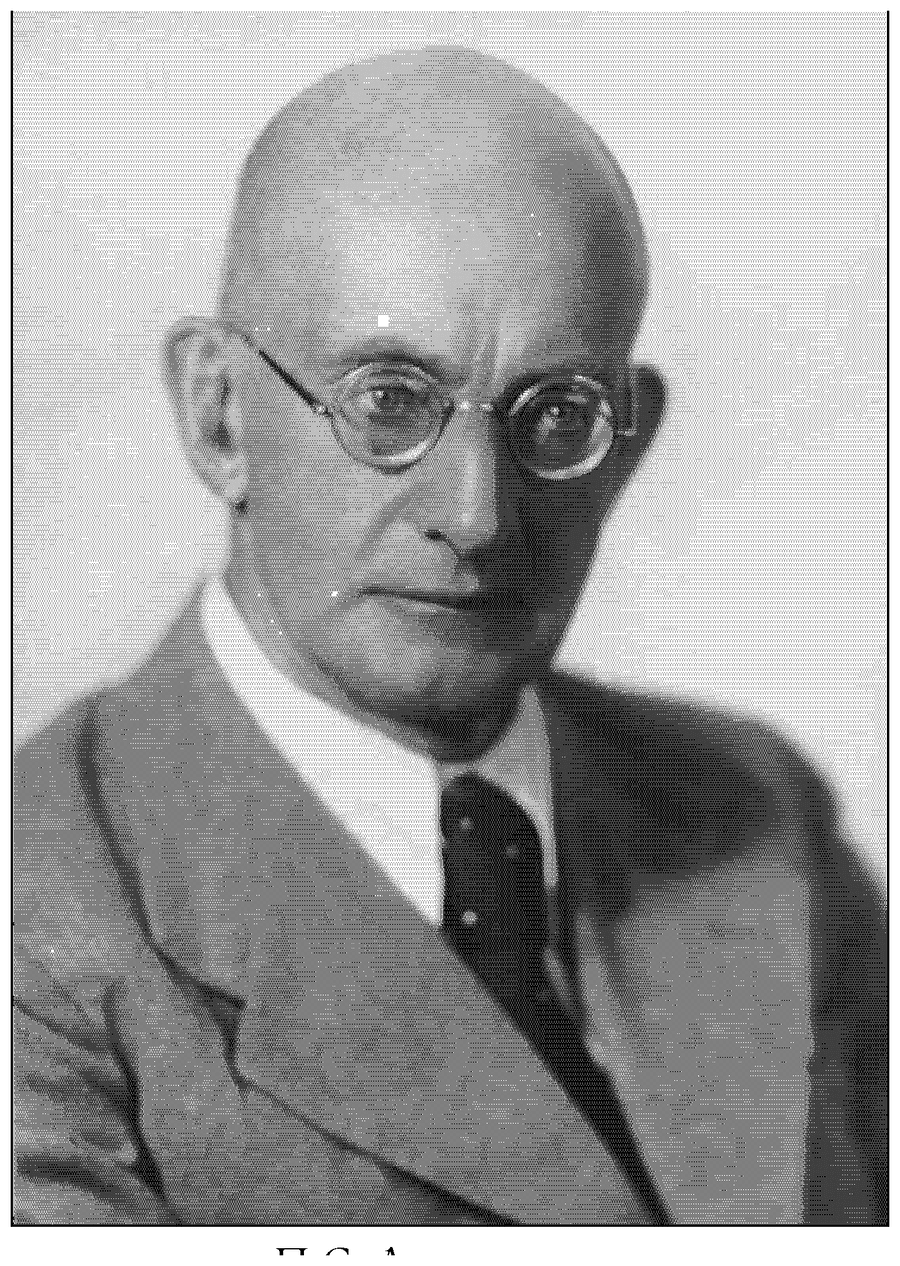
Before Pusya‘s lecture we walked with Oleg as far as the Crimean Bridge — we talked of the possibility of a joint life, his and mine, Anya‘s and Polina Alexandrovna’s. It somewhat surprised me that the very idea of such an arrangement was taken by Oleg without the least embarrassment: at once he passed to the question of whether it would be convenient for P.A. to travel to her institute from Kaluzhskaya. [Editor’s note:] Kaluzhskaya — on B. Kaluzhskaya St. (now Leninsky Prospekt), in house No. 13, the so-called “House of Academicians”, flat 144, where the Kolmogorovs then lived. The windows of the Kolmogorov flat gave onto Vystavochny Lane — now Academician Petrovsky Street, after Petrovsky, who lived in the same house. In answer to his question about the causes of the ill-feeling between Anya and Polina Alexandrovna I suddenly resolved to tell him of my own understanding of the shift in P.A.'s exclusive attachments (first to Seryozha, then to Oleg himself) and of the whole of P.A.'s attitude to Anya in the distant past. All such things Oleg grasps very quickly and seriously. [Translator’s note:] “P.A.” here is Polina Alexandrovna (Ivasheva-Musatova), Oleg’s grandmother — not Pusya (P. S. Alexandrov), and not A. P. Alexandrov. She is female and a different person; the abbreviation is the single easiest catastrophic misreading in the entry. “Pusya’s lecture” below is P. S. Alexandrov’s.
By twelve o’clock we came to the House of Scientists. At first they did not want to let Oleshka in on his guest ticket. [Editor’s note:] The House of Scientists — both A. N. Kolmogorov and P. S. Alexandrov were long-standing members of the Moscow House of Scientists (Andrei Nikolaevich held membership card No. 5422, Pavel Sergeevich No. 6044).
V. L. Komarov’s lecture on Timiryazev was read in the absence of V. L. himself.
Pusya’s lecture exceeded all expectations in the richness and variety of its content (from Tyutchev’s verse to the thieving of the apparatus functionaries within the walls of Kazan University), the elevation of the general tone and the mastery of the delivery. The audience listened attentively and responded vividly to the hints scattered through the lecture. They clapped long and warmly. Afterwards Abram Fedorovich shook Pusya’s hand for a long time and, in his own words, declared that “only now have I understood what mathematics is”. [Editor’s note:] Abram Fedorovich — A. F. Ioffe.
Maria Fedorovna Andreeva congratulated him on the success, “like an old actress”.
Into the lecture there had also been inserted an exact exposition of the Kleinian interpretation of Lobachevsky’s plane geometry, which took some five minutes of the fifty.
For me, however, this lecture was hard, simply to the point of tears. So agitated and captivating an exposition of Lobachevsky’s scholarly and educational ideals (that is, strictly, of Pusya’s, or of his and mine in common) before the Presidium of the Academy (and the lecturer addressed himself much to the Presidium precisely!) rang wild. I was troubled, too, by the thought of whether the listeners might not take the emotional tone of the lecture as a manifestation of the lecturer’s hurt and bitterness over his own non-recognition (and non-election...). [Editor’s note:] P. S. Alexandrov was elected a corresponding member of the USSR Academy of Sciences in 1929, and a full member (academician) only in 1953.
After the lecture Anya and Oleg set off to dine at Polina Alexandrovna’s, and I stayed to dine at the House of Scientists. For a long time they searched for my dinner coupon, which I had by mistake handed in that same morning for breakfast.
Because of this I was late to P.A.'s, and Anya and Oleg had left for Lyublino without me. I came to them already at dusk. In the dark Anya and I carried across all the cabbage from the near plot, which Oleshka had been cutting (he, after all, is not allowed to carry more than 15 pounds!). [Editor’s note:] Lyublino — in this then-suburban settlement (now a district of Moscow, Verkhnie Polya St.) was the Filtration Laboratory attached to the aeration fields, where Anna Dmitrievna worked. There too were the garden plots of the Laboratory’s staff.
Friday, 8 October 1943
Wednesday
I corrected the stenogram of my speech at the general assembly ⟨of the Academy⟩, wrote a short letter to A. Ya. Vyshinsky. [Editor’s note:] The letter to Vyshinsky — see the Note to the entry of 29 September 1943.
The Mathematical Society — O. Yu. Schmidt, Gelfand and Raikov (the theorem on the existence of irreducible representations of locally bicompact groups by unitary operators in Hilbert space).
The Board (of the Mathematical Society) (the problem of the approaching re-elections).
At S. Musatov’s.
Well, now much has been cleared up for an ordered life and work!
Anya has her first day free of the service (6 October 1943).
Thursday
At Borya’s (a son!). [Editor’s note:] Borya — B. V. Gnedenko. The son is Dima (D. B. Gnedenko), born 1943.
At the Mathematical Institute I got stuck on the jury for the socialist competition.
At the philology faculty, at Prof. Vinokur’s, on Petya‘s business.
Friday morning
Again at the philology faculty and on Trubnikovsky (also Petya’s business). [Editor’s note:] Petya’s business — Andrei Nikolaevich was at that time petitioning for a post at the Philology Faculty of Moscow University, and for a residence registration with his aunts in Trubnikovsky Lane, for Petr Savvich Kuznetsov, who had returned from evacuation.
At Oleg‘s — ill with mumps? Swollen on both cheeks, temperature 37.2. He says he always feels especially well when he is ill (?!). He is reading about the principle of relativity. My explanations he listens to sensibly.
A multitude of new projects for a military composition, among them a slain youth with his head tipped back into the water, with grass and water-lilies all around.
“The funeral service for the slain man” — the priest’s head is good — but the author insists stubbornly that this is exclusively “an analysis of form”.
Besides which, at my commission, he is copying Michelangelo’s “Adam”.
In watercolour — some very colourful dancing couples with generals, and the Presidium of the Academy at Pusya‘s lecture.
At last I have got to Komarovka for a good while: Saturday to Wednesday — five working days!
Saturday, 9 October 1943
In the morning Pusya and I bathed, drank coffee.
Then I did many small jobs: I looked through the notes submitted to the DAN, wrote the report of the chairman of the state examination commission, drew the diagram for Pusya’s lecture on Lobachevsky. [Editor’s note:] DAN — the journal Reports of the Academy of Sciences of the USSR (in the case where the author is not a member of the Academy, his note must be presented by one of the academicians). [Editor’s note:] The diagram for Pusya’s lecture — Andrei Nikolaevich liked to make diagrams; in P. S. Alexandrov’s monograph Combinatorial Topology many of the diagrams were done by Kolmogorov.
I worked rather lazily, reading in passing Plato (“Alcibiades I”), Goethe and Bogdanovich’s “Dushenka”.
In the evening we carried across the newly acquired firewood. In the course of it I felt a kind of faintness (?).
I was thinking over “visual non-Euclidean geometry”.[Editor’s note:] Visual non-Euclidean geometry — a lecture on such a theme was read by A. N. Kolmogorov on 6 November 1943, at a joint session of the Moscow Mathematical Society and the Mechanics-and-Mathematics Faculty of MSU devoted to the memory of N. I. Lobachevsky (see the entry for 6 November 1943).
Seryozha says that in reading Hegel he is not too much occupied by the literal logical sense of Hegel’s assertions, but is carried away by the grandeur of the Hegelian spirit. Hegel’s works he compares with Beethoven’s symphonies, and even indicates which of them is analogous to which symphony. Pusya found this “verbiage”. The category of “mental onanism” (O. Yu.'s) came into my head too, independently. This rapture before the grandiosity and greatness of ideas independently of their content is, perhaps, Seryozha’s basic, fatal weakness. [Editor’s note:] Seryozha — S. M. Ivashev-Musatov. [Translator’s note:] The edition prints Sergei Ivashev-Musatov’s patronymic inconsistently: here and in the note on folio 74 the page-foot notes give “S. M.” (Mikhailovich, his passport patronymic), but the Index of Names heads his entry “Sergei Nikolaevich” (S. N.). The discrepancy is the edition’s own and is left unresolved; his initials are reproduced folio by folio as printed, not normalised. Verbiage renders slovobludie — slovo “word” + blud- “fornication, going astray” (the root of zabludivshiisia, “gone astray”); the pejorative is vivid, closer to “word-whoring”. Mental onanism is O. Yu. Schmidt’s phrase, which Kolmogorov here reports adopting. “Independently of their content” is underlined.
Oleg’s markings in “Paul et Virginie”
“The courage that pushes us towards death lasts only a minute. It is often aroused by vain human praise. But there is another courage, rarer and more precious, which helps us to bear, daily, without praise and without witnesses, all life’s adversities — this is patience.
It is sustained in us not by others’ opinion and a momentary impulse, but by the will of God.”
“So many passions stir us that reason is often darkened and troubled by them; but we have a beacon at which we can rekindle its torch, namely — science.”
“Science, my son, is a true help from on high.”[Translator’s note:] The two quotations are the passages Oleg marked in his copy of Bernardin de Saint-Pierre’s Paul et Virginie, transcribed here by Kolmogorov under the heading above; each is flagged in the left margin by a boxed NB — Oleg’s mark, not Kolmogorov’s. Rendered into English as Russian prose, since they carry no metre.
Sunday, 10 October 1943
Bekehrte
| Bei dem Glanze der Abendröthe | — ∪ — ∪ | ∪ — ∪ — ∪ |
| Ging ich still den Wald entlang. | — ∪ — ∪ — ∪ — |
| Damon sass und blies die Flöte, | — ∪ — ∪ — ∪ — ∪ |
| Dass es von den Felsen klang. | — ∪ — ∪ — ∪ — |
| So la la! | — ∪ — |
| Und er zog mich an sich nieder | — ∪ — ∪ | ∪ — ∪ — ∪ |
| Küsste mich so hold, so süss. | — ∪ — ∪ — ∪ — |
| Und ich sagte: blase wieder! | — ∪ — ∪ — ∪ — ∪ |
| Und der gute Junge blies. | — ∪ — ∪ — ∪ — |
| So la la! | — ∪ — |
| Meine Ruhe ist nun verloren. | — ∪ — ∪ | ∪ — ∪ — ∪ |
| Meine Freude floh davon, | — ∪ — ∪ — ∪ — |
| Und ich höre vor meinen Ohren | — ∪ — ∪ | ∪ — ∪ — ∪ |
| Immer nur den alten Ton, | — ∪ — ∪ — ∪ — |
| So la la, le ralla! U.s.w. ... | — ∪ — || — ∪ — , u.s.w. |
By the glow of the evening red / I walked quietly along the wood; / Damon sat and blew the flute, / so that it rang back from the rocks. / So la la! / And he drew me down to him, / kissed me so sweetly, so sweet. / And I said: play again! / And the good boy played. / So la la! / My peace is now lost, / my joy has fled away, / and I hear before my ears / always only the old tune, / So la la, le ralla! etc. ...[Editor’s note:] u.s.w. — an abbreviation of und so weiter (“and so on”) — German. Here the poem of Goethe given above (“Bekehrte”) is marked out by stressed (—) and unstressed (∪) syllables. [Translator’s note:] The scansion is his, in the notation defined for the September anthology: (—) a stressed syllable, (∪) an unstressed one, ( | ) a word-division mark — not a caesura. The final line introduces a doubled word-division mark ( || ), undefined by the editors and not seen before; the folio-49 warning against upgrading | to a caesura holds with double force for it. This is the “Convert” of 15 September copied again — but from the 1836 Riemer–Eckermann text, textually variant from the Soviet pocket edition he used then (here Bei dem Glanze, Ging ich still den Wald, Und er zog mich an sich nieder, Meine Ruhe). The variants are the whole point of the entry below; they are given exactly as printed, unemended. Goethe’s speaker is a girl; Damon is a shepherd’s name out of Greek pastoral.
Thus in the edition of 1836 (the Riemer and Eckermann redaction).
So Goethe too was tidied up, like Tyutchev!
And the deliberateness of the change of rhythm is obvious, especially if one takes into account “Die Spröde”, written in a “correct” rhythm.[Editor’s note:] “Goethe too was tidied up...” — to grasp the sense of this note of Andrei Nikolaevich’s, one must compare the text of this poem of Goethe’s (A. N. gives it here from the Riemer and Eckermann edition) with the one given in the entry of 15 September, from the Soviet edition. See there too, on p. 53, a translation of this poem (its address in the edition “Goethes Werke”: I, 1 (1887), S. 21). Podchishchali, “were tidied up / cleaned up” (pod- + chist-, “clean”) — editorial smoothing of a poet’s text, not “corrected”. The thread runs back to 15 September, where he copied the “Convert” from a wartime pocket Goethe and remarked on the divergence; here, collating that against the 1836 text, he concludes the rhythmic irregularity was Goethe’s own, deliberately “tidied” by later editors as Tyutchev’s verse was.
Monday, 11 October 1943
Petrov brought Pusya the four-volume collected works of Esenin (GIZ, 1926–27).
Есть в дружбе счастье оголтелое И судорога буйных чувств — Огонь растапливает тело, Как стеариновую свечу. Возлюбленный мой! Дай мне руки — Я по-иному не привык, — Хочу омыть их в час разлуки Я желтой пеной головы. Ах, Толя, Толя, ты ли, ты ли, В который миг, в который раз — Опять, как молоко, застыли Круги недвижущихся глаз. Прощай, прощай. В пожарах лунных Дождусь ли радостного дня? Среди прославленных и юных Ты был всех лучше для меня. В такой-то срок, в таком-то годе Мы встретимся, быть может, вновь... Мне страшно, — ведь душа проходит, Как молодость и как любовь.
. . . . . . . . . . . . . . . . . . . . . . . . . . . . . . . . . . . . . . . . . . . . . . . . . . . . . . . . . . . . . . . . . . . . . . . . . . . . . . . .
Прощай, прощай! В пожарах лунных Не зреть мне радостного дня, Но все ж средь трепетных и юных Ты был всех лучше для меня.
There is in friendship a frenzied happiness / and a convulsion of unruly feelings — / fire melts the body / like a stearine candle. / My beloved! Give me your hands — / I am not used to it otherwise — / I want to wash them, in the hour of parting, / with the yellow foam of my head. / Ah, Tolya, Tolya, is it you, is it you, / at what instant, at what turn — / again, like milk, the circles / of your motionless eyes have set. / Farewell, farewell. In the moon-fires / shall I live to see a joyful day? / Among the famed and the young / you were the best of all for me. / At such-and-such a term, in such-and-such a year / we shall meet, perhaps, again... / I am afraid — for the soul passes, / like youth and like love. // . . . . . . . . // Farewell, farewell! In the moon-fires / I am not to see a joyful day, / but still, among the tremulous and the young, / you were the best of all for me.⟨S. Esenin, “Farewell to Mariengof”, 1922⟩, the editors’ attribution. “Tolya” is Anatoly Mariengof. The four rows of dots are his omission mark; the closing quatrain is the poem’s own varied reprise of the fourth, not a miscopy — the wording differs deliberately (“shall I live to see” / “I am not to see”; “the famed” / “the tremulous”). Kept in Russian: the copying of the verse is itself the day’s record, and which lines he keeps and skips is the datum.
And so the whole myth of my awakening to a pagan-beautiful sensuous life, which so occupied me since last autumn, comes to an end!
В неизведанный небес простор Грустный ветер листья с клена мечет И со мной заводит разговор, Ласково обняв меня за плечи:
Неужели тоже Вы поэт? Сколько повидал я вас на свете! Вам, как мне, наверно, тесен свет, Что порой так радостен и светел. Я привык: ведь издавна слыву Средь людей мечтателем суровым; Грустью и печалью лишь живу, Да с тоски кручу хвосты коровам!.. А бывает, слишком рассердясь (Над собою тоже я не властен), Грозной бурей смешиваю в грязь Человечьи мелочные страсти... Нам обоим дар мечтаний дан: Вместе с Вами то смеюсь, то плачу; Наш отец — бескрайний Океан, А подруга наша — Неудача! Он замолк, а вечер заливал Даль небес осеннею прохладой. Факел солнца тихо догорал За лесною синею оградой.
Into the untried expanse of the skies / the sad wind flings leaves from the maple / and strikes up a conversation with me, / tenderly putting its arm round my shoulders: // “Are you really a poet too? / How many of you I have seen in the world! / For you, as for me, the world is surely too narrow, / that world at times so joyful and bright. / I am used to it: for I have long been reputed / among people a stern dreamer; / I live only by grief and sorrow, / and out of anguish I twist cows’ tails!.. / And sometimes, growing too angry / (I have no power over myself either), / with a menacing storm I mix into the mud / men’s petty passions...” // We are both given the gift of dreams: / together with you I now laugh, now weep; / our father is the boundless Ocean, / and our companion — Misfortune! // He fell silent, and the evening flooded / the distance of the skies with autumn cool. / The torch of the sun quietly burned down / behind the blue fence of the forest.A second Esenin piece, unheaded on the page, copied from the same edition; the wind speaks the middle stanzas.
Мы теперь уходим понемногу В ту страну, где тишь и благодать. Может быть, и скоро мне в дорогу Бренные пожитки собирать. Милые березовые чащи! Ты, земля! И вы, равнин пески! Перед этим сонмом уходящих Я не в силах скрыть моей тоски. Слишком я любил на этом свете Все, что душу облекает в плоть. Мир осинам, что, раскинув ветви, Загляделись в розовую водь! Много дум я в тишине продумал, Много песен про себя сложил, И на этой на земле угрюмой Счастлив тем, что я дышал и жил. Счастлив тем, что целовал я женщин, Мял цветы, валялся на траве И зверьё, как братьев наших меньших, Никогда не бил по голове.
Знаю я, что не цветут там чащи, Не звенит лебяжьей шеей рожь. Оттого пред сонмом уходящих Я всегда испытываю дрожь. Знаю я, что в той стране не будет Этих нив, златящихся во мгле. Оттого и дороги мне люди, Что живут со мною на земле.
С. Есенин
We are leaving now, little by little / for that land where there is quiet and grace. / Perhaps soon I too must gather / my perishable belongings for the road. / Dear birch thickets! / You, earth! And you, sands of the plains! / Before this host of the departing / I have no strength to hide my anguish. / Too much did I love in this world / all that clothes the soul in flesh. / Peace to the aspens that, spreading their branches, / have gazed into the rosy water! / Many thoughts I have thought through in the silence, / many songs I have composed to myself, / and on this sullen earth / I am happy that I have breathed and lived. / Happy that I have kissed women, / crushed flowers, sprawled on the grass, / and never struck beasts, our lesser brethren, / on the head. // I know that the thickets do not bloom there, / that the rye does not ring with its swan’s neck. / And so, before the host of the departing, / I always feel a shudder. / I know that in that land there will not be / these fields, gilding in the gloom. / And so people are dear to me, / who live with me on the earth.The signature “S. Esenin” is his; the editors add ⟨”We are leaving now, little by little”, 1924⟩.
Tuesday, 12 October 1943
A smoky-sunny (Parisian) autumn day.
I am settling in for the winter in my room.
After breakfast Pusya and I walked down along the Klyazma, looked at the trees wrenched out by the hurricane (among them our two pines by the shore).
Vera Yakovlevna sits in turn in the different rooms and reckons up or recalls something. Just now she has gone to Pervomaiskaya.
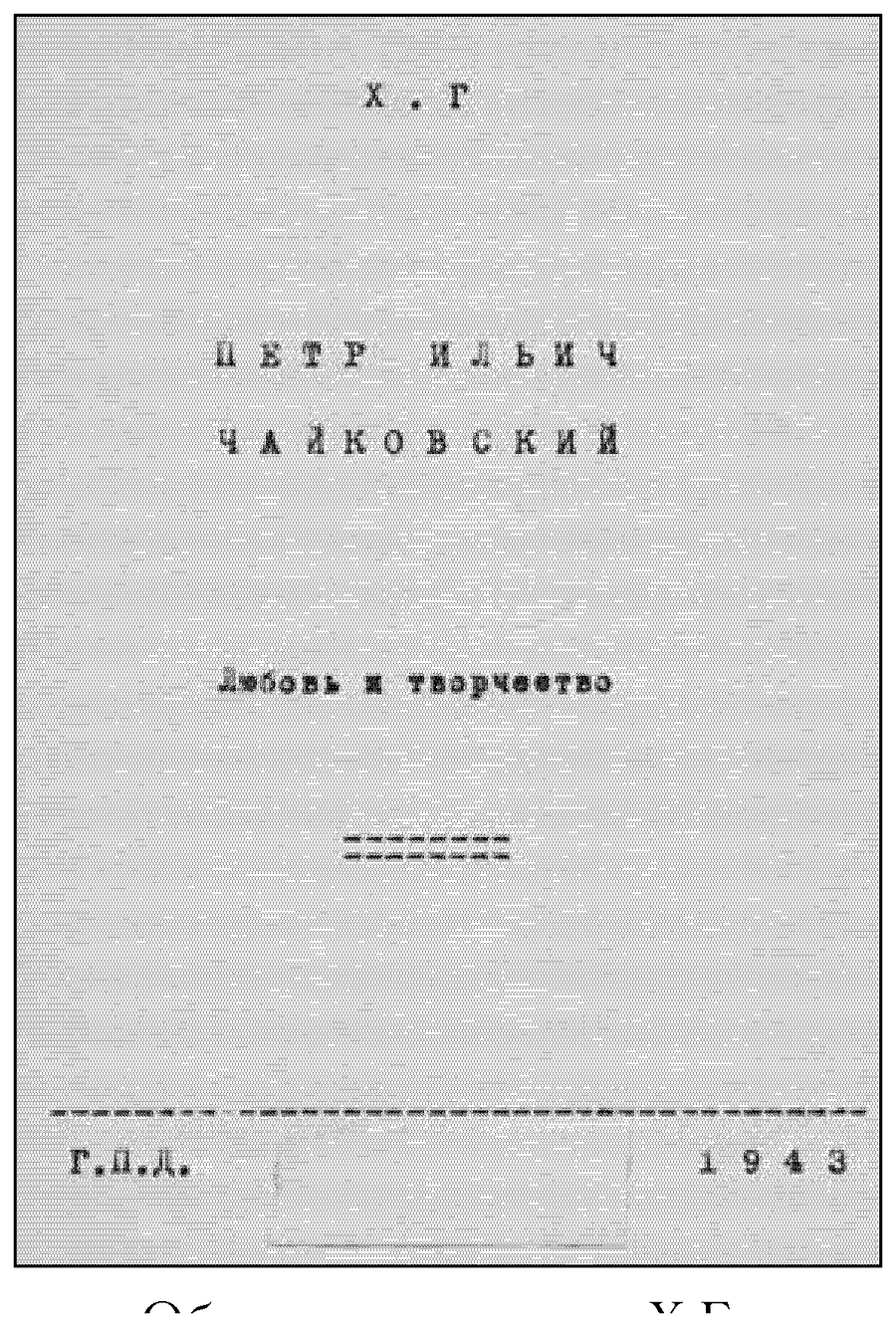
To the preceding reflections I here append the letter to Pusya of 6 February, which was written, in large measure, for myself (for want, that spring, of this notebook). This letter was itself the end of a whole period of life that had begun in the summer of 1942. [Editor’s note:] The letter of 6 February 1943 is glued into this notebook. It is printed in full in the book Selected Passages from the Correspondence of A. N. Kolmogorov and P. S. Alexandrov of the present edition (pp. 587–593).
After that, in February, I wrote my notes on P.I.Ch. [Editor’s note:] The notes on P.I.Ch. — see the Note to the entry of 1 August 1943 (p. 28). [Translator’s note:] The facsimile is the typeset cover of his own essay on Tchaikovsky, now in print: “Kh.G. / PYOTR ILYICH TCHAIKOVSKY / Love and Creative Work / G.P.D. / 1943”. “P.I.Ch.” are Tchaikovsky’s initials (Chaikovskii by transliteration); “Kh.G.” is the Kholmogory Goose, his own pen-name. The caption is his. “G.P.D.” is an unresolved mock-imprint, left as printed.
The mood was analogous to the present one. Only now there would be added the evening bathes by the Komarovka bridge after the first trip with Oleg to Lyublino, with talk of nature, Plato and the like.
Friday, 15 October 1943
Wednesday morning I spent on a letter to Sergei Musatov about Oleshka (there is a copy). [Editor’s note:] ⟨A copy of the letter to S. Musatov has not been found.⟩
Then I drove Vera Yakovlevna to Moscow.
I was at the defence of Kreines’s dissertation, on the synthesis of gear mechanisms. Ilyushin, in his general irritation at the mathematicians, started up a scandal, supported by Kosmodemyansky, Filonenko and, in part, Artobolevsky. Ilyushin here is A. A. Ilyushin, the mechanician — not S. V. Ilyushin, the aircraft designer; the same collision Kolmogorov himself flagged on 29 September.
I spoke a good deal, on the whole to good effect.
Result: for — 27, against — 5, abstained — 2.
Why, though, do we need such a huge council?
Only by ten o’clock did I get to Seryozha‘s. What was essential in the conversations that took place there will go into the next letter to him. It is worth going to Seryozha’s, though, not to converse but to hear the four-hand playing (Mozart, Schubert, Gluck). [Editor’s note:] For four hands — S. M. Ivashev-Musatov played the piano with his wife Alla. (The note stands at the foot of folio 74, keyed back to this page.) —Trans.
I got home just after twelve.
Thursday
| 10–11 | Lemmlein, |
| 11–12 | Ekaterina Fedorovna, conversations with Anya, dinner, the university. |
| 15–15.30 | Gelfand — genuinely, sincerely interested in random processes for the sake of spectra and the like. |
| 15.30–16.30 | N. V. Smirnov |
| 16.30–18.00 | Levin’s report.[Editor’s note:] Ekaterina Fedorovna — E. F. Konstantinova — worked at that time in the Lyublino laboratory together with A. D. Kolmogorova. N. V. Smirnov here is N. V. Smirnov, the statistician — not Yura (Yu. M. Smirnov) the poet, nor V. I. Smirnov the Leningrad analyst. |
The class L of functions
for which the number N(λ) of those k with |λ_k| < λ satisfies the condition
A function from L is uniquely determined by its values on an interval of length 2π !!Reconstructed from the image. These are almost-periodic functions (Bohr): a trigonometric sum over a discrete spectrum {λ_k}, with a counting condition on how the spectrum thins out. The “lim” is underlined on the page — the lower limit, liminf, set here as \varliminf; it is not modernised with a λ→∞ subscript, which the page does not carry. The doubled exclamation is his. The thread — stationarity, homogeneity, spectra — is item II of the “big jobs” list four days on.
Oleshka’s note:
Dear Andrei!
Many thanks for the book. It interested me exceedingly, but I could not get on with it, since my brains will not work and my temperature is rising. Everyone laughed a great deal when they read the captions and looked at the little added drawings. I live now as if in non-being — I lie down and do nothing. I lie from morning till evening, only now opening my eyes, now closing them.
Well, forgive me, I can write no more, I have a temperature of 40 just now.
Oleg.
I have no appetite at all. I lie all day and eat nothing. Only now and then I take a gulp of water. If I do eat (because one must) — in the morning a morsel with hot tea, and in the evening some soup-broth. Only hot tea or boiled water do I drink with pleasure.
I sent Oleg “The Voyage of Captain Scott” with penguins drawn in.
I got to Komarovka around midnight. Full moon, stars, mist.
Today is sunny and fine. I got up at 9 o’clock.
Vier Jahreszeiten (Winter)
Fallen ist der Sterblichen Loos. So fällt hier der Schüler, Wie der Meister; doch stürzt dieser gefährlicher hin.
To fall is the mortals’ lot. So here the pupil falls, / like the master; yet the latter plunges the more perilously.
Vieles gibt uns die Zeit
Vieles gibt uns die Zeit und nimmt’s auch, aber der Bessern Holde Neigung sei ewig dir froher Besitz.
Time gives us much and takes it too, but of the better ones the sweet affection be for ever thy glad possession.⟨Goethes Werke: I, 1 (1887), S. 359⟩ for the first distich; ⟨Goethes Werke: I, 4 (1891), S. 125⟩ for the second. “Winter” is letter-spaced on the page.
Man mag nicht mit jedem leben, und so kann man auch nicht für jeden leben; wer das recht einsieht wird seine Freunde höchlich zu schätzen wissen, seine Feinde nicht hassen noch verfolgen, ...
Goethe
One cannot live with everyone, and so one cannot live for everyone either; whoever rightly perceives this will know how to value his friends most highly, and neither to hate nor to persecute his enemies, ...⟨Goethes Werke: II, 6 (1891), S. 217⟩. In the German, mit (“with”) and für (“for”) are underlined — the contrast the maxim turns on. The edition’s Russian rendering of the maxim, printed beneath it, is dropped as reader-service.
I keep sitting and idling over this notebook, over Goethe in various editions, over Oleshka’s few letters and notes.
Marina yesterday put in the winter window-frames. Into my window there have got nothing but fly-agarics. The autumn sun warms my black jacket strongly through the panes.
I shall go now for a bathe!
. . . . . . . . . . . . . . . . . . . . Молкнет язык мой, и тонкое пламя Льется по членам моим, начинает Звон раздаваться в ушах, пред глазами Ночь наступает. Праздность, Катулл, насылает мытарства, Праздность и блажь на тебя напустила; Праздность царей и блаженные царства Часто губила.
Катулл (Подражание Сафо).
My tongue falls silent, and a thin flame / pours along my limbs, a ringing / begins to sound in my ears, before my eyes / night falls. // Idleness, Catullus, brings you torments, / idleness and caprice have taken hold of you; / idleness has often ruined kings / and blessed kingdoms.Catullus, “Imitation of Sappho” — Catullus 51, itself after Sappho’s fragment 31, in a Russian verse translation; his own leading dot-row marks the opening stanzas skipped. Filonenko A. S. (folio 72) — a mathematician, author of “Tables of Trigonometric Functions” (editors’ note).
I ought to have gone with Anya to cart the cabbage out of Lyublino, instead of pretending to be very busy at Komarovka with scholarly labours.
Sunday, 17 October 1943
Yurka‘s “Little Song”, composed on 6 October in Kursk.
Небо сонное надо мной. Месяц плавает золотой. Время позднее. Искры звездные Над прохладной водой.
⟨з а ч е р к н у т о⟩ Чутко слушаю, Все я думаю: ⟨в с т а в л е н о⟩ Берег спит, молчит, Сердце мне стучит: Где, любимый ты мой?
Ветер песенку мне поет, Что любимый ко мне придет. И звенит волна, Бьет о борт челна... Только он не идет! И печально мне, А в туманной мгле [В непроглядной тьме] Звезды вьют хоровод.
A drowsy sky above me. / A golden moon floats. / The hour is late. / Starry sparks / over the cool water. // ⟨struck out⟩ / Keenly I listen, / I keep thinking: / ⟨inserted⟩ / The shore sleeps, is silent, / my heart knocks at me: / Where are you, my beloved? // The wind sings me a little song, / that my beloved will come to me. / And the wave rings, / beats against the boat’s side... / Only he does not come! / And I am sad, / and in the misty haze / [in the pitch-black dark] / the stars weave a round-dance.[Translator’s note:] Yu. M. Smirnov’s song, in draft. The letter-spaced ⟨struck out⟩ and ⟨inserted⟩ are the editors’ record of the manuscript’s revisions; “[in the pitch-black dark]” is his own square-bracketed variant for the line above it. Kept in Russian, revision-marks and all, because the drafting is the object here. On the page each block is set off by a rule.
Friday, Saturday and Sunday I reflected, without positive results, on the spectra of stationary random functions and related questions.
I bathed, read Goethe, Plato. I drew penguins and, in general, idly amused myself between times.
To spend time so is vexing and, perhaps, stupid, but one must also enter into an unconstrained occupation with real science, and without such unconstrained, dreamy days that does not come off.
I read Brehm on birds and, as many times before, gave myself over to reflections on whether there are objective grounds for reckoning birds (even from the “spiritual”, though not specifically “intellectual”, side!) lower than people.
However ridiculous it sounds, sometimes I am seriously perplexed.
Monday, 18 October 1943
The day again fine, sunny.
I saw Anya off to Bolshevo — she had come the evening before — and Pusya to Tarasovka.
I read Turing and Van der Waerden’s “Gruppen von Linearen Transformationen”.
I dined alone.
In the evening, Obukhov.
I also read Gelfand and Raikov on the irreducible unitary representations of locally bicompact groups in Hilbert space.
I remain all the while in dread that I have unlearned how to work with concentration (in mathematics proper, that is!).
Sitz’ ich allein, Wo kann ich besser sein? Meinen Wein Trink’ ich allein, Niemand setzt mir Schranken, Ich hab’ so meine eignen Gedanken.
Goethe
I sit alone, / where could I be better? / My wine / I drink alone, / no one sets me bounds, / I have thus my own thoughts.⟨Goethes Werke: I, 6 (1888), S. 202⟩. The edition’s Russian rendering, set in a parallel column, is dropped as reader-service.
Well, well! — the poor Goose with his big family. His own emblem again — the Kholmogory Goose (Kh.G.), set against Goethe’s solitary wine-drinker.
Tuesday, 19 October 1943
Immediate jobs:
Ugh! Again for several months! — Markov, Lobachevsky, acceptance sampling, gunnery (2nd instalment), probability theory (book), crystallization. Must study: group theory (representations, Lie groups). [Translator’s note:] On the page these stand in three columns: far left his aside “Ugh! Again for several months!”; in the centre the list of immediate jobs; on the right, boxed off, “Must study: group theory (representations, Lie groups).” Brakovka is rendered throughout as acceptance sampling (Dodge–Romig lot inspection — never “rejection sampling”, which is a different thing); strel’ba as gunnery. The Gelfand–Raikov theorem of folio 66 is behind the group-theory note.
The big jobs [bol’shie dela]:
I. A course of analysis.
II. Stationarity, homogeneity, spectra.
III. Turbulence.
IV. The foundations of mathematics.
V. The foundations of statistics and of quantum physics.
VI (?) Infinite-dimensional linear algebra.
VII (?) Topology.[bol’shie dela], “the big jobs” — held distinct from bol’shie zamysly, “the great designs”. This is the zamysel → delo transition, a man moving from conceiving to doing: the seven-item list recasts the very content of the “great designs” (the analysis course, spectra, turbulence, foundations) as dela, jobs to be done. The glossary dates the switch to November; it is already here, 19 October. [Editor’s note:] Acceptance sampling — this concerns the problems, occupying Andrei Nikolaevich at that time, of constructing economical plans for inspecting batches of output, allowing for possible losses of two kinds: the acceptance of defective batches and the rejection of “good” ones. A. N. returned to this subject more than once afterwards (see, e.g., his “Statistical acceptance control with an admissible number of defective articles equal to zero” (Leningrad, 1951), or the joint report with Yu. K. Belyaev “Economical plans of acceptance control” (IV All-Union Mathematical Congress, Leningrad, 1960)). See also the biographical sketch of the life and work of A. N. Kolmogorov, Book 1 of our edition, pp. 86–88. [Editor’s note:] Lobachevsky — this may concern the preparation of the article “Lobachevsky and the mathematical thinking of the nineteenth century” for the jubilee collection “Nikolai Ivanovich Lobachevsky. 1793–1943” (see the commentary to the entry of 2 August 1943), or of the article “A great Russian scholar-innovator: on the 150th anniversary of the birth of N. I. Lobachevsky” for the newspaper Izvestia, which came out in the number for 2 November 1943. [Editor’s note:] The book on probability theory — at that time A. N. Kolmogorov planned to write, together with B. V. Gnedenko, a textbook of probability theory. A. N. discussed it much with B. V. and himself wrote several sections of this book. In its final form the Course of Probability Theory appeared in 1950 under the authorship of B. V. Gnedenko alone (in the Preface to the first edition B. V. himself writes that the sections written by Andrei Nikolaevich entered his book practically without change). [Editor’s note:] To questions of “crystallization” A. N. had turned as early as the end of the thirties — on 16 February 1937 he gave a report to the Moscow Mathematical Society on the theme “The statistical theory of the crystallization of solidifying metals”. See also his work “On the statistical theory of the crystallization of metals” (Izv. AN SSSR, ser. mat., 1937, No. 3, pp. 355–359), and later “On the question of the ‘geometrical selection’ of crystals” (DAN SSSR, 1949, vol. 65, No. 5, pp. 681–684).
Saturday, 23 October 1943
Tuesday, 19 October, evening
Nina Dorliak — sings well, dresses (in Anya‘s opinion) “much too cleverly” (a gold transparent wrap over a black dress) and carries herself somewhat pretentiously.
The concert began with “Believe me not, my friend, when in excess of grief” (1869), but Anya, through the first half, was more occupied with external impressions (how she carries herself, how she sings) than with Tchaikovsky. Very fine is the romance to Tyutchev’s words, “As over the hot ash” (1874), which I had not heard before.
The second half began with “Was I not a little blade of grass in the field” (words by Surikov, 1880) — very fine, and it carried Anya over, it seems, to the perception of the music itself.
Fine is “In the dark hell underground...” (words by Maikov, 1872).
There stayed in the memory the performance of the familiar “Bear my heart away into the ringing distance” (1873) and “Alone again, as before” (1893).
For the encores all sorts of nonsense was sung — well, though.
Pusya scolded me for applauding over “So what, then?” (words by P. I. Tchaikovsky, 1872).
Wednesday, 20 October
12 o’clock. The editorial board of Matematicheskii Sbornik.
Otto Yulievich presides brilliantly, but knows the business not at all and is not in the least embarrassed by it. [Editor’s note:] Otto Yulievich — O. Yu. Schmidt was then editor-in-chief of the journal Matematicheskii Sbornik; P. S. Alexandrov and A. N. Kolmogorov were on the editorial board.
I talked with S.N. in his office at the Academy institute and along the way, as far as the Crimean Bridge. [Editor’s note:] S.N. — Sergei Natanovich Bernstein.
N. V. Smirnov and P. S. Novikov took our and Pusya’s books, potatoes and Varvara Sergeevna’s things from Kapitsa’s out of the Mathematical Institute and brought them to us. (Both are pleased, since, apparently, without cooperation with us they would not have got a vehicle.)
At 6 o’clock — the Mathematical Society.
O. Yu. presided not only brilliantly but with a charming humour.
Re-elections:
| President | P. S. Alexandrov | 37 of 38 |
| Vice-presidents | A. N. Kolmogorov | 29 |
| V. V. Stepanov | 23 | |
| (L. S. Pontryagin | — 22)[Translator’s note:] These are the re-elections of the officers of the Moscow Mathematical Society (20 October 1943), not of the Academy of Sciences — the context two paragraphs up: “At 6 o’clock — the Mathematical Society.” On the page each elected name and its count are underlined (rendered bold here): Alexandrov 37, Kolmogorov 29, Stepanov 23; a right-hand brace groups the three vice-presidential lines against “of 38”. Pontryagin’s line is parenthesised and not underlined — the runner-up, not elected. The headline is Alexandrov re-elected President of the Society; the personal note is Kolmogorov elected a Vice-President under his presidency. |
The officer slate continues: Secretary — A. I. Maltsev, 20 (V. V. Nemytskii — 9); Treasurer — S. A. Galpern; Librarian — A. G. Kurosh; Members of the Board: A. Ya. Khinchin, O. Yu. Schmidt, L. A. Lyusternik, I. G. Petrovsky, L. S. Pontryagin. Maltsev’s count (20) is underlined, elected; Nemytskii’s (9), parenthesised, is the runner-up.
The roughly 50 members of the Society who had gathered belonged, for the most part, to the core of Moscow university mathematics in the good sense of the word (from the academic institute — Gelfand, Lyusternik, Plessner; of the geometers — Rashevsky alone); the “throbbing of hearts” and the diplomacy around the candidacy of V. V. Stepanov. “University” is underlined. “The throbbing of hearts” — his scare-quoted name for the pre-election lobbying, tied to the volume’s heart-motif (the title, The Quiet Sound of the Heart).
Discussions about the accessibility of talks.
Thursday, 21 October
Cabbage affairs at Margarita Mikhailovna’s.
At Borya’s (a son, Natasha’s mother). Two Natashas run in these weeks: here, N. K. Gnedenko, Borya’s wife (“Natasha’s mother” — i.e. mother of the newborn); and, folios 81–82, a portrait model who is a friend of S. Musatov.
At the Academy of Sciences institute. The reception of doctoral candidates.
Lev Semyonovich, as chairman of the postgraduate commission, is occupied for the most part with psychology: he strives to guess who praises his candidates sincerely and honestly, and who does not.
Admitted: Shilov, Tolstov, Kulikov, Volkovyskii, Verchenko and Kozlov.
Bernstein is greatly aggrieved on behalf of his Sarmanov.
On all three sittings, on Wednesday and Thursday, I demonstrated, with complete success but perhaps with excessive pressure, my superiority in the knowledge of the essence of the matter.
Concert of Sofronitsky (Schumann)
| Symphonic Études | 1834 |
| Sonata (which?) | 1835–1836 |
| Bunte Blätter | 1836, 1849 |
| Album Leaves | 1832, 1845 |
| Carnaval | 1834–1835 |
Encores: Chopin — a Nocturne and two mazurkas; Schumann — the Finale of “Kreisleriana” (1838).
The performance was severe, though also very rhythmically accented and full of contrast.
Pusya remarked that the Finale of “Kreisleriana” was performed in a peculiar way — “with a strong bringing-out of the left hand”.
Vera Yakovlevna found many little pieces from “Carnaval” familiar, and was pleased.
Anya took in the merits of Sofronitsky’s performance; Schumann she praised, but, it seems, more from a wish to give me pleasure by it.
Borya very much liked the idea of the procession of the “March of the Davidsbündler” over the transfinite numbers, but how far he really needs Schumann is doubtful.
Anya reported that Oleg is well, animated, drawing scenes of the crossing of the Dnieper, and eager for Komarovka, in particular for the sake of the morning on the river. Even Anya considers that, having lost weight, he has grown better-looking and carries himself more “smartly”.
On Friday ⟨22 October⟩ in the morning we sorted potatoes.
I went to the Shtekkers’ to find out the prospects for a vehicle to Komarovka. Ekaterina Dmitrievna received me very kindly. The domestic Shtekker museum keeps on growing. [Editor’s note:] The Shtekkers — Georgy Andreevich and Ekaterina Dmitrievna — neighbours (former owners) at the “Komarovka house”.
I got to Komarovka after five.
I read Fet, in the edition Pusya bought in place of my Petersburg one (1926 — at 30 kopecks a pound). By the chronological index we read the years 1840, 1842 and ... 1891–1892. [Author’s note:] This index makes unnecessary the little sheet of “old age” I recently drew up, which I am throwing away.
Besides the beginning and the end, a time of flowering was also the year 1857 (here now simply the lawful wife ⟨of A. Fet⟩, Maria Petrovna Botkina, the marriage with whom was concluded in Paris on 16 August 1857).
Pusya is wholly absorbed by Yurka‘s arrival (this evening?). [Editor’s note:] Boris (Borya) — B. V. Gnedenko. Yu. M. Smirnov — returned from a posting to Kursk on the business of his military service.
Monday, 25 October 1943
On Saturday I read L. I. Sedov’s article on turbulence and did various small jobs. [Editor’s note:] The article on turbulence — most probably this concerns L. I. Sedov’s article “The planar problem of planing on the surface of a heavy fluid” (Proceedings of the conference on the theory of wave resistance, Moscow: TsAGI, 1937, pp. 7–30).
In the evening Anya and Oleg arrived, soon Pusya, and then Yura.
Sunday
Conversations with Anya — most of all about Seryozha. She told much of interest about him: how resolutely he refused military service; how, guarding firewood, he let an old woman steal it; how he courted Dimetrusya; how he consoled someone, saving them from an attempt at suicide (even two of them). Then again, he once asked Anya for poison from the laboratory, for someone, at some family misfortune (?!). [Editor’s note:] Dimetrusya — D. D. Romashov — a gymnasium friend of A. N. and A. D. Kolmogorov and of S. M. Musatov.
Having received my little note about the material affairs of Polina Alexandrovna, he began to lament to Anya, in Oleg’s presence, that they are still feeding Natasha. [Editor’s note:] Natasha — a friend of S. Musatov, whose portrait he was painting at the time.
We walked along the forest edge as far as Tarasovka with Oleshka.
We talked, setting out from “Paul et Virginie”, of the simple life and of culture (self-simplification and a return to nature Oleg resolutely rejects), of love of all and love of the elect (he wishes that, in the main, it should be the former, but does not venture to deny the rights of the latter). About Polina Alexandrovna and Seryozha he understands everything, but Seryozha’s great possibilities in painting (and precisely as a painter-”theorist”) he naturally does not wish to yield. Is it good that I talk with him of all this?.. Self-simplification renders oproshchenie — the settled Russian term for Tolstoy’s doctrine of the simple life, the educated man renouncing comfort to live and labour like a peasant; a reflexive social-ethical programme, not mere “simplicity”. Paired with “a return to nature”. Oleg rejects the doctrine, not just a preference.
A ceremonial dinner in honour of Yura
Fet:
- 1842,
- 1891–92,
-
Gumilyov and, for his “annihilation”, Pushkin. [Author’s note:] Oleg recently took a liking to “The Worker” and “You and I”, read to him by Seryozha. “The Trees” was intensively discussed among us, and pleased everyone (Varvara Sergeevna in particular), except Pusya. “For his annihilation” — the Gumilyov, that is, to be countered by the Pushkin poem copied next. “The Worker”, “You and I” and “The Trees” are Gumilyov’s.
Пора, мой друг, пора! Покоя сердце просит, Летят за днями дни, и каждый час уносит Частичку бытия, а мы с тобой вдвоем Предполагаем жить, и глядь — как раз — умрем. На свете счастья нет, а есть покой и воля. Давно завидная мечтается мне доля —
Давно усталый раб, замыслил я побег В обитель дальнюю трудов и чистых нег.
It is time, my friend, it is time! The heart asks for peace — / day flies after day, and every hour bears off / a particle of being, while you and I together / suppose we shall live, and — lo — just then we die. / There is no happiness in the world, but there is peace and freedom. / Long have I dreamed of an enviable lot — / long, a weary slave, have I plotted my escape / to a distant abode of labours and pure delights.Pushkin, “It is time, my friend, it is time!” (1834). [Editor’s note:] To this poem of A. S. Pushkin’s (1834) “NB” was later added in red pencil.
The *) footnote (Oleg’s Gumilyov reading) belongs to the “Gumilyov” line above.
This morning Oleg quickly made a study of our riverbank with its fallen birch.
I, for my part, found an elegant solution of the simplest of Lemmlein’s crystallographic problems.
The Yagloms were here — to sign me up for the goods-lottery and to take advice about the physicist-brother’s admission to the postgraduate course. [Editor’s note:] The Yagloms — the twin brothers Akiva Moiseevich and Isaak Moiseevich.
Today, in general, I languish and idle.
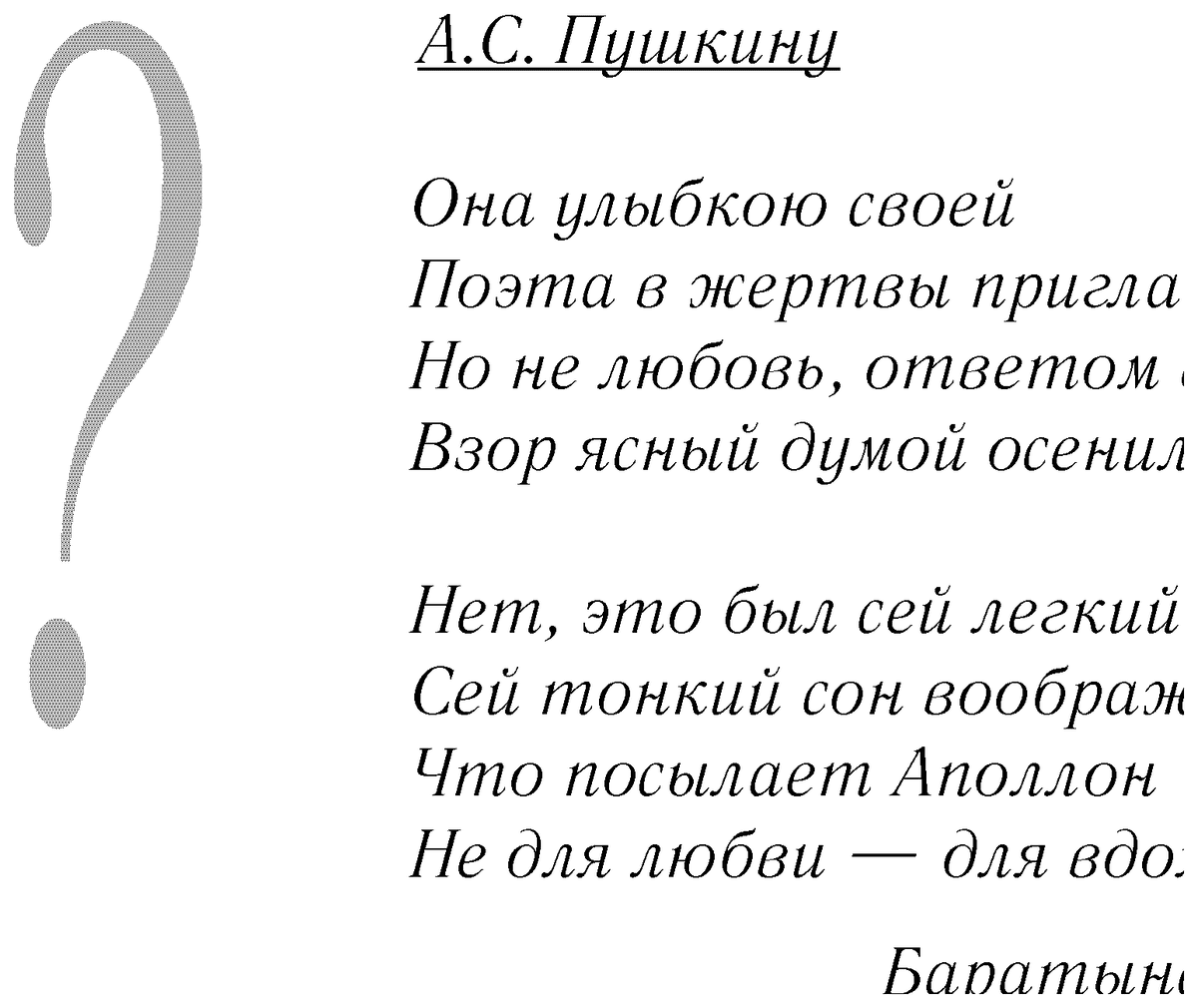
To A. S. Pushkin
Она улыбкою своей Поэта в жертвы пригласила, Но не любовь, ответом ей Взор ясный думой осенила.
Нет, это был сей легкий сон, Сей тонкий сон воображенья, Что посылает Аполлон Не для любви — для вдохновенья.
Баратынский, 1837.
She, with her smile, / invited the poet to be her victim, / but it was not love — with her answer to him / she overshadowed her clear gaze with a thought. // No, it was that light sleep, / that fine sleep of the imagination, / which Apollo sends / not for love, but for inspiration.[Translator’s note:] Baratynsky, “To A. S. Pushkin” (1837). The large “?” in the left margin is his own reaction-mark (it recurs elsewhere in the diary), invisible to the scan’s text layer; it stands against this poem, whereas the red-pencil “NB” of the editors’ note above stands against the Pushkin.
Tuesday, 26 October 1943
On the death of Goethe
. . . . . . . . . . . . . . . . . . . . Погас! Но ничто не оставлено им Под солнцем живым без привета; На все отозвался он сердцем своим, Что просит у сердца ответа: Крылатою мыслью он мир облетел, В одном беспредельном нашел ей предел.
Все дух в нем питало: труды мудрецов, Искусств вдохновенных созданья, Преданья, заветы минувших веков, Цветущих времен упованья; Мечтою по воле проникнуть он мог И в нищую хату, и в царский чертог.
С природой одною он жизнью дышал: Ручья разумел лепетанье, И говор древесных листов понимал, И чувствовал трав прозябанье; Была ему звездная книга ясна, И с ним говорила морская волна.
Изведан, испытан им весь человек! И ежели жизнью земною Творец ограничил летучий наш век, И нас за могильной доскою, За миром явлений не ждет ничего, — Творца оправдает могила его.
И если загробная жизнь нам дана, Он, здешней вполне отдышавший, И в звучных, глубоких отзывах сполна Все дольное долу отдавший, К предвечному легкой душой возлетит, И в небе земное его не смутит.
Баратынский, 1832
He is extinguished! But nothing is left by him uncherished / under the living sun without a greeting; / to everything he responded with his heart, / whatever asks the heart for an answer: / with winged thought he flew round the world, / and in the one boundless found its bound. // Everything nourished his spirit: the labours of sages, / the creations of inspired arts, / the legends and behests of bygone ages, / the hopes of flourishing times; / by dream, at will, he could penetrate / both the beggar’s hut and the tsar’s palace. // With nature alone he breathed one life: / he understood the babble of the brook, / and comprehended the speech of the trees’ leaves, / and felt the vegetation of the grasses; / the starry book was clear to him, / and the sea-wave spoke with him. // The whole of man has been fathomed and tried by him! / And if with earthly life / the Creator has bounded our fleeting span, / and beyond the graveboard, / beyond the world of phenomena, nothing awaits us — / his grave will vindicate the Creator. // And if a life beyond the grave is given us, / he, having fully breathed out the here-and-now, / and having given back in full, in resonant, deep responses, / all that is of the vale to the vale, / will soar up to the Eternal with a light soul, / and in heaven the earthly will not trouble him.Baratynsky, “On the death of Goethe” (1832), copied whole after weeks of Goethe. His own leading dot-row stands above the first line. Kept in Russian: the elegy is plainly the object, not the vehicle, here.
However, over the poetry I overlooked that yesterday’s solution of Lemmlein’s needle problem is mistaken.
In reality, the matter reduces to the integral equation
where P(α,l) is the probability that a needle, deflected by an angle α from the vertical, will grow to height l, and k is the mean density of needle-nuclei. Reconstructed from the image, his notation kept. Zarodysh — literally a “begotten little thing”, a germ or seed at the moment of coming into being; the technical term is nucleus, and “the mean density of needle-nuclei” is the seeding rate of the crystal needles whose growth the equation describes. This is Lemmlein’s crystallization problem — the “elegant solution” of the day before (folio 82) which he now finds wrong; it feeds item V of the “big jobs”, “the foundations of statistics”.
In the evening we walked with Pusya, drank tea and finished off the “Saamo” we had started with Yura on Sunday.
Wednesday, 27 October 1943
The taking of Dnepropetrovsk[Editor’s note:] The taking of Dnepropetrovsk — for A. N. this event was of a particular significance: in the thirties both he and P. S. read lectures more than once at Dnepropetrovsk University, lived in Dnepropetrovsk for long stretches, and had pupils there. In particular S. M. Nikolsky, formerly a postgraduate at DGU, became a pupil of A. N. Kolmogorov — of which S. M. Nikolsky writes in his memoir “In memory of A. N. Kolmogorov” in the collection Kolmogorov in Reminiscence (ed. A. N. Shiryaev; Moscow: Nauka, 1993) and in “P. S. Alexandrov and A. N. Kolmogorov in Dnepropetrovsk” (S. M. Nikolsky, Reminiscences of Dnepropetrovsk, DGU Press, 1998). His war-bulletin device: set in bold between double rules, as with “The taking of Oryol and Belgorod” (folio 33).
This morning −6°. A winter dawn all round the sky and a dazzling sunrise.
I saw Pusya off and looked over Leonardo da Vinci, Raphael, Titian and so on. In reality, though, I am awaiting the evening in Moscow with Oleg (he is to come and show his new drawings, if they do not put him on duty at school).
What, then, is the matter: whence my disquiet and impatience?
I think it is not in “greed”, nor in the insufficiency of the time Oleg spends with me, but in irritation at my own powerlessness to bring him out of his present state, and in disquiet over whether I have set about the business rightly.
Meanwhile, I must still prepare tomorrow’s report at ANIMI. [Editor’s note:] ANIMI — the Artillery Naval Research Institute — in this Institute joint research on the theory of gunnery was carried out with the V. A. Steklov Mathematical Institute of the USSR Academy of Sciences, under the direction and with the direct participation of A. N. Kolmogorov.
November 1943
Monday, 1 November 1943
Thursday ⟨28 October⟩
Lemmlein.
I cancelled the report at ANIMI.
At the AS institute, a discussion of the prospects for the development of the departments.
In the evening at Pusya‘s, Yura and Myasoedov. [Editor’s note:] Myasoedov — the head of a military depot at which Yu. M. Smirnov, being liable for military service, was on duty.
Friday ⟨29 October⟩
A senseless day.
Saturday ⟨30 October⟩
Even more so: I sat in Moscow and waited for the vehicle that Shurka had promised to send for the cabbage and the things. Anya read Gumilyov well to Vera Yakovlevna and me (“Lake Chad”, “The Rhinoceros” and the like — she especially loves “Mick”). Oleg on Saturday and Sunday is busy in Moscow laying the stove.
Sunday ⟨31 October⟩
In the morning I reflected on the representations [predstavlenie] of groups. “Representations of groups by unitary operators” — the campaign that runs, all but continuously, through the rest of the month (folios 89, 92, 95–97, 99, 101–109): his attempt to build a theory of unitary representations of infinite groups. See the entry of 16 November.
In the evening I finished the article on Lobachevsky for Izvestia. [Editor’s note:] Izvestia — here the central newspaper, in which on 2 November 1943 there appeared A. N. Kolmogorov’s article “A great Russian scholar-innovator: on the 150th anniversary of the birth of N. I. Lobachevsky”.
Anya spent only Saturday evening and Sunday morning at Komarovka. I saw her off to Tarasovka.
Monday ⟨1 November⟩
In the morning I wrote yet another letter to S. Musatov — in the main, about himself.
This, I hope, is the last.
Pusya, to the utter shaming of my weakness, obtained without difficulty from Bruevich an order to give a vehicle for transporting our things to Komarovka.
Saturday, 6 November 1943
Tuesday ⟨2 November⟩
In the morning I went to Moscow and learned of Varya‘s grave condition. [Editor’s note:] Varya — Varvara Yakovlevna Kolmogorova, Andrei Nikolaevich’s aunt, his mother’s sister; after her return from Kazan she lived in Trubnikovsky Lane. [Translator’s note:] Varya (Varvara Yakovlevna Kolmogorova, 1869–1943), who dies here, is not Varvara Sergeevna Alexandrova (V.S.), who is alive and appears a few folios on, beginning work at the sanatorium and moving into Marina’s room. Two Varvaras; one dies, one lives. Note likewise, later, V.Ya. = Vera Yakovlevna, his other, surviving aunt, against V.S. = Varvara Sergeevna. I myself went back with the things and the cabbage, and sent Anya to Varya. I meant to go to Moscow in the evening, but missed the train.
Varya died at 7.15 in the evening
Wednesday ⟨3 November⟩
On Trubnikovsky.
My report “Visual non-Euclidean geometry” at the Mathematical Society (a session in memory of N. I. Lobachevsky, jointly with the Faculty).
Thursday ⟨4 November⟩
Piskunov. [Editor’s note:] Piskunov, Nikolai Semyonovich — in 1937 A. N. Kolmogorov, jointly with I. G. Petrovsky and N. S. Piskunov, published in the Bulletin of MGU the “KPP” paper that became widely known, “A study of the diffusion equation coupled with an increase in the quantity of matter, and its application to a biological problem” (also published in the book: A. N. Kolmogorov. Selected Works. Mathematics and Mechanics. — M.: Nauka, 1985, pp. 221–246).
At Bruevich’s (a conference on the AS editions connected with the Lobachevsky jubilee). [Editor’s note:] The jubilee of N. I. Lobachevsky — in 1943 the 150th anniversary of the birth of N. I. Lobachevsky was marked. Among the editions connected with this jubilee should be counted also the collection of articles by P. S. Alexandrov and A. N. Kolmogorov “Nikolai Ivanovich Lobachevsky. 1793–1943” (M.–L.: GTTI, 1943).
Friday ⟨5 November⟩
Plato ([Philebus?], Euthyphro). [Translator’s note:] The page reads «Фалеб» — almost certainly Филеб, the Philebus, paired here with «Евтифрон», the Euthyphro. Kept as a doubtful reading of the printed form.
Yura’s verses.
Saturday ⟨6 November⟩
Sorting out my things.
I am going to Moscow to buy tickets for the concerts (Tchaikovsky) and to take Oleg to Tareev.
Varvara Sergeevna has begun work at the Sanatorium and has settled into Marina‘s room. [Editor’s note:] The Sanatorium where V. S. Alexandrova began work — the sanatorium “Sosnovy Bor” (formerly under the KSU), was at Bolshevo, near Komarovka.
Tuesday, 9 November 1943
Saturday ⟨6 November⟩
The tickets for the 16th (the Sixth Symphony) proved to be all sold out. I bought for the 13th and the 18th. I was briefly at Borya’s. By six o’clock I went to the polyclinic. Poor Oleg stood on the street by the doors and said that he had made a mistake and was down for the 13th, not for today. We went to our home. We drank tea. Disputes about the mind and feeling. Oleg hopes (!) that his heart will turn out bad enough for him to be released from school physical training. Talk about the connection of the spiritual and the physical — Oleg digs in his heels, but unexpectedly became very interested in Beethoven’s passion for brisk walking, and so on.
We set off with Anya for Komarovka late.
The taking of Kiev[Editor’s note:] The taking of Kiev — set here, as with “The taking of Dnepropetrovsk” (folio 84) and “The taking of Oryol and Belgorod” (folio 33), in the bold-between-rules of a war communiqué. Kiev was retaken by Soviet forces on 6 November 1943.
Sunday ⟨7 November⟩
I inserted formulas into the English text of the “Stationary Sequences” — I corrected many misprints and small errors in the Russian text. [Editor’s note:] “Stationary Sequences” — this concerns A. N. Kolmogorov’s paper “Stationary sequences in Hilbert space”, published in 1941 in the journal Bulletin of MGU. Mathematics, vol. 2, issue 6, 1941, pp. 1–40, and also in the book: Kolmogorov A. N. Probability Theory and Mathematical Statistics. — M.: Nauka, 1986, pp. 215–255. An English translation of this paper, it seems, then never saw the light.
Then we sawed and split firewood with Yura and Pusya.
After dinner we read Hoffmann’s “Sanctus” together.
With Anya I read the “Symposium” (we finished on Monday). Much in it frightens her, she is displeased that nothing is said there about the family (!), but some attractiveness and poetry she too felt.
We read besides, in addition, the beginning and end of “Alcibiades I”.
Apropos of the “Symposium” we looked (in my little guidebook) at Rodin’s “La mort d’Alceste” and some of his other things. For sculptures, like the Alcestis, Anya has good taste.
We looked too at Lysippus’s Socrates, since Anya remembered only Antokolsky’s Socrates.
Oleg was not there. They have the stove and the getting of potatoes.
Yura is on duty every third day and is much at Komarovka. On Sunday and Monday, with Pusya’s help, he set about translating Goethe. The first little attempt is good. In general, Yura flourishes. Physically, though thin and a little pale, he has grown even sturdier since Kursk.
Monday ⟨8 November⟩
I continued the “Stationary Sequences”.
I read Trubetskoy on Socrates and Plato.
In the evening at the concert of Oistrakh and Oborin:
- Beethoven’s 10th sonata for violin and piano (1812).
- Schumann’s Fantasy.
- Franck’s Sonata (A-dur) ⟨also for violin and piano⟩.
Everything pleased both me and Anya very much. They performed well and with enthusiasm. Under Beethoven I dreamed, after my new custom (a bad one or a good?): morning at Komarovka, the poplars in my windows, Oleg sleeping and waking, Anya in the evening... Franck seemed very fine, but, indeed, “Christianly detached” (Gleb). [Editor’s note:] Gleb — G. A. Seliverstov.
At the concert there sat before us Kishkina and a charming senior lieutenant. Anya had earlier imagined Kishkina to be like Tatyana Borisovna Gendlina (!?).
Demuth. Seh’ ich die Werke der Meister an, Sî seh’ ich das, was sie gethan; Betracht’ ich meine Siebensachen, Seh’ ich, was ich hätt’ sollen machen.
Goethe
I look at the works of the masters, and I see what they have done; when I consider my belongings, I see what I ought to have done.The title Demuth (“Humility”) is his, underlined on the page; the edition adds ⟨Goethes Werke: I, 2 (1888), S. 279⟩. Its Russian rendering, set in a parallel column, is dropped as reader-service. Siebensachen — “belongings, odds and ends”; the pun is unpacked in the note below. The second line is reproduced as the edition sets it — “Sî”, with a circumflex — where the standard text of Goethe’s epigram reads “So”; whether the form is the 2003 setting’s own slip or an archaism carried from its Weimar source, the printed page is kept, not silently normalised.
I, at all events, look sadly at the little boxes with my 70 opuses. Having got out of the habit of regular work these last years, I snatch now at this, now at that, to no purpose. Time passes, already the first volume of the course of analysis, promised for next autumn, hangs as a threat that it can be written in time only by giving up everything else for that period. [Editor’s note:] Here is a play on words: in German “Siebensachen” means “belongings, chattels, all that one has acquired”. But if one writes it separately, “Sieben Sachen”, the result is “seven things”, which A. N. then plays on, speaking of his 70 opuses.
Albert Albertovich Vilde has died
Tuesday, 16 November 1943
I reflected on the representations of groups by unitary operators. Yesterday I busied myself with the construction of a “continuously-coordinated” Hilbert space:
![A block of his own hand. Transcription: “Pairs {f,ψ}\{f, \psi\}{f,ψ} of non-negative functions … such that ψ(ξ)\psi(\xi)ψ(ξ) has a completely-additive square ψ2(ε)=μ(ε)\psi^2(\varepsilon) = \mu(\varepsilon)ψ2(ε)=μ(ε) and f(ξ)∈Lψ22f(\xi) \in L^2_{\psi^2}f(ξ)∈Lψ22.” Then, in his hand: ∥{f,ψ}∥2=∫f2(dψ)2\|\{f, \psi\}\|^2 = \int f^2 (d\psi)^2∥{f,ψ}∥2=∫f2(dψ)2; “if ψ≺φ\psi \prec \varphiψ≺φ, [then] {f,ψ}∼{f⋅dψ/dφ,φ}\{f, \psi\} \sim \{f \cdot d\psi/d\varphi, \varphi\}{f,ψ}∼{f⋅dψ/dφ,φ}, and further equivalence by transitivity”; {f1,ψ}+{f2,ψ}={f1+f2,ψ}\{f_1, \psi\} + \{f_2, \psi\} = \{f_1+f_2, \psi\}{f1,ψ}+{f2,ψ}={f1+f2,ψ}, ({f1,ψ},{f2,ψ})=∫f1fˉ2(dψ)2(\{f_1, \psi\}, \{f_2, \psi\}) = \int f_1 \bar{f}_2 (d\psi)^2({f1,ψ},{f2,ψ})=∫f1fˉ2(dψ)2. A note runs diagonally up the top-right corner and does not resolve even at high magnification — [diagonal note in the margin, illegible].](/images/translations/kolmogorov/figures/fig-folio089.png)
How to arrange so that the knowledge of would replace , and would coincide for equivalent ones?
For three mornings I corrected the English text of the “Stationary Sequences”. Every kind of work demands much time and application. That is why it is so hard for me now to take it up seriously: for that one must renounce an over-broad and philosophical flight of fancy.
And with the characters [kharakter] I have still not made out how they are distinguished from other positive-definite functions [polozhitel’no opredelionnaia funktsiia] on groups! Character, — classically the trace of a representation. But the whole November campaign turns on his attempt to redefine it: «my definition of a character» (folio 95), «how they are distinguished from other positive-definite functions» (here). He is trying to define a character for infinite groups, where the classical trace fails, as a distinguished positive-definite function. “Character” throughout renders his word, but a reader who takes it as the settled textbook object misreads the month — this is his own generalisation-in-progress. A positive-definite function on a group is , the matrix coefficient of a unitary representation (Bochner’s theorem) — the central object of the whole month. And I have already fantasised much about what to replace them with when they are absent (for infinite-dimensional unitary representations) in the “usual” sense of the word.
What, then — to plunge, in earnest, into the representations of groups? [Editor’s note:] As far as we know, Andrei Nikolaevich came forward with the problematics of group representations at the Mathematical Society only once, on 2 February 1944, with a report on this theme (the report was called “Unitary representations of infinite groups”).
Saturday ⟨13 November⟩
I was with Oleg at Tareev’s. Oleg is much disheartened that no endocarditis is to be found.
Then with Anya, Oleg and Varvara Sergeevna I listened to Tchaikovsky’s “Trio” (Oborin, Oistrakh, Knushevitsky) and various of his piano pieces (Oborin).
Anya finds Tchaikovsky “much too earthly”. There, after Wagner “one wants to do something great”, but after Tchaikovsky — no.
In the morning on Saturday I was also at the VAK.
Friday ⟨12 November⟩
With Pusya we opened the skiing season (along the forest edge to Tarasovka).
I gathered for Oleg illustrations for my ideas about portrait painting.
Thursday ⟨11 November⟩
I gave a report at ANIMI. At the university I examined the two Yagloms in probability theory.
Die Freude Es flattert um die Quelle Die wechselnde Libelle, Mich freut sie lange schon; Bald dunkel und bald helle, Wie der Chamäleon. Bald roth, bald blau, Bald blau, bald grün; O dass ich in der Nähe Doch ihre Farben sähe!
Sie schwirrt und schwebet, rastet nie! Doch still, sie setzt sich an die Weiden. Da hab’ ich sie! Da hab’ ich sie! Und nun betracht’ ich sie genau, Und seh’ ein traurig dunkles Blau.
So geht es dir, Zergliedrer deiner Freuden!
There flutters about the spring the changeful dragonfly; it has long delighted me — now dark and now light, like the chameleon. Now red, now blue, now blue, now green; oh, that I might see its colours close at hand! It whirs and hovers, never rests! But hush — it settles on the willows. Now I have it! Now I have it! And now I examine it closely, and see a sad, dark blue. So it goes with you, dissector of your joys!Goethe’s Die Freude, “The Joy”; the edition adds ⟨Goethes Werke: I, 1 (1887), S. 62⟩. Its Russian rendering, in the parallel column, is dropped as reader-service.
Wednesday ⟨10 November⟩
As I was carrying in the pipes for the stove, I discovered at Oleshka’s, next to Plato, a Gospel. In the evening we looked over Oleg’s paintings and drawings with Anya and Pusya.
Seriously good in Oleg’s work:
- Three portraits of 1941 (himself, Seryozha, Polina Alexandrovna);
- The first experiments in oil painting (1941): a) pretzels, b) cups and a teapot with gold on red, c) a bottle, a basin, a knife and bread;
- Watercolour landscapes (Voskresenskoye, spring 1943). Adjoining them is the last, the Komarovka one.
I also liked the view of winter from the window (1941, graphics).
Seryozha gave him much, the art school — almost nothing.
If he has something to express by his painting, then with the “how” he will, perhaps, cope worthily, but to shine by the “how” alone, even at the level of Sokolov-Skalya, he probably will not be able.
The composition with the crossing of the Dnieper may come out not badly, but it is an exercise in the “how”, and only that.
Sunday ⟨14 November⟩
In the morning I worked, wrote letters and did small jobs, then we ran on skis over the heavy, sticky snow with Yura.
Dinner with pudding.
We began to read Ovid’s “Metamorphoses”, and the first book — very good.
With Anya we looked over Serov, Titian, Velázquez, Rubens.
Oleg is busy carting peat for the school.
Yura flourishes on his translations of Goethe (really very good — somehow I find it hard to get used to the idea that Yura has, it must be, seriously turned out a genuine and considerable person!).
Monday ⟨15 November⟩
I worked in the morning.
After dinner we read Ovid (“Phaethon”), and then I reflected on the realisations of Hilbert space mentioned above.
I read Trubetskoy on Aristotle.
I dug up the translation for the Euthyphro: piety — ὅσια, impiety — ἀνόσια, The Greek is his, set letter-spaced on the page; he is making his own Russian-to-Greek gloss for the dialogue he means to expound to Oleg. ὅσια (holy, pious) and ἀνόσια (unholy, impious) are the terms the Euthyphro turns on. The edition sets them without breathings or accents — and the first word with a delta-like initial (δσια) — so they are restored here to the standard accented forms of those terms, not reproduced as the bare printed letters. but whether I shall carry out my intention to write about the Euthyphro, the psychology of Plato and the like for Oleshka — I do not know.
Overcast and warm. The snow has almost gone. From somewhere a multitude of tits has appeared.
They flit about the lilac bushes and now and then chirp.
Sunday and Monday — good days.
Today — reaction and anguish.
I am digging about in Plato, Aristotle, Xenophon, Thucydides and the encyclopaedias. Am I doing a serious thing thereby (clarifying and checking my own philosophical views, even if apropos of Oleg’s enthusiasms — the occasion is a good and serious one!) or am I simply filling with this digging my own bewilderment and incapacity for work — I do not yet understand properly.
On the table lies a very good photograph of Pusya (at about eight).
Saturday, 20 November 1943
An early pre-winter morning. The waning moon stands high, straight before my window. Beyond the poplars, on the green-blue sky, lilac-pink clouds glow ever brighter. The fields turn yellow and pink — on them only the remnants of snow.
Just now I put out the lamp. Pusya has run off, warmly dressed and with a ski-pole, to bathe. Varvara Sergeevna is getting up in the former little room of Marina‘s.
Wednesday ⟨17 November⟩
I did, after all, work out how to build a Hilbert space out of pure set functions:
On a family of subsets of a set one considers complex functions for which
are additive.
The addition of the functions is understood in the usual sense, and the multiplication in the sense
In the evening the Mathematical Society began at six o’clock, not at seven, as I had thought. So I missed Kurosh’s report. Kreines reported well. [Translator’s note:] Three Kreins run through these two folios and must be held apart: M. G. Krein, the author of the report on the moment problem below (and of the photograph); Selim = S. G. Krein, his younger brother; and Kreines = M. A. Kreines, whose dissertation on the synthesis of gear mechanisms is meant here (cf. folio 72).
At the board meeting the leadership of the abstracting section was discussed — Pusya announced that I do not decline to take it, and only asked whether there were any objections to this.
To Vyacheslav Vasilyevich they gave the school-olympiad activity. [Editor’s note:] Vyacheslav Vasilyevich — V. V. Stepanov.
Kurosh earned universal approval by his energy in the library affairs.
Thursday ⟨18 November⟩
Kolya Nyuberg was here. As always, we chatted with him about everything. Interesting were the stories he passed on, of his friend, a sergeant from among the research workers, about his impressions of Stalingrad. Somewhat wearisome — talk of poetic affairs.
Kolya took up the morning. Then we dined, and at two o’clock Petrovsky came to consult about faculty affairs (the establishment of a chair of physics, the situation with hydromechanics, and the like). Now Petrovsky, to such a degree, has definite judgements about everything (usually correct ones, and in my opinion too) that he comes rather to check and confirm them than for advice in the proper sense of the word.
At the Mathematical Institute I received Lemmlein (he keeps drawing the growth of “needles” and crystals on enormous sheets).
Then there was a very interesting report by Krein on the “generalized problem of moments”. A continuer of the traditions of classical analysis (albeit complicated by all sorts of modernity), he is, it seems, the most remarkable among us. Selim looked charming, while Krein the elder, in relation to Gelfand and the rest, was somewhat provocative (concerning classical applications).
With Pusya together we rode on the tram, in a great crush, to the conservatory.
I dropped in on Borya to leave my briefcase with him. There everything is little baths and swaddling-clothes. The son is to be called “Dima”, not “Mitya”. He is healthy, resembles Borya. [Editor’s note:] “...dropped in on Borya” — B. V. Gnedenko, who at that time lived with his family in the university building on Mokhovaya, i.e. right next to the Conservatory. [Editor’s note:] Dima — Dmitry Borisovich Gnedenko (born 6 October 1943) — son of B. V. Gnedenko, now a docent of the chair of probability theory at MGU.
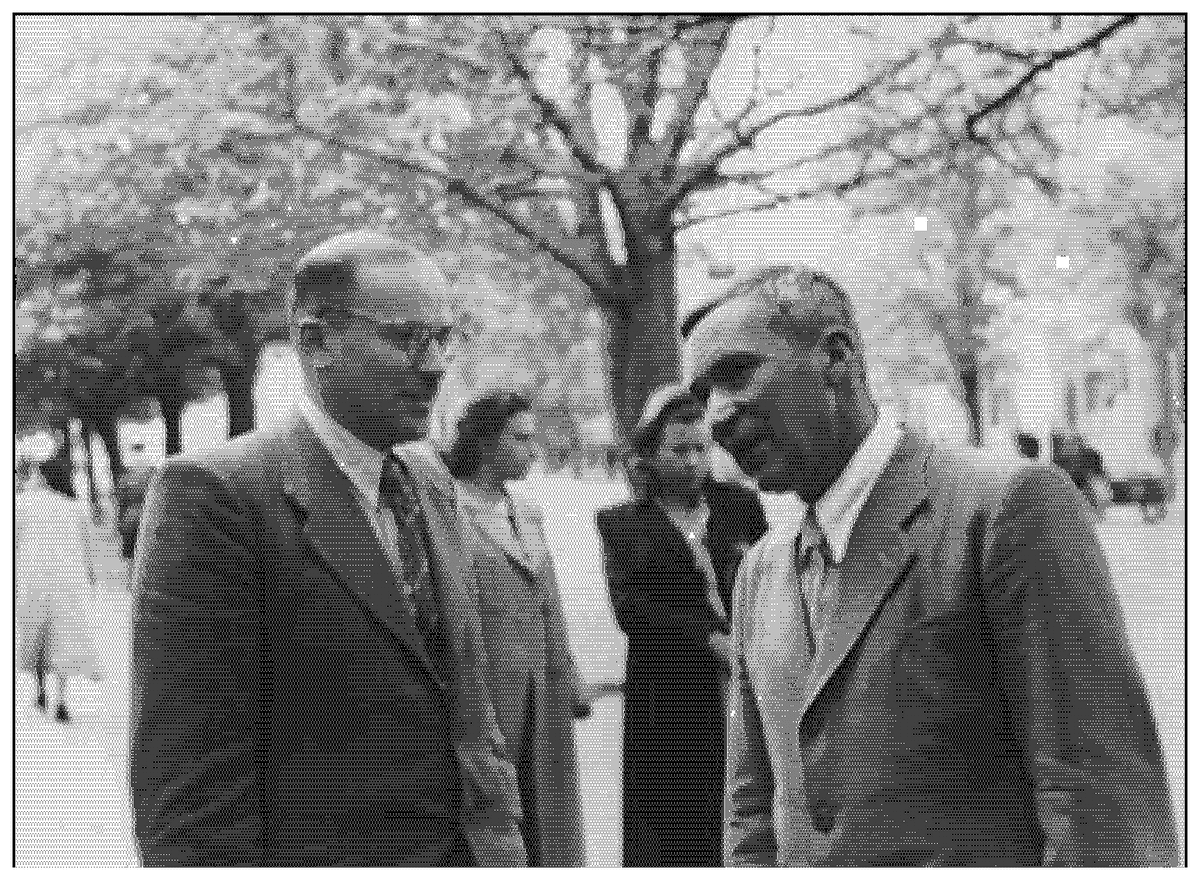
Meanwhile Pusya found, at the entrance to the conservatory, Yura — who thought that he had been invited to this concert and not to the next (the 24th) — and Anya, who had forgotten her ticket at home. For them and for himself he boldly begged a free pass (after a morning telephone call to the administrator, about him alone, from Mikhail Sergeevich, who had operated on the administrator’s wife). [Editor’s note:] Mikhail Sergeevich — M. S. Alexandrov — brother of P. S. Alexandrov, a well-known Moscow surgeon. Afterwards Pusya recounted, with pleasure, how Anya and Yura had a bewildered air and were ready to weep, looking at him with exactly the same eyes.
The “Concert Fantasia” (a composition of P. I. Tchaikovsky’s, Op. 56, for piano and orchestra) pleased me very much.
After it Igumnov played also a nocturne and a waltz from the music to “The Snow Maiden” (P. I. Tchaikovsky’s music for the dramatic production at the Maly Theatre after A. N. Ostrovsky’s play).
The Second Symphony (of P. I. Tchaikovsky), by its naive gaiety, put Anya in perplexity. More lyrical in it is only the second movement.
In the finale the “little goose Andryusha” unexpectedly breaks out of all the complexities and terrors and, ever more resonantly, scatters itself in one and the same theme of the “crane”. The Kholmogory Goose (Kh.G.) again — his own emblem and household self-name, a pun on his surname; it recurs through the diary. Here he hears himself in the finale of Tchaikovsky’s Second Symphony (the “Little Russian”), whose last movement is built on the folk-tune “The Crane”.
Ioanna’s aria (from P. I. Tchaikovsky’s opera “The Maid of Orleans”) Davydova also sang well.
Friday ⟨19 November⟩
We walked with Borya to the Skalba (a little river in the environs of Komarovka).
We discussed our little book. [Editor’s note:] Our little book — most probably the book with B. V. Gnedenko, “Limit Distributions for Sums of Independent Random Variables”. — M.–L.: Gostekhizdat, 1949.
After dinner Borya hurriedly left to bathe his son.
In the evening we read, with Pusya and V.S., Xenophon’s “Banquet”.
Sunday, 21 November 1943
At last, on the way home from Dimetrusya‘s, I resolved a somewhat naive perplexity concerning how the characters are distinguished from positive-definite functions (and why they are positive-definite at all — yesterday it turned out that I had not understood this before!).
Let be represented by (unitary) operators in . To each there corresponds a positive-definite function
If are the eigenvalues of and
in the corresponding coordinates, then
Averaging over the sphere ,
we obtain
Now it remains to make out just what representation is generated by itself: will it not, for example, always be a representation in ?
My definition of a character, to all appearances, holds in the case of any locally-bicompact [bikompaktnyi] groups? Bicompact (бикомпакт) is P. S. Alexandrov’s period term for what is now simply a compact (Hausdorff) space; «bicompact extension» = a compactification. Kept as he wrote it — it is a datum about the mathematical culture he worked in — rather than silently modernised. Recurs on folios 102, 106. Gelfand, however, said something about the absence, for them (generally speaking), of an analogue of characters in the form of positive-definite functions.
Perhaps the means are discontinuous?
In any case, it is true (though the proof is so far less direct than one would wish):
A representation in , splitting into identical irreducible representations in , admits a vector generating [proizvodiashchii vektor] all of if and only if . «Generating vector» is his literal term (производящий вектор); the modern name is cyclic vector — a vector whose orbit under the representation spans the whole space.
Monday, 22 November 1943
A direct proof of the last assertion.
1.
and this means precisely that is subject, independently of , to linear conditions.
2.
since
for any .
Proof.
By invariance,
And for
by analogous considerations.
This is true, but here it is a little unclear.
It still needs checking! [Editor’s note:] Added in red pencil, 6 December 1943.
Characters
In the space let us take
Let . Then
“Directions” in Hilbert space
— the totality of finite-dimensional subspaces. For the projections . A “direction” is the totality of vectors with for .
Relation to the various projective geometries (von Neumann’s, and to others conceivable) ?! This is J. von Neumann (his continuous-geometry / lattice-theoretic projective geometry) — not to be confused with M. A. Naimark, who appears near the end of the month (folios 108–109); the two names, Нейман and Наймарк, run close in Russian but are different mathematicians.
Tuesday, 23 November 1943
Saturday ⟨20 November⟩
I occupied myself with the representations of groups.
In the afternoon Anya arrived, and in the evening we set off to the celebration of Dimetrusya‘s doctoral degree (Seryozha, Alla, Dubinin, two fish-breeders, Dimetrusya, Ksenia, Elizaveta Rodionovna, Anya, I). It was pleasant and merry. Dimetrusya got somewhat drunk, which he had best not do. One of the fish-breeders read a poem about “halves”.
Elizaveta Rodionovna’s culinary talents are fully at the proper height.
Sunday ⟨21 November⟩
I occupied myself a little, read Anya some Voloshin (she finds it boring) and talked much with her about various things.
Oleg in the morning painted a good landscape.
Then we read the “Odyssey”.
I saw Oleg off to Tarasovka. I gave him algebraic problems, showed him photographs. He himself was reading “The Modern Architecture of the West”. Conversations about anything too philosophical (even about their Platonic readings) he keeps up with me reluctantly.
Yura has a new series of verses.
Monday ⟨22 November⟩
I saw Anya off, then walked almost to Mytishchi.
In the evening I was at Dimetrusya’s in the sanatorium.
I reflected much about the representations (see above).
The same today
I read a little Mayakovsky (“To Yesenin” — good, but even this is done slovenly, in spite of all his declarations of how carefully he composed!):
...И мир, как море пред зарею, И я иду по лону вод. И подо мной, и надо мною Трепещет звездный небосвод...
...And the world, like a sea before the dawn, and I walk upon the bosom of the waters. And beneath me, and above me, trembles the starry firmament...[In the margin:] Did Voloshin compose it himself, or take it from somewhere? The verse is Voloshin’s, kept in Russian because his margin-query is about the verse itself. The edition attributes it: ⟨M. Voloshin, the head-piece to the cycle “Years of Wandering”, 1902⟩. His five-word query stands as a vertical column down the left margin beside it.
This, so as to feel this way again someday (sometimes, it seems, this was characteristic of me).[Editor’s note:] Ksenia — K. A. Romashova — wife of Dimetrusya (D. D. Romashov), a geneticist by training, like him.
Wednesday, 24 November 1943
Yesterday evening I received Dimetrusya, gave him tea with jam.
Again conversations about Sergei Musatov (rather at Dimetrusya’s initiative than mine).
In my interest in S.M.'s affairs there is, of course, an element of grievance at the arrogance of these “spiritual” people, who consider me — with my equanimity (particularly insistently demonstrated, however, by myself precisely to them, by contrast) — all the same earthbound.
In my own justification I may remark that this grievance is really felt keenly by me only because the said attitude to me estranges me from Oleg, and that is hardly of use to him himself either.
More on the representations of finite groups
Let a representation be formed, for an irreducible representation in , in
by the usual recipe.
Then, it appears, generates all of if and only if () are linearly independent.
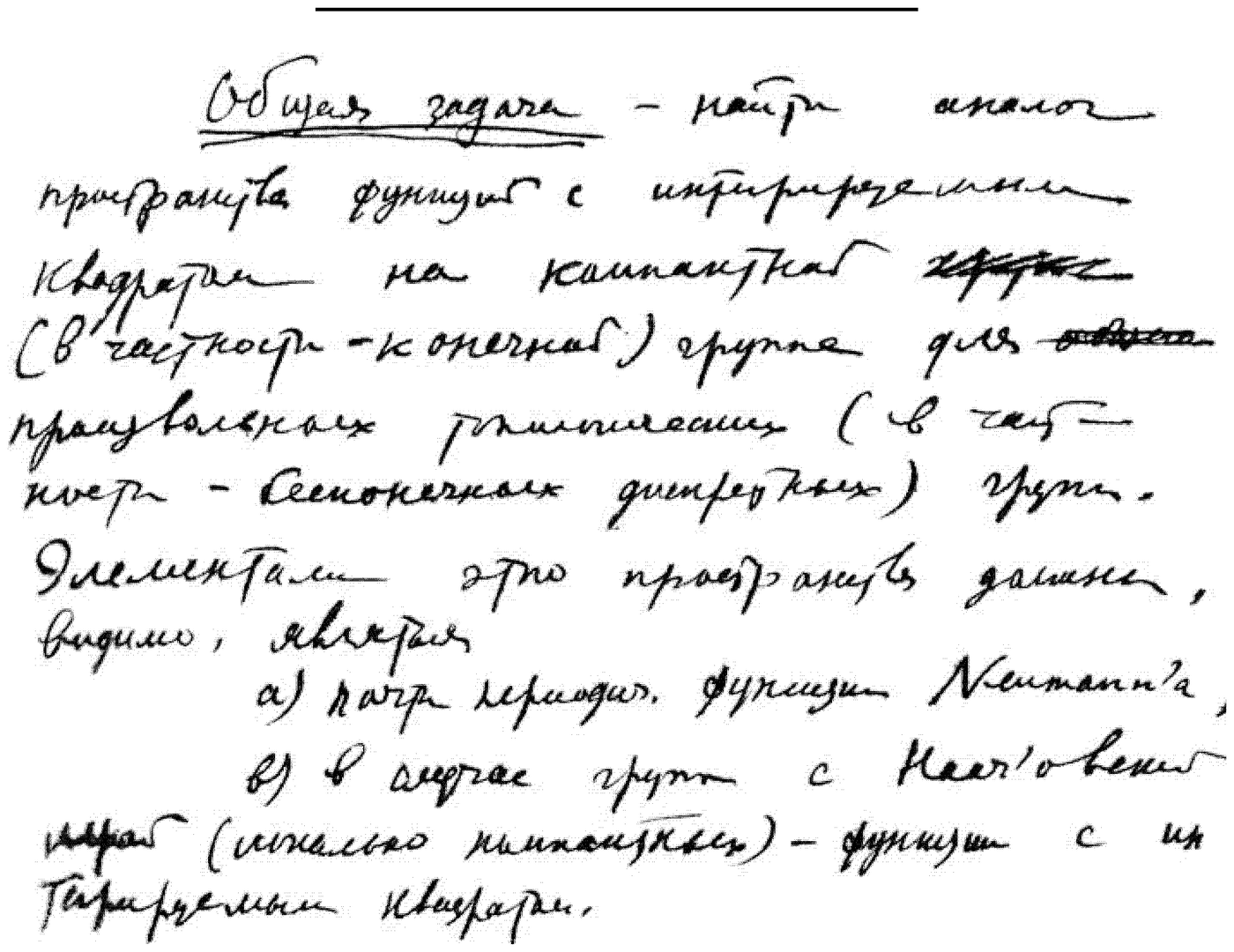
The synthesis of a) and b) for the one-dimensional case is present in the harmonic analysis of N. Wiener.
Will not the solution of the problem so posed (even only for a one-parameter group!) lead also to the clarification of my problem of the spectral analysis of random stationary functions, with allowance for “phase shifts”?
Competition with Gelfand, indeed, in my present mood is useful, to drag me out of the state of indifference to mathematics.
As it were, the solution is given by the Hilbert space from the record of 20-XI-1943, but with finitely-additive functions. What family of sets is one to choose, to integrate over it?
Thursday, 25 November 1943
Yesterday evening, a concert:
“The Tempest” Tchaikovsky: Duet of Romeo and Juliet, The Fifth Symphony.
“The Tempest” pleased Anya very much.
I dreamed, under it, of some forests, of thunderclouds over them, of steppes with luxuriant grass and the whistle of the wind. Then of my April–May journey through the Crimea. [Editor’s note:] The April–May journey through the Crimea — there is no clarity here. Judging by the letters and diaries of 1943, in May A. N. went to Kazan to fetch his aunts, and there is no mention of any journey through the Crimea preceding this (and it could hardly have taken place in 1943!). If the dreams were of the future, of 1944, then no letters of 1944 have yet been found at all, and the diary entries for that year break off on 24 April, and reveal no signs of a forthcoming journey. Perhaps Andrei Nikolaevich was recalling some much earlier, pre-war Crimean journey of his (for example, V. M. Tikhomirov, in his article “A word about the teacher” (collection “Kolmogorov in Reminiscence”. — M.: Nauka, 1993), mentions A. N.'s journey through the Crimea with pupils of the Potylikha school in 1924)...
To the Fifth Symphony I devised a programme: “Rejected — or love that has not justified its hopes, and yet all-devouring.”
Pusya, however, this time found this symphony brighter, and even more jubilant, than he had found it, it seems, before.
In reality, the Fifth Symphony, together with “Hamlet”, was written in the summer of 1888 at Frolovskoye, already after the infatuation (in the spring) with S. — evidently in the period of a wish to renounce personal life and only to work. Already in the autumn (again with S.) Tchaikovsky finds the symphony motley, insincere and long (2 Dec. 1888). Further vacillations.
This morning I went to the Leninsky district finance office to receive 600 rubles of overpaid military tax (without success — it must be done at one’s place of residence), received money at the AS savings-bank, and talked with Bermant about the prospects of Vinogradov’s return (Bermant is much taken with this idea of Pontryagin’s).
I dined with Anya and V.Ya., then left for here, feasted here alone on three pastries, read Hildebrand’s “Problem of Form” (clever, but ponderous), and am going to bed.
But Hildebrand too did not escape the common lot of theorizing artists: to prove logically that the peculiarities of their style of creative work are obligatory for all (this with the “planes”).
I keep thinking, however, stubbornly about the representations
A function of the form for some representation , the corresponding topology, and the “charges” [zariad] of A. D. Alexandrov, and the passage from the (complex) charge to A charge (заряд) is A. D. Alexandrov’s term — the geometer, not P. S. Alexandrov (Pusya), nor the surgeon M. S. — for a signed (or complex) measure, a set function that may take either sign, like an electric charge. He keeps the scare-quotes. The whole construction of the next folios is: charges → the normalised → a Hilbert space.
Friday, 26 November 1943[In the margin:] For the distant future.
In the multiplication of positive-definite functions there result positive-definite functions (Schur — see Pólya and Szegő, II, p. 113, section VII, problem 35). [Editor’s note:] Pólya and Szegő — this refers to the book Pólya G., Szegő G. Aufgaben und Lehrsätze aus der Analysis. — Bd. II, Julius Springer, Berlin, 1925. (In the Russian translation, by D. A. Raikov: Pólya G., Szegő G. Problems and Theorems from Analysis. II. The name G. Pólya is erroneously transliterated in the Russian as Полиа; correctly — Пойа.)
Does this generate also some multiplication of representations?
— In the abelian case, yes!
A possible variant of a narrowed Čech extension [Chekhovskoe rasshirenie] of groups: after A. D. Alexandrov, starting from uniformly-continuous functions. Not “Chekhov”: Чеховский here = of Eduard Čech; the «Čech extension» is the Čech (Stone–Čech) compactification. [Editor’s note:] The Čech extension — on bicompact extensions (after E. Čech, M. Stone) see, for example, § 6 of chapter 6 of P. S. Alexandrov’s book “Introduction to Set Theory and General Topology” (M.: Nauka, 1977). But for us, a narrowing of the Čech extension is desirable already in the case of discrete groups.
Friday, evening.
Hypothetical programme:
1). The ring : the linear-uniform closure of the shifts () of positive-definite functions.
2). The corresponding topology (in the sense of A. D. Alexandrov?) and the bicompact extension .
3). On this , the functions with completely-additive square — the unitary space . In it, the fundamental representation .
⟼ see the formulation of the problem on p. 99 (24 November).
Is it interesting whether it will all come out so or not?
And perhaps is constructed also in some still simpler way.
Until I finish, not to let myself be distracted by philosophemes and emotional experiences, but, so far as possible, by official or domestic-household affairs too! [Editor’s note:] Added and underlined in red pencil.
Finite groups again
The fundamental representation in the space of -dimensional vectors :
How to show that it contains a representation with any positive-definite function :
This form is invariant.
The vector (i.e. ) generates the whole space; .
Mailied O Lieb, o Liebe! So golden schön Wie Morgenwolken Auf jenen Höhn!
Du segnest herrlich Das frische Feld Im Blüthendampfe Die volle Welt.
O love, o love! So golden-fair, like morning clouds upon yonder heights! You bless in splendour the fresh field, the whole world in the vapour of blossom.Goethe’s Mailied, “May Song”; the edition adds ⟨Goethes Werke: I, 1 (1887), S. 72⟩. Its (partial) Russian rendering, in the parallel column, is dropped as reader-service. Yura’s own translation of this same poem stands, retained, as the day’s event two folios on (28 November).
Sunday, 28 November 1943
Майская песня О, как прекрасен Весь мир вокруг! Сверкает солнце, Смеется луг! Взбухают почки На всех ветвях, (сучкáх) И птичьи стаи Кричат в кустах; Блаженство, счастье (радость?) В груди моей; О лес, о солнце, О радость дней! Как утром рано Средь гор и круч Там золотятся Обрывки туч, Как солнцем залит Росистый луг, Весь мир объемлет Цветочный дух, Весенней страстью Цветет земля —Так ты прекрасна, Любовь моя!
Как, дорогая, Люблю тебя! Как глазки светят, Меня любя! Так любят птички Петь с высоты, Дыханье утра Впивать — цветы. И к новым песням И танцам вновь Дарит мне смелость Твоя любовь! И с нею радость, И с ней мечты! Так будь счастлива, Как любишь ты!
O, how beautiful is all the world around! The sun sparkles, the meadow laughs! The buds swell on all the branches (boughs), and flocks of birds cry in the bushes; bliss, happiness (joy?) in my breast; O forest, O sun, O joy of days! How, early in the morning, amid the hills and crags, the shreds of cloud gild themselves; how the dewy meadow is flooded with sun, the whole world embraced by the scent of flowers; with spring’s passion the earth blossoms — so are you beautiful, my love! // How, my dear, I love you! How your dear eyes shine, loving me! So do the little birds love to sing from on high, and the flowers to drink in the breath of morning. And to new songs and dances once more your love gives me boldness! And with it joy, and with it dreams! So be as happy as you love![Translator’s note:] «Майская песня» (“May Song”) is Yu. M. Smirnov’s (Yura’s) own Russian translation of Goethe’s Mailied — the German of folio 103 — recorded here as the day’s event (see the box below), and so retained as object-language, not dropped as an editors’ reader-service gloss. His underlined parenthetical variants «(сучкáх)» (“boughs”, for “branches”) and «(радость?)» (“joy?”, for “happiness”) are part of the working record and kept as printed.
Over this Yura sat the whole of Friday, as I over the representations of groups.
On Saturday the rustling snow kept falling, and in our shared rooms the same intense activity went on. Good.
Continuation of p. 103.
The spaces are invariant (all distinct).
This is not at all .
This is precisely what must be carried over to the infinite-dimensional case.
Multiplication of spaces
To each there corresponds an . In , a family of “measures” , .
For the infinite-dimensional generalisation of the above, only the case of one-dimensional is needed. But in multiplying irreducible representations, presumably, the case of general is needed too.
![Two blocks of his own hand. Transcription — first block: “One must learn to find η\etaη directly from ξ\xiξ; but the trouble, evidently, is that no such unique η\etaη exists in the infinite-dimensional case (as there are no characters!). (?!)” Second block: “Every representation is bound up with a family of positive-definite functions generated by all its central [vectors]. If UgU_gUg decomposes into Ug′U'_gUg′ and Ug′′U''_gUg′′, then φ\varphiφ is obtained from φ′\varphi’φ′ and φ′′\varphi''φ′′ as the aggregate φ=φ′+φ′′,φ′∈Φ′,φ′′∈Φ′′\varphi = \varphi’ + \varphi'’, \varphi’ \in \Phi’, \varphi'’ \in \Phi''φ=φ′+φ′′,φ′∈Φ′,φ′′∈Φ′′ (if Φ=Φ′⊕Φ′′\Phi = \Phi’ \oplus \Phi''Φ=Φ′⊕Φ′′).”](/images/translations/kolmogorov/figures/fig-folio105.png)
For the future
Does the von Neumann mean not always exist, for all positive-definite functions?
If this is so, then is an almost-periodic part singled out from them, with a remainder equal, on average, to zero?
Is the invariant measure on with unique, and coincident with the von Neumann density? In the absence of almost-periodic functions other than constants, this measure is very poor, but nothing prevents it from existing!
The simplest variant of the Milman–Krein theorem (applied, after Gelfand, to the case of discrete groups).
On a set :
Functionals with bounded ,
The Tychonoff weak topology in : if, for any and , there exists with .
In this topology, the set of all positive-definite functions with is bicompact and convex. In fact: it is weakly closed, and all with form a bicompact space. The extremal positive-definite functions form the set . All from are determined by measures on (perhaps, and not one-to-one).
All this may be too simple — or it may be that this is good too!
The space from
Its subspaces invariant with respect to all the shifts : they always have an element that generates them, and consequently the positive-definite functions corresponding to them as well. [Editor’s note:] The Milman–Krein theorem (on the “convex hull and extreme points”) — see the work of these authors, On extreme points of regular convex sets // Studia Math., 1940, v. 9, p. 133–138.
Monday, 29 November 1943
I must set the results down here more sparingly, and start a separate notebook for all sorts of wanderings in the representations.
Yesterday we walked with Anya, read together “Queen Pédauque” (Anya does not like it because of its indecency).
Her bad mood of these last weeks Anya explains by: 1) doubts (“is she not a bad wife”), 2) sufferings (from the “excessive” material well-being of ours).
For each positive-definite function :
is both right- and left-invariant, since .
— since and are invariant. For this is true, but for it must be required. However, the extraction of the square root of non-negative operators is, it seems, unique.
Left and right shifts:
Positive-definite functions and invariant positive-definite Hermitian operators.
In the finite-dimensional case: to the one-to-one correspondence and multiplication
there corresponds the convolution [svortyvanie]
From the considerations on pp. 104–105, the extraction of the root is possible, and unique.
For characters, thus. The corresponding system of invariant spaces common to all — ⟼ in the infinite-dimensional case it will first appear precisely from here!
Apparently, the are not hypermaximal, and therefore (in accordance with Naimark) give occasion for an extension of the space. [In the margin:] A large “?” and, beneath it, “!” are drawn to the left of this box — his reaction-mark, which recurs elsewhere in the diary.
Positive-definite functions of the form , for some vector , coincide with those for which
— This is the case of bounded .
In fact, formally, and lead to this result from the theorem on convolution over the group. (Where is it, this theorem?)
In the Tychonoff topology they generate everything.
Pusya set off yesterday for Moscow at Yura’s summons. Myasoedov is being posted for a month to Kiev, and Yura with him. Today he will learn everything more exactly.
Tuesday, 30 November 1943
On the group of integers, besides = the number of elements of the set , or = the density of , there exist invariant “densities of fractional orders”:
Perhaps with these invariant measures one can somehow manage, for the generation of all positive-definite functions in the form
Basic hypotheses
— without which all the rest becomes of little sense.
Kinds of representations:
1). Irreducible representations.
2). Those corresponding to powers of irreducible ones having a generating vector.
3). Representations with a generating vector.
4). ? ———— ?!
1. There exists a minimal representation which contains all representations with a generating vector.
2.
3.
But the beauty is with the operators —
The indecomposable are simply ! [Editor’s note:] These two lines are struck through in red.
So it is all in the extension of the space, after Naimark!?
? In order for a positive-definite invariant Hermitian operator to be an , it is necessary and sufficient that .
! How might I get across to invariant unitary or isometric ones?
The conversion of finitely-additive functions into countably-additive ones by means of Fomin extensions [Fominskie rasshireniia]. The Fomin extensions are of S. V. Fomin (later Kolmogorov’s co-author on the Elements of the Theory of Functions) — not to be confused with the Naimark of the same folios, nor with the Neumann of folios 99/105: three near neighbours in transliteration, three different mathematicians.[Editor’s note:] The following two lines are added in red pencil, apparently later.
Will not the characters that do not exist in the form of positive-definite functions correspond, all the same, to operators ?!
? Characters as positive-definite functions with .
I went to Moscow, to Feinberg’s concert (Beethoven, sonatas Nos. 17–22). With interest I listened to Nos. 17–18. I was enchanted by Nos. 19–20. I grew tired and listened poorly to Nos. 21–22. Anya liked Nos. 19–20. (Present were: Seryozha with Alla, Natasha and Oleg.) [Editor’s note:] “...after Naimark” — evidently the results of M. A. Naimark’s paper “Positive-definite operator functions on a commutative group” (Izvestia AN SSSR. Ser. mat., 1943, vol. 7, No. 5, pp. 237–244) are meant. [Editor’s note:] Corrections in red pencil occur on many pages (in the mathematical arguments) — one may suppose that all these corrections appeared at one time, on a re-reading of all the entries on group representations. [Translator’s note:] The facsimile pages are reproduced in greyscale, so the colour is lost: every ⟨...in red pencil...⟩ note is the only witness that a mark belongs to that later re-reading — a second stratum of the manuscript the image cannot show. [Editor’s note:] Natasha — an acquaintance of S. Musatov, whose portrait he was painting at the time. This month’s Natasha is his model, not N. K. Gnedenko.
December 1943
Wednesday, 1 December 1943
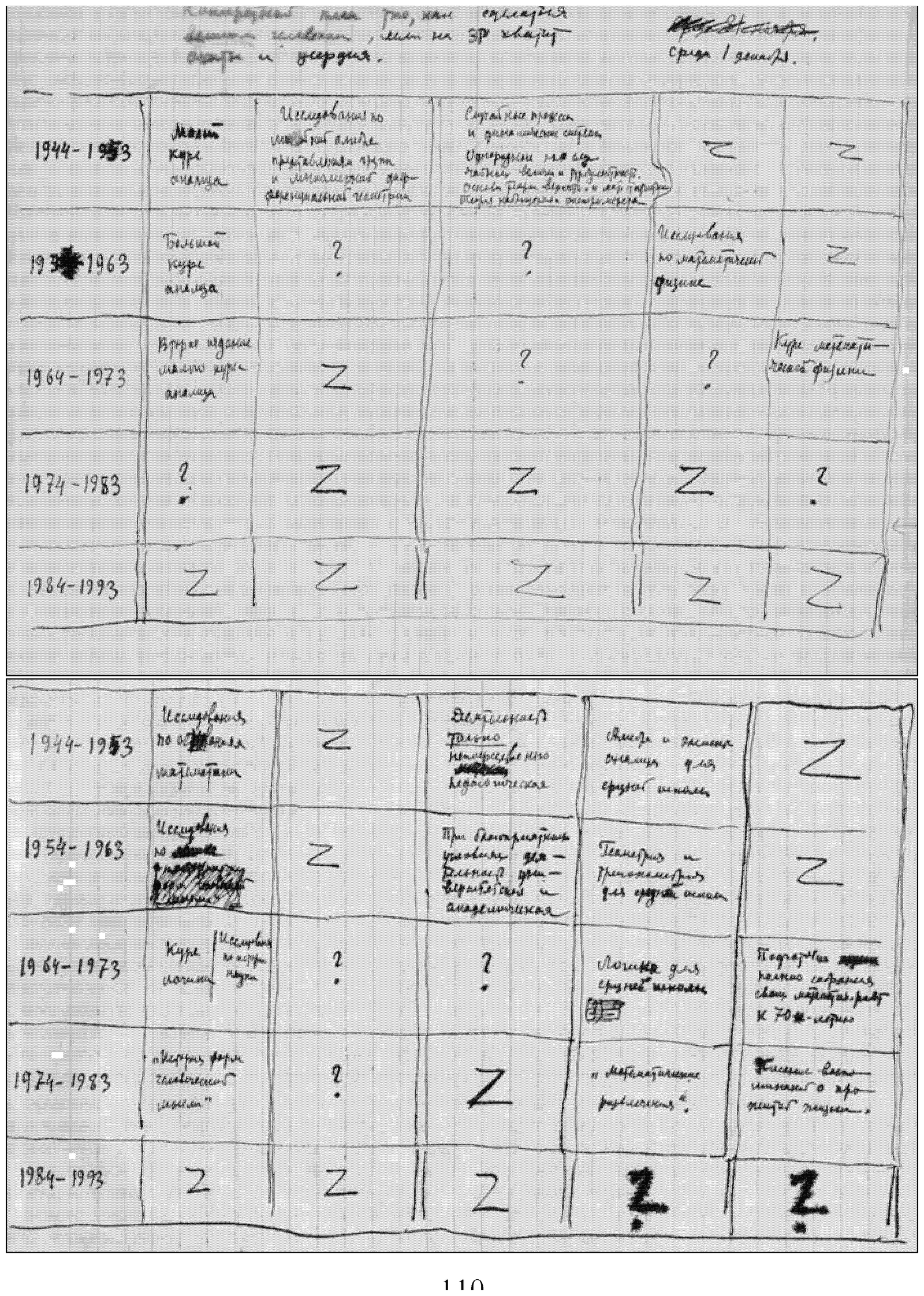
A concrete plan for how to become a great man, if there is enough desire and diligence for it. [Editor’s note:] Of this unique document much might be said, but we leave the reader the chance to acquaint himself with it in detail and to form his own opinion. Here we shall only draw attention to the fact that the Plan consists of two separate parts, which, it seems to us, may be entitled the plan of the “big” (the upper table) and the plan of the “small” (the lower table) jobs for the future. (The reader will, of course, have noticed too how and where Andrei Nikolaevich has placed the question marks and the omission marks (Z), and sometimes both together.) [Translator’s note:] The decade labels are transcribed here from the facsimile (folio 110), where they run 1944–1953 · 1954–1963 · 1964–1973 · 1974–1983 · 1984–1993 — confirmed at high magnification (the second row of the top table has an ink-blot over the first year but reads 1954–1963). The 2003 edition’s own typeset transcription on folio 111 misprints these labels, repeating “1964–1973” for the last three rows of both tables; that is a genuine error of the source edition, and the facsimile — not the flawed typeset — is followed here.
The plan of the “big” jobs:
| 1944–1953 | Short course of analysis | Investigations in linear algebra, group representations and multidimensional differential geometry | Random processes and dynamical systems. Homogeneous fields of random quantities and turbulence. Foundations of probability theory and mathematical statistics. Theory of observations and experiment. | Z · Z |
| 1954–1963 | Large course of analysis | ? | ? | Investigations in mathematical physics · Z |
| 1964–1973 | Second edition of the short course of analysis | Z | ? | ? · Course of mathematical physics |
| 1974–1983 | ? | Z | Z | Z · ? |
| 1984–1993 | Z | Z | Z | Z · Z |
The plan of the “small” jobs:
| 1944–1953 | Investigations in the foundations of mathematics | Z | Activity only immediately pedagogical | Algebra and elements of analysis for the secondary school · Z |
| 1954–1963 | Investigations in logic | Z | Under favourable conditions, university and academic activity | Geometry and trigonometry for the secondary school · Z |
| 1964–1973 | Course of logic | Investigations in the history of science | ? | ? | Logic for the secondary school · Preparation of a complete collection of one’s own mathematical works for one’s 70th anniversary |
| 1974–1983 | “A history of the forms of human thought” | ? | Z | “Mathematical entertainments” · The writing of memoirs of one’s life lived |
| 1984–1993 | Z | Z | Z | Ẓ · Ẓ[Translator’s note:] The two tables are drawn as roughly 5×6 grids; laid out flat here, the last two columns of each row are combined in the fifth cell (separated by ·). The final two cells of the “small” table carry a Z with a small dot beneath it, which the editors set as «Ẓ». The split cell “Course of logic | Investigations in the history of science” is drawn divided in two in the manuscript. |
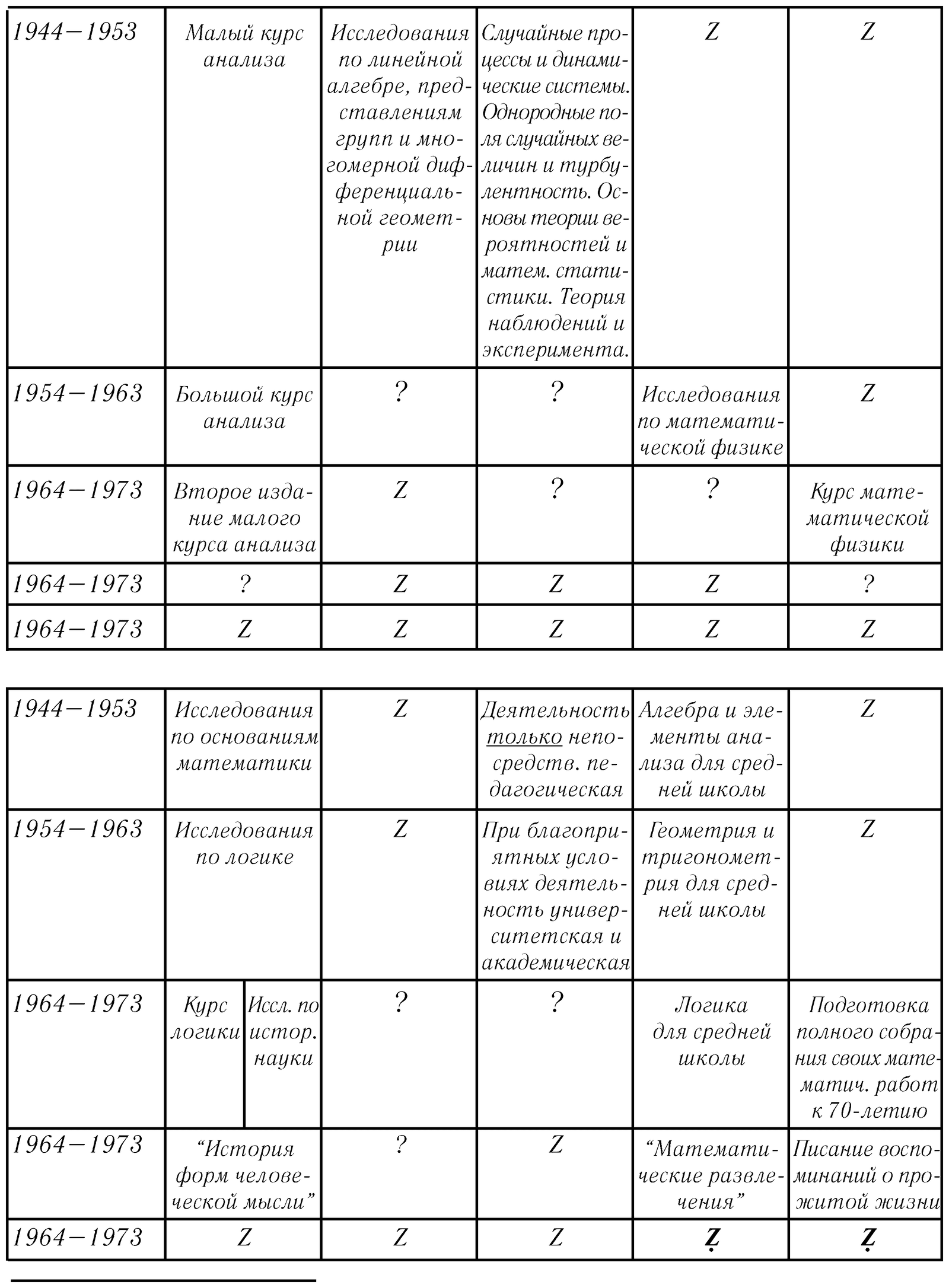
In the unitary representations these last days a hold-up — I am somewhat tired.
Yet another week of intense occupation with them must, however, be arranged, neglecting other affairs. If in a week nothing comes out, it will have to be put off a little.
On Friday, to begin with putting into order everything about the finite-dimensional case in a separate little notebook.
Today I did a large gymnastic session — this must be done daily. Now I take up Chetverukhin and the like. [Editor’s note:] The reference here is evidently to N. F. Chetverukhin’s paper “On the affine rigidity of polyhedra”, published in the Doklady of the USSR Academy of Sciences (1944, vol. 42, no. 1, pp. 3–6).
To each -dimensional representation there corresponds a representation in the -dimensional space of matrices.
More generally — in the -dimensional space of rectangular matrices. This is nothing other than the “-th power” of the representation .
Generalise this operator-wise to the infinite-dimensional case!
In the finite-dimensional case the “subordination” of representations is the finding of in some invariant subspace of . In the infinite-dimensional case there exists some extension . (Can one, in doing so, give a direct sense to — see above.)
Presumably, means that for the corresponding sets of positive-definite functions . Is just with ?
The difficulty is that already in the simplest cases of infinite groups cannot have a generating vector — that is, a single one generating all the positive-definite functions.
Before setting off for the Mathematical Society:
- See p. 109. Spaces in which any two vectors enter into the space generated by some third one.
Friday, 3 December 1943
Hypothesis. If ( — elementary positive-definite functions) and is absolutely continuous with respect to , then .
The mapping — the set of irreducible representations. on gives on .
For representations with a “simple” spectrum, is everything determined by this ?
Difficulties with integrating a vector (from the corresponding spaces) over !
The algebraic side of the completion. Let (, ) be positive-definite,
with the corresponding Hilbert space of the — with termwise addition — for which there exists a with positive-definiteness; the infimum of such is precisely . This is what gives the possibility of arranging as a measurable function of and then integrating over !
At the Mathematical Society on Wednesday, Lavrentiev’s report (the solvability and uniqueness of the problem of mapping a region onto a region for non-linear elliptic equations subject to certain conditions) was very interesting in conception, but Lavrentiev works crudely and untidily, and recounts things not yet verified. And in answering questions, it seems to me, he even fibs a little.
Thursday [2 December]
In the morning Verchenko and Myshkis were at my place.
Then I was at the savings-bank (the lost suitcase, naturally, did not turn up) and at the exhibition in the Tretyakov Gallery (to record my impressions after a second visit!).
Pusya brought several issues of journals. In the Annals for 1942 there is a paper of H. B. Mann’s with a proof, on five pages, of the theorem on the addition of densities of sets of whole numbers. [Editor’s note:] The paper of H. B. Mann — this concerns the article H. B. Mann, “A proof of the fundamental theorem on the density of sums of sets of positive integers” // Ann. of Math., 1942, v. 43, no. 3, pp. 523–527. And various other interesting things besides.
“Formal theory of representations.”
Hypothesis ( — a positive-definite function). If , then , .
Definition. A function is called “complete” if from there follows .
Classes of equivalent . The relation of subordination .
Hypothesis. For any two and there exist , , such that for any ,
The class generated by is what is called .
In the night much snow was heaped up. Now a thaw threatens again.
Yura made Pusya a present of Rustaveli. I read Nutsubidze’s introduction on Georgian neo-Platonism.
Monday, 6 December 1943
Saturday [4 December]
From Komarovka we set off with Varvara Sergeevna for a concert.
- Tchaikovsky: The Florentine Sextet
- Nature and Love
- Night
- The Second Quartet.
At the Conservatory we met Anya, who bade me go, after the concert, to Petya ⟨Kuznetsov⟩, who had only just arrived. [Editor’s note:] Petya — P. S. Kuznetsov. Petya physically looks better than usual. He recounted how splendidly he had been seen off, and so on.
We left at 11.45. We went to Komarovka along the forest path through the snowdrifts.
Sunday [5 December]
The whole day I killed on Chetverukhin (see the Note to the entry of 1 December 1943).
Interesting: is the condition necessary and sufficient for affine rigidity? For dual polyhedra .
On Sunday evening we read “Queen Pédauque” with Anya.
I keep feeling somehow out of sorts. The representations of groups have still not come out. Oleg is not here (he is puttying the windows at the school). With Anya and Pusya somehow it is all tea-and-coffee, dinners-and-grievances... Anya takes offence if you tell her she is putting on weight, and threatens to hire herself out as a laundress. We rise late and go to bed late too. The tables are heaped with Platos and mathematics; I am too lazy to sort through them. To go ski-running alone is somehow uninviting.
All that I sulk over — away with it! There is no polishing all this smooth in an analysis of my own moods!
Unexpected, though elementary: on the unit sphere of Hilbert space the weak topology coincides with the strong:
If , , for all , then .
It is in Plesner, p. 32. (2-2-1944) [Editor’s note:] ⟨Added later — 2 February 1944.⟩ The cross-reference is to A. I. Plesner’s survey “Spectral theory of linear operators” in Uspekhi matematicheskikh nauk (1941, issue 9, pp. 3–125). The date is the day of his own Mathematical Society talk on the representations of infinite groups — a second, later stratum of the manuscript, which the greyscale facsimile cannot otherwise show.
Proof: , ; .
Thus the introduction of the weak topology reduces to a topological extension of the surface of the sphere by interior points. The “complete sphere” in the weak topology is closed. Accordingly, the surface of the sphere is a . The normalised positive-definite functions subordinate to a given representation are, in their bicompact topology, continuous images of this and consequently -sets.
In the space an element is determined by the , with . The dependence of on and is continuous (in the bicompact topology).
The precise construction of a representation from the decomposition of a positive-definite function.
where is the set of normalised positive-definite functions ( is a ). On the are given as -measurable functions, with
It is essential that too is -measurable. In fact, this is so when !
The infimum over the , for a bounded number of , is continuous.
The basic element with a given is that with , for .
Completeness. If , then the corresponding converge to .
- The measurability of the partition of into systems of equivalent ones; 2) equivalent representations — the possibility of uniformisation. How the uniformisability and the measurability are connected — this is already interesting for trajectories: the everywhere-dense winding of the torus is not uniformised in a measurable way.
So, finally, , the infimum over all possible ;
One must not forget that this winter I am free both of lectures and of household cares. Of such a winter I long dreamed, and bound up with it broad plans of work and of my own regeneration. So there is nothing to mope about senselessly!
Today I ran well on skis with Pusya and Yura. Then I saw Anya off to Bolshevo. Frost. Moonlight.
Tuesday, 7 December 1943
One must collect examples of irreducible infinite-dimensional representations (for non-compact Lie groups and ones of a set-theoretic character).
Example 1. For the group of all rotations each vector has its own particular positive-definite function (which are, however, all conjugate to one another). The mapping of the unit sphere onto the set of normalised positive-definite functions is continuous (in the set of positive-definite functions our bicompact topology; on the sphere the strong or the weak — it is indifferent). In Example 1 it is also one-to-one.
Struck out: O horror! What if the indecomposable representations may turn out to be “decomposable” in the sense of a continuous spectrum!? [Editor’s note:] “Struck out” — the editors here print, in this device, a line the author himself deleted.
The indecomposable are characterised by the fact that for any
Hence the notion of uniform indecomposability, if for ,
Does non-uniform indecomposability occur? It does.
Example 2. All permutations of a finite number of the coordinates in the Hilbert coordinate-space.
Proof of indecomposability. Let , , with , ,
The permutation
we arrange so that and, apart from this, for , only for . Then , with small.
At the same time,
has with any unit vector , where , only .
In the finite-dimensional case the analogous representation of the full permutation group is decomposable (into the one-dimensional identity and an indecomposable -dimensional one (?)).
In our case one sees, further, that the set of positive-definite functions has as a limiting function , which does not itself belong to the given representation.
Under what conditions can two vectors not connected by the relation have one and the same positive-definite function? (Perhaps this is only in the case of a “multiple spectrum”?) Indeed, for the indecomposable ones this cannot be: let , and let , like , generate the whole space. Then there exists a with for all , and for all .
For the future: the theorem of Frobenius (Speiser, p. 199) in the case of infinite and topological groups. [Editor’s note:] This concerns the book: A. Speiser, Die Theorie der Gruppen von endlicher Ordnung. Mit Anwendungen auf algebraische Zahlen und Gleichungen sowie auf die Kristallographie. 3rd ed. — Berlin: Julius Springer, 1937.
Yura’s translation from Goethe (12 November).
Морская тишина. Тишиной глубокой полно Без движенья море спит. И моряк в тревоге черной Озабоченно глядит: Все вдали смертельно-тихо, Без волненья моря гладь. В бездне вод, в пустыне дикой Безнадежно ветер звать.
Sea Calm. Filled with a deep stillness, without motion the sea sleeps. And the sailor, in a black anxiety, gazes about him uneasily: all in the distance is deathly-still, the sea’s expanse without a stir. In the abyss of the waters, in the wild wilderness, it is hopeless to call upon the wind.[Translator’s note:] «Морская тишина» is Yu. M. Smirnov’s (Yura’s) own Russian translation of Goethe’s Meeres Stille, recorded here as an event of the diary’s world (like the «Майская песня» of 28 November), and so retained as object-language, not dropped as an editors’ reader-service gloss.[In the margin:] Swap “без движенья” and “без волненья”. ⟨A. N.'s correction, in pencil.⟩ — that is, transpose “without motion” (line 2) and “without a stir” (line 6); a second, pencil stratum of the page, in his own hand.
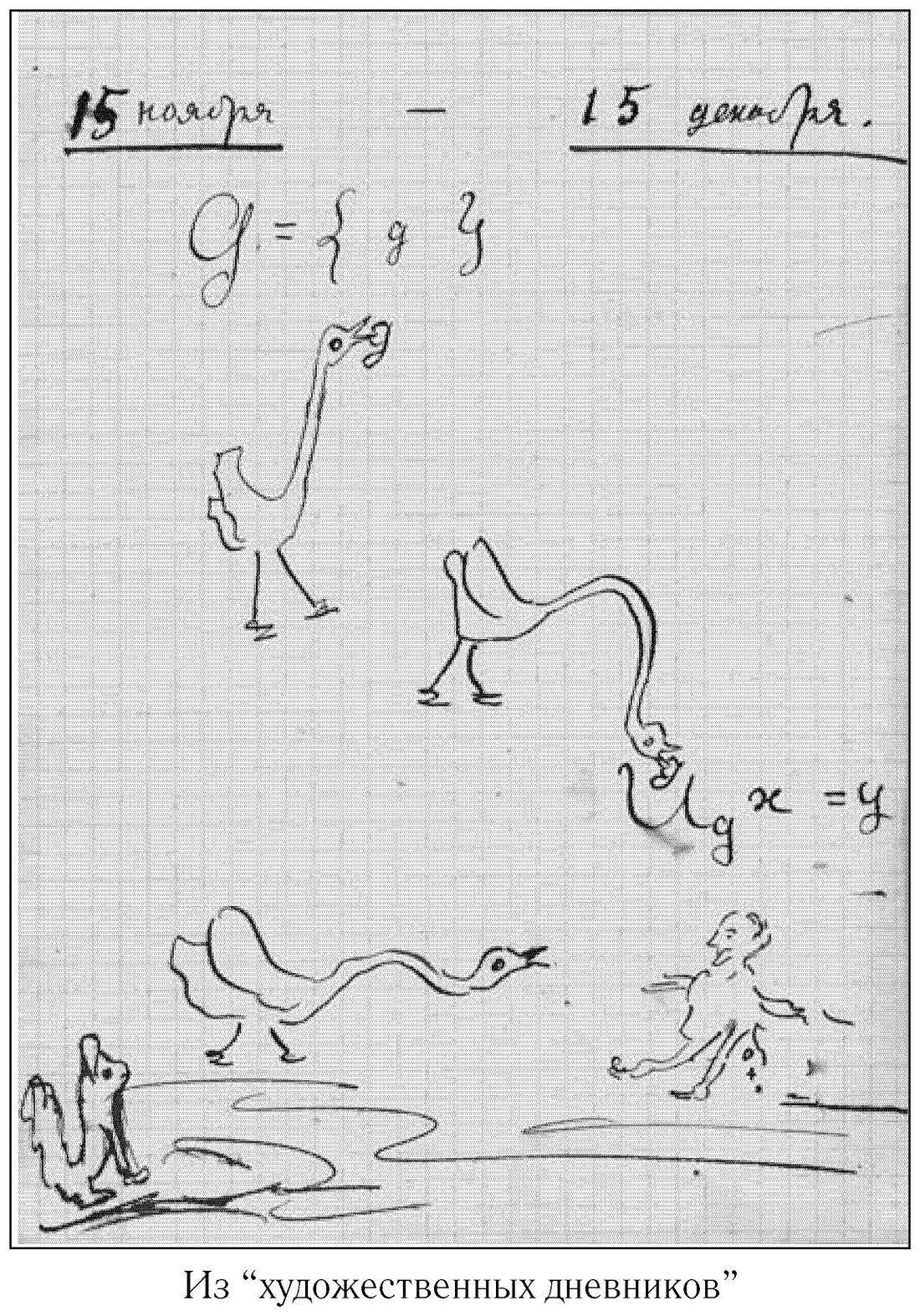
Thursday, 9 December 1943
A little more than twenty days (see the entry for Tuesday, 16 November) I have been stubbornly occupying myself with mathematics. Although, strictly, nothing yet has come out, the result — in the sense of penetration into a new and important area — is not so bad.
But whether it is worth raging on further, or working systematically without abandoning other affairs too — we shall see.
I ran off to Komarovka from my consulting-day and institute-day. In the morning sunshine, . I slept my fill, sorted and re-stowed the provisions. I mean to go skiing.
Tuesday [7 December]
In the evening I was at L. S. Pontryagin’s report.
Wednesday [8 December]
At A. N. Seliverstov’s; [Translator’s note:] A. N. Seliverstov here is Aleksandr Nikolaevich Seliverstov, father of Kolmogorov’s gymnasium friends Gleb and Nikolai Seliverstov, whom he visited while their sons were at the front; he is to be held apart from Gleb (G. A. Seliverstov), who appears on folio 135 (killed at the front in 1944), and from N. A. Seliverstov. Three Seliverstovs run through the diary. at the Academy of Sciences; at the Faculty Council (candidates for the Stalin Prizes); at a concert. In place of Mozart there was Brahms’s First Symphony. Anya decided that this is music abstract and “cosmic”; Oleg did not care for it. Then I was at Borya’s.
In partitioning a space with a measure into an ergodic family of trajectories,
where is the density along a trajectory (constant almost everywhere with respect to ), and is an “extravagant” measure on , equal to or . One must begin from this resemblance to “measurable” partitions, and only then establish the differences. To help the investigation of the general character there should serve, probably, suitable bicompact extensions.
Might one not make of this yet another theme for the doctoral dissertation of S. V. Fomin?[Editor’s note:] ⟨The reproduction of what is given here, as also in many other places of the diary text, was attended with great difficulty — the pages are at times badly washed out, and the formulas, moreover, do not follow one after another but are scattered over the whole area of the page.⟩ The garbled state of the passage reflects real damage to the manuscript; the formulas are the editors’ reconstruction.
Is there a purely formal beauty, and in what does it consist? There is, and even in two kinds.
-
One likes complex forms which surprise, despite their complexity, by their accessibility to intuitive understanding. (Mathematical proofs.) (The cycloid and the like curves.)
-
One likes the union, without contradiction, of various regularities that seemed unconnected (Speiser, p. 95 — whence philosophy too arose (for the literary reference to the book see p. 120)). (Yet another Goethean Amaque [Amaque?].) [Translator’s note:] The word after “новый” is set as «Amaque» (the final letters do not resolve confidently, reading between a Latin “-ue” and a Cyrillic “-ие”); it does not resolve to a certain meaning, and is left bracketed rather than emended by guess. (Chess problems.)
In the night from Tuesday to Wednesday, in Moscow, I hit upon the idea of characterising positive-definite functions in the powers of irreducible representations by Hermitian forms in the space of the irreducible representation itself.
Hence, at last, what indeed is a character in the infinite-dimensional case!? “Character” throughout renders his word, but the whole campaign turns on his attempt to redefine it: classically the trace of a representation, here a distinguished positive-definite function for infinite groups, where the classical trace fails. This double-ruled box, with its down-double-arrow, is the December climax of the question opened on 16 November — his own generalisation-in-progress, not the settled textbook object.
For , with and , , one has , where the are the projections onto the orthogonal axes; and
Problem: does the full group of all unitary of a given not have a single irreducible representation? For the representations I am starting a separate notebook.
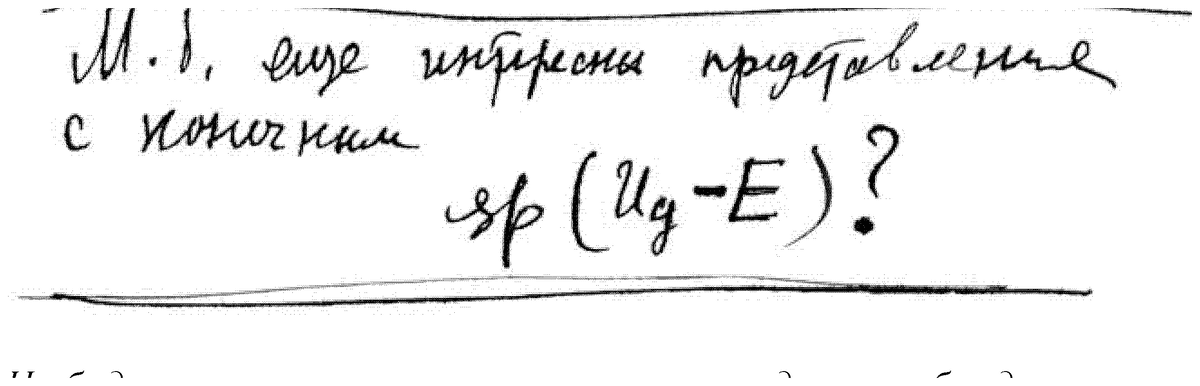
...and the characters when , and our when ; in the coordinates of the corresponding .
For irreducible a one-to-one correspondence !(?). for any positive-definite Hermitian with . As for any (reducible) one?
For future entertainments: the symmetry of coloured ornaments with permutation of the colours. Will they not decompose into irreducible ones possessing the same property, and be found always in sufficient quantity? Such infinite-dimensional irreducible ones do occur: the groups of all in an infinite-dimensional with . In the abelian case are these the representations by Besicovitch almost-periodic functions [pochti-periodicheskie funktsii]? He names three kinds of almost-periodic function on these two folios, and they must be kept distinct: the Bohr (uniform), the von Neumann, and the Besicovitch (the widest class). The adjectival Russian forms are built from the surnames.
Perhaps there are cases where there are no uniform (Bohr) almost-periodic functions (in von Neumann’s sense), but there are “Besicovitch” ones? The decompositions here are always only countable. Can it really be that the Lie groups will not all fall at least into this class?
Does there exist, for any group, a sufficient system of mappings into bicompact groups? For those for which this is so, one obtains a definite maximal bicompact group-extension. To obtain it one must multiply together all the bicompact groups into which the given group is mapped everywhere-densely. From the measure on this maximal extension there should come a density for the given group.
? No: on a subgroup of a bicompact group there are always sufficient von Neumann almost-periodic functions.
And what, then, is the group of continuous transformations of bicompact spaces?
To the theme of what geometry is. An infinite-dimensional topological group admitting one or several realisations as differentiable transformations of finite-dimensional manifolds. The relations between such realisations (that is, between the corresponding classes of conjugate subgroups and the manifolds of their cosets). For example, in the case of Riemannian geometry the matter concerns two types of geometric object (each of which forms a finite-dimensional manifold): points, and quadratic forms at the points. In this form P. K. Rashevsky too will enter into my Philosophemes.
Monday, 13 December 1943
Today is Oleg‘s birthday, celebrated, however, yesterday.
Saturday ⟨11 December⟩
I went to Moscow for a session of the Higher Attestation Commission. The session was cancelled, since Kaftanov and the rest are ill with influenza. I was at the university; I bought from a second-hand dealer Ovid’s “Epistles” and a Greek dictionary. Petya was at our place for dinner. Then I set off to Bogolyubov at the “Moskva” hotel. Bogolyubov plied me with coffee and cognac and recounted interesting things about Kiev. For the first time I saw his wife and children. Bogolyubov himself has grown thin and somehow more serious, but has aged much for his thirty-odd years. [Editor’s note:] N. N. Bogolyubov was at that time living and working in Kiev.
(?) In the night before Sunday: .
Sunday ⟨12 December⟩
With Oleg we were at the Tretyakov Gallery. Sokolov-Skalya — the sub-machine-gunner and the sapper — are good; the entry of Ivan the Terrible is a botch. Konchalovsky — “dacha painting”, venomous bright colours, but the usual mastery. Deineka — the perishing of the German “ace”, “transport is working”, “the shower” — everything strictly circumscribed, but done in masterly fashion and honestly. Korin — “in the studio” shows the exotic surroundings of the brothers. In “Alexander Nevsky” and “The Russian Ballad” only the landscape is good. Igumnov is good, but also confined to severity alone; whereas the portrait of a scholar in a white coat with a microscope shows the one thing for which all that severe training was of use. [Editor’s note:] Igumnov — K. N. Igumnov, the pianist, whose portrait S. Ivashev-Musatov was intending to paint (see the entry of 15 December). The name here labels a picture in the exhibition, not the painter. The Yakovlev brothers — the portraitist is cold, but possesses mastery; the landscapist is somewhat too graphic, but interesting. — Which of them is the portrait painted by Lebedev? Lebedev, for his part, exhibited a portrait of Sarra Lebedeva — interesting, but repellent. Sarra Lebedeva — Dzerzhinsky, Stakhanov, Mikhoels, Knipper, Gastello, the Znamensky brothers, Shostakovich’s wife — all remarkable, but Alla is right that the feeling of beauty is quite alien to her: her drawings of nude figures are devoted to the study of ugliness. Mukhina beside Lebedeva is lightweight. Among the sculptors good, besides, is Nikoladze (Beritashvili, Veresaev, Gamrekeli).
Pavlov — Leningrad and the Volga. The Leningraders — whose names I did not remember. Partisans and so on — in the drawings often very good. Someone’s studies in a great frost (“Frozen?”, “At the field-hospital”), and the like. Empty places on the enormous canvases with banners, horrors and battles. Oleg, indeed, is inert, but judges maturely and well.
Dinner and tea at Anya‘s. It was pleasant and animated. Polina Alexandrovna paid a call on Lina Samoilovna and was well pleased with them. [Editor’s note:] Lina Samoilovna — L. S. Neiman, the children’s writer, sister of the mathematician P. S. Urysohn, in whose flat Alexandrov and Kolmogorov lodged in the 1930s and early 1940s. Not to be confused with the mathematician von Neumann of these same folios. At the end there was also Sofya Nikolaevna Nyberg. I departed for Komarovka by the 21.16 train. Full moon — a clear night.
By the way, Alla, for all her primitiveness, has a keener artistic taste and a truer eye than Seryozha. [Author’s note:] In the experiment. — The note is anchored at “a truer eye”, and its content is the two hand-drawn perspective sketches reproduced below. Seryozha, it seems to me, only tried to conceal his bewilderment.
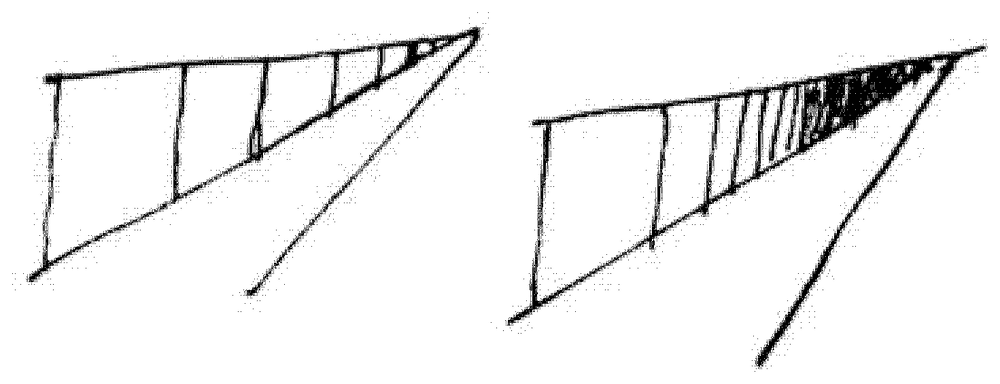
Seryozha was good, even helped Anya not to be shy of putting in her word in a conversation too high-flown for her. He hopes in a month to finish “Natasha” in two variants. He wants to go to Igumnov (only he is afraid of Korin). Of course, if Seryozha has a suspiciousness of the base and the ordinary (Tchaikovsky, Serov, to whom in portraiture he prefers Vrubel!), then I have a suspiciousness of false loftiness. In philosophy, however, he himself feels unsure before me! It is astonishing that of painting I have as yet almost never chanced to hear from him anything clever that I did not know beforehand. Rather more so on the subject of music.
Ovid, “Hero and Leander”. Zelinsky’s theory of translation from the Latin.
Yura:
Кто тосковал, поймет, Как я страдаю; Гляжу на небосвод, Себя терзаю. Кто любит, знает — тот Вдали, далёко. Ах! Тошно мне и жжет Внутри жестоко. Живу среди невзгод И изнываю. Кто тосковал, поймет, Как я страдаю!
Only he who has yearned will understand how I suffer; I gaze at the firmament and torment myself. He who loves knows — that one is far, far away. Ah! I am sick at heart, and it burns cruelly within. I live amid misfortunes and languish. Only he who has yearned will understand how I suffer![Translator’s note:] Headed only «Юра:», this is nonetheless Yura’s (Yu. M. Smirnov’s) translation of Goethe’s Nur wer die Sehnsucht kennt — Mignon’s song — retained as object-language, of the same class as «Морская тишина» (folio 120), not an original poem.
Today I plunged into the rings of operators [kol’tsa operatorov]: direct competition with Neumann (whom, however, I have still not studied). von Neumann’s «кольца операторов», the rings of operators (the period name; later called von Neumann algebras). Kept distinct from his own «group ring» / «true group ring» of the following folios. What will come of it? Either he has lost himself in the multitude of possibilities that presented themselves and did not draw out the main thing, or my hopes are in vain and I too shall merely wander off into all sorts of thickets.
Should I not first carry through to the end the representation of positive-definite functions in the form over a system of irreducible representations? This, surely, must already come out! Whereas because of the reduction of the “non-measurable” representations, nothing comes out at all! [Editor’s note:] ⟨Added 10 January 1944.⟩ — a later stratum of the page.
Tuesday, 14 December 1943
Again thaw and snow. I occupy myself much, but to no purpose.
A strengthening of Example 2 from pp. 118–119. A space with coordinates (two indices!). The group of permutation of the axes: any finite permutations within each row, joined with a given group of permutations of the rows. In the limit one obtains a positive-definite function depending only on the permutations of the rows.
After Kant:
| Theoretical cognition | Feeling | Desire / Begehrung | |
|---|---|---|---|
| Vernunft (Reason) | — | — | × |
| Urteilskraft (Judgement) | — | × | — |
| Verstand (Understanding) | × | — | —[Editor’s note:] “The Critique of Judgement” — the work of Immanuel Kant (1790), his so-called “Third Critique”. [Translator’s note:] The German faculty-terms stand with his own Russian glosses beneath them — Vernunft = Разум (Reason), Urteilskraft = Способность суждения (the faculty of judgement), Verstand = Рассудок (Understanding), Begehrung = Желание (Desire) — his gloss, kept, not 2003 apparatus. |
For “The Critique of Judgement”. This is for Sergei Musatov: only here, according to Kant, are placed the synthetic principles apprehensible a priori. In earnest, though: the Kantian “faculty of judgement”, joining theoretical philosophy with the practical, the understanding with reason, the sensuous with the supersensuous, is a sad substitute for the Platonic Eros.
Wednesday, 15 December 1943
Toward an abstract theory of representations.
A representation of a group by transformations of a set . The automorphisms for which all the are unchanged: . If there are none, the representation is “simple”. Example: — all the motions of the Euclidean plane. By virtue of this the points can be generated in a fully determined way: from the subgroup of rotation.
Today is a month since the revival of my proper mathematical occupations (see the entry of 16 November). One must concentrate, within the theory of representations itself, on the definitive solution of precisely-posed problems. Not to spread thin [rastekat’sia]. «Растекаться», “to spread thin” — literally “to flow off in all directions”: his self-discipline vocabulary, the December counterpart to the August резолюции, set against «сосредоточиться» (“concentrate”). It pairs with the slackness/discipline axis of the diary (развинченность / дисциплина).
- A unitary representation of a group is “connected” [sviaznoe predstavlenie] if for any and there exists a such that and , the subspace generated by . «Связное представление», his own working term for the sought maximal representation — like «character» this month, a coinage-in-progress rather than a settled textbook object.
1a. Does there exist a universal connected representation — that is, such a connected representation as contains within itself (on invariant subspaces) all other connected representations?
1b. If so, is the universal connected representation not, up to isomorphism, unique? Is it obtained thus:
- — the uniform-linear closure of the system of positive-definite functions on ( is a ring).
- — the corresponding -bicompactification of .
- — the system of “functions with additive square” on .
And here, in the way of spreading thin: to find out from Kurosh how far the generalisation of the Jordan–Hölder theorem ⟨Mathematical Encyclopaedia, vol. 2. — M.: Sov. Encyclopaedia, 1979; p. 424⟩ has been carried, for the case of a “continuous spectrum”.
I wrote a report on the work of L. V. Keldysh on canonical elements. [Editor’s note:] In the list of L. V. Keldysh’s works there is one on canonical elements, published in 1940: “A direct proof of the theorem on the belonging of the canonical element to the class , and arithmetical examples of -sets of high classes” // Doklady of the USSR Academy of Sciences, 1940, vol. 28, no. 8, pp. 675–678. Some day I shall have to occupy myself with these things: probably all of it can be done “rein begrifflich” and very beautifully! [Translator’s note:] rein begrifflich (German) — “purely conceptually”, in abstract terms. The 2003 edition’s parenthetical Russian gloss is dropped as reader-service.
Yesterday Anya arrived. She told of a new fit of despair in Seryozha (Korin painted Igumnov, and the girl in the anti-gas suit was not accepted for the exhibition). We read “Hero and Leander” and drank tea with jam in our room.
For a non-constructive proof of 1a. Definition: representations are mutually prime if they do not contain isomorphic parts. Lemma. The direct sum of mutually prime ones with a generating vector has a generating vector.
I have — my throat aches a little. This morning I sorted through books and busied myself with trifles.
![A full-plate interior in his own hand — a reclining figure on a bed, a window, a fir tree, a framed picture on the wall. A handwritten note runs diagonally at the lower right; it does not resolve even at high magnification — [diagonal note, illegible].](/images/translations/kolmogorov/figures/fig-folio130.png)
Thursday, 16 December 1943
In finite groups I have not yet understood intuitively the equality of the number of irreducible representations with the number of classes. I set it down pending exact verification:
Positive-definite functions correspond to invariant positive-definite Hermitian operators in the space of the group ring [gruppovoe kol’tso]. The invariant Hermitian ones decompose into invariant projection ones (with projection onto invariant subspaces). The indecomposable positive-definite functions are the projection operators onto minimal invariant subspaces. The characters are the projection operators onto the “space ”.
Well, of course, all this is true (for the finite case). In the infinite-dimensional case, literally speaking, it is not so, since the unit vector of the group ring may be orthogonal to certain indecomposable spaces. In the infinite-dimensional case, perhaps, one should build itself, all the same, by an extension after Naimark? (See the entry of 29 November.) [Translator’s note:] Naimark (M. A. Naimark) is not von Neumann of the preceding folios: the two names, Наймарк and Нейман, run close in Russian but are different mathematicians. The reference back is to the 1943 Naimark paper on positive-definite operator functions, noted in the entry of 29 November.
The Hermitian positive-definite operators corresponding to characters are invariant, besides, with respect to , where are the automorphisms (representations). Or again: to the characters there correspond those positive-definite Hermitian operators which are commutable with all the other positive-definite invariant Hermitian operators.
The disposition of in — is there in it anything bound up with the group, or is it always the same? Evidently the latter is true.
“The systematic exposition” goes heavily. See, however, what was written for 13–15 December (separate sheets ⟨not found⟩). [Editor’s note:] “separate sheets ⟨not found⟩” — the sheets on which the 13–15 December work stood were, the editors note, not located; not a gap in the present folios. After dinner I sat long by the stove. I looked at the gradually dying-out sunset-glow and the twilight. I still dug about in the finite-dimensional case (see the separate entries).
Monday, 20 December 1943
In the lunar calendar the year begins at the first new moon after the winter solstice: so 1944 begins on 27 December 1943 (the following Monday).
Friday ⟨17 December⟩
The whole morning I wrote “The unitary ring of a finite group”. I do not know whether it is new, but it is very beautiful. [Editor’s note:] As an article, the work “The unitary ring of a finite group”, so far as is known to us, was never published. On 2 February 1944, at a session of the Moscow Mathematical Society, A. N. gave a report on the theme “Unitary representations of infinite groups”. (If one compares the dates — 17 December 1943 and 2 February 1944 — one may suppose that this report touched also on the theme of finite groups.) I read Balmont’s translation of Rustaveli — weak.
Saturday ⟨18 December⟩
I brought “The unitary ring of a finite group” to a successful conclusion. We went with Yura and Pusya on skis to the far Ucha. A warm, almost spring-like day.
Sunday ⟨19 December⟩
The morning — algebra with Oleg. The day — skiing with Dimetrusya and Oleg. After dinner — Gumilev (“Pearls”, various). In the evening — “Klara Milich” (Pusya, Anya and V.S.).
For discrete abelian groups the “true” “group ring” is the Hilbert space (by the recipe from p. 89) of complex measures on the group of characters. How is it to be made on the discrete group itself? For bicompact abelian ones it is simply the Hilbert space of functions with integrable square on the group itself, and with convolution.
There still hangs the question
— the indecomposable normalised positive-definite functions; — the indecomposable representations. Are there examples where is not an integral with respect to a genuine measure over the set of belonging to ?
Does not every unitary representation somehow naturally generate a ring representation? (“Hilbert rings”, and so on.) One must work through some essentially infinite-dimensional example — for instance, the representations of the group of all, or of all finite, permutations in a countable set (see the finite case in van der Waerden).
Tuesday, 21 December 1943
Little problems for Oleg.
-
, ; 2) , .
-
Curves: , , . 4) Systems: , .
Yesterday’s chief piece of news: in the infinite-dimensional case positive-definite functions are not elements of a Hilbert space, but the notion of “orthogonality” [ortogonal’nye mery] is preserved for them: and are “orthogonal” if, for generated by and , the space is generated by . Orthogonal representations, through indecomposable ones:
for which and for non-intersecting and are orthogonal. «Ортогональные меры», his generalised “orthogonality” of positive-definite functions (and the measures that build them) which are not themselves Hilbert-space elements; the object is his extension of the standard notion. The existence of orthogonal ones, it seems, I can prove.
If one builds from the for which , then in the orthogonal decomposition
The constancy of the extremal for all ought to hold, but by the construction adopted the existence of extremal was not assumed!
Hypothesis 1. If and is orthogonal, then too is orthogonal. If this hypothesis is true, then there is built up a maximal system of joinable (in the sense of the existence, for and in the system, of a with , ) orthogonal measures.
Hypothesis 2. On such a maximal system one can also fashion the long-desired universal connected representation.
Lemma on the replaceability of any orthogonal measure by another orthogonal joinable with a given orthogonal .
All this is simple, and ought to have been done long ago! In the finite-dimensional case Hypotheses 1 and 2 are true.
All of this is by no means invented; but one must concentrate on the completion of precisely this elementary train of thought and obtain an answer to the question whether a representation is characterised (as in the case of a one-parameter group!) by the sequence of types of measures on the set of irreducible representations. [Author’s note:] Finite- or countable-dimensional. — His qualification of the word “representation” at the anchor.
In the evening I read “Chertopkhanov and Nedopyuskin”, “The End of Chertopkhanov” (stories from Turgenev’s “Sketches from a Hunter’s Album”). Today I idled and even drank cognac with tea. In the night I sulked violently at everything — not for nothing the darkest day. It is time to take myself in hand and work without jerks!
Friday, 24 December 1943
The set of normalised indecomposable positive-definite functions decomposes into a sum , where are the positive-definite functions of the irreducible representation . A measure on generates a measure on .
-
Is any given on generated by some given on ? Probably yes. If not, one must consider only the generated ones.
-
Is any generated by such a as lies on a uniquely-projectible (into ) set from ? Unlikely. Were it so, then everything, presumably, would be simple.
-
If not, then there exist indecomposable . They are generated by a “ that is almost everywhere not less than countably-multiple”. To such, probably, there correspond representations that are reducible, but such that they decompose only into ones isomorphic to themselves.
Well, we shall see whether it is true that
“In re mathematica ars proponendi quaestionem pluris facienda est quam solvendi”? (G. Cantor)
“In mathematics the art of posing a question is to be valued more highly than the solving of it.” (G. Cantor)[Translator’s note:] The Latin is kept as he set it; the 2003 edition’s Russian gloss is dropped. He plays on it at once, in the sentence following.
In the direction of proponendi I am still moving forward, without any solvendi coming out of it. proponendi / solvendi (Latin) — “of proposing” / “of solving”: the two words carried over from Cantor’s epigram just above.
Wednesday ⟨22 December⟩
I tried to reflect on groups, and somewhat disorderedly prepared the report “Lobachevsky and modern mathematical thought”. [Editor’s note:] The article under the same title appeared in the collection of P. S. Alexandrov and A. N. Kolmogorov “Nikolai Ivanovich Lobachevsky. 1793–1943” (M.–L.: Gostekhizdat, 1943). The report itself was given at the Moscow Mathematical Society on 3 November 1943. Then, in place of the Faculty Council, I set off on skis to our little hills, to the Baibaks, to Obraztsovo. , golden clouds with a bluish tinge. At the Baibaks I saw a hare close by. I called in on S. Musatov. His rejected girl “with the regality of movements”. I grew quite exasperated at the ascription to Gleb of “hurrah-patriotism”.
To S. V. Fomin — a plan for a dissertation on bicompact extensions, partitions and measures.
The solstice — tea with Anya and Pusya. I read Tyutchev to Anya and Vera Yakovlevna.
I dreamed a dream: Alla has a temperature of , by her own account from creative ardour alone — she wants to paint the joy poured out in nature; Seryozha says this cannot be, that nature is hostile to the spirit. I, for my part, think of calling in E. M. Tareev (the therapist) or Yu. M. Zinoviev (the psychiatrist). [Translator’s note:] The initials are set as «Ю.М.» (Yu. M.) in the print; the person is P. M. Zinoviev (Pavel Mikhailovich), the psychiatrist known to Kolmogorov and the only Zinoviev in the edition’s index — the same man, whom the editors here gloss ⟨psychiatrist⟩. The printed “Yu. M.” appears to be a slip, and is reproduced as set rather than silently corrected.
Sunday, 26 December 1943
Verchenko, Fomin, Yaglom — for them compartments in the cupboard. Problems for S. V. Fomin.
I am reading A. I. Maltsev’s “On the theory of the Lie groups in the large”. [Editor’s note:] “On the theory of the Lie groups in the large” // Matematicheskii sbornik, 1945, vol. 16 (58), no. 2, pp. 163–190; 1946, vol. 16 (61), no. 3, pp. 523–524. Apparently very deep and good. Perhaps, with my interest in groups, we shall yet join forces for large works. I must do something good myself, but, having felt confidence in myself anew, seek out strong collaborators: in my capacity to pose problems to a greater degree than to solve them there is nothing bad. — How to deal with Maltsev’s English publication?
Friday ⟨24 December⟩
We were with Pusya and Yura at Kholmyagino. Forests covered with rime, the crumbling Kholmyagino church (it enchanted Yura too). Along the Skalba into the dusk, through Ivanteevka — already in the dark. In the evening I set down a certain mathematical nonsense (that is why a page is torn out). [Translator’s note:] The torn-out page is his own note, and a recorded fact, not a gap in the present folios.
Saturday ⟨25 December⟩
Petrov brought Gumilev: both “The Pillar of Fire” and the posthumous collection — these are, perhaps, the best of the Gumilev books. Oleg is coughing and does not come. Anya stays in Moscow for a parents’ meeting (and for my hours?). I read Gumilev to Vera Yakovlevna and Anya (although the latter is already “sated” with him, by her own expression — the growth of her taste proceeds safely in its due course). I arrived by the 10.30 train (a cuckoo-connection to it). New snow.
Concretely: I must read “The Classical Groups” (Princeton, 1939), by H. Weyl, though Weyl’s style is antipathetic to me (there is no certainty that he always strives for simplicity and not for mystification!).
A full page of verse in his own copying-out — two poems of Gumilev’s, set in two columns.
Снова лес и поля Мне открылись, как в детстве, И запутался я В этом милом наследстве. Легкий шорох шагов, И на белой тропинке Грузных майских жуков Изумрудные спинки. Вдруг в душе у меня Зародилась тревога, Вот прольется, звеня, Зов весеннего рога.
Н. Гумилев
Once more the forest and fields have opened to me, as in childhood, and I have become entangled in this dear inheritance. A light rustle of steps, and on the white path the emerald backs of heavy May beetles. Suddenly in my soul an anxiety was born: now, ringing, the call of the spring horn will pour forth. — N. Gumilev
Временами, не справясь с тоскою И не в силах смотреть и дышать, Я, глаза закрывая рукою, О тебе начинаю мечтать.
Не о девушке, тонкой и томной, Как тебя увидали бы все, А о девочке, милой и скромной, Наклоненной над книжкой Мюссэ.
День, когда ты узнала впервые, Что есть Индия — чудо чудес, Что есть тигры и пальмы святые, — Для меня этот день — не исчез.
Иногда ты смотрела на море, А над морем вставала гроза, И совсем настоящее горе Застилало туманом глаза.
Почему по прибрежьям безмолвным Не возноситься дворцам золотым? Почему по светящимся волнам Не приходит к тебе Серафим?
И я знаю, что в детской постели Не спалось вечерами тебе. Сердце билось, и взоры блестели, О большой ты мечтала судьбе.
Утонув с головой в одеяле, Ты хотела быть солнца светлей, Чтобы люди тебя называли Счастьем, лучшей надеждой своей.
Этот мир не лукавил с тобою, Ты внезапно прорезала тьму, Ты явилась слепящей звездою, Хоть не всем — только мне одному.
Но теперь ты не та, ты забыла Все, чем в детстве ты думала стать. Где надежда? Весь мир, как могила. Счастье где? Я не в силах дышать.
И таинственный твой собеседник, Вот я душу мою отдаю За твой маленький детский передник, За разбитую куклу твою.
Н. Гумилев (“Девочка”)
The Girl. At times, unable to master my anguish and with no strength to look or to breathe, I, covering my eyes with my hand, begin to dream of you. Not of a maiden, slender and languid, as everyone would see you, but of a little girl, dear and modest, bent over a book of Musset. The day you first learned that there is an India — the wonder of wonders — that there are tigers and holy palms: for me that day has not vanished. Sometimes you gazed at the sea, and over the sea a storm was rising, and a wholly real grief veiled your eyes with mist. Why, along the silent shores, should not golden palaces be raised? Why, over the gleaming waves, does no Seraph come to you? And I know that in your child’s bed you could not sleep of evenings. Your heart beat, and your glances shone: you dreamed of a great destiny. Sunk head and all into the blanket, you wished to be brighter than the sun, that people might call you their happiness, their best hope. This world did not deal falsely with you; you suddenly cut through the darkness, you appeared as a blinding star — though not to all, only to me alone. But now you are not the same, you have forgotten all that in childhood you thought to become. Where is hope? The whole world is like a grave. Where is happiness? I have no strength to breathe. And, your mysterious interlocutor, here I give up my soul for your little child’s pinafore, for your broken doll. — N. Gumilev (“The Girl”)[Translator’s note:] Two poems of N. Gumilev’s, copied out in his own hand and kept in Russian as object-language (he is transcribing Gumilev), with a crib beneath. Between the stanzas of “The Girl” he has written in the aside «Вот уж, право!» (“Well, really!”) — his own interjection at the verse.
27 December ⟨1943⟩
Новолуние.
Конец сумбурного 1943-го года. The last dated entry of the section. «Новолуние. Конец сумбурного 1943-го года.» — “New moon. The end of the muddled year 1943.” The close is chosen, not a truncation: on folio 132 he computes the lunar new year of 1944 as falling on this same 27 December, and his new notebook opens before New Year, so that the 29 and 31 December entries physically sit inside the 1944 section and are given later. Below this close, the notebook’s endpapers follow.
New moon. The end of the muddled year 1943.[Editor’s note:] What follows was set down in the Komarovka house on the endpapers of the 1943 diary-notebook, and is transcribed here by the editors as a closing appendix to the 1943 section.
1943 — plans of reading aloud (the date · the work):
- Fri. 1 January · Shakespeare, “King Lear” (Kuzmin’s translation)
- Sun. 10 January · A. Blok, “The Rose and the Cross”
- Sun. 17 January · Prishvin, “The Spring of Light and Water” (from “The Springs of Berendei”)
- Sun. 7 February · Pushkin, “The Queen of Spades”
- Sun. 14 February · Shakespeare, “Hamlet” (Lozinsky’s translation), Act 1
- Sun. 21 February · “Hamlet”, Act 2
- Sun. 7 March · “Hamlet”, Acts 3, 4, 5
- Sun. 14 March · Hamsun, “Victoria”, chs. I–VII
- Sun. 28 March · “Victoria”, chs. VIII–XIII
- Sun. 11 April · Turgenev, “Three Meetings” (1851)
- Sun. 25 April · “Father Alexei’s Story” (1877)
- Mon. 26 April · “The Song of Triumphant Love” (1881); Pushkin, “Boris Godunov”; Turgenev, “A Quiet Backwater”
- Thu. 10 June · Apuleius, “Cupid and Psyche”
- Fri. 25 June · Hoffmann, “The Doge and Dogaressa” (from “The Serapion Brethren”)
- Sun. 11 July · Hoffmann, “The Mines of Falun” (from “The Serapion Brethren”)
- Sun. 1 and 8 August · Thomas Mann, “Tonio Kröger”
- Sun. 24 August · Hafiz, in the translations of A. Fet and V. Solovyov.
On the endpaper (written out in a column) — the Sundays of 1943, by month:
| January | February | March | April |
|---|---|---|---|
| 3, 10, 17, 24, 31 | 7, 14, 21, 28 | 7, 14, 21, 28 | 4, 11, 18, 25 |
| May | June | July | August |
|---|---|---|---|
| 2, 9, 16, 23, 30 | 6, 13, 20, 27 | 4, 11, 18, 25 | 1, 8, 15, 22 |
On the reverse side — a colour key: ◇ — purple · ◇ — silver · ◇ — gold · ◇ — black · ◇ — green · ◇ — blue · ◇ — red. [Editor’s note:] ⟨The little rhombi are hatched, each in its own way.⟩ [Translator’s note:] Each of the seven little rhombi is hatched in its own way to stand for a colour — a private colour-coded scheme he ran over his year (cf. the pencil calendar at folio 201). The facsimile is greyscale, so the colours survive only as these hatch patterns and in the printed key; the actual colour is a lost stratum the image cannot show.
1944–1945
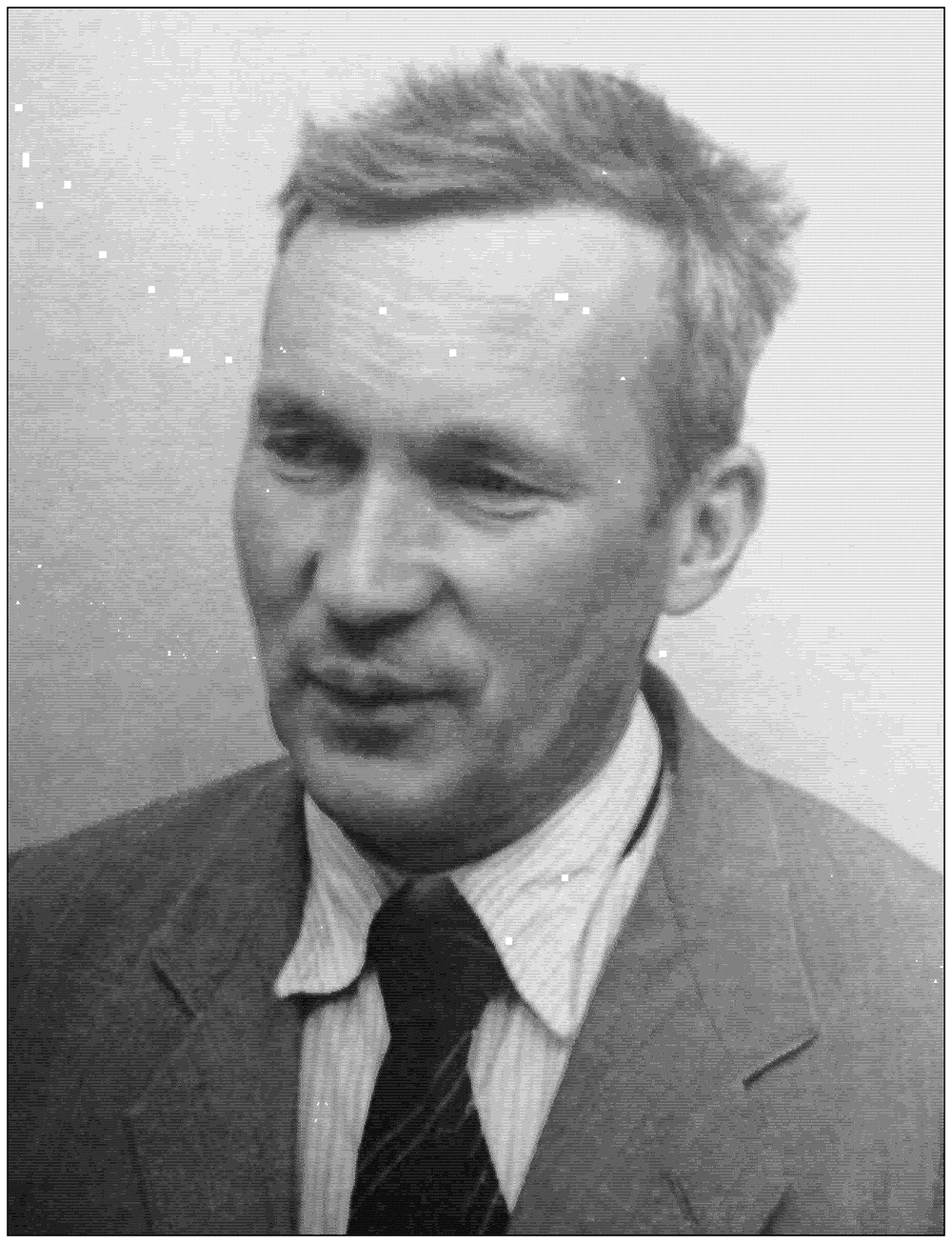
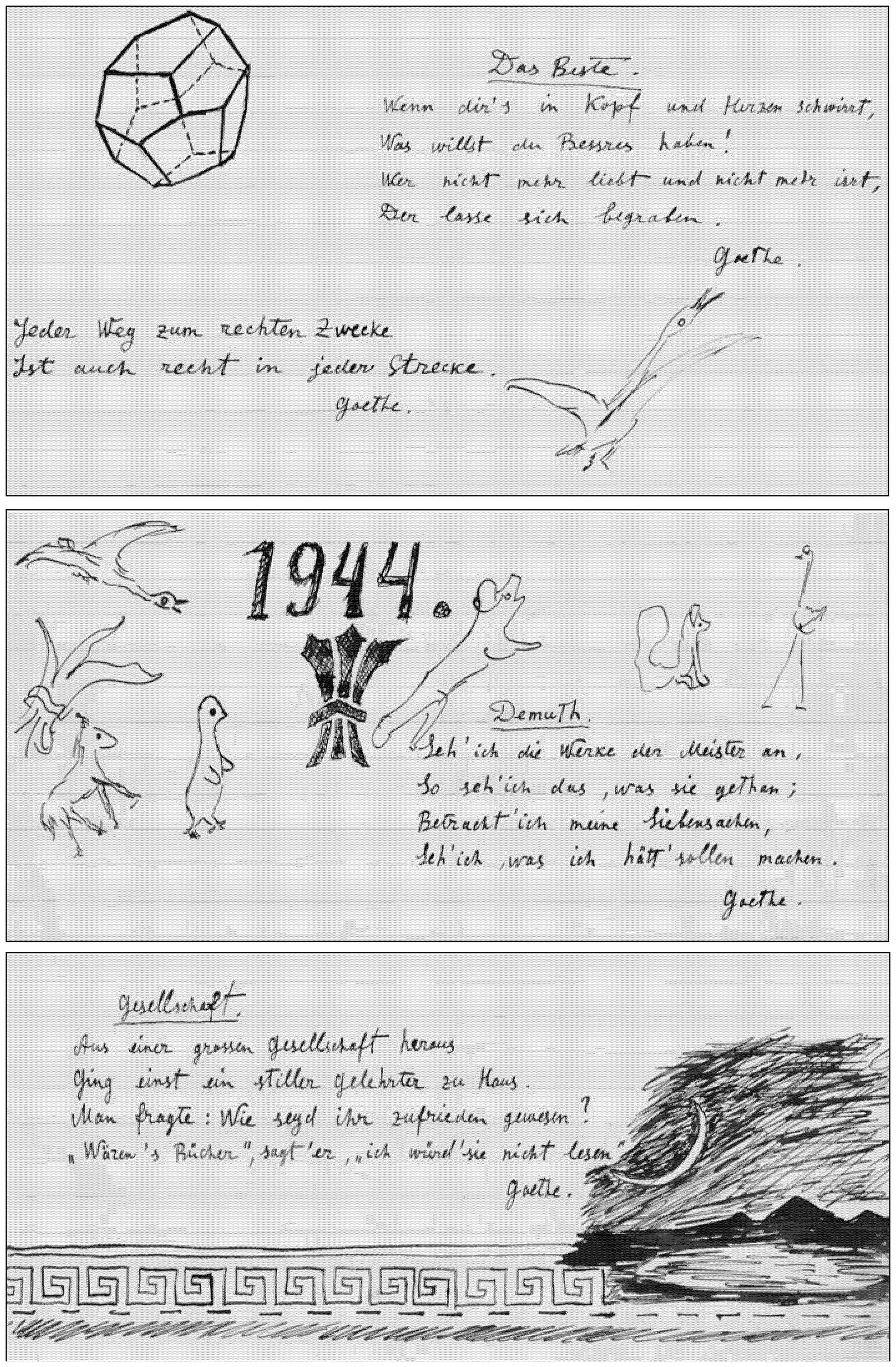
Das Beste
Wenn dir’s in Kopf und Herzen schwirrt, Was willst du Bess’res haben! Wer nicht mehr liebt und nicht mehr irrt, Der lasse sich begraben.
— Goethe
The Best. — When in your head and heart it whirs, / What better would you have! / Who loves no more and no more errs, / Let him lie in his grave.Goethes Werke: I, 2 (1888), S. 282. A recurrence of folio 26 — he re-copies it to open 1944; Goethe’s irrt (“errs, strays, wanders”) is the same verb that ran through the diary’s first fortnight, behind Mann’s verirrter Bürger. The 2003 edition’s Russian verse gloss «Лучшее» is dropped.
Jeder Weg zum rechten Zwecke Ist auch recht in jeder Strecke.
— Goethe
Every road to the right goal / is right, too, in each stretch of it.Facsimile-only: the editors did not typeset this couplet on folio 141, so its crib is taken from the flyleaf image (folio 140).
Demuth
Seh’ ich die Werke der Meister an, So seh’ ich das, was sie gethan; Betracht’ ich meine Siebensachen, Seh’ ich, was ich hätt’ sollen machen.
— Goethe
Humility. — When I look upon the works of the masters, / I see what it is they have done; / when I take stock of my own bits and pieces, / I see what I ought to have done.Goethes Werke: I, 2 (1888), S. 279. His hand here writes «So seh’ ich das» — confirming that the «Sî» printed at folio 88 was the edition’s own slip. Siebensachen — one’s odds and ends, “traps”; the pun behind his private “seventy opuses”. The Russian gloss «Смирение» is dropped.
Gesellschaft
Aus einer grossen Gesellschaft heraus Ging einst ein stiller Gelehrter zu Haus. Man fragte: Wie seid ihr zufrieden gewesen? “Wären’s Bücher”, sagt’ er, “ich würd’ sie nicht lesen”.
— Goethe
Society. — Out of a great gathering a quiet scholar once went home. They asked: How well were you pleased? “Were they books,” said he, “I should not read them.”Goethes Werke: I, 2 (1888), S. 273. The Russian gloss «Светское общество» is a free re-invention (a little dialogue), not a close rendering — dropped.
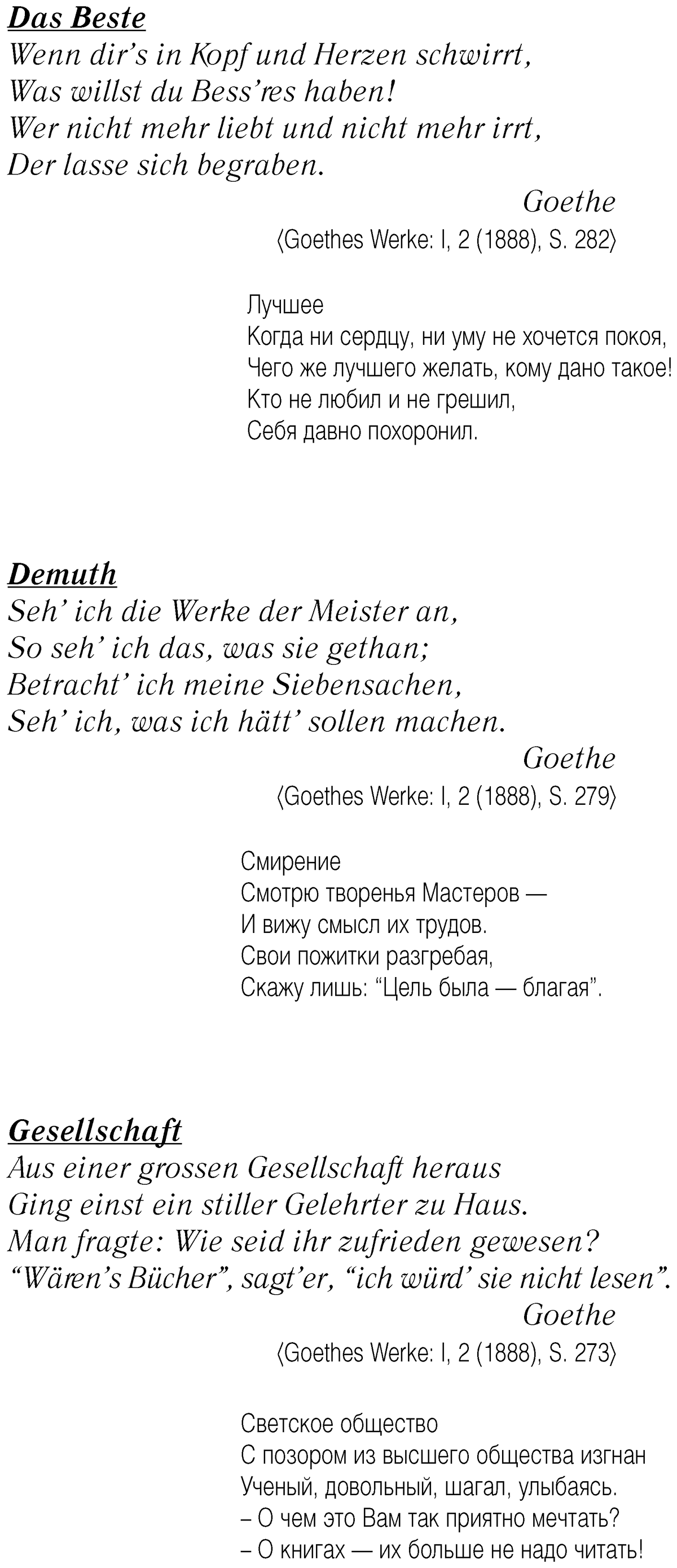
Lebensregel
Das Wenigste muss dich verdriessen, Musst stets die Gegenwart geniessen, Besonders keiner Menschen hassen Und die Zukunft Gott überlassen.
— Goethe
A Rule of Life. — Let the least of things vex you; / you must always enjoy the present; / above all, hate no human being, / and leave the future to God.Goethes Werke: I, 2 (1888), S. 284. Typeset only (folio 142) — this poem is not on the flyleaf 140; its Russian gloss «Жизненное правило» is dropped.
Monday, 29 December 1943[Translator’s note:] From this heading through 8 January the notebook’s weekday names run exactly two days behind the true ones. He writes «Monday» for 29 December (in fact a Wednesday), «Wednesday» for 31 December (Friday), «Friday» for 2 January (Sunday), «Saturday» for the 3rd (Monday), «Sunday» for the 4th (Tuesday), «Monday» for the 5th (Wednesday), «Thursday» for the 8th (in fact a Saturday); the count corrects itself at 11 January (Tuesday, correct) and 13 January (Thursday, correct). December’s headings were all correct. He lost the thread of the days across the frost-bitten turn of the year — he was nursing frostbite (see 11 January) — and caught up mid-month. His weekdays are kept here exactly as written, uncorrected, a datum of the man opening a new notebook over a disorienting New Year. [Editor’s note:] As A. N. remarks at the end of the 1943 Diary, the new year 1944 came, by the lunar calendar, on 27 December 1943. He therefore assigns this entry (29.12.1943) already to the winter of 1944, as is indeed recorded on the title-leaf.
Dafür soll dir denn auch halbfuslang die Prächtige Rute Strozzen vom Mittel herauf, wenn es die Liebste gebeut.
— Goethe
And in return the splendid rod, a good half-foot long, shall swell up for you from the midst of the body, whenever your beloved commands it.⟨Goethes Werke: I, 53 (1914), S. 7⟩ — from the Roman Elegies (the priapic elegies). [Translator’s note:] The epigraph is frankly erotic. In its place the 2003 edition prints a clean, unrelated Russian couplet — a bowdlerized substitute, not a translation. A scholarly edition does not bowdlerize: the actual German stands, with a faithful English crib, and the Russian gloss is dropped.
A. I. Maltsev, “On the theory of the Lie groups in the large”.
Two groups are “equivalent” if they are finite-sheeted coverings of one and the same group.
Anatoly Ivanovich, given the Lie algebra, classifies the groups “up to equivalence” (Theorem 12). Why so?
Does an essential difficulty remain unovercome — or, on the contrary, is carrying the matter through to the end too simple for A. I.'s magnificence?
It would be desirable to obtain a copy of the work for myself, [Editor’s note:] Maltsev’s work “On the theory of the Lie groups in the large” was published later in Matematicheskii sbornik (1945, vol. 16 (58), no. 2, pp. 163–190; 1946, vol. 19 (61), no. 3, pp. 523–524) — so what is spoken of here is a copy of the manuscript. in order to read it attentively in the coming months.
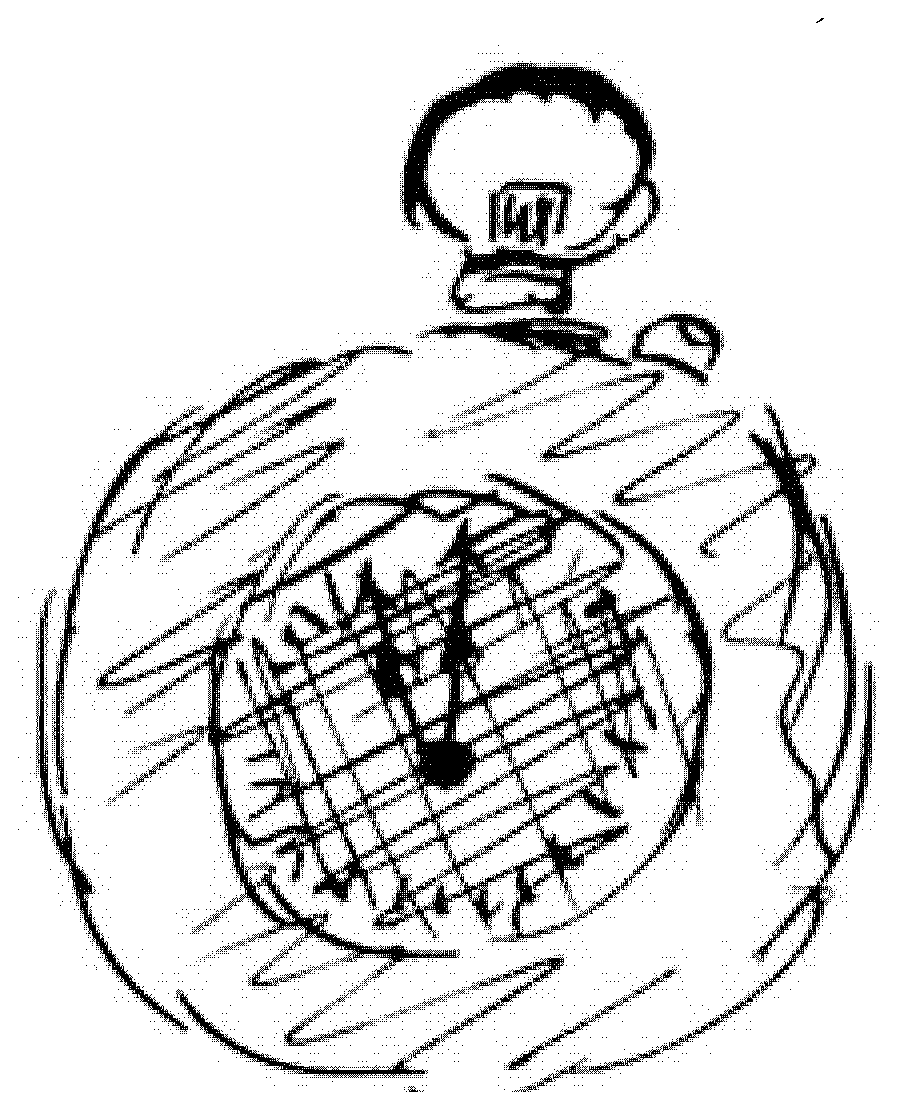
For 1–15 January (before the departure to Uzkoye).
-
To ascertain what I can achieve now in the unitary representations of groups. If nothing essential, then to drop it and take up the study of Weyl’s book (The Classical Groups, Princeton, 1939) and the like.
-
To plan out the work on the probability-theory textbook, so as not to hold up Borya [Editor’s note:] See the Note to the entry of 19 October 1943. Borya — B. V. Gnedenko. (see the Note to the entry of 19 October 1943).
-
To prepare the second gunnery collection, up to the additional computations (if they are very much needed).
A. Ya.'s “Eight Lectures” are very good, but still not without a certain trickery (see p. 28).[Editor’s note:] This concerns his well-known little book: A. Ya. Khinchin, Eight Lectures on Mathematical Analysis. — M.–L.: Gostekhizdat, 1943.
For my analysis course:
- The axiom of the least upper bound, the length of a curve after E. Schmidt, the Perron integral.
On the other hand, it is attractive:
- Cauchy’s axiomatic criterion, and the existence of the integral and of the solution of a system of differential equations from the Cauchy-convergence of “ε-solutions”.
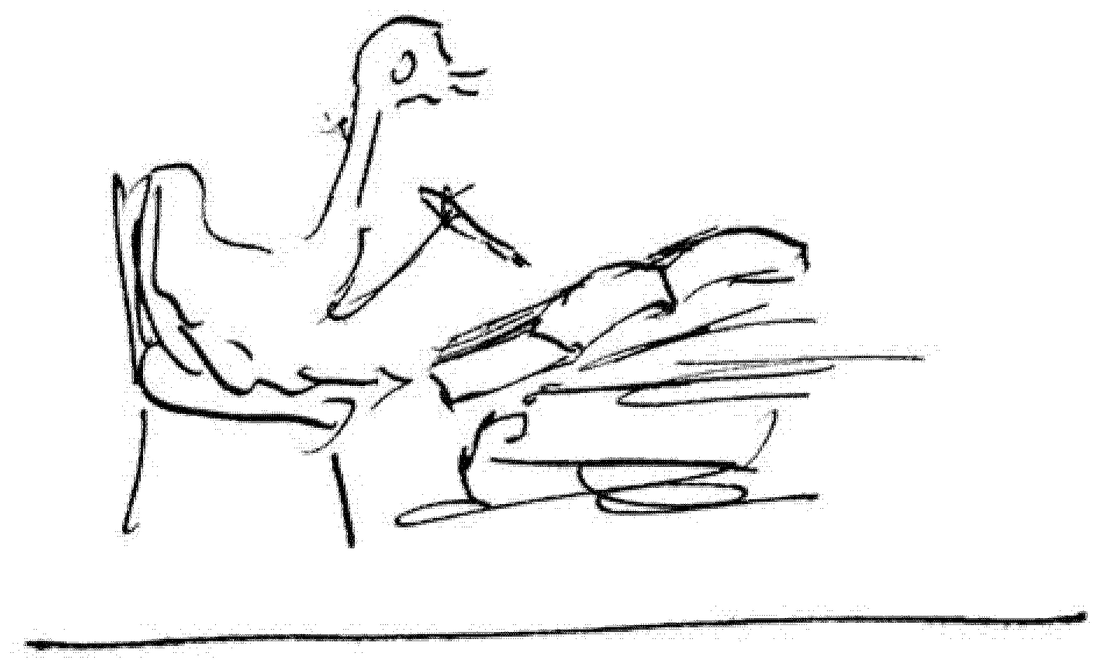
Wednesday, 31 December 1943
The evening of 29 and 30 ⟨December⟩
Senseless days:
a) Pusya‘s grievances at my wish to be at Oleg‘s for the New Year, and so on.
b) Socialist emulation at the Academy of Sciences and the Mathematical Institute. [Editor’s note:] Socialist emulation — see the entry of 8 October 1943.
c) Gelfand saw me from the institute to the metro, declared himself my pupil, and grieved that he and Raikov had not been put forward for a Stalin Prize.
![A block of writing set on a ~45° diagonal across the page (he writes across the sheet when it is full): “The morning of the 30th, Verchenko with [—]… N. N. Bogolyubov’s report on the 29th — the distribution of the New Year gifts (Marg. Mikh., Oleg, Nina Petr., Petya’s Volodya).” The tail of the first line, after “Verchenko with”, trails to the margin and does not resolve.](/images/translations/kolmogorov/figures/fig-folio145-b.png)
And from here on it will be the real 1944! [Editor’s note:] “the real 1944” — see the Note to the entry of 29 December 1943 (the lunar new year had already fallen on 27 December).
At Komarovka: rise at 7, breakfast at 8. In Moscow: to bed at 23.30, rise at 7.30.
The next problem in the representations.
An analogue of in the infinite-dimensional case: such a representation as generates all the positive-definite ones —
where is the set of indecomposable positive-definite functions attached to the given irreducible representation. To establish, finally, that such a one exists and what it is. This will already be a small result.
I am at last 4 poods! A pood [pud] is 16.38 kg; four poods is about 65.5 kg — his own weight, recorded with satisfaction after a well-provisioned Komarovka winter (cf. folio 185).
1 January 1944
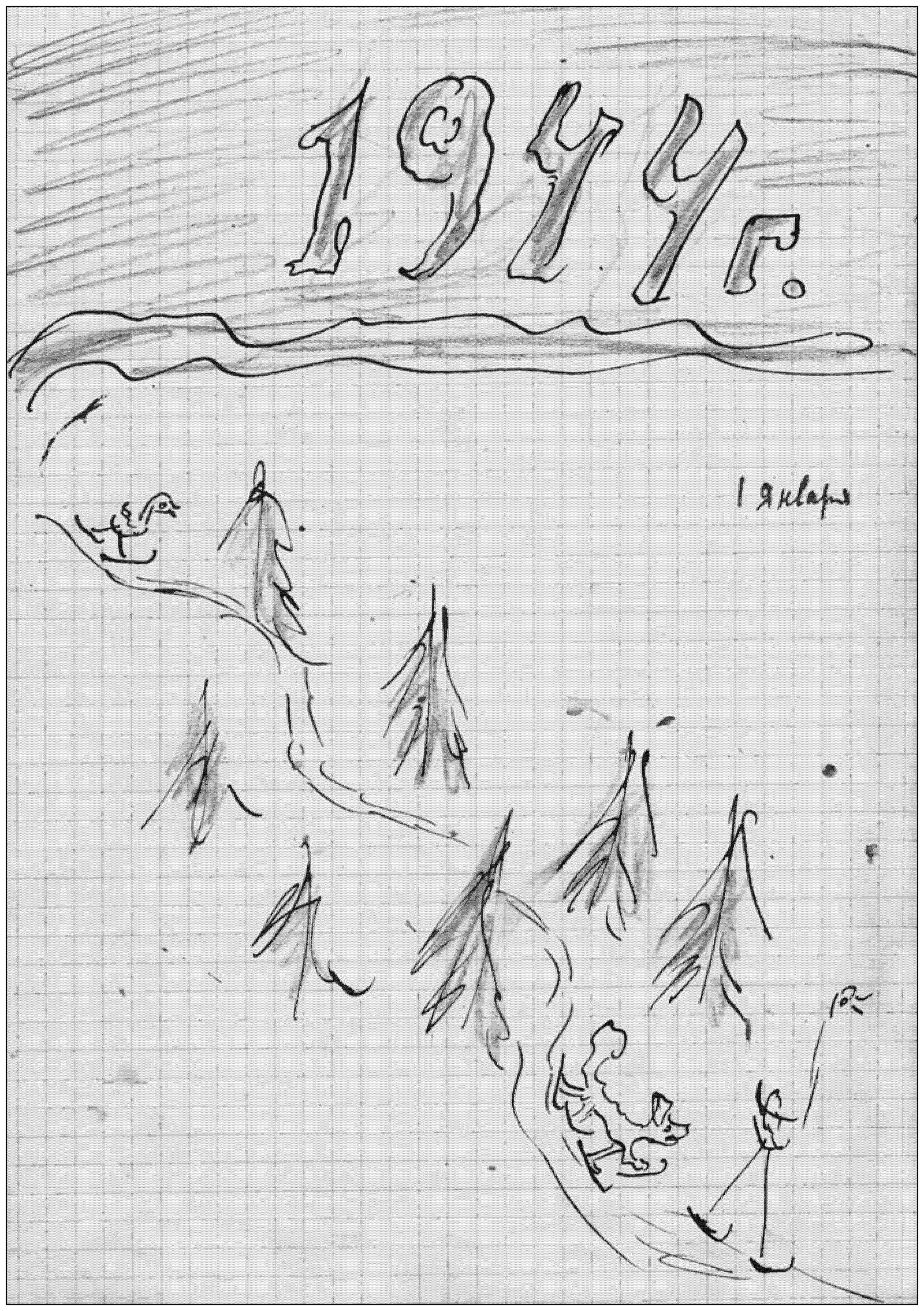
Friday, 2 January 1944
A little sun, a blue picture-book winter with the trees fluffed up with snow, and a rosy dawn.
31 ⟨December⟩
In the morning at Komarovka I worked at the groups with some success.
Pusya and V.S. went off to Ts.I. [Editor’s note:] Ts.I. — Cezaria Ioakimovna Alexandrova (Zdanovskaya), the mother of P. S. Alexandrov. The Alexandrov family’s dacha was close by, in the settlement of Klyazma.
Since Anya and Vera Yakovlevna did not come, I set off by the train at about 20.30 for Moscow.
We saw in the New Year as a threesome, with Anya and V.Ya., who were very pleased.
1 ⟨January⟩
In the morning I called on Kolya Nyberg about his dissertation affairs. [Translator’s note:] Kolya (Nikolai) Nyberg — N. D. Nyberg (Nikolai Dmitrievich, 1902–1990), the physicist and optical scientist, a gymnasium friend, just then finishing his dissertation. To be held apart from his mother, S. N. Nyberg, confirmed as docent two days later (folio 148); verified against the print — the two are distinct.
Then Anya and I took V.Ya. to Komarovka by the 14.25 cuckoo-train.
I caught up with Pusya and Yura on skis, toward the Obraztsovo pond.
A ceremonial dinner with champagne and mandarins.
We read a little Dickens, “Christmas Stories” — moralistic and rather dull.
We all washed in turn.
2 ⟨January⟩
I read Gumilev to Oleg, Vera Yakovlevna and Anya. Then I worked.
Oleg read Gumilev and A. Tolstoy to V.Ya. and Anya, then saw Anya off, while Pusya, Yura and I went on skis to the hills.
Borya came for the offprints for his history of the Russian theory of probability. [Editor’s note:] In the list of B. V. Gnedenko’s works there are Essays on the History of Mathematics in Russia (M.: GTTI, 1946), The Development of Probability Theory in Russia (Trudy of the Institute of the History of Natural Science, 1948, vol. 2, pp. 390–425), and several still later essays.
After tea I saw him and Oleg off to Tarasovka.
At last, I saw the new moon. It is very good in the forest.
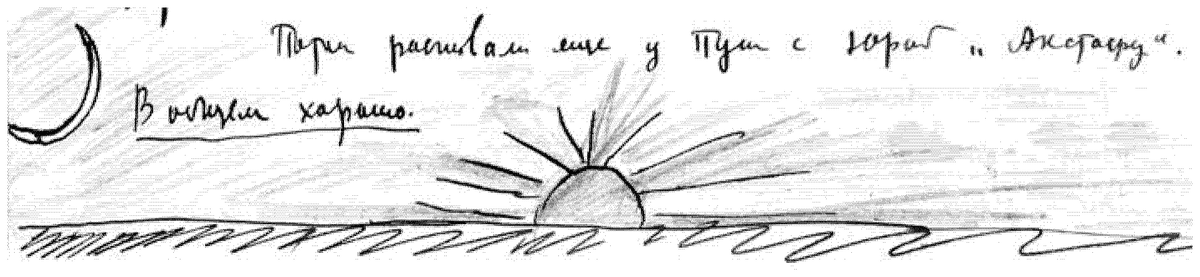
Saturday, 3 January 1944
Problem. To characterise algebraically the groups with a sufficient number of almost-periodic functions.
? The “restricted holomorphy” of a group . [Translator’s note:] «Суженная голоморфия» (“narrowed / restricted holomorphy”) — his own scare-quoted, in-progress notion, rendered literally; like «character» and «connected representation», a working direction rather than a settled object.
is represented as the group of permutations of its own elements. Just as the permutations represent the automorphisms preserving the classes (they form a group ), so a minimal enveloping group is formed.
To S. V. Fomin (in development of Krein): for groups admitting a continuous one-to-one mapping into bicompact ones (that is, for those having enough almost-periodic functions), to consider all such mappings and to obtain the Krein group rein begrifflich. [Translator’s note:] rein begrifflich (German) — “purely conceptually”, in wholly abstract terms; it recurs from 15 December (folio 130). The 2003 edition’s parenthetical Russian gloss is dropped as reader-service.
In the representations I move along little by little.
In the evening at the university council with Pusya.
An embarrassment with seven philosophers and two majors.
A lesser embarrassment with the docent in Darwinism.
They confirmed S. N. Nyberg as docent. [Translator’s note:] S. N. Nyberg — Sofia Nikolaevna Nyberg (1874–1964), the Orientalist and Latin teacher who took her candidate’s degree in art history in 1944; the mother of N. D. (“Kolya”) Nyberg of the previous entry. The initials read «С.Н.» on the print — the two Nybergs are genuinely distinct people.
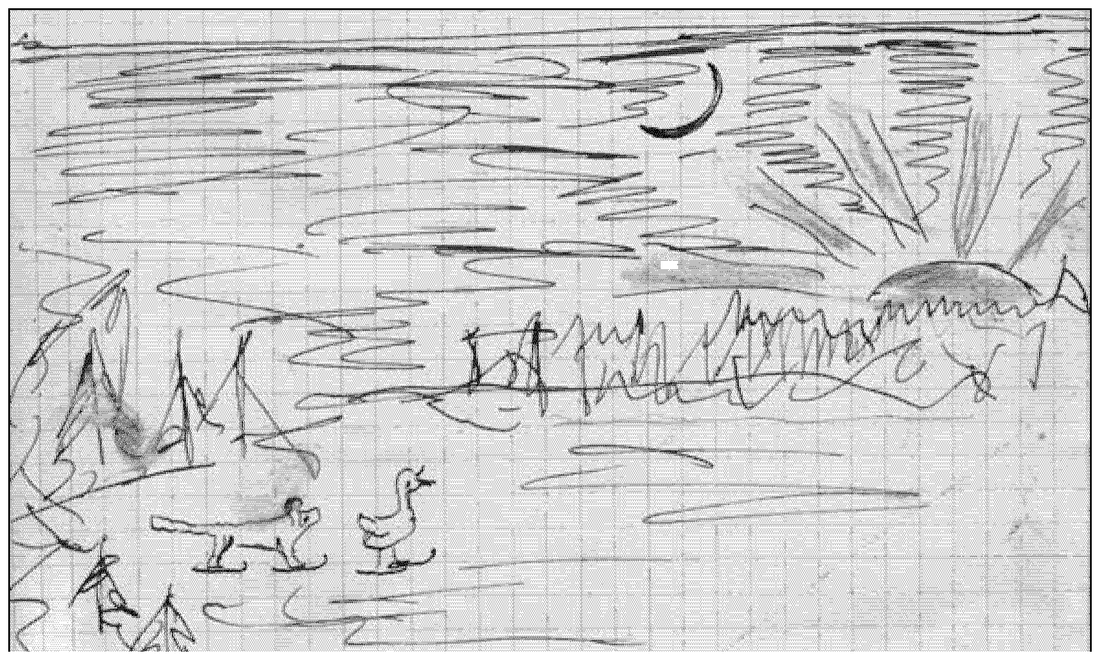
Sunday, 4 January 1944
Novgorod-Volynsky taken[Translator’s note:] The town liberated on 3 January 1944 is Novograd-Volynsky (Novohrad-Volynskyi); his «Новгород-» conflates it with Novgorod. This is the fourth and last instance of the war-news inset (folios 33, 84, 87, 149).
I was returning by the 20.25 train. Wind, the moon through torn clouds, a thaw.
Notable advances in the representations of groups (we shall see, though!).
Conversations with Vera Yakovlevna.
Anya spent the whole day on the housing and re-evacuation affairs of her Natasha and arrived only after seven. [Editor’s note:] Anya’s Natasha — N. N. Treyvas.
I read Verchenko’s work on L-continuous surfaces. This is, apparently, the definitive form of the theory for surfaces : at any further extension one must take account of the “vertical” parts. [Editor’s note:] The work of I. Ya. Verchenko — apparently his “Investigations in the theory of the area of surfaces of the form ” (published later in Doklady of the USSR Academy of Sciences, 1949, vol. 68, no. 1, pp. 5–8).
I must think it through to the end myself — in what form the dream of compactness under bounded density can be realised!
Yura’s No. 61:
Старшина был храбр и отважен. На груди лежат ордена. Ранен был. Всеми уважен, — Не уважила только одна . . . . . . . . . . . . . . . . . . (Старшина был стар и бессилен, А Елена молода и проворна)
The sergeant-major was brave and bold. / On his breast lie the medals. / He was wounded. Honoured by all — / only one did not honour him / . . . . . . . . . . / (The sergeant-major was old and spent, / while Elena was young and quick.)[Translator’s note:] «Юрин № 61» is Yu. M. Smirnov’s (Yura’s) own bawdy quatrain, numbered 61, copied out so that its quality can be weighed; it turns on the double sense of уважить — “to honour, respect” and, colloquially, “to gratify”. Alongside it, in a facing column, stands A. N.'s own commentary: “Seems good, but I am not fully sure!? Pusya seriously likes it, and he even put up with the vulgar-philistine «уважен» and the like.” Retained as object-language (the poem is under judgement), not dropped as apparatus.
Monday, 5 January 1944
For the analysis course (the big one or the small one?)
A commutative group with a cyclic ordering .
-
If , then .
-
If for one always has , then there exists a such that always , but from for all it follows that .
Theorem: there are exactly two such. [Translator’s note:] After “two such” he draws a small emblematic glyph in parentheses (a figure beneath a horizontal double-headed arrow) that does not resolve to a symbol; flagged for verification against the print. The connective glyph between and in the handwritten box below likewise reads ambiguously (a cursive ⊃ / ↦) and is rendered here as .
![A boxed passage in his own hand, headed “Towards a theory of invariants”: “For a system of objects-with-relations SSS — the automorphism group A(S)A(S)A(S). If S⊃S′S \supset S’S⊃S′, then there arises [a struck-out word, illegible] a homomorphism φSS′(α)=α′\varphi_{SS’}(\alpha) = \alpha’φSS′(α)=α′; A(S)→A(S′)A(S) \to A(S’)A(S)→A(S′). Definition. S′′ α S′S'’ \,\alpha\, S’S′′αS′ if there exists an SSS such that S⊃S′S \supset S’S⊃S′, S⊃S′′S \supset S''S⊃S′′, with φSS′\varphi_{SS’}φSS′ an isomorphism and φSS′′\varphi_{SS'’}φSS′′ mapping A(S)A(S)A(S) onto the whole of A(S′′)A(S'’)A(S′′).” A large “?” is drawn in the left margin.](/images/translations/kolmogorov/figures/fig-folio150.png)
But is every group the group of all automorphisms of some system of objects? [Translator’s note:] The “theory of invariants” and — the group of automorphisms of a system of objects-with-relations — are a new, in-progress direction (whether every group is for some system of objects); rendered literally, a working notion, not yet a settled object.
It has frozen a little. The trees are in rime and snow.
Just before setting off I think I thought out everything for Verchenko within the bounds with the “vertical pieces”.
We are going, toward five o’clock, to the three-month day of Borya’s little one. [Editor’s note:] On 6 January 1944 B. V. Gnedenko’s son Dmitry turned three months old.
Thursday, 8 January 1944
5 ⟨January⟩
We were at Borya’s.
I presided, in Pusya‘s absence, at the Mathematical Society.
Bogolyubov’s report was intelligible only to Stepanov, Khilmi and Ishlinsky.
This I said aloud, to Kurosh’s satisfaction.
A brilliant report by Markushevich — he must have surfaced unexpectedly into a real mathematician.
I brought Verchenko home. He already knows almost everything I had thought out for him.
6 ⟨January⟩
In the morning I dawdled long to no purpose.
At 12.40, at the Academy of Sciences, I was present at the handing-over of the first edition and the draft of a letter of Newton’s (to Menshikov).
Lunch with the Englishmen was interesting.
With Vinogradov and Kapitsa I discussed candidates for the Stalin Prizes.
I missed the “historic” session of the Steklov Institute. [Editor’s note:] The “historic session” was devoted to the return of I. M. Vinogradov to the post of director of the V. A. Steklov Mathematical Institute of the Academy of Sciences, after the institute’s return from its evacuation to Kazan.
After a rather muddled packing we left with Pusya for Komarovka.
7 ⟨January⟩
The morning was rather muddled.
From 3 o’clock at Kaftanov’s (a discussion of the situation in the physics faculty): A. N. Krylov, P. L. Kapitsa, L. I. Mandelstam, N. D. Papaleksi, Frumkin, Semenov, Alikhanov, myself, Spitsyn, Predvoditelev, Ivanenko.
The postgraduate commission, with Pontryagin and Plesner. Total chaos. Pontryagin is very captious toward Fomin and Millionshchikov (not without grounds, but with a special antipathy to the set-theoretic bent).
I arrived in Komarovka late.
8 ⟨January⟩, today
I did not go skiing with Pusya and Yura.
Into the representations (again I begin to understand something new!).
An attempt to prove that there are no two irreducible representations with one and the same closure of the sets of positive-definite functions.
Tuesday, 11 January 1944
9 ⟨January⟩
Tonsillitis, 38°.
10 ⟨January⟩
Yura read us — Pusya, V.S. and me — “The Mines of Falun”. Mordovtsev, “Russian Women”; “The Cavalry Maiden” — Durova — and others — interesting. [Translator’s note:] “The Mines of Falun” — Hoffmann’s Die Bergwerke zu Falun. D. L. Mordovtsev — historical novelist (“Russian Women”). “The Cavalry Maiden” — Nadezhda Durova (1783–1866), who served in the cavalry disguised as a man and left memoirs of it. None of the three is in the 2003 index.
Because of the New Year adventure with the frostbite, I am spending the first ten days of the new year even more stupidly than last year.
In my occupation with mathematics there is some defect of will: as I draw near to a successful solution of a problem, I somehow shirk the immediate clarification of the situation (?!).
Only now have I realised: I ought long ago to have tried to establish the “measurability” of all representations by a purely “descriptive” study of the partition of the space of positive-definite functions into the sets corresponding to the irreducible representations.
Does the system of invariants of the operators
form a complete system of invariants of the pair ?
![A passage in his own hand: “Today is a wonderful sunny day. [Strange snowdrifts?]: the passers-by walk as if along the top of our tomorrow.” Below it, in a flourish: “Пара приводится в порядок” — “the pair is being put in order” (the operator pair (A,B)(A, B)(A,B)). Two mid-line words in the first sentence do not fully resolve.](/images/translations/kolmogorov/figures/fig-folio152.png)
The types (in the sense of unitary equivalence) of normal operators (with complex spectral decomposition ) naturally form a space with the second axiom of countability (their own system of -sets with a countable basis!).
Is it so for all operators — or are their types, rather, analogous to the trajectories in an ergodic system?
?? Come now, is this right? — 28 January ⟨Added later.⟩ — a second, later stratum of the page, which the greyscale facsimile cannot otherwise show.
I wrote a reference on Petrovsky.
REFERENCE
Ivan Georgievich PETROVSKY is one of the very greatest of Soviet and world mathematicians. His works on systems of partial differential equations must be regarded as constituting the foundation of a wholly new stage in the development of this branch of mathematics, whose significance for mathematical natural science is well enough known. Fundamental discoveries belong to I. G. Petrovsky also in the theory of functions of a real variable, of ordinary differential equations, of algebraic geometry, and of probability theory.
Before Petrovsky’s works, the general theory of systems of partial differential equations was confined to the consideration of the analytic case. To this belong the classical Cauchy–Kovalevskaya theorem and certain subsequent investigations. But, as Hadamard pointed out, the approximation of the initial data and of the equations themselves by analytic ones does not always guarantee the approximation of the sought solution. Therefore those problems for partial differential equations for which arbitrarily small changes in the initial data cause large changes in the corresponding solution are unsuited to the description of physical phenomena.
Mathematics was faced with the question of singling out classes of equations, and the problems relating to them, which — in Hadamard’s terminology — are well posed, that is, whose solutions vary continuously with a change in the initial data. In a whole series of works following one upon another, I. G. Petrovsky lays the foundation of a new general theory of partial differential equations. First he singles out the classes of hyperbolic and parabolic systems of equations and shows that the Cauchy problem for these classes of equations is well posed. Next the class of elliptic systems is singled out, for which the setting of the Cauchy problem proves to be ill posed, and it is then proved that all sufficiently smooth solutions of such equations are analytic. This problem was posed in 1900 at the Paris Mathematical Congress by D. Hilbert, among his famous problems. For the case of a single second-order elliptic equation in two independent variables the theorem was proved in 1908–1912 by S. N. Bernstein. Finally, in 1941–42, I. G. Petrovsky investigated the dependence of the solutions of hyperbolic systems on the initial data. For the case of the wave equation it had been known since the beginning of the nineteenth century that the displacements at a given point, in the three-dimensional case, depend on the initial displacements only on the boundary of the sphere lying at the base of the characteristic cone, whereas in the two-dimensional case the displacements depend on the initial values over the whole area of the base disc of the characteristic cone — this last phenomenon is called the diffusion of waves. In his works I. G. Petrovsky gives the conditions for the presence or absence of diffusion of the solutions of general hyperbolic systems, and also discovers a phenomenon hitherto entirely unknown — that of partial diffusion. In solving this problem it was necessary to investigate deep properties of algebraic surfaces and abelian integrals.
The cycle of investigations of I. G. Petrovsky that I have briefly described is the result of concentrated work of the last ten years. Before this period I. G. Petrovsky, with the same concentration typical of him, occupied himself in turn with several other areas of mathematics. With exceptional confidence, having spent a year or two on the mastery of a new area, I. G. Petrovsky would give in it the solution of one of the central and difficult problems, in order then, with the same concentration, to pass for the next several years to work in a seemingly wholly new and alien direction.
In the theory of functions of a real variable, with which almost all the mathematicians of the Moscow school began, I. G. Petrovsky is the author of the solution of a problem posed in 1916 by Lebesgue — the determination of a function from its exact relative derivative with respect to any given function.
In algebraic geometry I. G. Petrovsky is the author of remarkable theorems on the number of real ovals of an algebraic curve, overcoming the difficulties before which Hilbert had halted.
I. G. Petrovsky’s theorems on the behaviour of the solutions of a system of ordinary differential equations near a singular point likewise far surpassed, in generality and definitiveness, the previously known results.
In probability theory I. G. Petrovsky is the author of a powerful method of proving limit theorems, which, in particular, formed the basis of A. Ya. Khinchin’s well-known monograph on the asymptotic laws of probability theory.
I. G. Petrovsky’s principal place of work is Moscow State University. He enjoys exceptional authority as a professor, a director of scientific seminars, and a supervisor of a large number of capable postgraduates. In the difficult years of the war I. G. Petrovsky did enormous work as dean of the Faculty of Mechanics and Mathematics. His textbook “Lectures on the Theory of Ordinary Differential Equations” enjoys great and deserved renown, in which, with exceptional rigour, clarity and brevity, the classical theories are set forth with an organic use of all the achievements of modern mathematics.
In view of all that has been said, I consider the nomination of Ivan Georgievich PETROVSKY as a full member of the USSR Academy of Sciences to be fully justified.
A. Kolmogorov
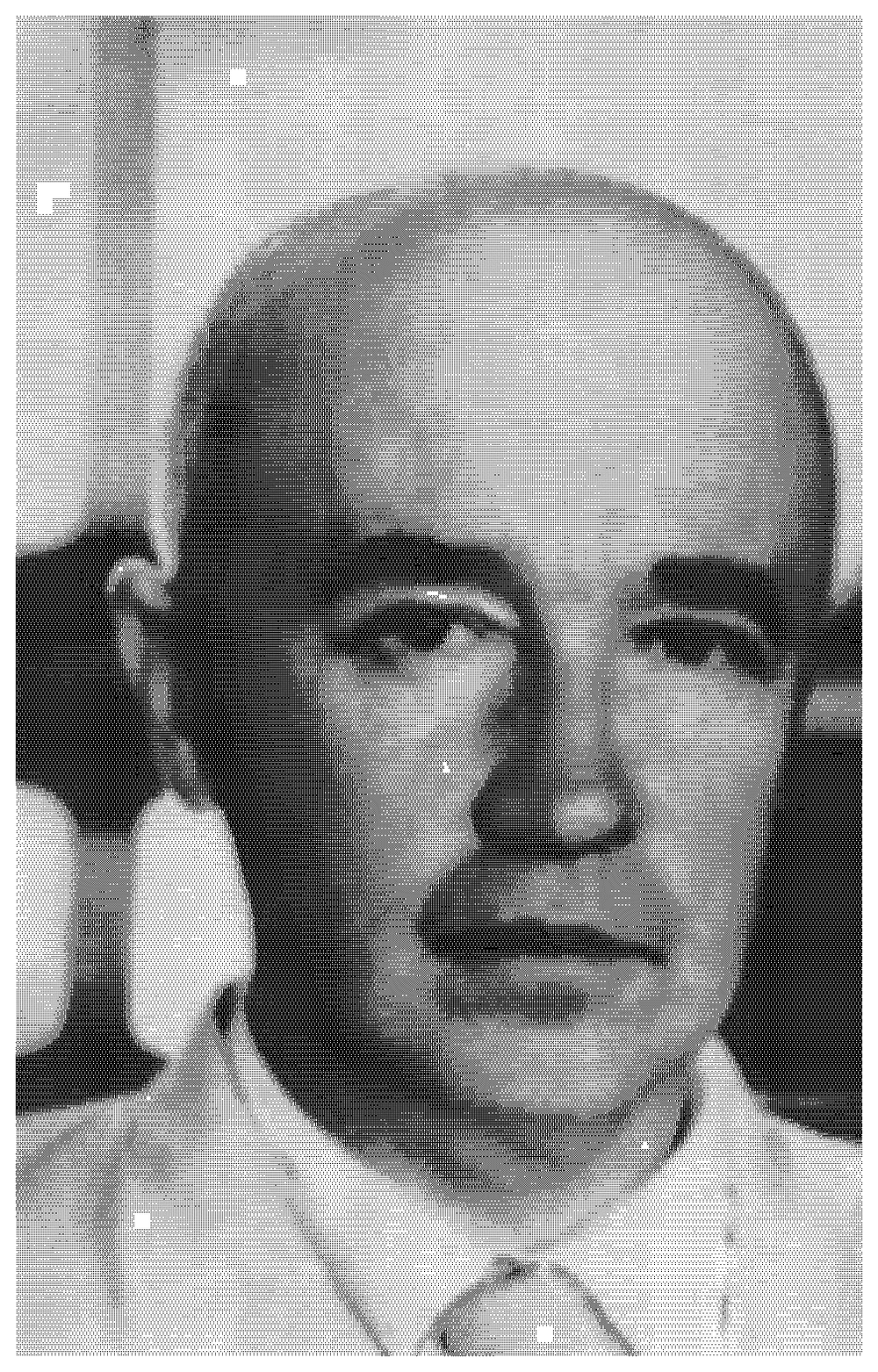
Thursday, 13 January 1944
The postgraduate commission: Pontryagin deigned to agree to Fomin; Leibman came to grief over trickery with applied mathematics; poor Vilner — to Lazar Aronovich. [Editor’s note:] Lazar Aronovich — L. A. Lyusternik. [Translator’s note:] Leibman — a candidate before the commission; not in the 2003 index.
Conversations about representations with Gelfand and Raikov.
With Anya at Margarita Mikhailovna’s. (Stories of the partisan schemes of Andreev Yura.) [Editor’s note:] Andreev Yura — a nephew of A. D. Kolmogorova, the son of her brother Andrei Dmitrievich Egorov.
I went to Bolshevo for skis and got stuck here till morning.
Yura gave me the works of Dmitry of Rostov. [Editor’s note:] Dmitry of Rostov (Daniil Savvich Tuptalo) (1651–1709) — Metropolitan of Rostov, a writer.
Setting out from Alpatov’s book on the portrait, I reflected on the humanism of the modern age: the ancient world did not know, as any at all stable phenomenon, a creative, constructive, humane, and optimistic individualism. [Editor’s note:] Alpatov, Mikhail Vladimirovich — art historian, doctor of art studies (1941), full member of the USSR Academy of Arts (1954). Alpatov’s book on the portrait: M. V. Alpatov, Essays on the History of the Portrait. — M.–L., 1937.
After Pericles and Socrates there came at once either Stoics or Epicureans. From the social point of view this is, of course, the opposition between the slave-based economy and the (albeit bourgeois) free producers.
To Uzkoye — on 14 January. [Translator’s note:] The fortnight 14–31 January is not a missing folio: he was at the Uzkoye sanatorium, which he sums up retrospectively on 1 February («В Узком откормился, катался на лыжах, думал понемногу о представлениях групп» — “At Uzkoye I fattened up, went skiing, thought a little about the representations of groups”). Folio 156 opens February.
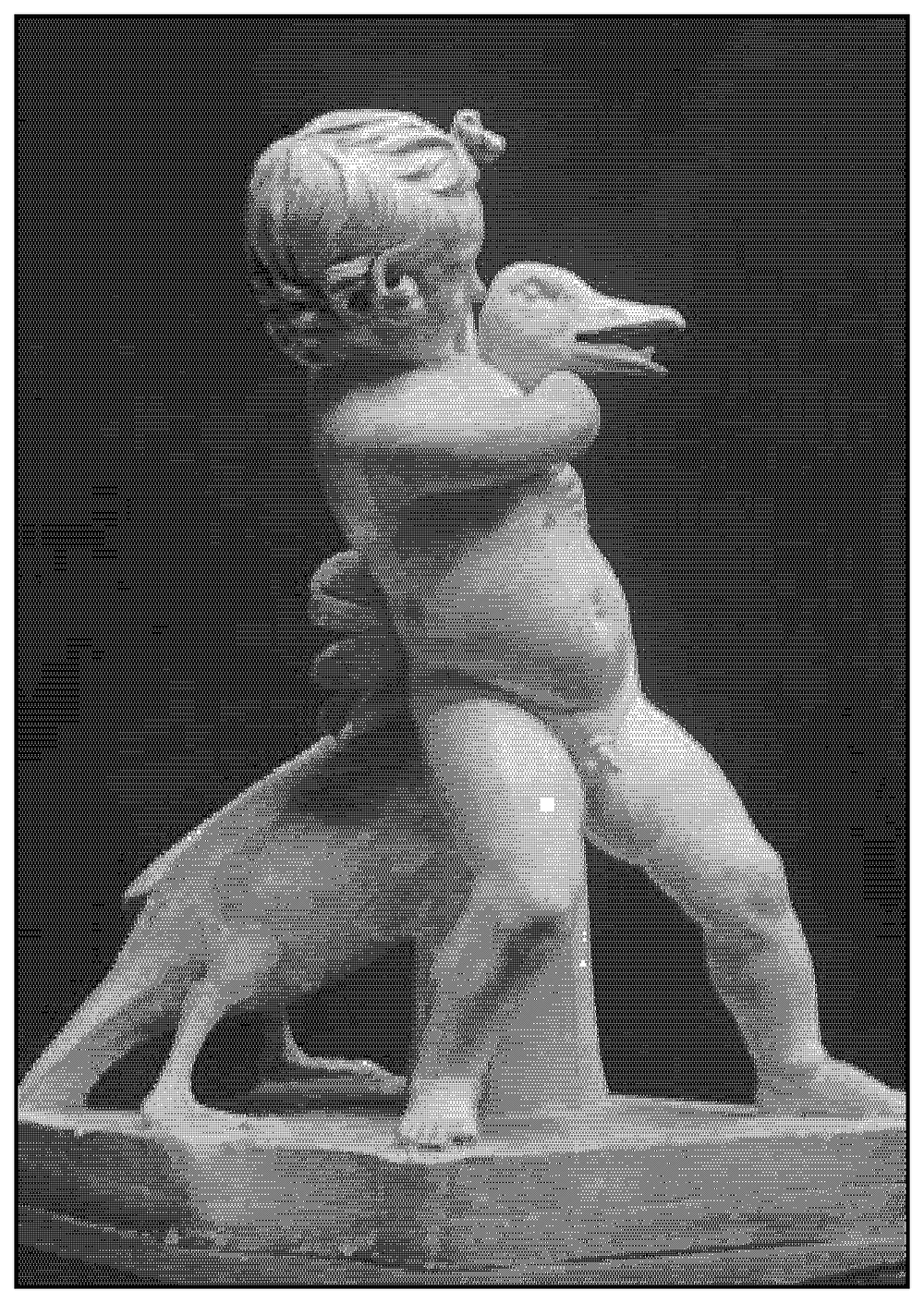
February 1944
Tuesday, 1 February 1944
At Uzkoye I fattened up, went skiing, thought a little about the representations of groups, planned the book on probability theory [Editor’s note:] See the Note to the entry of 19 October 1943. and wrote twenty pages of introductory chatter.
⇓
The reckonings on systematic work and on beginning the analysis-course studies are not fulfilled.
Pusya, for his part, counted the days (mod 3) of telephone conversations more and more.
By the concept of humanism we are accustomed to designate, above all, that mighty movement which, at the close of the Middle Ages, embraced first Italy and then the whole of Europe, and whose watchword was man — the free human personality.
Thus the fundamental and original mark of humanism is individualism.
— A. Blok, “The Collapse of Humanism” [Translator’s note:] The epigraph is Blok’s own Russian prose, which A. N. copies out (continuing the humanism/individualism thread of the 13 January reading of Alpatov); it is translated into the body, not retained as object-language. His emphasis is kept — гуманизма and человек stand letter-spaced in the print, индивидуализм underlined.
⟨The past days⟩
Reading at Uzkoye:
The three of us:
- Blok — Translations from Goethe and Avetik Isahakyan. [Translator’s note:] Avetik Isahakyan (1875–1957) — the Armenian poet, some of whose verse Blok translated. Not in the 2003 index.
- Turgenev — “Pyotr Petrovich Karataev”.
- Turgenev — “A Month in the Country”.
- Ognev — “The Diary of Kostya Ryabtsev”. [Translator’s note:] N. Ognev — the pen-name of M. G. Rozanov, author of the schoolboy diary-novel “The Diary of Kostya Ryabtsev” (1927). Not in the 2003 index.
- Blok — “The Last Days of Imperial Power”.
- Blok — “Bertrand’s Notes”.
- Blok — Verses from “The Grey Morning”.
- Hoffmann — “Mademoiselle de Scudéry”.
With Pusya:
- Goethe — “Roman Elegies”.
- Anacreon — in Mey’s translation.
- Blok — “Notes of a Pagan”.
Myself:
- Tchaikovsky — Diaries.
- Tchaikovsky — Correspondence with his family.
- Blok — “The Collapse of Humanism”.
- Blok — “On the Poet’s Calling”.
- Grabar — “My Life”.
Anya:
- Turgenev — “Smoke”, “Virgin Soil”, “Rudin”.
- Grabar — “Repin”.
- Evdokimov — “Surikov”.
- Grabar and Glagol — “Levitan”. [Translator’s note:] Glagol — Sergei Glagol, the pen-name of the art critic S. S. Goloushev, co-author with Grabar of a book on Levitan. Not in the 2003 index.
And a further looking-through of various books (“Memoirs” by Witte, books on Velázquez, Rokotov, Levitsky, and the like).
Friday, 28 ⟨January⟩. Returned from Uzkoye. We arrived at 3 o’clock.
Saturday, 29 ⟨January⟩.
The Akademsnab shop.
The Higher Attestation Commission (a long one: Mme Krachkovskaya, the world-famous Shakespearean Matveev, the polluted air in Kuibyshev, Roman satires, and so on and so forth).
Oleg. (Twos, fours, fives; goes to bed at 12; is sad at his studies; has grown thinner; is fine.)
With Pusya we came to Komarovka in the evening.
Borya was at our place (I went to fetch him).
By our book [Editor’s note:] See the Note to the entry of 19 October 1943. “Our book” — the probability-theory textbook with B. V. Gnedenko. I am dissatisfied with him: in the proof of the integral Laplace theorem the extreme fractional intervals are fudged [uzhuleny], the examples are worked out for , which is not typical; to get beyond the Moscow themes is hard for him. «Ужулены» — a colloquial, slangy form (roughly “fudged, finagled, dodged”), kept verbatim as he wrote it rather than normalised.
A conversation about what “we” is.
Yura — conversations about “The Sergeant-Major”, “Tonio Kröger” and “The Calling of the Poet”.
Sunday, 30 ⟨January⟩. Morning coffee and a “conference about everything” with Pusya. Pusya’s “Roman Elegies” ⟨Goethe⟩.
Hopes of a final success with the representations of groups.
Finally: a proof of the existence of the irreducible representations by a direct method.
And yet — the possibility of unpleasantnesses with non-measurability.
In the evening (after Pusya and Varvara Sergeevna returned from the Klyazma) I received Pusya “at my place”, on a base of “Akstafa”, until 1.40 in the morning. “Akstafa” — a well-known Azerbaijani dessert wine; “on a base of Akstafa” is his own drollery for the terms on which he entertained Pusya.
Monday, 31 ⟨January⟩.
The example with
(J. von Neumann and E. P. Wigner, Annals of Math. 41 (1940), pp. 746–750). [Translator’s note:] The affine “” group of the line — J. von Neumann is here the mathematician of these folios (with E. P. Wigner), to be kept apart from M. A. Naimark and from L. S. Neiman elsewhere in the diary.
The three of us ran fast on skis to the hills, and all around.
I broke in the old long skis.
The remaining odd ones — one of Yura’s and one of Pusya’s (the others are broken) — formed a new pair.
Tuesday, 1 ⟨February⟩, morning. Pusya came round with talk of Yura’s Tamara [Editor’s note:] Yura’s Tamara — Yu. M. Smirnov’s future wife, Tamara Natanovna. and so on.
From the representations of arbitrary groups, the last example and so on, it is time to return to the commutative case, to dynamical systems and random functions (“nonlinear spectral analysis”). [Translator’s note:] «Нелинейный спектральный анализ» — his own scare-quoted, in-progress programme (it recurs on folio 165); rendered literally in his quotes, a working direction rather than a settled object.
Now, probably, something will open up there.
After the talk (tomorrow) it is time to write a memoir, with the unsolved problems at the end and, perhaps, almost entirely without positive-definite functions.
Further, toward the elements of functional analysis. [In the left margin, written vertically:] «Нет у Плеснера. А вообще?» — “Not in Plessner. But in general?” A rotated margin note beside this passage; the reference is to A. I. Plessner’s survey “Spectral theory of linear operators” (Uspekhi mat. nauk, 1941), cross-referred at the entry of 6 December 1943.
In Hilbert space the boundedness of an operator is equivalent not only to
- , if ,
but also to
- , if .
It suffices to prove
, if . Throughout, is weak sequential convergence and is strong (norm) convergence.
If , then from 1).
If , then from it one can select an almost-orthogonal subsequence. If , then there exists a finite-dimensional with , i.e. for some subsequence . But for some subsequence the have almost the same direction.
Let us form with , .
And so on...
The group of unitary operators with (when for all ) is complete in the sense of the “two-sided” Cauchy condition. With the “one-sided” one, however, isometric non-unitary operators stick to it.
Sunday, 6 February 1944
For further work, to take as a starting point the paper of Ya. S. Dubnov and V. K. Ivanov (!) “On the lowering of the degree of affinor polynomials” (DAN, XLI, no. 3 (1943), 99–102). [Translator’s note:] V. K. Ivanov — pinned to V. K. Ivanov (Valentin Konstantinovich) by the Doklady citation, not to be conflated with the many other Ivanovs. «Аффинорные полиномы» (“affinor polynomials”) is their term, rendered literally; it feeds the affine-rigidity thread of folio 115 (December) that surfaces again on folio 167 below.
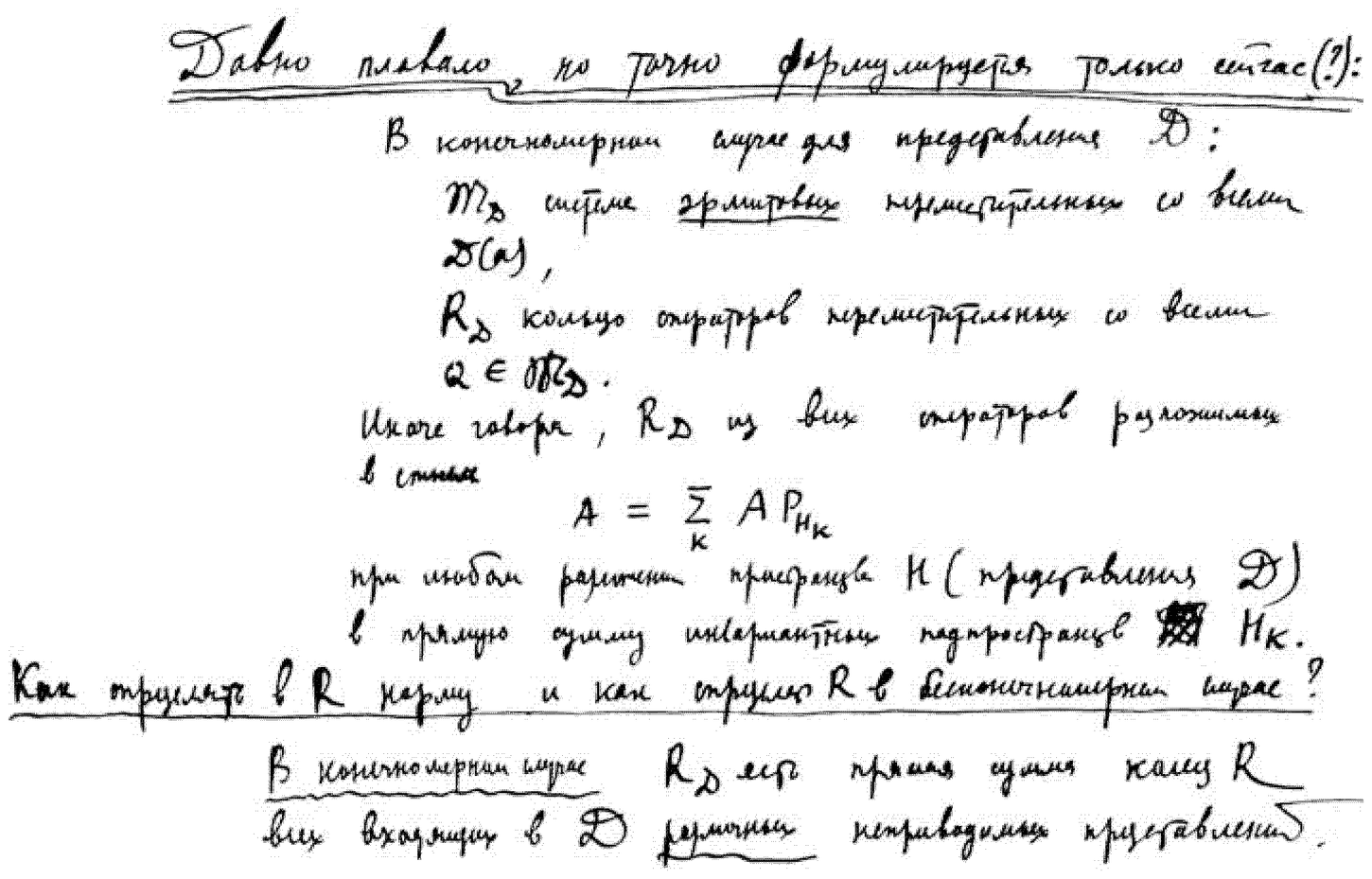
Monday, 7 February 1944
Yesterday (Sunday) — I discovered an error in the considerations reported to the Mathematical Society on the non-uniqueness of the decomposition into reducible ones.
( All of it with ! )
Wednesday, 2 ⟨February⟩.
Morning — preparation for the Mathematical Society.
Before the Society I called on Borya.
The talk on representations at the Mathematical Society went off animatedly (Pontryagin, Gelfand). Gelfand’s example, contradicting he himself knows not what:
A Clifford-type anticommutation relation: the anticommute up to the central involution .
Thursday, 3 ⟨February⟩.
9–11 — the university (by the newly-instituted order). Only Yaglom was there. I went to the savings-bank.
12–4 — the expert commission of the Stalin Committee.
6 — Borya with the probability-theory book.
Endless telephone conversations.
Friday, 4 ⟨February⟩. The Mathematical Institute.
The Chebyshev commission — a reading of the draft contract with the publishing house, drawn up by A. N. Krylov. [Editor’s note:] The contract with the publishing house — most likely for the edition of the Selected Works of P. L. Chebyshev.
With Vinogradov at Pontryagin’s.
A telephone conversation with Ioffe — news of Sobolev’s resignation.
Ventsel (the wife) — her works, praise of mine, indications of the errors in the latter. [Translator’s note:] Ventsel “(the wife)” — E. S. Ventsel (Elena Sergeevna, later the writer I. Grekova); the parenthesis marks her as the wife of D. A. Ventsel. Held apart from the “Ventsel” of the university on 10 February (folio 167), who is probably her husband D. A. Ventsel; the 2003 index carries only E. S. Ventsel.
A concert by Flazh — Schumann’s “Dichterliebe”, Mussorgsky. [Translator’s note:] «Любовь поэта» is Schumann’s song-cycle Dichterliebe. Flazh — the concert-giver; the spelling and identity are not established (not in the 2003 index).
Anxiety over Pusya‘s disappearance.
Departure for Komarovka (11 o’clock).
Saturday, 5 ⟨February⟩. Tired; I sleep badly. I did nothing worthwhile.
I read A. N. Krylov’s article on Chebyshev — in it all manner of muddle.
A thaw. Anya arrived in the evening.
Pusya at the Klyazma. Heine, Goethe — Yura (a reading with V.S. and Anya). [Translator’s note:] The last four lines stand in the print as two short columns (life on the left, reading on the right); they are set here one after another.
Sunday, 6 ⟨February⟩. I worked badly and little — I only found an error in the analysis of the representations.
Conversations with Marina and Anya about milk, with Pusya about the geese and hens.
Pusya and Yura settled down to the Phaedrus, Varvara Sergeevna is at her studies, and Anya and I read Leskov’s “The Man on Sentry-Duty”. [Translator’s note:] «Федра» here (accusative of Федр) is Plato’s dialogue the Phaedrus, not Racine’s Phèdre.
Then I tried to work a little more.
Dull.
Monday, 7 ⟨February⟩. We drank coffee apart (because of V.S.'s packing for her own sanatorium?) — Anya and I in our room.
I busied myself with the groups to no purpose.
We went on skis (−10°, sun) over the crust to the Baibaks and Obraztsovo.
Pancakes (without Anya).
We read a little Fet.
Any group is the group of all automorphisms of an “abstract algebra” — G. Birkhoff.
“Zentralblatt”, 13, p. 1; “Proc. Cambr. Philos. Soc.” 31, 433–454 (1935); ibid. 7, p. 395; 29, 441–464 (1933). [Translator’s note:] The direct continuation of the “theory of invariants” / thread of 5 January (folio 150) — the question whether every group is the automorphism group of some system — now attributed to G. Birkhoff. The ditto-marks in the print stand for the repeated journal titles.
Pontryagin’s question, apparently, is whether any locally compact group with the second axiom of countability will admit a locally complete system of finite-dimensional representations.
For Lie groups this is, as is known, so!
For discrete groups — likewise?[Editor’s note:] The talk to the Mathematical Society — see the Note to the entry of 1 February 1944.
Tuesday, 8 February 1944[Editor’s note:] ⟨On this day Andrei Nikolaevich sets down many of the events of his life and mathematical creativity of several preceding years that are memorable to him; to some of them we give brief explanations. A. N.'s mathematical works may be traced through the Bibliography of the first book — the “addresses”, where possible, we indicate in angle brackets.⟩
G.P.D. [Translator’s note:] «Г.П.Д.» [G.P.D.] = «Гусье-Песий Дом», the Goose-and-Dog House — his household’s private name for the Komarovka house (decoded by the editors’ note below). A companion to the Kholmogory Goose [Kh.G.]: the goose is himself, the dog the household’s other totem. The initials are kept as he abbreviates them. In the chronology that follows, the «||» glyphs mark his own past papers, and the ⟨[Б_I–NN]⟩ are the editors’ bibliography “addresses” in the first book of this edition.
1935. Summer 1935. The building-work. Living at the Bolshevo sanatorium. Preparation for the topological conference. [Editor’s note:] The building-work / Г.П.Д. — the house at Komarovka (Г.П.Д. — “the Goose-and-Dog House”) was bought in 1935; by “the building-work” A. N. means the renovation and certain innovations (a shower), during which he and P. S. lived nearby, at the Bolshevo sanatorium of the KSU. September. The topological conference. [Editor’s note:] The topological conference — the First International one; see it in detail in the letters of Kolmogorov and Alexandrov (Book 2, pp. 590–593). October. Gaspra. Hopf. Pusya is ill. November–December. The fitting-out. The Cat. [Editor’s note:] The Cat, Sharik — the first domestic animals at the Komarovka house (geese were also kept from the very start). All the cats that lived at Komarovka over the years were always called simply “Kot”, and all the dogs “Sharik”. The shower (19 December). The finishing of Alexandroff–Hopf (19 November). [Editor’s note:] The finishing of Alexandroff–Hopf — the book of P. S. Alexandrov and H. Hopf, “Topologie I”. This book is often mentioned in the Alexandrov–Kolmogorov correspondence published in the second book of our edition. To complete the work H. Hopf came to Russia at that time and, together with A. N. and P. S., stayed at the sanatorium at Gaspra (the Crimea). The book appeared that same year, 1935.
1936. New Year. Leningrad — the “Astoria”. February. General work on open mappings ⟨[Б_I–66]⟩ || My notes on the Betti groups. The homology ring. ⟨[Б_I–66, Б_I–62, Б_I–63, Б_I–64]⟩. A sunny skiing spring. Ice-cream. Bathing on the 12th of April (Borya’s photographs). The change from skis (on the 12th) to the kayak (on the 13th). || Markov chains with a countable number of states ⟨[Б_I–57, Б_I–68]⟩ July 1936. The little horse in the picture-book. Preparations for Oslo. [Editor’s note:] Preparations for Oslo — for the regular International Mathematical Congress of 1936. Autumn. The endless Bati-Liman.
(Turbulence)
But what mathematics, then, was I occupied with that winter? I wrote about Markov chains. I thought up the work on crystallisation.
1937. 18–26 January. Valdai–Seliger. (Turbulence) Crystallisation ⟨[Б_I–70]⟩. Spring. Borya’s dissertation. A walk. Summer. Seliger. The algebra textbook. The Caucasus. Pusya does not go to Bati-Liman. Autumn. Algebra. Sharik (born 11 Oct.).
1938. Algebra — the going-round of the People’s Commissariats of Education. Kiselev at Komarovka. [Editor’s note:] “Algebra” — the writing, jointly with P. S. Alexandrov, of the “Algebra” textbook for the secondary school, which appeared (after the going-round of the People’s Commissariats of Education) in 1939. It was apparently in connection with this that A. P. Kiselev (1852–1940), author of the well-known school algebra textbook, came to Komarovka. Spring. Borya at Komarovka. Photography. [Editor’s note:] Borya — B. V. Gnedenko. Summer. Ufimka–Belaya–Kama–Volga. [Editor’s note:] Ufimka–Belaya–Kama–Volga — the route of a boat journey with P. S. Alexandrov, A. I. Maltsev and S. M. Nikolsky (to which the drawings of folio 163 belong).
![A full-page plate, rotated ninety degrees in the source: a two-by-two grid of four pencil scenes from the 1938 boat journey, each captioned in his own hand — «на Каме» (on the Kama), «на Волге (Мы перед Ундорами)» (on the Volga — “Us before Undory [?]”), «По реке Уфимке» (along the river Ufimka), «на реке Белой» (on the river Belaya). (The Volga place-name is a faint pencil scrawl ending «-ами»; it reads best as «Ундорами» — Undory, the village of Jurassic cliffs on the Volga near Ulyanovsk — rather than «Угличем»/Uglich or «Жигулями»/the Zhiguli, and is kept as a doubtful reading.) Editorial caption, set vertically: «Из “художественных дневников” Андрея Николаевича» (“From Andrei Nikolaevich’s ‘artistic diaries’”).](/images/translations/kolmogorov/figures/fig-folio163.png)
Autumn and winter. The pre-election commission at the Academy of Sciences. || Inequalities between derivatives ⟨[Б_I–77]⟩ || Stationary processes (Turbulence)
1939. New Year — Leningrad. || The solution of the problem on the spectra of extrapolable processes ⟨[Б_I–80]⟩
29 January — the election to the Academy [Editor’s note:] The election to the Academy, the activity — on 29 January 1939 Kolmogorov was elected a full member (academician) of the USSR Academy of Sciences and at once a member of the Presidium of the Academy and academician-secretary of the Division of Physical and Mathematical Sciences. (He held this post until 1942.)
Spring — activity at the Academy of Sciences. — a journey to the Crimea (alone). Summer — a journey on the “Kostroma Duck”. August — work. September — Bati-Liman. (Anya) [Editor’s note:] Anya — Anna Dmitrievna came to Komarovka then for the first time. Borya’s marriage. Autumn — Wiener spirals, etc. ⟨[Б_I–81, Б_I–82]⟩ — [in the facing column:] Attempts with dynamical systems. [Translator’s note:] From here the chronology runs in two columns: the left records the life and the finished papers (the «||» works), the right his in-progress mathematical programme — the turn toward dynamical systems and “nonlinear spectral analysis”.
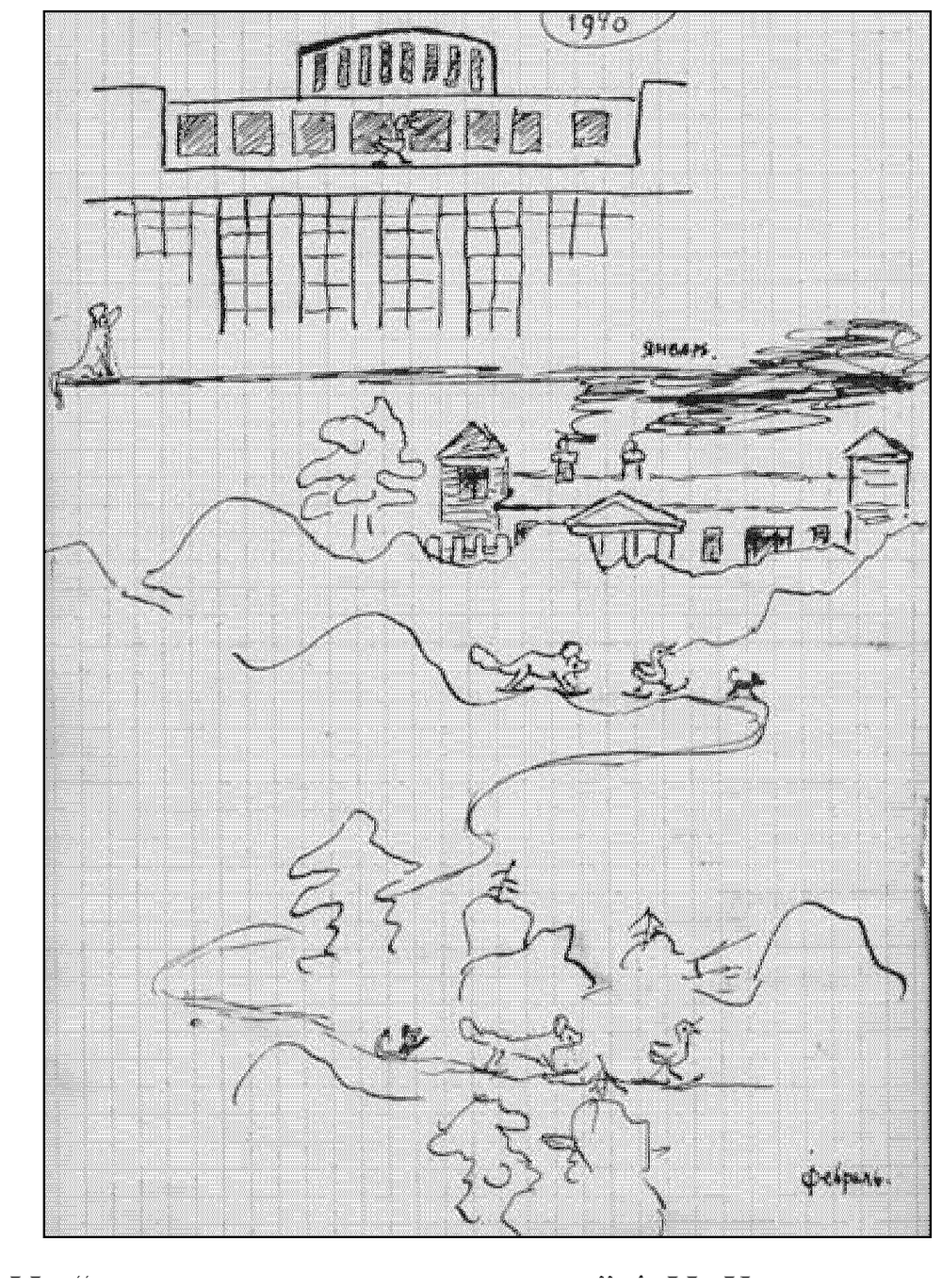
1940. Recovery. Kislovodsk. A holiday at Komarovka. August — Bati-Liman.
Autumn. The writing of stationary sequences (turbulence) ⟨[Б_I–84, Б_I–85, Б_I–87]⟩. Various trifles. || Local isotropy — [in the facing column:] Persistent study of the spectra of stationary processes and of dynamical systems. Designs of “nonlinear spectral analysis”.
1941. January. Tbilisi, Bakuriani, Abastumani. Spring. Local isotropy (Obukhov).
War
And with science, though things are poor, it is not so hopeless as I sometimes think! As soon as there is a little freedom, then something does get done.
So let us not lose any more time!
Only more organisation:
Concentration of effort on the great problems, but also no sitting over them in contemplation to the point of stupefaction.
Wednesday, 9 February 1944
Yesterday — a day given over to senseless yearning, to reminiscences (see above), to the reading of “The Fate of Blok” and the correspondence of Blok with A. Bely.
However, something is beginning to hatch out with the representations.
That is, there are hopes of arranging it so that the only “truly indecomposable” representations (, rational) turn out to be [Translator’s note:] «Истинно неразложимые» (“truly indecomposable”) — his own scare-quoted qualifier on the sought irreducible representations; kept in his quotes, a working notion.
-
the one-dimensional , where the are the characters of the multiplicative group of the rational ;
-
the infinite-dimensional , where the are the coordinates of the vector, numbered by the rational , and the are the characters of the additive group of the rational ,
That is, the dependence is not on the whole group , but on its factor-group by .
The inner world of Blok.
Despite the floridness of the expressions, the stable realities of this world were:
-
“gold”...(?) (“The Golden Countenance”, “The Gold of the Curls”);
-
“the lilac dusk” (later, the lilac storm-clouds of the revolution);
-
“The Spirit of music”;
-
The dream of the “Man-Artist”.
“For war — is, before all, gay” (“The Fate of Blok”, p. 203).
Events of life of which no one in the world knows. (Letter to A. Bely, 15–17 Aug. 1907).
The acrobat-girl, 1911. (“The Fate of Blok”, 159, 161 ⟨Diaries of A. Blok. 17 October and 10 November 1911⟩).
The “reality” of the mystical. A letter about relatives. (“The Fate of Blok”, 144 ⟨Letter to his mother. 1 October 1906⟩).[Editor’s note:] “The Fate of Blok” — the book by O. Nemerovskaya and Ts. Volpe. — L., 1930. [Editor’s note:] “Alexander Blok and Andrei Bely. Correspondence” — M., 1940.
Monday, 14 February 1944
![A full-page facsimile of two small hand-drawn mathematical figures, headed «Сегодня два маленьких открытия:» (“Today, two small discoveries:”). (1) «Многогранник с сеткой» (“A polyhedron with a net”) — a polyhedron with an internal dashed net, vertices a,b,c,da, b, c, da,b,c,d, and the criterion: affinely rigid if a,b,c,da, b, c, da,b,c,d do not lie in one plane, and affinely non-rigid if a,b,c,da, b, c, da,b,c,d lie in one plane. (2) «Кристаллизация шпилём (пробегает задача Леммлейна)» (“Crystallisation by a spire (the Lemmlein problem runs through it)”) — a triangle with apex BBB and base at AAA, with growth-arrows, and a two-clause argument: (a) “Either the one leaning to the right (ABABAB) [a struck word, illegible] can be stopped only by a spire beginning at the point AAA, going steeper than ABABAB and steeper than all the intermediate ones”; (b) “Of those satisfying condition (a), in reality ABABAB will be faceted [огранит] by the one which, under free growth, would have faceted ABABAB earlier than the others.” Several words of clauses (a) and (b) do not resolve under his rapid hand.](/images/translations/kolmogorov/figures/fig-folio167.png)
Wednesday, 9 ⟨February⟩, evening. At Davydova’s concert (Glinka, Dargomyzhsky) with Anya, Pusya, Yura.
Good. Anya likes it too.
Thursday, 10 ⟨February⟩. 9–11 — the university — Ventsel. Yaglom. Timan.
12 — the Stalin Committee.
Oleg does not wish me to come in the evening (he and Seryozha are reading).
“The Nutcracker” (150 rubles for two tickets!)
Friday, 11 ⟨February⟩.
The Stalin Committee — the last session of the expert commission.
The Expert Commission (Chetverukhin):
- I. Lavrentiev, Landau.
- II. Vavilov (Cherenkov), Petrzhak–Flerov, Petrovsky. [Translator’s note:] Petrzhak — K. A. Petrzhak, the physicist of the Petrzhak–Flerov discovery of the spontaneous fission of uranium; “Cherenkov” names S. I. Vavilov’s group. Not in the 2003 index.
Long-standing (mathem.):
- I. Stepanov, Krylov.
- II. Sintsov, Romanovsky.
In the evening I read to Vera Yakovlevna and Anya from Mordovtsev’s “Remarkable Women”, about the “cavalry-maiden” Durova. Very well written. [Translator’s note:] D. L. Mordovtsev — the historical novelist (“Remarkable [Russian] Women”); the “cavalry-maiden” is Nadezhda Durova (1783–1866), who served in the cavalry disguised as a man and left memoirs of it. Both recur from 10 January (folio 152); neither is in the 2003 index.
Saturday, 12 ⟨February⟩. A session of the Physics-Technical Society [Editor’s note:] ФТО — the Physics-Technical Society. with reports by Kibel and Obukhov. My own speeches. Fedorov. Shuleikin. The Higher Attestation Commission. Chetverukhin — the end. [Editor’s note:] ⟨What is meant is that the session of the expert commission of the Committee for Stalin Prizes, which was chaired by N. F. Chetverukhin, was the last.⟩
To Komarovka with Anya by the 20.38 train (the cuckoo).
Sunday, 13 ⟨February⟩.
Letters: to Nadya, S. N. Nyberg, Oleg, Bobrov, Lyapunov, Grabar (about Komyagino). [Translator’s note:] The initials read «С.Н.» in the print — S. N. Nyberg (Sofia Nikolaevna, 1874–1964), the Orientalist and Latin teacher, mother of N. D. (“Kolya”) Nyberg; the two are distinct people. Komyagino is a place — the village and its Kosma-and-Damian church, a Grabar restoration subject (again on 18 February), not a person.
Report for 1943, at the Academy of Sciences
Dynamical systems:
from the with integrable square.
from , where .
from all the commuting with , corresponding to some function that maps the space isometrically onto . The last letter of the clause reads as in the print (possibly ); flagged for the print.
The shift operator .
from all the , .
? Beautiful, but whether it is productive for dynamical systems is not clear.
I read to Anya and Pusya “Nevsky Prospect” and Yura’s verses.
Saturday, 19 February 1944
Das Schenke (schläfrig)
So hab’ ich endlich von dir erharrt: In allen Elementen Gottes Gegenwart. Wie du mir das so lieblich giebst! Am lieblichsten aber dass du liebst.
— Goethe
The Cupbearer (drowsy). — So at last I have waited out from you: in all the elements, God’s presence. How lovingly you give me that! but most lovingly of all — that you love.Goethes Werke: I, 6 (1888), S. 223. From the “Schenkenbuch” of the West-östlicher Divan. The 2003 edition’s Russian verse gloss is dropped.
If only it were so! «Если бы так!» — his own interjection (Russian) after the poem, kept in the body.
Hatem
Der schläft recht süss und hat ein Recht zu schlafen Du guter Knabe hast mir eingeschenkt, Vom Freud und Lehrer, ohne Zwang und Strafen, So jung vernommen wie der Alte denkt. Nun aber kommt Gesundheit holder Fülle Dir in die Glieder dass du dich erneust. Ich trinke noch, bin aber stille, stille Damit du mich erwachend nicht erfreust.
— Goethe
Hatem. — He sleeps right sweetly and has a right to sleep. You good boy, you have poured for me; from joy and from your teacher, without constraint or punishment, so young you have taken in how the old man thinks. But now health’s fair fullness comes into your limbs, that you renew yourself. I drink on still, but silent, silent — so that your waking may not gladden me.Goethes Werke: I, 6 (1888), S. 223.[Translator’s note:] The Schenke/Hatem exchange is the Divan‘s tender cupbearer register — the older poet (Hatem) and the «guter Knabe» / «geliebter Knabe», the “good boy” / “beloved boy” (like the Roman Elegies of folio 143). The German stands, with a faithful crib; nothing is softened.
Tuesday, 15 ⟨February⟩. The Academy of Sciences — V. V. Golubev on Chaplygin. Alexandrov on rigid bodies (dull and viscous).
In the evening Oleg at our place.
Nesterov. Tolstoy’s “Circle of Reading” (?). The clowning, with its ingratiations [zaiskami], persists. «Заисками» is an odd form (roughly “with fawnings, ingratiations”); read as printed and flagged for the print.
Stupid explanations in the entrance-hall at the end.
Wednesday, 16 ⟨February⟩. In the morning at the institute and the presidium — to no purpose. 1 o’clock — reports by Grabar and Lazarev.
Anya for the first time took in the beauty of icon-painting.
In the evening — the reporting session of the Division.
Thursday, 17 ⟨February⟩. A trip to Komarovka for a suit.
“Cocktails” at the English ambassador’s.
The Academy of Sciences.
Friday, 18 ⟨February⟩. To Komarovka by the 10.44 train.
Komyagino.
Dante’s “Vita Nova”.
Saturday, 19 ⟨February⟩. Morning — the sorting-out of the Wusüstlicher Divan ⟨a cluttered couch — German⟩. [Translator’s note:] He mangles Goethe’s West-östlicher Divan into Wusüstlicher Divan, punning on Divan — both the poem-collection and a couch — with an overtone of wüst (waste, cluttered): “sorting out the cluttered couch”. The 2003 bracket ⟨захламленный диван — нем.⟩ is the editors glossing his coinage; his German is kept verbatim.
Saki
Sag’ mir nur warum die Jugend, Noch von keinem Fehler frei, So ermangelnd jeder Tugend, Klüger als das Alter sei? Alles weisst du, was der Himmel, Alles was die Erde trägt, Und verbirgst nicht das Gewimmel, Wie sich’s dir im Busen regt.
— Goethe
Saki. — Tell me only, why should youth — not yet free of any fault, so lacking in every virtue — be wiser than age? All that heaven, all that the earth bears, you know; and you do not hide the swarming of how it stirs in your breast.Goethes Werke: I, 6 (1888), S. 218.
Hatem
Eben drum, geliebter Knabe, Bleibe jung und bleibe klug; Dichten zwar ist Himmelsgabe, Doch im Erdeleben Trug. Erst sich im Geheimniss wiegen, Dann verplaudern früh und spat! Dichter ist umsonst verschwiegen Dichten selbst ist schon Verrath!
— Goethe
Hatem. — For that very reason, beloved boy, stay young and stay wise; to make poetry is indeed a gift of heaven, yet in earthly life a deception. First to cradle oneself in mystery, then to chatter it away early and late! In vain does the poet keep silence — to make poetry is itself already betrayal!Goethes Werke: I, 6 (1888), S. 218.
Auch in der Ferne dir so nah! Und unerwartet kommt die Qual. Da hör’ ich wieder dich einmal, Auf einmal bist du wieder da!
— Goethe
Even in the distance, so near to you! And unexpectedly the torment comes. There I hear you once again — all at once you are there again!Goethes Werke: I, 6 (1888), S. 172.
If on the real line ( — the Lebesgue measure), then, up to sets of measure zero, the mapping
can be realised by means of a measurable function of the form
If , then this is impossible.
An analogous situation for with the “logarithmic” measure.
? Hence representations containing neither mutually-prime ones nor ones equivalent to the whole. The measure structure is tied here back to the rational- representations of 9 February (folio 166): the rational shifts and dilations are the additive and multiplicative pieces of the group.
March 1944
Saturday, 11 March 1944
21–24 February ?
Friday, 25 February — Tuesday, 7 March. Uzkoye
In twenty days I ran out on skis in the sun five times (Tsaritsyno, along the river Bitsa, and so on). With acceptance sampling and analysis I busied myself only by way of preliminary reflections. [Translator’s note:] «Браковка» — acceptance sampling (the wartime lot-inspection work), the settled term; not “rejection sampling”. This second Uzkoye stay is narrated retrospectively here, in the 11-March entry; his «21–24 февраля ?» is his own question-mark over four unaccounted days, not a lost leaf. Bogolyubov was also at Uzkoye (see below).
I read Khinchin’s “Statistical Mechanics”. [Editor’s note:] ⟨A. Ya. Khinchin. Mathematical Foundations of Statistical Mechanics. — M.–L.: Gostekhizdat, 1943; 126 pp.⟩
I thought up: 1) Under the condition of reversibility ; for . [Translator’s note:] The March mathematics is a new thread — reversibility [obratimost’] and irreversibility [neobratimost’] of dynamical systems and random processes, and the statistical second law («неубывание энтропии», the non-decrease of entropy) — tied to the Khinchin reading just above. It runs across folios 171, 173 and 179 (typeset) and folio 180 (a handwritten open problem). His notation is kept as he set it.
If, as ,
then, evidently,
2) a) Conjugacy in dynamical systems with an integrable invariant:
b) In the mapping into a Markov chain with one obtains a Markov chain with the condition of reversibility (?).
c) The passage from a dynamical system with an integrable invariant into an irreversible dynamical system.
This seems good, though it still requires the working-out of concrete problems!
Bogolyubov (who was at Uzkoye) liked it.
We read: [Author’s note:] Aloud to Pusya. — The asterisk on each title below marks those read aloud to P. S. Alexandrov.
-
Goethe — “Italian Journey”
-
Xenophon — The Socratic Writings
-
Tieck — “The Rune Mountain”*, “The Love-Charm”*, “A Poet’s Life”*, “Life Overflows”
-
Kleist — “Marica” [?], “The Duel”* «Марица» does not resolve to a certain Kleist title (read as printed; “Поединок” = Der Zweikampf, “The Duel”); flagged for the print.
-
E. T. A. Hoffmann — “Die Abenteuer der Sylvestervacht”*
-
Ferdowsi — Selected passages from the Shah Nameh* [Editor’s note:] ⟨Lozinsky (the translator).⟩ — M. L. Lozinsky, translator of Ferdowsi.
-
Verses of Lenau, Eichendorff, Tieck and others, from a German anthology* (“Deutsche Lyrik seit Goethes Tode”; “Ausgewählt vom Max. Bern”). [Translator’s note:] The German-script titles stand as he wrote them (per the object-language rule); the 2003 edition’s parenthetical Russian glosses ⟨Немецкая лирика после Гёте⟩ and ⟨Избранное⟩ are dropped as reader-service. Lenau and Eichendorff — the Austrian and German Romantic poets; neither is in the 2003 index.
On Saturday, 26 February, we went with O. Yu. to Bruevich’s. O. Yu. on the Institute of Geophysics and on his own cosmogonical work. O. Yu. at our place. [Editor’s note:] O. Yu. — Otto Yulievich Schmidt.
From 9 p.m. on the 28th of February until 3 p.m. on the 29th — a “psychological session” with Pusya. «Психологическая сессия», in his own scare quotes — of a piece with the “psychological investigations” [psikhologicheskie issledovaniia] and “psychological conversations” with Alexandrov that run through the diary; his register, kept.
In the evening ⟨29 February⟩ — Rimsky-Korsakov’s “Mozart and Salieri” (the Stanislavsky and Nemirovich-Danchenko Theatre).
Spernere mundum Spernere neminem Spernere te ipsum Spernere te sperni
Despise the world; despise no one; despise yourself; despise being despised.[Translator’s note:] A medieval monastic maxim, kept in the Latin as he stepped it out (four lines, not run together) with our crib beneath; the 2003 edition’s Russian gloss is dropped.
In my absence Anya laid on pancakes at Polina Alexandrovna’s and at her own place for Margarita Mikhailovna and Varvara Sergeevna, and had various unpleantnesses besides. [Translator’s note:] Polina Alexandrovna — P. A. Ivasheva-Musatova (Oleg’s paternal grandmother); Margarita Mikhailovna — M. M. Egorova, A. D. Kolmogorova’s mother; Varvara Sergeevna — V. S. Alexandrova, P. S. Alexandrov’s sister.
I rushed about on skis in every direction until 1.30 (departure at 2). In the evening at Borya’s and at Dimetrusya‘s. [Translator’s note:] Borya — B. V. Gnedenko; Dimetrusya — the geneticist D. D. Romashov.
Tuesday, 7 ⟨March⟩. Sun, a firm crust.
Morning with Anya. With Pusya and Anya we read Gogol’s “Nevsky Prospect”. Polina Alexandrovna’s Cahors.
Wednesday, 8 ⟨March⟩. Explanations with Anya (Pusya is an “egoist”, in her opinion, and so on).
The Academy of Sciences. My seminar (N. V. Smirnov on the statistical criterion of symmetry). Krein. [Translator’s note:] N. V. Smirnov — the statistician N. V. Smirnov, held apart from Yu. M. Smirnov (“Yura”, the poet, below) and from V. I. Smirnov the analyst; his paper on the symmetry criterion is cited in the editor’s note at the foot of folio 174. “Krein” here is most probably M. G. Krein (Mark Grigorievich), to be kept apart from his brother S. G. Krein.
Oleg at dinner. In the evening — a Schumann concert.
But in actual fact: first a Mozart quartet; then Schumann: five duets for cello and piano, a Spanish Intermezzo, a Venetian Barcarolle, No. 3 from “Dichterliebe” (G. Tietz). «Любовь поэта» is Schumann’s song-cycle Dichterliebe; G. Tietz — the singer, not in the 2003 index.
Thursday, 9 ⟨March⟩. The university (in the renovated premises).
The bureau of the Division. Krein. The Institute. The removal of Bermant. The appointment of Lavrentiev.
In the evening at Vyacheslav Vasilievich’s ⟨Stepanov’s⟩. [Translator’s note:] Vyacheslav Vasilievich — V. V. Stepanov, head of the Moscow University chair of differential equations.
Friday, 10 ⟨March⟩. 8.30. Stechkin.
The military commissariat. 11–17 — the Institute of Geophysics. To Komarovka only by the 21.16 train. In three days I grew terribly tired.
Tuesday, 14 March 1944
Alone I rested (from what?) and idled. Letters to Gleb and Nadya. [Translator’s note:] Gleb — G. A. Seliverstov, his gymnasium friend then at the front (killed in 1944); Nadya — N. Ya. Kolmogorova, his aunt.
In the mapping of dynamical systems and random processes: let there be, in the limit, determinism . The case of such that, as , from we almost always fall into , and into almost always from . So it is, it seems, usually for good regions, in the statistical grounding of thermodynamics and the like?
Темнеют волны, ветер рвет. Как над пучиной, вздулось море! И в грозовом, немом просторе Оно и пухнет и растет. Вот мачта гнется, трос звенит. И хлещет скользкая волна, И зреет ярость в бездне вод! И мгла вокруг дрожит и ждет...
Юра, 20 февраля, 1944.
The waves darken, the wind tears. As over an abyss, the sea has swelled! And in the stormy, mute expanse it both swells and grows. Now the mast bends, the cable rings, and the slippery wave lashes, and fury ripens in the deep of the waters! And the murk all around trembles and waits… — Yura, 20 February 1944.[Translator’s note:] Yura’s own Russian poem (Yu. M. Smirnov’s), which A. N. copies out. Like the Gumilev poems of folio 137 and the Voloshin of folio 98, a copied poem is kept in the Russian with a crib beneath, not translated into English display verse.
Облаков седые стаи Гонит ветер торопливый. Как тоскую я, желая В зыбком воздухе вечернем, В мглистом зеркале из стали Рассмотреть твой облик милый! Как тоскую я, желая, Чтобы мне улыбкой нежной Серые глаза сияли, Чтоб уста, не уставая, Мне слова любви шептали!
Юра, 20 февраля, 1944.
The grey flocks of clouds are driven by the hurrying wind. How I yearn, longing — in the unsteady evening air, in the misty mirror of steel — to make out your dear features! How I yearn, longing that grey eyes might shine on me with a tender smile, that lips, untiring, might whisper me words of love! — Yura, 20 February 1944.
Saturday, 11 ⟨March⟩. I waited in vain for Anya and Oleg.
The correspondence of P. I. Tchaikovsky and S. I. Taneyev. Very fine and sincere. At first I set about finding likenesses in the style of Taneyev’s early letters with Borya’s to me, but then the episode of Taneyev and Arensky jumping across a brook turned the comparisons in another direction. [Translator’s note:] S. I. Taneyev (1856–1915) and A. S. Arensky (1861–1906) — the composers; Taneyev was Tchaikovsky’s pupil and correspondent. Neither is in the 2003 index. The Tchaikovsky–Taneyev “art-from-personal-experience” question runs through this entry and the next two (folios 176, 178).
Sunday, 12 ⟨March⟩. The “combing-out” of Anya’s feelings and jealousies.
Sawing wood with Pusya. Chekhov’s “The Lady with the Little Dog”. On “A Month in the Country”, from Stanislavsky’s reminiscences.
Monday, 13 ⟨March⟩. A stormy conversation (with A. D.) on the road to Moscow.
At Margarita Mikhailovna’s. At the Seliverstovs’. Anya‘s request “to forget all that was said”. [Translator’s note:] “At the Seliverstovs’” — the parents Aleksandr Nikolaevich and Nina Vasilievna Seliverstov (father and mother of Gleb and Nikolai), a joint index entry; held apart from Gleb (G. A.) himself and from N. A. Seliverstov.[Editor’s note:] N. V. Smirnov — see his paper: “On the criterion of symmetry of the distribution law of a random variable” // Doklady of the USSR Academy of Sciences, 1947, vol. 56, no. 1, pp. 13–16.
Wednesday, 15 March 1944
I have found the final form of the first of the “letters” I had planned: [Translator’s note:] The structured essay-outline of a first “letter” — pure philosophy. Its parts are set here as he numbered them (I / II / III, points 1–9); the small a⇄b⇄c relation-diagrams (points 8₁–8₃ here, point 9 on folio 176) and the mock table of contents (folio 176) are the editors’ typesetting of his outline, and are given as structured text, not as image-figures.
I.
1) Begin with Fichte, who (according to P. A.) holds that “a man, decidedly with every one of his acts, performs either negative or positive work upon the path, fore-ordained for mankind, toward a single genuine life”. To stipulate the limitedness of this (as of any) approach. [Translator’s note:] Fichte — J. G. Fichte (1762–1814), the German idealist philosopher; not in the 2003 index. “P. A.” is decoded by the editor’s note at the foot of folio 176 as Polina Alexandrovna Ivasheva-Musatova.
2) To underline that this work is always directed upon people — making the reservation about the little beasts, as after all not essential, and, on the other hand, recalling the Euthyphro, where it is shown that the gods need no other service than that directed upon people. [Translator’s note:] The Euthyphro — Plato’s dialogue (named on folio 91 too); here in his Cyrillic «Евтифрона», rendered by the standard English title.
3) To divide the work directed:
- a) upon oneself,
- b) upon particular people whose individual genuine needs are known,
- c) upon people “in general”.
II.
4) Analysis of c). Its barrenness in the absence of b) (and indeed of a)). On artistic (and scientific) creative work here only briefly.
5) Analysis of b). The near and the wide circle. The seductiveness, but also the dubiousness, of a direct influence upon a wide circle (Zosima from “The Brothers Karamazov”?). The eternal and general value of work upon a few near ones. The vocation of woman. [Translator’s note:] Zosima — the elder in Dostoevsky’s “The Brothers Karamazov”.
6) Remarks about a)?
III.
7) Contradictions and synthesis. No man ought to be “only a means” (Kant).
8₁) § a ⇄ b 8₂) § b ⇄ c 8₃) § c ⇄ a 9) The paths of (artistic) creation:
- a → c
- b → c
- a → b → c
- b → a → c (?)
Jokingly: a Table of Contents —
- I. 1) … 2) … 3) a, b, c …
- II. 1) c … 2) b … 3) a …
- III. 1) … 2) α) a ⇄ b … β) b ⇄ c … γ) c ⇄ a … 3) [a, b → c … “Or even” further node-graphs][Translator’s note:] A mock front-matter for the unwritten “letter” — a parody table of contents with dot leaders and, in the last line, small directed graphs of , (and a variant with “Or even” more arrows). Beside it he has written the aside that follows, in his own hand.
Can it really be that a whole year — in which Yura wrote his best verses and grew so, — has gone by, with Oleg and me, to no purpose? Here is yet another new kind of jealousy!
Apropos of Tchaikovsky’s letters to Taneyev, a question arose:
Does great artistic creation always proceed from personal, great and absorbing experiences?
Pusya now wishes it were not so!
I recalled Mozart. I read his biography in Livanova. Extracts from the letters. Indeed (now independently of Pusya’s wishes), it would be interesting to get hold of a biography (Ulybyshev’s or Otto Jahn’s? Perhaps Rolland’s too?) and the letters. [Editor’s note:] The works on Mozart meant are: Livanova, T. A History of West-European Music up to 1789. — M.–L., 1940; Ulybyshev, A. D. A New Biography of Mozart. — M., 1890–92; Jahn, O. W. A. Mozart, Bd. 1–4. — Leipzig, 1856–59; Rolland, R. Mozart, in the book Musicians of Days Gone By. — L., 1925.[Editor’s note:] P. A. — Polina Alexandrovna Ivasheva-Musatova.
Wednesday, 15 March 1944. In the evening.
Благословляю все, что было, Я лучшей доли не искал. О сердце, сколько ты любило! О разум, сколько ты пылал! Пускай и счастие и муки Свой горький положили след, Но в страстной буре, в долгой скуке — Я не утратил прежний свет. И ты, кого терзал я новым, Прости меня. Нам быть — вдвоем. Все то, чего не скажешь словом, Узнал я в облике твоем. Глядят внимательные очи, И сердце бьет, волнуясь, в грудь. В холодном мраке снежной ночи Свой верный продолжая путь.
А. Блок, 15 января 1912 г.
I bless all that has been; I sought no better lot. O heart, how much you have loved! O reason, how you have blazed! Though both happiness and torments have laid down their bitter trace, yet in the passionate storm, in the long tedium, I have not lost the former light. And you, whom I tormented with something new, forgive me. We are to be — together. All that cannot be said in a word, I have come to know in your countenance. Attentive eyes gaze, and the heart beats, agitated, in the breast — continuing, in the cold gloom of the snowy night, its faithful way. — A. Blok, 15 January 1912.
И вновь — порывы юных лет, И взрывы сил, и крайность мнений... Но счастья не было — и нет. Хоть в этом больше нет сомнений! Пройди опасные года. Тебя подстерегают всюду. Но если выйдешь цел — тогда Ты, наконец, поверишь чуду, И, наконец, увидишь ты, Что счастья и не надо было, Что сей несбыточной мечты И на пол-жизни не хватило, Что через край перелилась Восторга творческого чаша, И все уж не мое, а наше, И с миром утвердилась связь, — И только с нежною улыбкой Порою будешь вспоминать О детской той мечте, о зыбкой, Что счастием привыкли звать!
А. Блок, 19 июня 1912 г.
And again — the impulses of youthful years, and bursts of strength, and extremity of opinions… But happiness there was not — and is not. Though of this there is no longer any doubt! Pass through the perilous years. They lie in wait for you everywhere. But if you come out whole — then, at last, you will believe the miracle, and, at last, you will see that happiness was not even needed, that this unrealisable dream was not enough even for half a life, that the cup of creative rapture has brimmed over, and everything is now not mine but ours, and a bond with the world has been made fast, — and only with a tender smile will you sometimes recall that childish dream, that unsteady one, which we are accustomed to call happiness! — A. Blok, 19 June 1912.[Translator’s note:] Two poems of A. Blok’s, which A. N. copies out in two columns; kept in the Russian with cribs, of the same class as the copied Yura and Gumilev poems, not routed through the body as English verse.
Beherzigung
Ach, was soll der Mensch verlangen? Ist es besser, ruhig bleiben? Klammernd fest sich anzuhangen? Ist es besser, sich zu treiben? Soll er sich ein Häuschen bauen? Soll er unter Zelten leben? Soll er auf die Felsen trauen? — Selbst die festen Felsen beben. Eines schickt sich nicht für alle! Sehe jeder wie er’s treibe, Sehe jeder, wo er bleibe, Und wer steht, dass er nicht falle!
— Goethe
Taking to Heart. — Ah, what should a man desire? Is it better to stay quiet? To cling fast, holding on? Is it better to drive oneself onward? Should he build himself a little house? Should he live under tents? Should he trust to the crags? — even the firm crags tremble. One thing does not suit all! Let each see how he drives on, let each see where he stays, and let him who stands take care that he does not fall!Goethes Werke: I, 1 (1887), S. 65. His indentation of the four “Soll er” lines is kept; the 2003 edition’s Russian verse gloss (titled «Заветное») is dropped as reader-service apparatus.
Oleg informed Anya that Chekhov and Shakespeare are for him equally unacceptable, since (!) they are taken up with “ordinary” life.
Saturday, 18 March 1944
I came up to Moscow on Wednesday. I went to bed early.
Thursday, 16 ⟨March⟩. Preparation for the session of the commission on the I.L.H. (it ought to have been done earlier!).
9–11 — the university. Yaglom (had got the reversibility in a tangle). Monin (arrived, with a sergeant’s shoulder-straps, to be commissioned lieutenant; concerns himself with Petrov’s progress). Nikolsky (with a proposal to write a book on approximations on the lines of Courant–Hilbert). [Translator’s note:] Yaglom — A. M. Yaglom; Monin — A. S. Monin; Petrov — A. A. Petrov, Kolmogorov’s pupil and secretary; Nikolsky — S. M. Nikolsky. “The reversibility” ties to the March mathematical thread. [Editor’s note:] The commission on the I.L.H. — we can only suppose that A. N. took part in some discussion of the activity of the Institute of Labour Hygiene, with which Anna Dmitrievna Kolmogorova was connected by her work. On the lines of Courant–Hilbert — the analogy meant is with the well-known monograph: Courant, R., Hilbert, D. Methoden der mathematischen Physik. I. — Berlin: J. Springer (Russian translation: Methods of Mathematical Physics, vol. I. — M.: Gostekhizdat, 1951).
12 — Boulanger (on gravimetry), Kubetsky. 12.30–14 — Dzerdzeevsky, Khilmi. 14–16.30 — the commission. [Translator’s note:] Boulanger — Yu. D. Boulanger; Dzerdzeevsky — B. L. Dzerdzeevsky; Khilmi — G. F. Khilmi. Kubetsky — not established in the 2003 index; read as printed.
Dinner with Vera Yakovlevna. Anya at Andrei Egorov’s; his Yura (to whom two tins of preserves for the road). Tea. Departure for Komarovka by the 20.36 train. [Translator’s note:] “His Yura” is a SECOND Yura — Yuri Andreevich Egorov, son of Andrei Dmitrievich Egorov (A. D. Kolmogorova’s brother), to be held apart from Yu. M. Smirnov, the “Yura” of the household (whom the editors disambiguate with ⟨Смирнов⟩ on this same folio). Vera Yakovlevna — V. Ya. Kolmogorova, his aunt. [Editor’s note:] Andrei Dmitrievich Egorov — brother of A. D. Kolmogorova; Yura is his son.
Friday, 17 ⟨March⟩. Pusya’s broken arm.
9–15 — the Sklifosovsky Institute. Psychological conversations with Pusya (about me, Anya, and so on). Tea with Varvara Sergeevna and port wine.
Saturday, 18 ⟨March⟩. Pusya’s moralisings about my excessive digging-about in myself.
A letter to Gleb (I copied it out afresh). [Editor’s note:] Gleb — G. A. Seliverstov.
Yura ⟨Smirnov⟩ arrived at 11. We went on skis with him to the far Ucha. The snow was heavy. I ran Yura off his legs. The Ucha has broken up. Anya arrived towards the end of dinner. With her I read the Tchaikovsky–Taneyev correspondence. Anya liked it. We talked, to Anya’s satisfaction, about Olesha, and, to her dissatisfaction, about Pusya. On the whole, though, it is good with Anya. [Translator’s note:] “Olesha” — the affectionate form of Oleg (O. S. Ivashev-Musatov), not the writer Yuri Olesha (cf. folio 185, «Олешей недоволен», clearly Oleg).
The abolition of scribbling, and the impression of full orderliness.
Monday, 20 March 1944
Sunday, 19 ⟨March⟩. I wrote various reviews.
Anya looked at Grabar, Michelangelo, Leonardo da Vinci. We made ice-cream, went for a walk down along the Klyazma. Then Yura and I hauled firewood across. In the evening Anya showed me what she had liked. In sculpture she has a feel for it (Shubin, Rastrelli). [Translator’s note:] Shubin — F. I. Shubin (1740–1805), the sculptor; Rastrelli — B. C. Rastrelli (1675–1744), the sculptor (father of the architect). Neither is in the 2003 index. “Yura” here and below is Yu. M. Smirnov.
Monday, 20 ⟨March⟩. I filled out questionnaires and wrote an autobiography.
I reflected on reversibility and irreversibility. I saw Anya off to Tarasovka. I talked with Pusya about Anya, and more — about Yura. With Anya we talked of artistic creation. S. N. Stroganov and Yura. [Translator’s note:] S. N. Stroganov — a professor who lectured at Moscow University while A. D. Kolmogorova was a student there.
The transforming of a random process into a dynamical system:
A random process is given by the probabilities of falling into at the moments , .
The requirement of the existence of and of a family of probabilities with
(1)
for a sufficiently rich store of sets (for ). Whence
(2)
For all its triviality — this is precisely the qualitative aspect of the non-decrease of entropy!
If, moreover,
(3)
(4)
The conditions for (3), with conjugacy — as was found earlier.
Saturday, 25 March 1944
Tuesday, 21 ⟨March⟩. Morning — I reflected on questions of the theory of the acceptance sampling of mass production.
In the evening I set off to Moscow.
Wednesday, 22 ⟨March⟩. From early morning I prepared my report on acceptance sampling. I was at Borya’s.
3–5 — the seminar, with my report. 5–8 — the faculty council.
Thursday, 2 ⟨March⟩. 9–12. Postnikov (new transfinite numbers). Konus (acceptance sampling). Yaglom. Conversations with Petrovsky. [Translator’s note:] The heading is his day-NUMBER slip: written «Четверг, 2 ⟨марта⟩» (“Thursday, 2 ⟨March⟩”), it stands in sequence between the 22nd and the 24th, and «Четверг» requires 23 March (23 March 1944 was indeed a Thursday). He dropped the “3” of “23”; the weekday is correct. Kept verbatim, not renumbered. Postnikov — A. G. Postnikov; Konus — A. A. Konus; Petrovsky — I. G. Petrovsky.
I bought Goethe, Uhland and so on at the “Akademkniga” shop. The council of the Steklov Institute. We got Fomin through ⟨into the doctoral programme of the Mathematical Institute⟩. Anya‘s old ladies came about Natasha Treivas’s affairs. We read extracts from Stanislavsky’s memoirs. [Translator’s note:] Uhland — Ludwig Uhland (1787–1862), the German poet; not in the 2003 index. Fomin — S. V. Fomin; Natasha Treivas — N. N. Treivas, A. D. Kolmogorova’s closest friend. [Editor’s note:] From Stanislavsky’s memoirs — most probably the well-known work of K. S. Stanislavsky, “My Life in Art”.
Friday, 24 ⟨March⟩. We went to Komarovka with V. S. by the 7.05 train.
I read Uhland and Lenau, looked over the purchased edition of Goethe and books on medieval sculpture and on Giotto. After dinner we went with Pusya to Varvara Sergeevna at the sanatorium. Pusya and I celebrated, the two of us, the day of the spring equinox. Yura’s “Disillusionment” — very good. [Translator’s note:] “Disillusionment” — a poem of Yura’s (Yu. M. Smirnov’s), named but not copied out here.
![A handwritten note at the foot of the page, in his own hand, headed “Problem.” (underlined): “Functionals Φ(F)\Phi(F)Φ(F) of distribution functions that add separately under composition. Mξ=∫x dFξM\xi = \int x\, dF_\xiMξ=∫xdFξ — linear; σ2(ξ)=∫x2 dFξ−(∫x dFξ)2\sigma^2(\xi) = \int x^2\, dF_\xi - \left(\int x\, dF_\xi\right)^2σ2(ξ)=∫x2dFξ−(∫xdFξ)2 — quadratic. How many of them [are there?] of each degree?” The struck word in the final, underlined line does not resolve (read as «получается», “are there”); bracketed.](/images/translations/kolmogorov/figures/fig-folio180.png)
Sunday, 26 March 1944
The division of the energy of a system into ordered (“mechanical”) and disordered (“thermal”) ought to come about automatically upon the passage to a “reduced” description (with a limit-passage restoring determinism?). A good, clear exposition of the compatibility of reversibility with the irreversible approach to the likeliest state, in Ioffe’s physics textbook. [Translator’s note:] Ioffe — A. F. Ioffe, the physicist. This reflection continues the reversibility/irreversibility thread of the worked mathematics on folios 171/173/179.
Classification of the tasks of students and assistants for April–June 1944. [Editor’s note:] ⟨The text from I₁ to III_a is struck through; A. N. returns to this plan in the entry of 27 March 1944.⟩ — The editors print the struck-through classification here even so; it is set out below as he wrote it (his own hand, then typeset by the editors).
- I₁. Representations of groups.
- I₂. Turbulence.
- I₃. Reversibility and irreversibility.
- II₁. Analysis.
- II₂. Probability theory.
- To be brought to a close as soon as possible: III_a. The Gunnery Collection, 2.
For the future:
- I₄. Spectral theory of random processes — for the present, materials for M. G. Krein.
- I₅. Foundations, starting from Turing — the obtaining of the literature. [Translator’s note:] «Основания, отправляясь от Turing’a» — “Foundations, starting from Turing”, written in the Latin script; a genuine 1944 reference to A. M. Turing, kept exactly. M. G. Krein — Mark Grigorievich Krein (spectral theory), not his brother S. G. Krein.
- II₄. Approximations — materials for Nikolsky.
- II₅. A course on the representations of groups.
- II₆. Mathematical statistics.
- A₁. The Division and the chair. A₂. Post-graduates and doctoral students. A₃. The Doklady, the memoir, and so on.
The assignment of students and assistants:
| P₁. Verchenko. | Q₁. Borya — II₂. | q₁. Vinogradova — II₂, III₁, III₂. |
| P₂. Obukhov — I₂, I₄. | Q₂. Nikolsky — II₄. | |
| P₃. Fomin — I₁. | Q₃. Vasilkov — III₁, III₂. | |
| P₄. Yaglom — I₃. | [Translator’s note:] “Vinogradova” is feminine — a student/assistant, NOT I. M. Vinogradov the number theorist (the only “Vinogradov” in the 2003 index); she is not separately indexed. Verchenko — I. Ya. Verchenko; Obukhov — A. M. Obukhov; Vasilkov — D. A. Vasilkov. [Editor’s note:] Borya — B. V. Gnedenko. Materials for Nikolsky — for the book spoken of in the entry of 18 March 1944. |
Monday, 27 March 1944
It goes on, all the same as before: I busy myself with everything a little — with nothing as I should. What, then, in truth, is it unavoidable to do, without putting it off? To the ideal arrangement — to occupy oneself only with some one thing — it is as far off as ever. For the present, it seems, a division of attention is unavoidable among the following: [Translator’s note:] The re-doing of the previous day’s struck plan as running prose — the “spreading-thin” self-reproach that recurs through the diary; here his representation-theory campaign survives only as the planning item I₁.
I₁. Unitary infinite-dimensional representations of groups. This must be done, and one must try to write the work up by the autumn.
I₂. Turbulence. In connection with Dryden’s paper it is clear that all that is on hand must be set out, as soon as possible, in a large article. [Translator’s note:] Dryden — H. L. Dryden (1898–1965), the American aerodynamicist; the surname is in the Latin script, not in the 2003 index, kept exactly.
I₃. Reversibility and irreversibility. Since the ideas are developing, one must not hinder them. But there is no need to hurry with the writing-up.
II₁. Analysis. By the autumn, to make something that can be shown — without fail.
II₂. Probability theory. In the course of 1944 Borya, with my help, must finish the textbook.
II₃. School lectures. Five lectures have been announced. Their materials must not be lost. (But the working-up into a little book, and the expansion, must be put off.)
III₁. Acceptance sampling. It must be carried on with Vasilkov, but with an economy of effort.
III₂. The theory of gunnery.
III₃. Crystallisation.
Tuesday, 28 March 1944
After the wet, foggy days the snowstorms began, and only today, towards the end of the day, did a settled sun show itself. It caught Yura and me at the sawing of firewood. Leaving me to split that wood, Yurka (on Pusya‘s insistent instructions) ran off on skis and ran without a shirt along the wood’s edge as far as Tarasovka.
Then the three of us dined, and after dinner I caught sight of the young moon and got ready for skis. Yura was making ready to come with me, but remembered that he had promised Pusya to read “Hamlet”, began apologising profusely, and stayed behind. I set off, likewise, along the wood’s edge towards Tarasovka.
, snow like caster sugar, blue from the light of the moon and rosy from the sunset-glow, the fine tracery of the birches on the twilit sky, the first stars, a lilac dusk in the east, and the dark forest-ride among the firs and pines.
I am finishing the sorting of papers and letters. With the new moon, the sun, and the clearing-out of the paper drifts, perhaps I shall in truth right myself and begin to work and to live without constraint (for the first, the second is needed too!).
On Saturday Anya appeared at dinner, and Oleg a little later. Oleg came from Moscow in a light overcoat, but under it a shirt, a jersey, a tunic and a padded jacket — he arrived completely wet through. Oleg had not been at Komarovka for more than two months, but feels himself fairly unconstrained. The end-of-term tests finished with 4s and 5s (except the dictation, for which he got a 3). Now there are a week’s holidays, but out of them, apart from the Sunday, whether anything will fall to Komarovka is unknown. [Translator’s note:] The school marks are on the Soviet five-point scale (5 = excellent, 4 = good, 3 = fair).
I showed Oleg and Anya medieval sculpture, the Gothic, and so on. On Sunday I busied myself, with success, over various trifles (a letter to Gleb‘s superiors, Dobroklonsky’s note on the temperature of sea-water, Rodov’s work on the maxima of derivatives, and the like). Then I reflected on reversibilities. [Translator’s note:] Dobroklonsky — M. V. Dobroklonsky, art historian; Rodov — A. M. Rodov, mathematician.
Oleg sat by the cupboard and looked through my whole art library anew. Anya sewed, and then wrote letters by the stove.
I told Oleg, by way of examples (Hadamard — Shilov, I, Rodov), how scientific work proceeds. Then of my course of analysis, and of the role of new discoveries and of the ordering of the old and known. [Translator’s note:] Hadamard — J. S. Hadamard, in the Latin script (= Адамар); Shilov — G. E. Shilov. The works behind these “examples” are given in the editor’s note at the foot of folio 184.
There was very much stirred in Oleg (!) by the Helmholtz vortex concep- tion of matter. It was recounted against a background of general reflections on the explaining of the intuitively-comprehensible by the incomprehensible in modern physics, and on the relativity of the distinction between substance and accidence. [Translator’s note:] Helmholtz — H. von Helmholtz; his vortex theory of matter. “Substance and accidence” — «субстанция и акциденция», the scholastic pair.
Then, all at once, I took it into my head to expound Platonic philosophy briefly:
![A large diagram of Platonic metaphysics in his own hand. An upper cloud — “The world of ideas, headed by the idea of the absolute good” — sends down a spray of radiating fan-lines, with birds perched among them; a horizontal arrow-line running beneath it, left to right, is labelled “logos”; a lower cloud reads “Chaos — the undifferentiated ‘primary matter’ (apeiron)”. The handwritten commentary at the right: “The higher stage of the movement toward the fusion of the world of ideas with chaos — that is, of the introduction of ‘[measure / dimensionality?]’ into concrete things: the rational souls that serve the ideas. Mastery over all [things belongs to] the idea of the good; and deriving them [geometrically?] (and not by sophisms, of which there are many in the [Phaedrus?]!).”](/images/translations/kolmogorov/figures/fig-folio184.png)
Anya is fine and content. I hurt her a little, reminding her, for instance, how she had decided that we ought to set up our Moscow flat separately from Pusya, since “it will be hard for Pusya to part with Lina Samoilovna”. This was, however, already on the Monday, when I was seeing Anya off to the train. [Translator’s note:] Lina Samoilovna — L. S. Neiman, the children’s writer, sister of the mathematician P. S. Urysohn, in whose flat Alexandrov and Kolmogorov lodged.
Then I read much Goethe.
Out of doors it is spring.[Editor’s note:] Of how scientific work proceeds, Andrei Nikolaevich, by his own account, spoke by the examples of Hadamard, Shilov, Rodov, and his own. We can give here only the works that might have lain at the basis of these “examples”: Shilov, G. E. “On inequalities between derivatives” // Collection of students’ scientific works of the (Moscow) University. — M., 1937, pp. 17–27; Kolmogorov, A. N. “Une généralisation de l’inégalité de M. J. Hadamard entre les bornes supérieures des dérivées successives d’une fonction” // C. r. Acad. sci. Paris, 1938, v. 207, pp. 764–765; Rodov, A. M. “Dependences between the upper bounds of the derivatives of a function of a real variable” // Izvestiya of the USSR Academy of Sciences, math. ser., 1946, vol. 10, no. 3, pp. 257–270.