Ben Gaskin
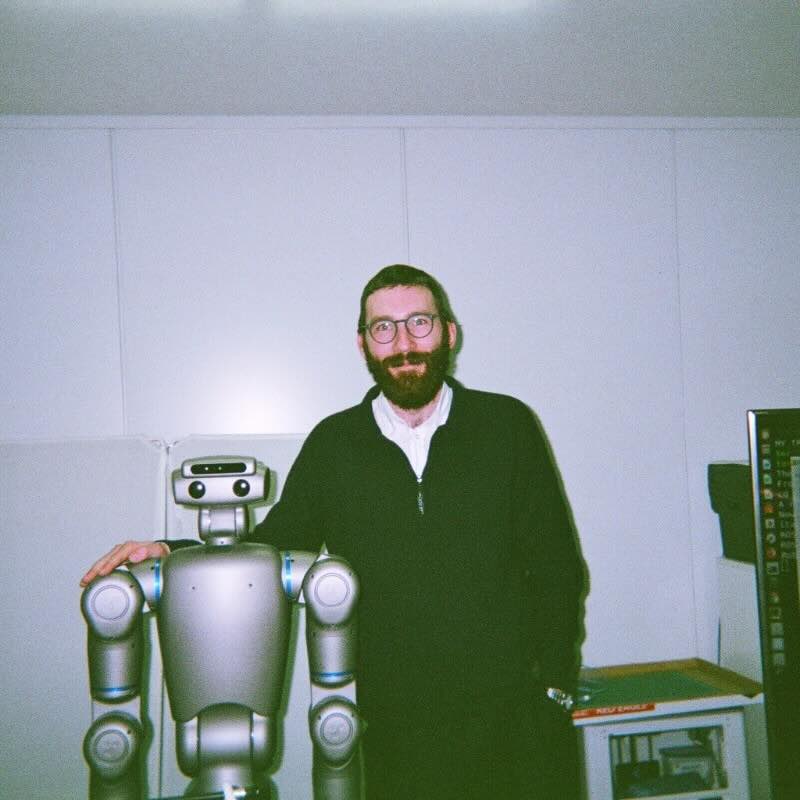
- PhD at the University of Sydney, supervised by Peter Godfrey-Smith
- naturalised epistemology and philosophy of mind
- thermodynamic origins of self-organisation
- ontogenetic and phylogenetic methods
- computer science as experimental philosophy
- biology to computation, computation to biology
Papers & Presentations
| Curriculum vitae | Last updated June 2025 |
| Internally-funded improbability | Distinguishes living systems from dissipative structures via Bauer's free structural energy, framing agency as the costly divergence from passive distributions with Maxwell's demon as a minimal agent. ECogS, OIST (2025) |
| Activity and knowledge | Situates the relationship between mind and world at the heart of the philosophical tradition. Traces complementarities between Ilyenkov's dialectical materialism and materiality in the later Nishida, drawing out implications for cognitive developmental robotics as at once an applied and experimental philosophy. Asada Laboratory, Osaka University (2025) |
| DevNCA | Extends work on developmental activity on plastic self-organisation during neurogenesis (e.g., retinal waves) to spiking neural networks with STDP for control tasks. Spontaneous activity is shown to be crucial during this development phase, with NCA-generated patterns further outperforming random activity. Artificial Life, Kyoto (2025) |
| Another kind of clay | Reconsiders the role of noise in biological intelligences across levels, from molecular to neural and even social. drawing on Brembs' work on intrinsic activity and Pattee's biosemiotics, frameS intelligence as emerging from the sculpting of spontaneous dynamics through symbolic constraints. TONAL workshop, Artificial Life, Kyoto (2025) |
| Temporal continuity and machine consciousness | Develops a substrate-neutral distinction between perceptual, behavioural, and intrinsic continuity and applies this to a range of architectures in artificial intelligence: artificial neural networks, spiking neural networks, neuromorphic computing, and neural organoids. Based on this distinction, argues that analog architectures with a continuous dynamical core are more likely candidates for machine consciousness. Models of Consciousness, Sapporo (2025) |
| Can a single cell learn? | Reviews evidence for habituation and associative conditioning in a range of unicellular organisms, analysing in particular the strongest evidence for the presence of habituation and associative conditioning. From this analysis, derives a subtrate-neutral distinction between adaptive behavioural plasticity and learning proper based on the nature of the relevant signals: scalar concentrations and spatiotemporal patterns, respectively. ANZPhilBio (June 2025) |
| Logic and artificial life | Explores Nishida's concepts of acting-intuition and the historical body, exploring the relationship between these and Soviet developmental psychology, examines the alignment of these perspectives with contemporary work in cognitive developmental robotics. International Society of East Asian Philosophy, Fukuoka University (December 2024) |
| 'The brain as a dynamically active organ' | Reviews Brembs' active-dynamic view of nervous systems, where intrinsic activity is primary and sensory input modulates behaviour; as opposed to the passive input-output view modeled on ideas drawn from computational mechanisms. Cortical Labs journal club (December 2024) |
| Symbol grounding in the age of LLMs | Argues with reference to conditional Kolmogorov complexity that the inefficiency of LLM language learning follows from their disembodied nature, and that while multi-modal grounding may improve this, such learning depends on the tracks already laid down by embodied experience. Robophilosophy, University of Aarhus (August 2024); published in the proceedings |
| The symbol as such | Argues that perceptual consciousness provides access to symbols as such, as opposed to in the form of affordances, around which language crystallises via morphological computation. The Epistemic Significance of Perceptual Consciousness, Jagiellonian University (May 2024) |
| Egocentric speech in children and machines | Compares the role of egocentric speech in children and recent studies of chain-of-thought prompting in LLMs, supports a dynamic approach to mechanistic interpretability: if at each token we find only inference, where is reasoning? Drawing on Vygotsky's experiments on the structuring role of language in decision-making behaviour in children, argues that language serves in both humans and machines to provide cultural frameworks for the autoregressive structuring of attention—and in this way, serves as the basis for the indirect routing of behaviour in problem-solving. Agency and Intentions in AI, University of Göttingen (May 2024) |
| After Babel, the horizontal war | Traces the way from the ancient City to the Technique of modernity through Ellul's theological and sociological works, drawing on the notion of inscriptions and the relationship between reality and the remainder. Illustrates by way a literary analysis of McCarthy's Blood Meridian, and particularly the character of Judge Holden. Philosophical Journal of Conflict and Violence (2023) |
| The view from nowhere | Argues that mediating inscriptions—text, images, legal codes, maps, engineering drawings—cultivate a 'view from nowhere' which justifies the unity of Technique as described by Jacques Ellul, with this 'metaphysics of inscription' further shown to underlie its particular characteristics. Master's dissertation, University of Auckland (2022) |